📐 "First 50 Enterprise Queries Get Custom 3D Warehouse Design" Plan


The Ultimate Strategic Guide: Maximizing Industrial Racking ROI Through Advanced High-Density Solutions
In the competitive landscape of global supply chains, warehouse managers and corporate financial officers are perpetually locked in a critical evaluation: how to justify significant capital expenditure on infrastructure. For decades, the conversation around industrial racking ROI has been dangerously oversimplified, often reduced to a myopic focus on the price per pallet position.
This outdated perspective ignores the profound truth that the highest ROI from an industrial racking system is not derived from its initial purchase price, but from its strategic capacity to generate continuous operational savings and drive top-line growth. A sophisticated analysis of industrial racking ROI must look beyond the invoice to understand how a system transforms the very fundamentals of warehouse economics. This comprehensive guide posits that the path to a superior industrial racking ROI is through the deliberate adoption of high-density storage solutions, which are engineered to optimize an organization’s two most capital-intensive resources: space and labor.
The subsequent sections will provide a granular, expert-level dissection of how calculating, achieving, and maximizing industrial racking ROI through high-density systems is the definitive competitive advantage in modern logistics. The pursuit of a superior industrial racking ROI is not merely a financial exercise; it is a strategic imperative for any business aiming for resilience and scalability.
Deconstructing True ROI: A Multifaceted Financial Analysis for Industrial Racking
To genuinely comprehend the potential for industrial racking ROI, one must first dismantle the conventional, and ultimately flawed, calculation model. The standard approach of dividing the system cost by the number of new pallet locations captured provides a superficial figure that fails to account for the systemic inefficiencies of outdated storage methods. A truly robust industrial racking ROI model is holistic, incorporating both direct and indirect variables that impact the total cost of ownership and the value generated. The fundamental goal of any industrial racking investment should be to achieve a transformative industrial racking ROI that enhances the entire operation’s profitability.
The hidden costs of conventional selective pallet racking are the primary antagonists in the story of achieving a strong industrial racking ROI. These costs, often accepted as unavoidable operational overhead, include the immense financial drain of dedicating up to 45% of a facility’s premium floor space to non-revenue-generating forklift aisles. This inefficient use of real estate directly undermines industrial racking ROI by forcing companies to lease or build larger facilities than necessary.
Furthermore, the labor model associated with wide-aisle configurations is inherently wasteful; forklift operators spend a majority of their shift in non-productive travel, burning fuel, accruing equipment wear-and-tear, and accumulating wage costs without adding proportional value. This operational drag severely depresses the potential industrial racking ROI. Additionally, factors like diminished order fulfillment throughput, higher energy costs for lighting and climate-controlling wasted space, and increased inventory inaccuracy due to disorganization all contribute to a significantly lower-than-expected industrial racking ROI from conventional systems. Therefore, a deep and accurate assessment of industrial racking ROI must begin with a full accounting of these pervasive, often hidden, expenses.
The High-Density Arsenal: Precision-Engineered Systems for Maximizing Industrial Racking ROI
The term “high-density storage” represents a strategic portfolio of engineered systems, each designed to attack the specific inefficiencies that cripple industrial racking ROI. Selecting the correct system is not a matter of preference but a data-driven decision crucial for optimizing the specific industrial racking ROI for a given operation. The following systems represent the core tools in the arsenal for any business serious about achieving a market-leading industrial racking ROI.
Narrow Aisle & Very Narrow Aisle (VNA) Racking: The Strategic Evolution
For operations requiring direct access to every pallet while still demanding a substantial boost in storage density, Narrow Aisle and VNA solutions offer a powerful lever for improving industrial racking ROI. By utilizing specialized forklifts that operate in aisles as narrow as 5 to 6 feet, these systems can instantly increase storage capacity by 20% to 30% or more within the same building envelope.
The industrial racking ROI in this scenario is powerfully driven by the deferral or complete avoidance of costly facility expansion or relocation. The enhanced industrial racking ROI is further amplified by the reduced travel times for operators, leading to more picks and puts per hour and a direct improvement in labor productivity, a key component of any industrial racking ROI calculation.
Drive-In & Drive-Through Racking: The Density Powerhouse
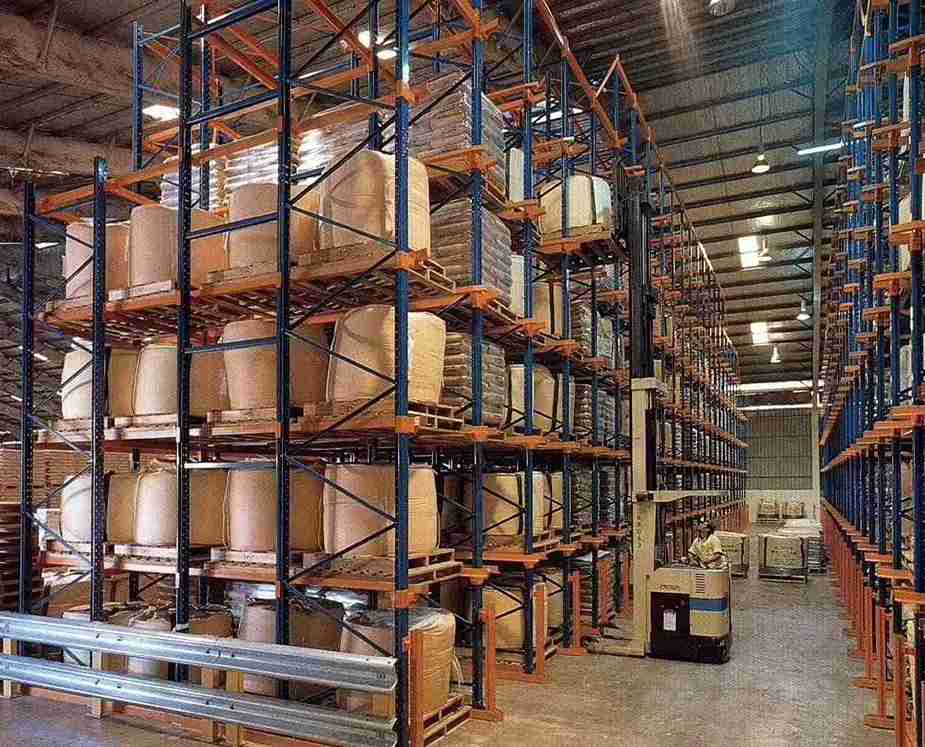
When the storage profile involves a high volume of similar SKUs with lower rotation rates, Drive-In and Drive-Through racking systems become the undisputed champions of industrial racking ROI. By allowing forklifts to drive directly into the rack structure, these systems eliminate virtually all internal aisles, enabling storage depths that can increase pallet positions by up to 90% compared to selective racking.
The industrial racking ROI here is predominantly, and dramatically, driven by radical space consolidation. For a company paying a premium for warehouse space in a strategic location, the industrial racking ROI from a Drive-In system, which effectively doubles the utility of their existing footprint, can be astronomical, often yielding a payback period measured in mere months.
Push-Back Racking: The Optimal Balance of Selectivity and Density
For operations managing a medium number of SKUs with a medium-to-high turnover rate, Push-Back racking presents an exceptionally compelling model for industrial racking ROI. Operating on a Last-In, First-Out (LIFO) basis, this system stores pallets on inclined carts nested on rails, allowing for multiple pallets to be stored deep without sacrificing selectivity.
The industrial racking ROI from a Push-Back system is a hybrid of space savings and throughput enhancement. It offers significantly greater density than selective racking while providing faster access to a wider range of products than a Drive-In system, making its industrial racking ROI particularly attractive for dynamic distribution centers where both space and speed are critical to profitability.
The Pinnacle of Performance: Pallet Shuttle and Mobile Racking Systems
At the apex of density and technological integration are two systems that deliver an unparalleled industrial racking ROI for the right applications.
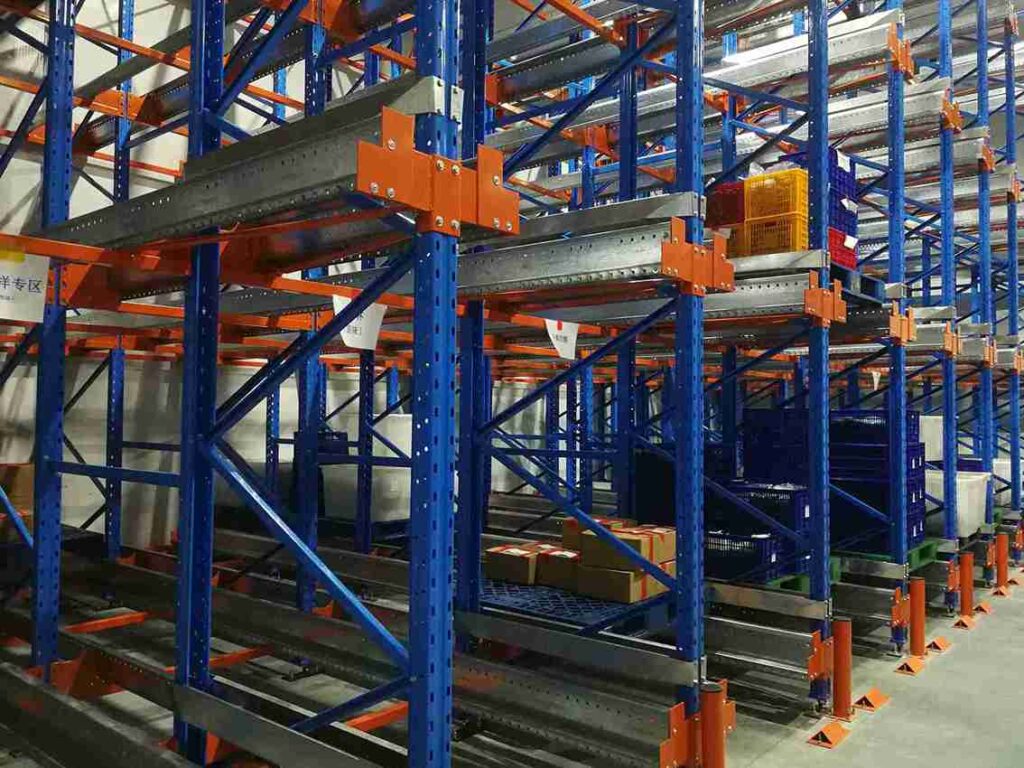
Pallet Shuttle Systems: This semi-automated solution employs a battery-powered, remotely controlled shuttle that runs on rails inside the racking structure, transporting pallets deep into storage lanes. The industrial racking ROI from a Pallet Shuttle system is multifaceted and profound. It enables ultra-deep storage (10+ pallets deep) with a single, minimal access aisle, generating space utilization increases that can exceed 100%. The industrial racking ROI is further supercharged by a dramatic reduction in forklift activity within the racks, leading to lower labor costs, significantly less product and rack damage, and improved safety—all of which positively impact the bottom line and strengthen the overall industrial racking ROI argument.
Mobile Racking: For facilities storing high-value, slow-moving products where real estate is at an absolute premium, Mobile Racking delivers a revolutionary industrial racking ROI. In this system, entire rows of racking are mounted on motorized bases that move laterally on rails, requiring only one operating aisle to be open at any given time. The industrial racking ROI is staggering, with potential storage capacity increases of over 100% by condensing the entire storage footprint. While the initial investment is higher, the industrial racking ROI for a Mobile Racking system is often justified by the astronomical cost of land and construction, making it a strategic, long-term asset that protects and enhances property value.
The Space Multiplier: Quantifying the Real Estate Component of Industrial Racking ROI
The most immediately tangible and calculable component of industrial racking ROI is the liberation and optimization of warehouse real estate. To move from abstract concept to concrete financial justification, consider a detailed, quantified scenario.
A distribution company operates a 200-foot by 150-foot warehouse, totaling 30,000 square feet. Their current selective pallet racking, with its requisite 13-foot aisles, dedicates approximately 45% of this space—13,500 square feet—solely to forklift traffic. The usable storage footprint is therefore only 16,500 square feet. In this configuration, they might achieve a capacity of, for example, 5,000 pallet positions.
Now, consider the implementation of a high-density Push-Back system, which reduces the aisle footprint to just 25% of the total area (7,500 sq ft). The usable storage footprint skyrockets to 22,500 square feet—a net gain of 6,000 square feet of prime storage space. This represents a 36% increase in usable capacity. The financial value of this 36% is the cornerstone of the industrial racking ROI calculation in this context. It can manifest as:
Cost Avoidance: Canceling plans for a new $5 million satellite warehouse, thereby saving on construction, property taxes, and ongoing utilities.
Lease Consolidation: Exiting a secondary leased facility, directly saving $250,000 annually in rent and operational overhead.
Revenue Generation: Utilizing the freed-up square footage for value-added services like custom kitting, returns processing, or cross-docking, creating new profit centers.
In each of these scenarios, the industrial racking ROI is not just about storing more; it’s about fundamentally transforming the cost structure and revenue potential of the physical operation. Every square foot saved is a direct contributor to a healthier, more robust industrial racking ROI.
The Labor Revolution: How High-Density Systems Drive ROI Through Operational Efficiency
If real estate optimization is the most visible driver of industrial racking ROI, the transformation of labor productivity is often the most impactful over the long term. Labor constitutes the single largest recurring operational expense in most warehouses, and high-density systems are engineered to attack this cost center with surgical precision.
The War on Non-Value-Added Travel
In a traditional wide-aisle warehouse, the geometry of the facility dictates inefficiency. A compact, high-density layout inherently compresses the operational grid, drastically reducing the travel distance between consecutive tasks. When a forklift operator or an order picker covers less ground per retrieval, the number of order cycles completed per hour naturally increases. This direct correlation between density and throughput is a non-negotiable element of a strong industrial racking ROI. By systematically eliminating wasted motion, a high-density system directly translates into lower labor costs per unit handled, a key performance indicator that directly feeds into a positive industrial racking ROI.
Ergonomics, Accuracy, and the Human Element
The benefits extend beyond simple travel metrics. A logically designed, high-density warehouse reduces both mental and physical fatigue for operators. Less time spent navigating vast, repetitive aisles leads to higher levels of concentration and reduced error rates. Fewer errors mean less time spent on costly reconciliations and reshipments, which silently erode industrial racking ROI. A safer, less stressful work environment also contributes to lower staff turnover, reducing the substantial costs associated with recruiting and training new personnel. This human-centric benefit is a critical, though often unquantified, contributor to sustainable industrial racking ROI.
The Automation Synergy: A Force Multiplier for Industrial Racking ROI
The highest echelons of industrial racking ROI are achieved when high-density physical structures are seamlessly integrated with advanced automation. This synergy creates a force multiplier effect on productivity and accuracy.
Automated Guided Vehicles (AGVs) and Autonomous Mobile Robots (AMRs): These robotic workhorses thrive in predictable, optimized environments. A high-density layout with defined, narrow pathways is the ideal terrain for AGVs. The industrial racking ROI from this integration is transformative, enabling 24/7 operation with unwavering consistency and freeing human workers for more complex, cognitive tasks. The industrial racking ROI calculation here must include the value of operational scalability and resilience against labor market fluctuations.
Automated Storage and Retrieval Systems (AS/RS): This is the ultimate expression of high-density efficiency. A unit-load AS/RS, comprising towering cranes operating in aisles as narrow as 5 feet, can store and retrieve pallets with superhuman speed and perfect accuracy. The industrial racking ROI for an AS/RS, while requiring a significant capital outlay, is often unparalleled. It can reduce labor costs in the storage function by over 90%, triple throughput rates, achieve near-perfect inventory accuracy, and operate in darkness, saving immense amounts on energy costs. For large-scale, high-volume operations, the long-term industrial racking ROI of an AS/RS is frequently the most compelling financial argument available.
The Ripple Effect: Secondary Drivers that Solidify Industrial Racking ROI
The justification for a high-density system extends beyond primary space and labor metrics. A well-engineered installation creates a positive ripple effect across the organization, introducing secondary benefits that further cement the project’s industrial racking ROI.
Enhanced Safety and Asset Protection
Modern high-density systems are designed with integrated safety features. Guided aisles in VNA setups, robust end-of-aisle protection, and the reduced need for forklifts to enter the rack structures (as with shuttle systems) collectively create a inherently safer work environment. This leads to a direct reduction in the frequency and severity of accidents, which in turn lowers insurance premiums and prevents costly downtime. The drastic reduction in forklift-to-rack contact also minimizes both product damage and damage to the racking asset itself, protecting the integrity of the investment and contributing positively to the long-term industrial racking ROI.
Unparalleled Inventory Control and Supply Chain Agility
A condensed, organized storage facility is infinitely more manageable than a sprawling one. Cycle counting becomes faster and more accurate, leading to improved inventory visibility. This enhanced control directly translates into fewer stockouts, reduced safety stock requirements, and higher customer satisfaction rates. In today’s environment, the ability to quickly adapt to fluctuating demand is a form of currency. The agility afforded by a high-density system, which allows for efficient management of a larger SKU range in a smaller footprint, is a strategic advantage that positively influences the overall industrial racking ROI by strengthening the entire supply chain.
Future-Proofing and Scalability for Long-Term ROI
A significant risk of any capital investment is premature obsolescence. A well-conceived high-density system is inherently modular and scalable. The ability to add vertical levels, reconfigure lanes, or integrate new technologies as business needs evolve protects the initial investment. This scalability ensures that the industrial racking ROI is not a one-time event but a continuous benefit over the asset’s entire lifecycle, adapting to growth and market changes without requiring a complete system replacement.
Case in Point: A Data-Driven Illustration of Transformative Industrial Racking ROI
Consider the real-world transformation of “Alpha Distributors,” a multinational parts supplier facing a severe capacity crisis. Their existing selective racking was maxed out at 12,000 pallet positions in a 40,000 sq. ft. facility, and daily throughput was failing to meet demand, threatening key client contracts. The company was days from signing a lease on a second, costly facility.
The Challenge: Maximize capacity and throughput within the existing 40,000 sq. ft. footprint to avoid expansion and improve service levels. The primary KPI was a demonstrable and rapid industrial racking ROI.
The Precision Solution: A hybrid system was engineered, combining Push-Back Racking for fast-moving A-class SKUs and a Pallet Shuttle System for slower-moving B and C-class items. This tailored approach ensured the industrial racking ROI was optimized for different product velocity profiles.
The Quantified Results & ROI Impact:
Pallet Locations: Soared from 12,000 to over 19,500—a 62.5% increase in storage density.
Labor Productivity: Throughput, measured in picks per man-hour, increased by 40% due to radically reduced travel times and more efficient product access.
Cost Avoidance: The second lease, costing $18,000 per month ($216,000 annually), was canceled.
Damage Reduction: Forklift-related product and rack damage decreased by an estimated 80%, saving approximately $35,000 annually.
The Calculated Industrial Racking ROI: The total project investment was $850,000. The annual hard savings (avoided lease + damage reduction) totaled $251,000. This alone generates a simple payback period of approximately 3.4 years. However, when the value of the 40% labor productivity gain and the new revenue enabled by the additional 7,500 pallet positions are factored into a more comprehensive industrial racking ROI model, the actual payback period was calculated to be under 2 years. This case powerfully demonstrates that a strategic approach to industrial racking ROI can yield transformative business outcomes.
Crafting the Unassailable Business Case for Maximum Industrial Racking ROI
Securing executive and financial approval for a high-density system requires building a business case that transcends a simple equipment quote. It must be a compelling narrative focused squarely on industrial racking ROI.
Conduct a Total Cost of Ownership (TCO) Analysis: Contrast the 7-year TCO of the existing system (including all hidden costs of space and labor inefficiency) against the projected TCO of the proposed high-density solution. This model will reveal the true industrial racking ROI.
Quantify the Intangibles: Assign conservative financial values to improved safety (reduced insurance premiums), enhanced accuracy (fewer stockouts), and greater agility (ability to capture new business). These elements are vital components of the full industrial racking ROI picture.
Present a Phased Implementation Plan: For capital-conscious organizations, propose a phased rollout. Start with the area offering the quickest industrial racking ROI to generate the cash flow and performance data needed to justify subsequent phases. This de-risks the investment and builds confidence in the overall industrial racking ROI projection.
Benchmark Against Industry Standards: Use data from associations like MHI or similar case studies to demonstrate that the projected industrial racking ROI is not an anomaly but an achievable industry standard for those who innovate.
Conclusion: Industrial Racking ROI as the Cornerstone of Strategic Warehousing
The journey toward a high-performance, financially resilient warehouse begins with a fundamental paradigm shift. The central question must evolve from “What is the cost of this industrial racking?” to “What is the strategic value and total industrial racking ROI this system will deliver?” High-density storage solutions represent the pinnacle of this value-driven approach. They are not simple storage furniture; they are sophisticated, operational platforms engineered to generate a continuous and compelling industrial racking ROI.
By systematically converting wasted space into productive asset and transforming variable labor costs into scalable, efficient throughput, these systems do more than store goods—they build a formidable competitive moat. In the relentless, margin-sensitive world of global commerce, a warehouse optimized for maximum industrial racking ROI is no longer a passive cost center; it is a proactive, profit-driving engine. The data is clear; the technology is proven. The only remaining variable is the strategic decision to pursue it.
Frequently Asked Questions (FAQs)
1. How does the weight and dimensions of our palletized goods influence the choice of system and the ultimate industrial racking ROI?
Pallet specifications are arguably the most critical technical factor influencing both system selection and the resulting industrial racking ROI. Heavier and non-standard sized pallets may require custom-engineered racking components or limit the viability of certain automated solutions. A detailed analysis of your unit load data is the first step in designing a system that delivers a safe, efficient, and maximized industrial racking ROI. An improper match can lead to safety hazards, underutilization, and a severely compromised industrial racking ROI.
2. What is the typical structural and foundational requirement for installing a high-density system like Mobile Racking or a heavy-duty AS/RS?
These high-performance systems have significant structural implications. Mobile Racking concentrates immense loads on its rail system, often requiring a reinforced concrete floor with specific load-bearing capacity. An AS/RS, due to its height and dynamic loads, often requires approval from a structural engineer to ensure the building shell can withstand the forces. These factors are baked into the initial feasibility study and project planning, as unforeseen structural upgrades can impact the project timeline and overall industrial racking ROI.
3. Can our existing fleet of forklifts be used with a new high-density system, or will we need to invest in new equipment?
This depends entirely on the system chosen. Transitioning to a Narrow-Aisle or VNA system will necessitate the procurement of specialized narrow-aisle forklifts or turret trucks, which is a capital cost that must be included in the industrial racking ROI analysis. However, systems like Push-Back or Drive-In can often be operated with a company’s existing counterbalance forklifts, provided they meet the required capacity and mast specifications. A qualified consultant will always perform a fleet compatibility analysis as part of the industrial racking ROI projection.
4. How do we accurately forecast inventory growth to ensure the system we install today doesn’t become obsolete in 5 years, protecting our long-term industrial racking ROI?
This is a core challenge of strategic warehouse planning. The solution involves a multi-faceted approach: analyzing 3-5 years of historical SKU data, collaborating with sales and marketing teams on future product launches, and, most importantly, selecting a high-density system with inherent scalability. The modularity of systems like Push-Back or Pallet Shuttle allows for reconfiguration and expansion. Designing for future growth from the outset is a non-negotiable practice for safeguarding your industrial racking ROI.
5. What does ongoing maintenance and technical support look like for an automated high-density system, and how are these costs factored into the lifetime industrial racking ROI?
Automated systems like Pallet Shuttles and AS/RS require a proactive, scheduled maintenance regime similar to that of a fleet of vehicles. This includes regular inspections, software updates, and wear-part replacements. Reputable suppliers offer comprehensive annual maintenance contracts to ensure system uptime and longevity. The cost of this service agreement is a critical component of the Total Cost of Ownership and must be included in any sophisticated industrial racking ROI model to provide a realistic picture of long-term financial performance. Neglecting this can lead to unexpected downtime that devastates the projected industrial racking ROI.
Welcome to contact us, if you need warehouse rack CAD drawings. We can provide you with warehouse rack planning and design for free. Our email address is: jili@geelyracks.com