📐 "First 50 Enterprise Queries Get Custom 3D Warehouse Design" Plan















Industrial Racking System Suppliers & Automation Integrators: The Ultimate Guide for High-Density Warehouses
In the relentless pursuit of maximizing every cubic foot of warehouse space, the synergy between industrial racking system suppliers and automation integrators has become the cornerstone of modern logistics. For businesses operating high-density warehouses, this partnership is no longer a luxury but a critical imperative for survival and growth. The industry is witnessing a fundamental shift from traditional storage solutions to integrated, intelligent systems that combine robust physical infrastructure with sophisticated software and robotics. This comprehensive guide delves deep into the world of high-density storage, exploring how the collaboration between top-tier industrial racking system suppliers and visionary automation integrators creates unparalleled efficiency, density, and ROI.
It unpacks the core systems, from pallet shuttle and ASRS to the software that binds them, providing a roadmap for any operation looking to optimize its space, streamline its workflows, and future-proof its investment in an increasingly competitive market. The selection of the right industrial racking system suppliers is arguably the most critical first step in this journey, as the entire automated ecosystem is built upon the integrity and precision of the racking foundation.
The Modern Warehouse Dilemma: Skyrocketing Costs and Space Constraints
The pressure on modern supply chains is immense. E-commerce demands for rapid fulfillment, urban land scarcity, and rising labor costs are squeezing profitability from multiple angles. Simply building a larger warehouse is often not a feasible or financially sound solution. This is where the concept of high-density warehousing transitions from a smart strategy to a business necessity, a challenge that forward-thinking industrial racking system suppliers are uniquely positioned to solve.
The Financial Imperative of Vertical and Dense Storage
The economics are straightforward: the cost of land and new construction is prohibitive. By increasing storage density within an existing footprint, companies can defer or eliminate the need for costly expansion. High-density storage systems allow businesses to store more product in the same space, effectively lowering the cost per pallet or item stored. This isn’t just about using height; it’s about intelligently eliminating wasted aisle space, which can consume up to 50% or more of a conventional warehouse’s floor area.
The role of expert **industrial racking system suppliers** is to provide the physical means to achieve this, offering engineered solutions that transform wasted air space into profitable inventory capacity. These specialized **industrial racking system suppliers** conduct detailed capacity analyses to ensure the proposed system maximizes the cube while adhering to all safety and load-bearing regulations.
Beyond Space: The Labor and Accuracy Challenge
It’s not just about space. The challenges of recruiting, training, and retaining a skilled warehouse workforce are well-documented. Manual operations in high-density environments can be slow and prone to error. An integrated automated system, designed by a skilled automation integrator working in lockstep with experienced industrial racking system suppliers, mitigates these risks. It reduces the reliance on manual labor for repetitive and physically demanding tasks, minimizes product damage, and dramatically improves inventory accuracy.
When the racking system provided by proficient industrial racking system suppliers and the Warehouse Management System (WMS) speak the same language, mis-picks and lost inventory become anomalies of the past. This level of integration is only possible when the chosen **industrial racking system suppliers** have a proven track record of collaborating with automation partners.
The Power Couple: Why Your Racking Supplier and Automation Integrator Must Be in Sync
One of the most critical, and often overlooked, success factors is the seamless collaboration between the chosen industrial racking system suppliers and the automation specialist. Treating these as two separate procurement events is a recipe for costly delays, finger-pointing, and subpar performance. The most successful projects are those where the industrial racking system suppliers are involved from the earliest conceptual stages.
The Pitfalls of a Disconnected Approach
Imagine this scenario: a company purchases a state-of-the-art automated guided vehicle (AGV) system, only to discover that the industrial pallet racking they sourced from a different, low-cost supplier cannot handle the dynamic loads imposed by the AGVs, or that the tolerances are too loose for the robots to operate consistently.
The result? System failures, safety hazards, and a project that is over budget and behind schedule. This nightmare underscores why the automation integrator and the industrial racking system suppliers must work from a unified set of specifications, load calculations, and performance requirements. Reputable **industrial racking system suppliers** will insist on this collaboration, providing detailed structural calculations and installation tolerances that are critical for the automation’s performance.
The Integrated Solution: A Single Point of Accountability
The most successful projects often involve partners who offer, or can seamlessly manage, both sides of the equation. When **industrial racking system suppliers** have deep experience working with automation integrators, the entire process is streamlined. They conduct joint site surveys, collaborate on the structural design to ensure it complements the automation equipment, and develop a unified control strategy. This partnership provides a single point of accountability, simplifying communication, problem-solving, and warranty support.
This integrated philosophy is non-negotiable for achieving the promised ROI on a high-density warehouse project. Leading **industrial racking system suppliers** often have established partnerships with specific integrators or have in-house integration divisions, ensuring a cohesive and reliable system from the ground up.
A Deep Dive into High-Density Racking Systems: The Backbone of Your Operation
The physical storage structure is the foundation upon which everything else is built. Choosing the right type of industrial racking system is a strategic decision that dictates storage capacity, throughput, and the type of automation that can be implemented. The expertise of the industrial racking system suppliers is paramount in selecting and engineering the correct system for the specific application.
Pallet Shuttle Systems: The Flexible Workhorse
The pallet shuttle system has revolutionized high-density storage for homogeneous SKUs. This system uses a battery-powered, remote-controlled shuttle cart that runs on rails within a racking lane, transporting pallets to and from the front. It effectively turns each deep lane into a dynamic, first-in-first-out (FIFO) or last-in-first-out (LIFO) buffer. The design and installation precision required for these systems mean that not all **industrial racking system suppliers** are qualified to provide them. The rails must be perfectly level and aligned, a task that demands a high level of expertise from the **industrial racking system suppliers**.
How it Works: An operator places a pallet at the lane entrance and deploys the shuttle. The cart automatically transports the pallet to the next available position deep within the lane. For retrieval, the shuttle brings the designated pallet to the front.
Ideal For: High-density storage of products with high turnover and low-to-medium variety. Perfect for cold storage environments where minimizing human presence is a priority.
Integration with Automation: The pallet shuttle is a prime candidate for automation. The shuttle carts themselves can be fully automated, and the load/unload process at the lane entrance can be handled by an Autonomous Mobile Robot (AMR) or a stacker crane, creating a highly dense, lights-out operation. The industrial racking system suppliers must work closely with the integrator to ensure the rack interface points are designed for seamless robotic interaction.
Drive-In and Drive-Through Racking: Maximizing Density for Slow-Moving Goods
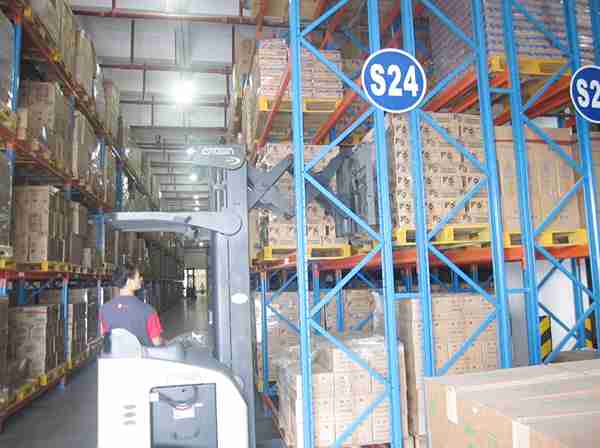
Drive-in racking is a classic high-density solution where forklifts actually drive into the rack structure itself to place and retrieve pallets. Drive-through racking is similar but allows access from both ends, facilitating FIFO inventory management. The structural integrity of these systems is critical, as they must withstand the impact and loads of vehicle traffic.
How it Works: This system eliminates access aisles between rows, creating a solid block of storage. It relies on a guided path for the forklift within the rack structure.
Ideal For: Bulk storage of slow-moving products, or products with low variety but high quantity, such as seasonal items or raw materials.
The Automation Link: While traditionally manual, these systems can be semi-automated with the use of very narrow aisle (VNA) forklifts that are wire- or rail-guided, improving safety and efficiency. The structural requirements for these systems are critical, and the industrial racking system suppliers must design them to withstand the specific forces of the guided vehicles, a calculation that requires sophisticated engineering software and experience.
Push-Back Racking: Dynamic LIFO for Enhanced Selectivity
Push-back racking offers a compelling compromise between selectivity and density. It is a LIFO system where pallets are stored on nested carts on a slightly inclined rail. When a new pallet is loaded, it pushes the existing pallets back in the lane. The complexity of the cart mechanism requires **industrial racking system suppliers** to provide high-quality components and precise installation.
How it Works: Each lane typically holds 2-6 pallets deep. Loading a new pallet pushes the previous one back. During retrieval, as a pallet is removed, the next one automatically rolls forward to the pick face.
Ideal For: Applications requiring better selectivity than drive-in systems but higher density than selective pallet racking. Great for multi-SKU lanes where you need to store several pallets of a few different products.
Automation Synergy: While often manual, the predictable movement and clear pick faces of push-back systems make them compatible with semi-automated forklifts or robotic palletizers working in conjunction. The industrial racking system suppliers ensure the system is rated for the dynamic loads of automated equipment.
Mobile Pallet Racking: The Ultimate Space Saver
For the absolute maximum storage density, mobile pallet racking is a powerhouse. Instead of having fixed aisles, entire rows of racking are mounted on electrically driven bases that move laterally on rails embedded in the floor. This is one of the most complex systems to engineer and install, demanding the highest level of expertise from the industrial racking system suppliers.
How it Works: Only one aisle is opened at a time, directly in front of the required product. A button press or system command moves the racks to create a temporary access aisle.
Ideal For: Archives, cold stores, and any facility with a vast number of SKUs but low daily throughput, where space is at an absolute premium.
Integration Potential: This is a system ripe for full automation. When combined with a robotic retrieval unit, the entire process of moving the racks and picking the load can be automated, creating an incredibly dense, automated storage and retrieval system (ASRS). The industrial racking system suppliers are responsible for the structural design, the mechanical drive system, and the safety interlocks, all of which must be perfectly synchronized with the automation controls.
<h2>**The Brains and Brawn: Automation Technologies for High-Density Environments**</h2>
The racking is the skeleton, but the automation is the nervous and muscular system. An automation integrator selects and combines these technologies to bring the static storage system to life. The compatibility between these technologies and the racking provided by the industrial racking system suppliers is what separates a successful project from a failed one.
Automated Storage and Retrieval Systems (AS/RS): The Precision Engine
AS/RS is a broad term for computer-controlled systems that automatically place and retrieve loads from defined storage locations. In high-density warehouses, they are the gold standard for speed and accuracy. The racking for an AS/RS is not standard; it is a precision-engineered structure that acts as the guide path and support for the cranes.
Unit-Load AS/RS: These are large systems designed for handling full pallet loads. They consist of tall rack structures served by dedicated aisle-running cranes (stacker cranes). The crane travels up and down the aisle, with a telescoping mast that stores and retrieves pallets. The industrial racking system suppliers must fabricate the racking to extremely tight tolerances to ensure smooth and reliable crane operation over the entire height of the system.
Mini-Load AS/RS: Designed for smaller items in bins or totes, these systems are the backbone of e-commerce and parts handling. They operate on the same principle as unit-load systems but on a smaller, faster scale, often servicing goods-to-person picking stations. The industrial racking system suppliers provide the shelving or bin-support structures that are integral to the system’s performance.
The Integrator’s Role: A skilled automation integrator doesn’t just install the cranes; they program the entire ecosystem, ensuring the AS/RS communicates flawlessly with the WMS and any upstream or downstream conveyor systems. Their work, however, is entirely dependent on the precision of the racking structure supplied by the industrial racking system suppliers.
Autonomous Mobile Robots (AMRs) and Forklifts: The Flexible Fleet
While AS/RS are fixed-path systems, AMRs offer unparalleled flexibility. These robots use sophisticated sensors, cameras, and LIDAR to navigate a warehouse floor dynamically, avoiding obstacles and rerouting on the fly. Their interaction with the racking is less about structural integration and more about operational interface.
Goods-to-Person Robotics: AMRs are famously used in “goods-to-person” (G2P) systems. Instead of a picker walking the aisles, a fleet of AMRs brings the entire shelving unit (a “pod”) to a stationary picker. This drastically reduces walking time and increases picking productivity.
Automated Forklifts: For pallet handling, automated guided vehicles (AGVs) and AMR-style forklifts are becoming increasingly sophisticated. They can transport pallets from receiving to a pallet shuttle system, or from a high-density rack to a staging area, all without human intervention.
Why Integration is Key: The magic happens when the robot’s fleet management software is deeply integrated with the WMS and the racking system’s inventory data. The system knows not just what to pick, but the exact location and status of the industrial racking it’s in, directing the robot with pinpoint accuracy. The industrial racking system suppliers ensure that the racking is designed for easy access by these robots, with clearances and load heights that match the robots’ capabilities.
The Critical Role of Engineering and Compliance in Racking Systems
The engineering behind the solutions provided by industrial racking system suppliers is what ensures safety, durability, and performance. This is not a commodity business; it is a discipline of precision engineering.
Seismic Considerations and Dynamic Load Calculations
In many geographical regions, seismic activity is a major design consideration. Professional industrial racking system suppliers employ engineers who perform sophisticated seismic calculations to ensure the racking system can withstand seismic events without catastrophic failure. Furthermore, when automation is introduced, dynamic load calculations become essential. The forces exerted by a decelerating stacker crane or an AGV inserting a pallet are significantly different from the static load of a pallet at rest. Reputable industrial racking system suppliers factor in these dynamic loads to prevent fatigue and failure over time.
Adherence to Standards and Professional Stamping
Leading industrial racking system suppliers adhere to strict industry standards, such as those from the Rack Manufacturers Institute (RMI) and the Material Handling Institute (MHI) in North America. Crucially, for any structure that impacts public safety (which includes warehouse structures where employees work), the designs are often required to be “stamped” by a licensed Professional Engineer (P.E.). This stamp is a guarantee that the design has been reviewed and certified to meet all applicable building and safety codes. When evaluating industrial racking system suppliers, verifying their commitment to these engineering standards is a non-negotiable step.
The Implementation Blueprint: A Phased Approach to Success
Deploying a fully integrated high-density storage and automation system is a complex undertaking. A methodical, phased approach is essential for managing risk and ensuring success. Throughout this process, the role of the industrial racking system suppliers evolves but remains critical.
Discovery and Analysis: The process begins with a deep dive into data: SKU profiles, order histories, growth projections, and operational pain points. Both the integrator and the industrial racking system suppliers are involved in this phase to define the business case and set clear KPIs.
Conceptual Design and Simulation: Using advanced software, a digital model of the proposed system is created. Simulations using real data test throughput and identify bottlenecks. The industrial racking system suppliers provide critical data on racking capacities and configurations for an accurate model.
Detailed Engineering: This is where the partnership between the industrial racking system suppliers and the automation integrator is most intense. Every beam, bolt, motor, and line of code is specified. The industrial racking system suppliers produce detailed shop drawings for fabrication and installation, all stamped by professional engineers.
Staging and Factory Acceptance Testing (FAT): Major components are assembled and tested off-site. While the automation is tested, the industrial racking system suppliers may pre-assemble complex sections to verify fit and function, reducing on-site installation time.
Phased Installation and Commissioning: The physical industrial racking is installed first by the crews from the industrial racking system suppliers, followed by the automation hardware and software. The installation teams work to minimize disruption to ongoing operations. Commissioning involves fine-tuning the entire system.
Site Acceptance Testing (SAT) and Go-Live: The integrated system is rigorously tested against the agreed-upon KPIs. Once it passes, the system goes live, with full support from both the integrator and the industrial racking system suppliers standing by.
<h2>**Calculating the Return: The Tangible and Intangible Benefits of Integration**</h2>
The investment in an integrated system from expert industrial racking system suppliers and automation integrators is significant, but the returns are transformative. The value provided by high-caliber industrial racking system suppliers extends far beyond the initial cost of the steel.
Radical Space Savings: Achieve 50-100%+ more storage capacity within the same footprint, a direct result of the high-density designs from the industrial racking system suppliers.
Dramatic Labor Optimization: Reduce direct labor requirements by 50-70%, reallocating staff to higher-value tasks.
Unprecedented Accuracy and Traceability: Achieve inventory accuracy rates of 99.99%+, virtually eliminating shipping errors and stockouts.
Enhanced Safety: Remove humans from repetitive, heavy, and potentially hazardous tasks, significantly reducing workplace accidents. The structurally sound racking from qualified industrial racking system suppliers is the foundation of this safety.
Scalability and Future-Proofing: A well-designed system from visionary industrial racking system suppliers can be modularly expanded as a business grows, protecting the long-term investment.
Conclusion: Forging the Future-Proof Warehouse
The journey to a truly optimized high-density warehouse is a strategic one, demanding more than just purchasing equipment. It requires a visionary partnership between deeply knowledgeable industrial racking system suppliers and a forward-thinking automation integrator. This collaboration fuses the physical and digital worlds, creating a living logistics ecosystem that is more than the sum of its parts. It is a system that breathes with data, adapts to market fluctuations, and delivers not just products, but a powerful competitive advantage.
The foundational role of the industrial racking system suppliers cannot be overstated; their engineering expertise, quality of fabrication, and commitment to integration form the bedrock upon which automation success is built. In the face of rising costs and customer expectations, this integrated approach is the definitive path to building a warehouse that is not just efficient for today, but resilient and profitable for the future.
Frequently Asked Questions (FAQs)
1. What is the typical lead time for a fully integrated high-density storage and automation project?
Lead times can vary significantly based on the project’s scale and complexity, but a realistic timeline from initial design to go-live typically ranges from 9 to 18 months. This includes the detailed engineering, manufacturing of custom components (like racking and machinery), software development, and the phased on-site installation and testing. It is always recommended to start the planning process well in advance of the anticipated need.
2. How do you ensure the structural integrity and safety of tall, high-density racking systems, especially when integrated with automation?
Structural integrity is the paramount concern for reputable industrial racking system suppliers. All designs are performed by certified professional engineers who perform rigorous load calculations, taking into account not just static loads but the dynamic forces imposed by automated equipment like stacker cranes and shuttles. High-grade steel is used, and adherence to all relevant standards (e.g., RMI, FEM) is mandatory. Furthermore, the control software includes multiple layers of safety protocols, such as anti-collision systems for cranes and emergency stop circuits, to ensure safe interaction between the automation and the structure.
3. Can these automated high-density systems be retrofitted into an existing warehouse, or do they require a new building?
While a new, purpose-built facility offers the most flexibility, it is very common and often highly effective to retrofit integrated systems into existing buildings. The key is a thorough site survey conducted by the industrial racking system suppliers and the integrator to assess clear heights, floor flatness, column spacing, and building integrity. Pallet shuttle and ASRS solutions have been successfully implemented in many existing facilities. Sometimes, minor building modifications are needed, but a skilled integration team can design a solution that works within the current constraints.
4. What kind of ongoing maintenance and support do these integrated systems require?
Proactive maintenance is critical for maximizing uptime. A scheduled maintenance program is recommended, including regular inspections of the racking system for damage or deflection, and preventative maintenance for all automation components. Most sophisticated systems include remote monitoring and diagnostics. Comprehensive service level agreements (SLAs) from both the industrial racking system suppliers and the integrator ensure the operation remains running smoothly.
5. How does the software handle inventory management, such as cycle counting and lot tracking, in a fully automated, high-density environment?
The software is what makes accurate inventory management possible in such a dense environment. Since every single storage and retrieval transaction is recorded in real-time by the WMS, the system always knows the exact location and quantity of every SKU. For cycle counting, the system can automatically direct the automation to present specific pallets or totes for counting, making the process incredibly fast and accurate. For lot tracking, the WMS maintains a complete chain of custody, tracing a product from receipt to shipment, which is essential for industries like food, pharmaceuticals, and aerospace.
Welcome to contact us, if you need warehouse rack CAD drawings. We can provide you with warehouse rack planning and design for free. Our email address is: jili@geelyracks.com