📐 "First 50 Enterprise Queries Get Custom 3D Warehouse Design" Plan
















For any manufacturing leader, the sight of a congested, disorganized plant floor is a source of constant frustration. As production volumes increase and product lines diversify, the physical space within the facility’s walls remains a fixed asset. This fundamental mismatch creates a silent crisis, where growth is hampered not by market demand, but by internal logistical paralysis. The quest for efficient shelf racking for manufacturing plants becomes paramount, transcending a simple procurement task to become a core strategic initiative.
This definitive guide explores how a meticulously engineered shelf racking for manufacturing plants is not merely a storage utility but the foundational framework upon which scalable, safe, and profitable operations are built. It delves into the critical transition from generic shelving to a fully optimized shelf racking for manufacturing plants, designed to unlock every cubic foot of available space, streamline workflows, and propel a business forward. The right shelf racking for manufacturing plants is, in essence, the architecture of efficiency.

H2: The High Stakes of Inefficient Storage: More Than Just Wasted Space
Many manufacturing operations treat their storage systems as a passive backdrop, a necessary evil to be managed reactively. This perspective is dangerously outdated. In a competitive landscape, inefficient storage is an active and continuous drain on profitability, safety, and growth potential. The specific shelf racking for manufacturing plants in use directly dictates the ceiling of operational performance.
H3: Quantifying the Direct Financial Drain
The most visible cost of poor storage is the waste of expensive industrial real estate. In facilities relying on outdated shelf racking for manufacturing plants, it’s common to see aisles that are too wide, vertical space lying completely fallow, and layouts that force unnecessary travel distances. This translates into paying premium rates for square footage that generates zero output. Furthermore, the labor inefficiencies inherent in a disorganized system are staggering.
Workers spend an inordinate amount of their shift in “search and retrieve” missions, navigating chaotic layouts instead of performing value-added tasks. The cumulative cost of this non-productive time, when calculated annually, often represents a significant and shocking figure that directly erodes the bottom line. A reassessment of the shelf racking for manufacturing plants is often the first step toward recapturing these lost resources.
H3: The Hidden and Corrosive Operational Costs
Beyond the clear financial metrics lie more insidious penalties. The safety implications of an inadequate shelf racking for manufacturing plants system are severe. Cluttered aisles, improperly loaded shelves, and the lack of designated walkways create a high-risk environment for trips, falls, and falling object incidents. This not only endangers employees but also leads to higher insurance premiums and potential liability claims.
Equally damaging is the crippling effect on inventory control. Without a systematic shelf racking for manufacturing plants framework governed by clear logic, achieving accurate inventory counts is nearly impossible. This leads to chronic problems like stockouts that halt production lines, overstocking that ties up capital, and frustrating delays in order fulfillment that damage customer relationships.
H2: The Engineering Mindset: Transforming Storage from a Cost Center to a Growth Engine
The leap from basic shelving to a truly engineered shelf racking for manufacturing plants solution represents a fundamental shift in philosophy. It’s the difference between buying a standalone tool and commissioning a fully integrated production line. An engineered shelf racking for manufacturing plants system is designed with a deep understanding of physics, material flow, and business objectives.
H3: The Critical Engineering and Design Process
The term “engineered” is not mere marketing flair. It signifies a rigorous, data-driven process that begins with a comprehensive operational audit. Specialists in shelf racking for manufacturing plants don’t just take measurements; they analyze the entire ecosystem. They map the journey of raw materials from the receiving dock to the production line and track finished goods to the shipping area. They catalog SKUs by size, weight, turnover velocity, and handling requirements.
This intelligence is then used to create digital models of the facility, simulating different configurations of shelf racking for manufacturing plants to find the optimal balance of density, accessibility, and cost. This method ensures the final design for the shelf racking for manufacturing plants is a custom-built solution, not a one-size-fits-all compromise.
H3: Foundational Principles of World-Class Storage Design
Every superior shelf racking for manufacturing plants system is built upon three core, interdependent principles:
Vertical Utilization: The most underutilized asset in most plants is the cubic air space. Modern shelf racking for manufacturing plants is designed to safely exploit the full clear height of a building, often up to 40 feet or more, transforming empty air into valuable storage capacity.
The Density-Selectivity Equilibrium: A core challenge in designing shelf racking for manufacturing plants is balancing the amount of stock stored (density) with the speed of access to any given item (selectivity). The perfect shelf racking for manufacturing plants system finds the precise equilibrium point for a specific operation’s needs.
Holistic Workflow Integration: The shelf racking for manufacturing plants must not exist in isolation. It must be seamlessly interwoven with production cells, quality control stations, and logistics areas to create a smooth, uninterrupted flow of materials, effectively becoming the circulatory system of the plant.
H2: High-Density Industrial Racking: The Ultimate Space Multiplier
When floor space is at an absolute premium, conventional storage layouts fail. This is where advanced high-density shelf racking for manufacturing plants becomes a game-changer. These systems are engineered to systematically eliminate non-productive aisle space, delivering unparalleled storage density within the same footprint.
H3: Navigable High-Density Systems
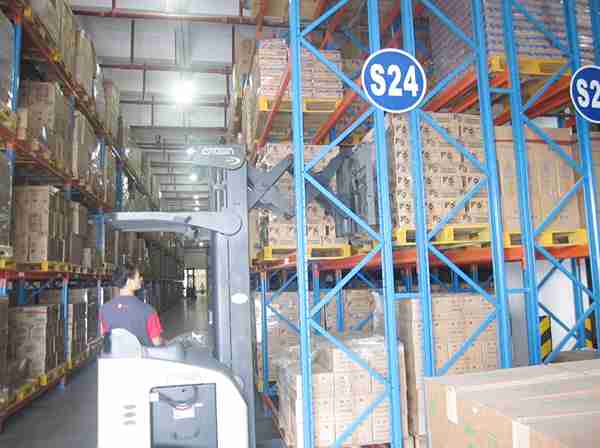
Drive-In and Drive-Through Rack Systems: This type of shelf racking for manufacturing plants is engineered for bulk storage of products with low SKU variety but high volume. Forklifts drive directly into the rack structure, storing pallets in deep, multi-pallet lanes. It is an exceptionally dense form of shelf racking for manufacturing plants, ideal for cold storage or holding raw materials where LIFO (Last-In, First-Out) inventory management is acceptable. The primary benefit is a dramatic increase in pallet positions per square foot.
Push Back Racking Systems: A more versatile form of high-density shelf racking for manufacturing plants, Push Back Racking operates on a series of nested carts on inclined rails. Pallets are stored several deep, and when one is removed, the next automatically rolls forward. This system offers a superior blend of density and selectivity compared to Drive-In racks, making it a highly popular choice for shelf racking for manufacturing plants that require faster access to a broader range of SKUs while still conserving immense amounts of floor space.
H3: The Pinnacle of Automation: AS/RS
For manufacturing plants aiming for maximum density, accuracy, and throughput, the Automated Storage and Retrieval System (AS/RS) represents the apex of engineered shelf racking for manufacturing plants. These are not just racks; they are fully integrated, computer-controlled storage and retrieval ecosystems.
Unit-Load AS/RS: Designed for full pallet handling, this shelf racking for manufacturing plants system features narrow aisles serviced by fully automated cranes. Operating within a tight structural framework, it can utilize virtually the entire building’s cube. Governed by a sophisticated Warehouse Management System (WMS), it delivers near-perfect inventory accuracy, slashes labor costs, and enhances safety by removing manned forklifts from the storage equation. For a large-scale plant, this is the ultimate expression of shelf racking for manufacturing plants.
Mini-Load AS/RS: This variant of shelf racking for manufacturing plants is designed for smaller, lighter items stored in bins or totes. It serves as the high-speed engine for kitting operations or MRO storage, delivering items directly to an ergonomic pick station. This eliminates worker travel time entirely and is a key component in a modern, efficient shelf racking for manufacturing plants strategy for small parts.
H2: Customizable Shelving Solutions: The Backbone of Plant Organization
While pallet racking handles unit loads, a significant portion of a plant’s vitality depends on the organization of smaller components. This is where customizable manufacturing shelving proves its worth as a critical element of a complete shelf racking for manufacturing plants strategy.
H3: Heavy-Duty and Boltless Shelving
For storing everything from tooling and spare parts to electrical components and packaging supplies, heavy-duty shelving is indispensable. Modern boltless shelving for manufacturing plants offers tremendous strength and unparalleled flexibility. The ease of assembly and reconfiguration allows the storage system to adapt as needs change, ensuring the shelf racking for manufacturing plants evolves with the business. A wide array of accessories—dividers, bin boxes, drawer inserts, and security doors—enables a hyper-organized environment for every item category within the broader shelf racking for manufacturing plants ecosystem.
H3: Mezzanine Systems: Instantly Creating a Second Floor
When the floor plan is fully optimized but more space is desperately needed, the only logical direction is upward. A structural mezzanine is the most effective way to add significant square footage without expanding the building’s footprint. A well-designed mezzanine is a quintessential example of engineered shelf racking for manufacturing plants principles applied to macro-space creation.
It can support offices, packaging lines, parts departments, or additional storage, effectively freeing up the valuable ground-level space for core production activities. Integrating a mezzanine is a strategic masterstroke in any project aimed at maximizing manufacturing floor space.
H2: The Synergy of Automation and Storage
A static storage structure, no matter how well-designed, operates at a fraction of its potential without efficient material handling. The true power of modern shelf racking for manufacturing plants is realized when it is integrated with automated equipment.
H3: AGVs and Unmanned Forklifts
Automated Guided Vehicles (AGVs) and unmanned forklifts bring a new dimension of efficiency to the shelf racking for manufacturing plants environment. These robotic workhorses can transport materials to and from the shelf racking for manufacturing plants around the clock with pinpoint accuracy.
They can operate safely in aisles much narrower than those required for manned vehicles, further contributing to the high-density nature of the shelf racking for manufacturing plants layout. This integration automates the connection between production and storage, ensuring a consistent, predictable flow that maximizes the ROI of the entire system.
H3: Conveyor Systems for Continuous Flow
For high-volume movement along fixed paths, conveyor systems are the vital link that unifies a plant. They seamlessly connect the shelf racking for manufacturing plants to production cells, staging areas, and shipping docks. By automating the transport of goods, conveyors reduce aisle congestion, minimize product damage, and dramatically accelerate order throughput. A conveyor system feeding a pallet racking zone or servicing a mezzanine pick module creates a synchronized, fluid material handling ecosystem that is the hallmark of a top-tier manufacturing operation.
H2: The Intelligent Core: Warehouse Management Systems (WMS)
The physical shelf racking for manufacturing plants is the muscle of the operation, but the Warehouse Management System (WMS) is the brain. It is the software that animates the hardware, transforming a static structure into a dynamic, intelligent system.
A robust WMS provides real-time, granular visibility into every asset stored within the shelf racking for manufacturing plants. It transcends simple tracking, offering optimized put-away and picking paths that minimize travel time. For complex shelf racking for manufacturing plants like Push Back Racking or AS/RS, the WMS is the essential orchestrator, knowing the exact location of every pallet and directing the equipment accordingly.
It manages inventory levels, triggers replenishment tasks, and ensures flawless cycle counting. Implementing a WMS is not an optional add-on; it is the critical component that unlocks the full intelligence, accuracy, and efficiency designed into a modern shelf racking for manufacturing plants solution.
H2: A Strategic Blueprint for Your Storage Transformation
Embarking on a project to redesign a plant’s storage infrastructure is a significant undertaking. A structured, phased approach managed by experts ensures success and minimizes operational disruption.
H3: Phase 1: Deep-Dive Discovery and Analysis
The process begins with an immersive analysis. Consultants specializing in shelf racking for manufacturing plants will conduct interviews with personnel across shifts, perform time-motion studies, and meticulously catalog all inventory types and their flow patterns. This phase is about building a complete data model of the current state and future growth projections to inform the design of the new shelf racking for manufacturing plants.
H3: Phase 2: Dynamic Modeling and Solution Design
Using state-of-the-art CAD and simulation software, designers create multiple, detailed layout options for the new shelf racking for manufacturing plants. These are not static images; they are dynamic models that can simulate a day’s worth of activity, quantifying the potential gains in space utilization, labor efficiency, and order throughput for each proposed shelf racking for manufacturing plants configuration. This allows for data-driven decision-making before a single piece of steel is ordered.
H3: Phase 3: Seamless Implementation and Integration
With a finalized design, experienced project managers take the helm. They coordinate the installation of the new shelf racking for manufacturing plants in phases to avoid shutting down production. This requires precise planning and execution, often working during off-hours or in designated sections. The final, crucial step is the integration of the physical shelf racking for manufacturing plants with the WMS and any automation, ensuring the entire system operates as a single, cohesive unit from day one.
H2: Calculating the Compelling Return on Investment
Investing in a professionally engineered shelf racking for manufacturing plants system is a capital decision with a clear and multifaceted return. The ROI extends far beyond the initial cost.
Direct Financial Returns: This includes a lower cost-per-pallet-stored due to higher density, a significant reduction in labor hours through optimized workflows, and a decrease in inventory shrinkage via improved accuracy.
Throughput and Capacity Gains: Orders are fulfilled faster, production delays are minimized, and the overall capacity of the plant increases without a physical expansion.
Risk Reduction and Safety: A well-organized shelf racking for manufacturing plants creates a safer work environment, leading to fewer accidents, lower insurance costs, and enhanced regulatory compliance.
Strategic Scalability: The new shelf racking for manufacturing plants infrastructure is built to scale, providing a clear path for future growth and avoiding the massive costs and disruptions of a facility relocation.
H2: Conclusion: Building a Foundation for Unconstrained Growth
In the modern manufacturing landscape, operational excellence is non-negotiable. The ability to store, manage, and retrieve materials with precision and speed is a fundamental driver of that excellence. Outdated and disorganized storage is a tangible constraint on profitability and growth. The future belongs to manufacturers who view their shelf racking for manufacturing plants not as a passive expense, but as a dynamic, strategic asset.
By embracing a holistic, engineered shelf racking for manufacturing plants solution—one that integrates high-density storage, customizable shelving, smart automation, and intelligent software—a business does more than just create space. It builds a resilient, agile, and scalable operational foundation.
It eliminates the friction that stifles productivity and unlocks the velocity required to capture market opportunities. The journey to maximize manufacturing floor space begins with a single, strategic decision: to partner with experts who can transform a storage challenge into a durable competitive advantage through superior shelf racking for manufacturing plants.
H2: Frequently Asked Questions (FAQs)
1. What are the key load capacity considerations when specifying new shelf racking for manufacturing plants?
Load capacity is the most critical safety and performance factor. It involves evaluating both the uniform load capacity (weight distributed across a shelf) and the point load capacity (weight concentrated on a small area). Professional providers of shelf racking for manufacturing plants will calculate dynamic loads (from seismic activity or impact) and ensure the system’s design includes a significant safety factor, often 1.5 to 2 times the rated capacity, to account for unforeseen stresses.
2. How does the choice of shelf racking for manufacturing plants impact fire safety and sprinkler system compliance?
The design of the shelf racking for manufacturing plants has a direct impact on fire protection. Dense storage, especially high-reaching systems, can obstruct sprinkler heads, preventing water from reaching a fire effectively. NFPA and local fire codes have specific requirements for clearance between the top of storage and sprinkler deflectors. An engineered shelf racking for manufacturing plants design will always incorporate these clearances and may require modifications to the fire suppression system, such as in-rack sprinklers, to maintain compliance and safety.
3. For a facility with a very diverse mix of product sizes and weights, what is the best approach to shelf racking for manufacturing plants?
A hybrid or zoned approach is typically the most effective strategy. A single type of shelf racking for manufacturing plants is rarely optimal for a highly diverse inventory. The solution involves segmenting the storage area. For instance, bulk pallet loads might go into a Push Back system, medium-sized items onto sturdy boltless shelving, and small, high-value parts into secure bin shelving or a Mini-Load AS/RS. The overall shelf racking for manufacturing plants master plan creates a logical, efficient home for every item type.
4. What is the typical lead time for the manufacturing and delivery of a custom-engineered shelf racking for manufacturing plants system?
Lead times can vary based on project complexity, system customization, and global supply chain conditions. For a standard structural racking system, lead times can range from 4-8 weeks. For more complex systems like high-density mobile racking or a full AS/RS, the lead time for the shelf racking for manufacturing plants components can extend from 12 to 20 weeks. A reputable supplier will provide a detailed project timeline with clear milestones after the final design is approved.
5. Beyond the initial installation, what does a long-term service and maintenance program for shelf racking for manufacturing plants entail?
A professional service program is essential for safety and longevity. It typically includes annual or semi-annual inspections by certified technicians to check for loose connections, plumbness, beam lock engagement, and any signs of impact damage. The program should also include guidance on proper loading procedures for staff and a process for reporting and repairing any damage promptly. This proactive approach to maintaining the shelf racking for manufacturing plants protects both the workforce and the capital investment.
Welcome to contact us, if you need warehouse rack CAD drawings. We can provide you with warehouse rack planning and design for free. Our email address is: jili@geelyracks.com