📐 "First 50 Enterprise Queries Get Custom 3D Warehouse Design" Plan


The selection and engineering of shelf racking for cold storage is a discipline unto itself, a critical investment that dictates the operational efficacy, safety, and profitability of a temperature-controlled supply chain. This guide delves beyond superficial comparisons to explore the material science, structural dynamics, and logistical philosophies that underpin a successful shelf racking for cold storage installation. It provides a rigorous framework for warehouse managers, logistics engineers, and facility planners to specify a system that delivers optimal density, accessibility, and durability under the relentless duress of sub-zero environments.
(H2) The Unforgiving Physics of the Cold Chain: Why Standard Racking Fails
A standard warehouse operates under one set of physical laws; a freezer operates under another. The fundamental error many make is treating the selection of shelf racking for cold storage as a simple adaptation of a dry warehouse system. The reality is far more complex. The constant thermal cycling between, for example, -30°C during operation and slightly higher temperatures during defrosting, imposes repeated stress on steel. Humidity, a constant companion even in low-temperature environments, seeks every opportunity to condense and freeze. This combination demands a specialized approach to shelf racking for cold storage that begins at the atomic level of the material itself.
(H3) Metallurgical Imperatives: The Science of Low-Temperature Toughness
The steel used in standard racking can undergo a dangerous transition from ductile to brittle behavior at low temperatures. A minor impact from a pallet or forklift, negligible in an ambient warehouse, can propagate a catastrophic crack in a compromised material. Therefore, high-quality shelf racking for cold storage is fabricated from specially formulated low-temperature carbon steel or fine-grained alloy steels.
These materials are characterized by a superior Charpy V-Notch impact value, meaning they absorb significant energy before fracturing at operational temperatures as low as -40°C. This isn’t a luxury; it’s a non-negotiable safety requirement for any credible shelf racking for cold storage provider.
(H3) The Corrosion Battle: Advanced Coating Systems for Longevity
The protective finish on shelf racking for cold storage is its first line of defense against a relentless enemy: corrosion. Standard powder coatings, while sufficient for dry warehouses, are porous and can succumb to the permeation of moisture. The superior solution for shelf racking for cold storage is an epoxy-based coating system, often applied through an electro-deposition process (E-coat) that ensures a uniform, non-porous layer even on complex geometries.
This is frequently followed by a powder coat top layer for additional durability. This multi-stage system creates a hermetic seal, preventing moisture from reaching the steel substrate and thus thwarting the corrosion that would otherwise compromise the integrity of the shelf racking for cold storage over time.
(H2) A Detailed Taxonomy of Cold Storage Racking Systems
Navigating the landscape of available shelf racking for cold storage systems requires a clear understanding of the trade-offs between density, accessibility, and cost. The optimal choice is never generic; it is a precise match to the facility’s specific SKU profile, throughput requirements, and inventory management philosophy.
(H3) Selective Pallet Racking: Unparalleled Accessibility
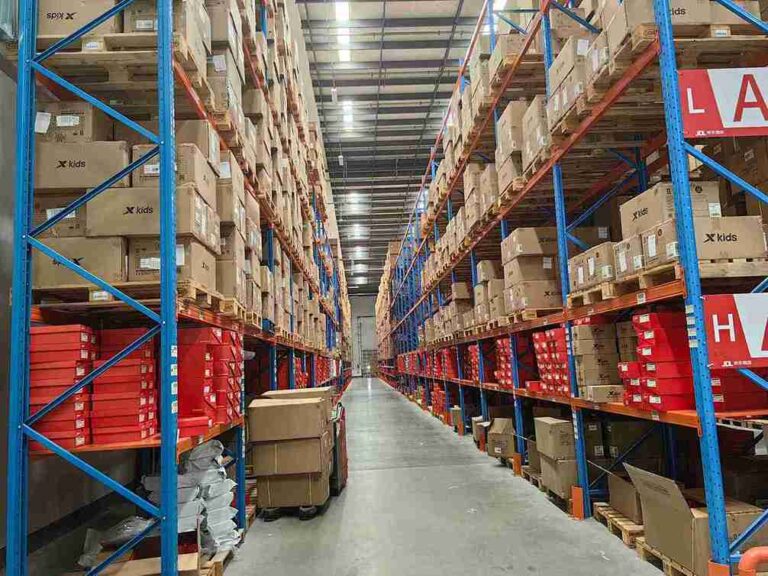
As the most versatile form of shelf racking for cold storage, selective pallet racking offers direct, unimpeded access to every single pallet position. This makes it the ideal shelf racking for cold storage solution for facilities with a vast number of SKUs and a first-in, first-out (FIFO) inventory strategy. However, in a cold storage context, its open design presents a thermodynamic challenge: it exposes a large surface area to the cooled air, which can increase energy consumption.
Furthermore, the high number of upright frames increases the potential condensation points. Sophisticated designs for this type of shelf racking for cold storage mitigate this with base plates engineered to minimize thermal bridging to the floor.
(H3) Drive-In and Drive-Through Racking: Maximizing Storage Density
For facilities storing large quantities of a limited number of SKUs, drive-in and drive-through configurations represent a highly dense form of shelf racking for cold storage. In this LIFO (Last-In, First-Out) system, forklifts drive directly into the rack structure to place and retrieve pallets, which rest on rails rather than beams.
The density achieved by this shelf racking for cold storage is exceptional, as it eliminates numerous aisles. The critical consideration for this shelf racking for cold storage is the operational risk; the confined environment demands highly skilled operators and a robust system of protective column and rail guards to withstand inevitable impacts. The structural design of this shelf racking for cold storage must account for both the dynamic loads and the potential for lateral forces during vehicle maneuvering.
(H3) Pallet Shuttle Systems: The Semi-Automated Density Solution
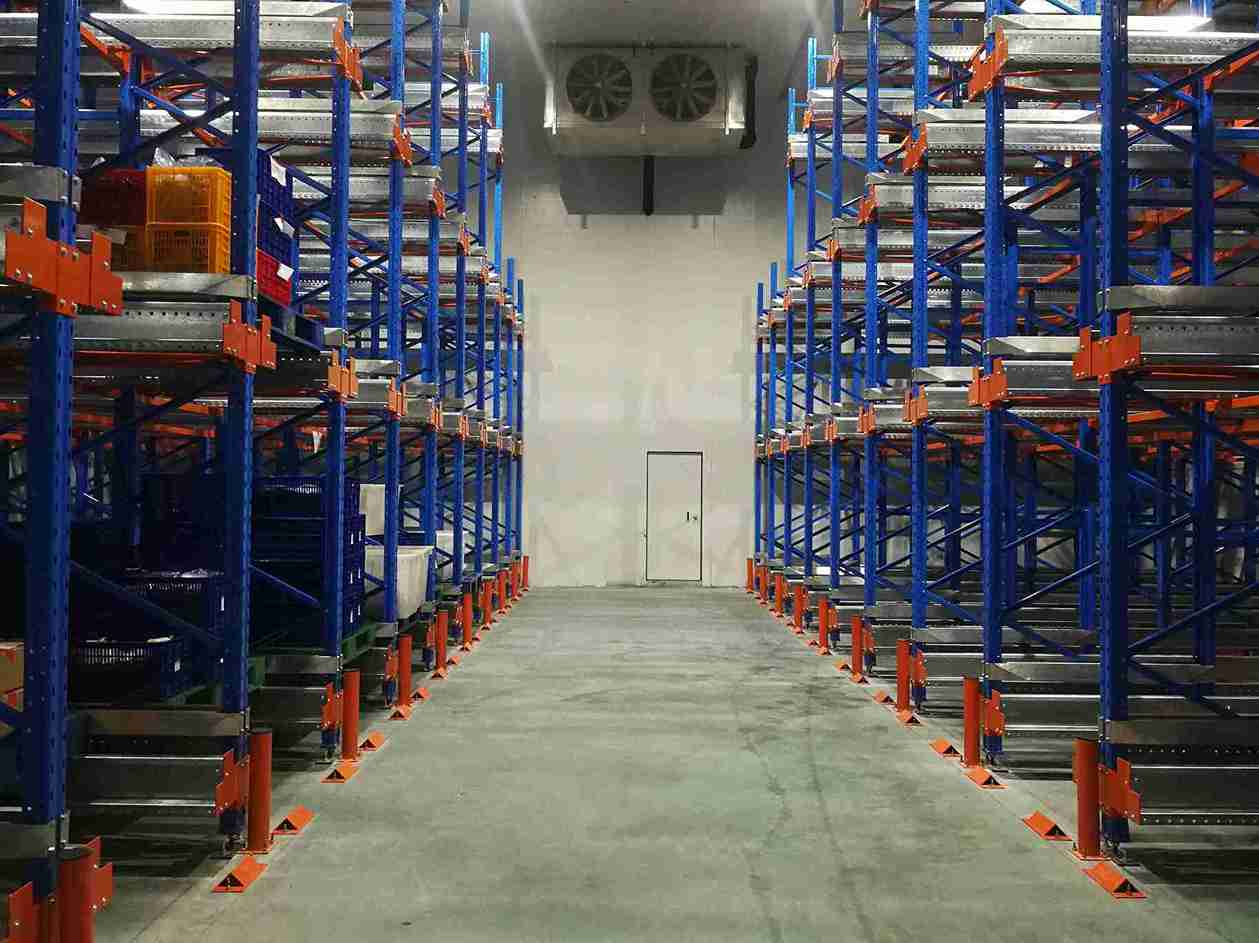
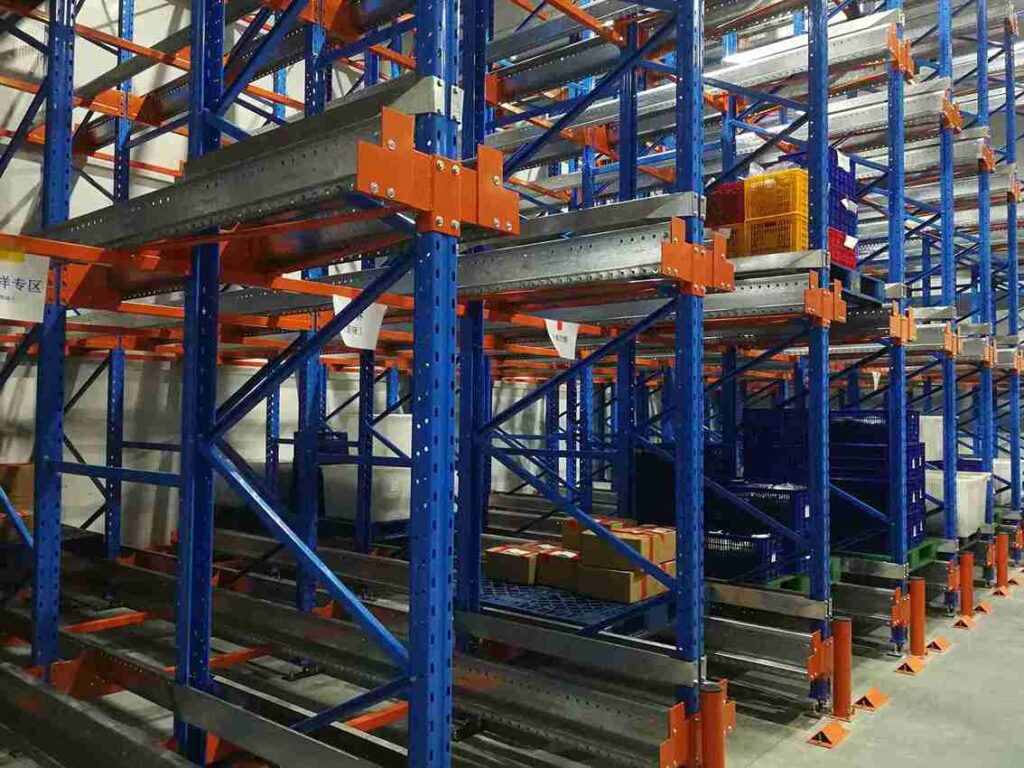
The pallet shuttle system is a revolutionary advancement in shelf racking for cold storage, offering a superb balance of high density and operational efficiency. This shelf racking for cold storage utilizes a battery-powered, remotely controlled shuttle that runs on rails within a storage lane.
A forklift operator only interfaces with the shuttle at the aisle front, loading it to send pallets deep into the lane or retrieving them. This methodology for shelf racking for cold storage dramatically reduces the forklift’s time inside the freezer, a significant benefit for both operator welfare and energy conservation, as each forklift brings heat and moisture into the environment. This type of shelf racking for cold storage can be configured for either FIFO or LIFO operation, providing flexibility.
(H3) Push-Back Racking: Dynamic LIFO Storage
Push-back shelf racking for cold storage provides depth-based storage through a system of nested carts on a slight decline. Loading a new pallet pushes the existing pallets back. Retrieval is the reverse process, with the next pallet moving forward into the pick position. This shelf racking for cold storage is ideal for applications requiring multiple pallets deep per SKU with better stock rotation than a drive-in system.
It offers faster access than drive-through shelf racking for cold storage but requires a higher initial investment. The dynamic nature of the system means the structural calculations for this shelf racking for cold storage must precisely account for the rolling loads and the potential for impact at the end of the travel.
(H3) The Automated Frontier: ASRS and Mobile Racking
At the pinnacle of density and efficiency lies fully automated and high-density movable shelf racking for cold storage.
Automated Storage and Retrieval Systems (ASRS): This shelf racking for cold storage integrates fixed-aisle retrieval machines that operate within the rack structure, entirely eliminating the need for forklifts in the storage area. The benefits for cold storage are profound: monumental energy savings from a sealed environment, near-perfect inventory accuracy, and unparalleled throughput. The specification of this shelf racking for cold storage is a complex integration of mechanical, electrical, and software engineering.
Mobile Racking: This innovative shelf racking for cold storage mounts standard selective racking on motorized carriages that move laterally on rails, creating temporary aisles only where needed. This system can increase storage capacity by over 80% within the same footprint. For cold storage, this shelf racking for cold storage is exceptionally efficient as it minimizes the volume of air requiring refrigeration, leading to substantial operational cost savings. The structural design must account for the dynamic loads of the moving system and the integrity of the rail foundation.
(H2) The Engineering Deep Dive: Calculating for Real-World Conditions
The capacity plate on a piece of shelf racking for cold storage tells only part of the story. The real engineering rigor is applied in understanding and calculating for the forces that occur during daily operation.
(H3) Dynamic Loads and Impact Factors: Beyond Static Weight
The stated capacity of shelf racking for cold storage is typically a static load rating. However, the act of a forklift placing a pallet onto a beam generates a dynamic load, which can be significantly higher—often 1.5 to 2 times the static weight—depending on the speed of placement. In the brittle fracture-sensitive environment of a freezer, accounting for these dynamic forces in the design of shelf racking for cold storage is paramount. Reputable engineers incorporate substantial safety factors that envelop these real-world impact forces, ensuring the shelf racking for cold storage retains its integrity under harsh operating conditions.
(H3) The Criticality of Beam Deflection Limits
Beam deflection, the sag or bending of a beam under load, is a critical performance metric for shelf racking for cold storage. Excessive deflection is not merely an aesthetic issue; it can make pallets unstable and difficult to retrieve, and it transfers unintended moment forces to the upright frames.
For shelf racking for cold storage, the accepted deflection limit is often stricter than in ambient warehouses, typically not exceeding 1/180th of the span. This ensures the system remains rigid and stable, preventing a cascade of operational and safety issues. The design of the beam profile—its height, thickness, and weld pattern—is optimized in high-quality shelf racking for cold storage to achieve this stiffness without unnecessarily adding weight.
(H2) Foundation and Installation: The Bedrock of System Integrity
The most expertly engineered shelf racking for cold storage will fail if installed on an inadequate foundation or by an unqualified team. This phase is where theoretical design meets physical reality.
(H3) The Critical Role of Floor Flatness (F<sub>F</sub>/F<sub>L</sub>)
Cold storage floors are complex engineered systems, often incorporating heating elements to prevent ground freeze. The flatness of this surface is crucial for the stability of shelf racking for cold storage. An uneven floor will prevent upright frames from being installed plumb, creating a system that is pre-stressed and vulnerable to overload.
A professional floor survey, measuring the F<sub>F</sub> (overall flatness) and F<sub>L</sub> (local levelness), is an essential prerequisite before installing any shelf racking for cold storage. Tolerances are tight, and any deviation outside the specified range must be addressed before proceeding.
(H3) The Art and Science of Cold Environment Installation
Installing shelf racking for cold storage is a specialized trade. Crews must work in short, managed shifts with appropriate cold-weather personal protective equipment. The cold affects not just the workers but the tools and the materials; steel components are extremely cold to handle, and torque settings on bolts can be affected. Precision is non-negotiable.
Every connection must be secured to specification, and every frame must be perfectly plumb and aligned. Experienced installers of shelf racking for cold storage understand these nuances, coordinating their work seamlessly with other trades, particularly the refrigeration contractors, to ensure a flawless and integrated final installation.
(H2) Integrating Operational Workflow with Racking Design
The shelf racking for cold storage is the stage upon which daily operations unfold. Its design must be intrinsically linked to the workflows of people and machines.
(H3) Operator Safety and Efficiency in Confined Spaces
As shelf racking for cold storage systems push for higher density, aisles become narrower, leaving minimal room for error. In narrow-aisle or drive-in configurations, operator training is paramount. Furthermore, the choice of shelf racking for cold storage has a direct impact on human factors. Implementing a pallet shuttle or ASRS significantly reduces the time personnel spend in harsh environments, enhancing safety by reducing fatigue and the risk of cold-related injuries. This human-centric consideration is a critical differentiator in modern shelf racking for cold storage planning.
(H3) Aligning Racking with Inventory Management Strategy (FIFO vs. LIFO)
The type of shelf racking for cold storage selected will inherently enforce an inventory rotation policy. Selective racking enables pure FIFO, essential for products with strict expiry dates. Drive-in and push-back systems are inherently LIFO. Pallet shuttle systems can be configured for either, based on software control. This decision is fundamental and must be made in concert with product life cycle management. Selecting the wrong shelf racking for cold storage for a given inventory strategy can lead to massive spoilage and operational inefficiency.
(H2) Conducting a Rigorous Total Cost of Ownership (TCO) Analysis
The most significant mistake in procuring shelf racking for cold storage is focusing solely on the initial purchase price. A sophisticated evaluation requires a full lifecycle cost analysis.
(H3) Upfront Capital Expenditure vs. Long-Term Operational Savings
While a selective shelf racking for cold storage system may have a lower upfront cost per position, a high-density automated system, though requiring a greater capital outlay, can deliver a superior Return on Investment. The TCO for the shelf racking for cold storage must factor in the dramatic reduction in energy costs (from a smaller cooled volume and the absence of forklifts), lower labor costs, reduced product damage, and improved inventory accuracy.
For a high-throughput facility, the payback period for a more advanced shelf racking for cold storage solution can be remarkably short, making it the more financially sound long-term investment.
(H3) Factoring in Maintenance, Longevity, and System Lifecycle
All shelf racking for cold storage requires a proactive maintenance regimen. This includes scheduled inspections for corrosion, impact damage, and bolt tightness. A premium shelf racking for cold storage system, fabricated from the correct materials and installed with precision, will have a operational lifespan that extends for decades. Conversely, a cheaper, inferior system will incur higher maintenance costs and require premature replacement. The quality of the shelf racking for cold storage directly influences its lifecycle cost, making initial quality a key determinant of long-term value.
(H2) Future-Proofing the Investment: Designing for Adaptability and Growth
A warehouse is a dynamic asset, and the shelf racking for cold storage within it must be capable of evolving alongside the business it supports.
(H3) Scalability and Modular Design Principles
The best shelf racking for cold storage systems are designed with scalability in mind. This means working with a manufacturer whose product line is stable and whose components will be available years into the future. A modular design allows a facility to add height, expand its footprint, or even reconfigure from a selective system to a higher-density shelf racking for cold storage solution without a complete and costly tear-down. This foresight in the initial planning of the shelf racking for cold storage protects the capital investment and provides strategic flexibility.
(H3) The Inseparable Link Between Racking and Warehouse Software
In the modern distribution center, the physical shelf racking for cold storage and the Warehouse Management System (WMS) are two halves of a whole. Even without full automation, the shelf racking for cold storage layout must be logically compatible with the WMS’s slotting and tracking capabilities. For high-density shelf racking for cold storage, this is especially critical, as the WMS must have precise logic for managing inventory that is not directly visible or accessible. Designing the shelf racking for cold storage with software integration as a core requirement prevents costly and disruptive retrofits down the line.
(Conclusion)
Specifying the right shelf racking for cold storage is a complex, multi-faceted decision with ramifications that will echo through a company’s logistics performance for decades. It is a synthesis of advanced material science, precision engineering, and strategic logistics planning.
The choice is never about finding the cheapest pallet position; it is about engineering a system that provides the optimal balance of density, accessibility, and durability for a specific operational profile. By embracing a rigorous, holistic, and forward-looking approach to selecting shelf racking for cold storage, businesses can transform their cold chain operations from a cost center into a formidable, reliable, and efficient competitive advantage.
(H2) Frequently Asked Questions (FAQs)
(H3) 1. What is the typical lead time for the procurement and installation of a large-scale cold storage racking system?
Lead times for a major shelf racking for cold storage project are typically in the range of 12 to 20 weeks for manufacturing, with an additional 4 to 8 weeks for onsite installation. Complexities such as custom-engineered components, specialized coatings, or integrated automation can extend these timelines. Engaging with a provider early in the planning process is critical for accurate scheduling.
(H3) 2. How do you mitigate the risk of forklift damage to the racking in such a sensitive environment?
Protecting shelf racking for cold storage from impacts involves a multi-pronged strategy. The racking itself should be specified with integral protection, including high-grade column guards, reinforced uprights, and easily replaceable beam connectors. Operationally, comprehensive, ongoing forklift operator training specific to the cold environment is essential. Technological aids, such as forklift camera systems and proximity sensors, can further reduce collision risks.
(H3) 3. Can existing warehouse racking be retrofitted or reinforced for use in a new cold storage conversion?
This is extremely inadvisable and poses significant safety risks. Standard shelf racking for cold storage is not manufactured from low-temperature steel, lacks the required corrosion-resistant coating, and its structural design has not been certified for the dynamic loads and material embrittlement concerns of a freezer environment. A purpose-built, professionally engineered shelf racking for cold storage system is the only safe and reliable path forward for a cold storage conversion.
(H3) 4. What are the key certifications or standards we should look for in a cold storage racking supplier?
A reputable supplier of shelf racking for cold storage should demonstrate compliance with internationally recognized standards. The most relevant is FEM 10.2.02, the European standard that provides specific design rules for steel storage pallet racking in cold storage applications. Additionally, ISO 9001 certification for quality management is a baseline. The provider must supply full, sealed engineering drawings and calculations stamped by a licensed professional engineer, specific to your project.
(H3) 5. How does the presence of an automated monorail system (for product conveyance) interact with the racking system design?
Integrating a monorail system with shelf racking for cold storage requires co-engineering from the outset. The racking structure must be designed to support the additional dead weight, dynamic loads, and vibrational forces of the monorail. This often involves designing a unified structure where the monorail is supported by, and integrated into, the shelf racking for cold storage framework. To avoid structural conflicts and ensure system harmony, it is highly recommended to have a single point of responsibility for the design and supply of the integrated shelf racking for cold storage and monorail system.
Welcome to contact us, if you need warehouse rack CAD drawings. We can provide you with warehouse rack planning and design for free. Our email address is: jili@geelyracks.com