📐 "First 50 Enterprise Queries Get Custom 3D Warehouse Design" Plan


Executive Summary: The Critical Paradigm Shift from Reactive Fixes to Proactive Science
In the global logistics and warehousing sector, from the bustling ports of Southeast Asia to the expanding industrial hubs of Africa and Latin America, a dangerous misconception persists: that following basic pallet rack leveling instructions is sufficient for maintaining storage system integrity. This document aims to shatter that misconception. While pallet rack leveling instructions are a vital component of routine upkeep, they represent a fundamentally reactive approach—a temporary fix applied to a symptom.
This comprehensive guide posits that a professional, systematic rack audit is the indispensable, proactive engineering practice that identifies root causes, quantifies risk, and prevents the chain of events leading to catastrophic failure. For any operation utilizing pallet racking—whether standalone, as part of a mezzanine floor system, or within an automated storage and retrieval system (AS/RS)—understanding the vast chasm between simple leveling and a forensic audit is the first step toward ensuring safety, protecting assets, and achieving operational excellence. This is not merely about maintenance; it’s about implementing a culture of engineered safety and due diligence.

The Foundational Flaw: Why “Leveling” is a Symptom, Not a Solution
Every warehouse manager has encountered it: a visibly leaning upright, a beam that seems uneven, a pallet that doesn’t sit quite right. The instinctive response is to seek out pallet rack leveling instructions. These instructions, often found in manufacturer manuals or online forums, typically detail how to loosen base plates, use shims, or adjust anchor bolts to bring a frame back to plumb. Reliance on these pallet rack leveling instructions creates a critical operational blind spot.
The act of leveling addresses only one potential manifestation of a problem—misalignment. It does not, and cannot, answer the crucial questions: Why did the rack go out of level? Was it a single forklift impact, or the cumulative effect of a dozen minor ones? Is it due to subfloor settlement, overloading on adjacent beams, or a failure of the anchoring system?
Applying pallet rack leveling instructions without this diagnostic insight is akin to taking painkillers for a recurring headache without investigating a potential underlying illness. The leveling instructions might temporarily correct the lean, but the underlying stressor remains, continuing to degrade the structure until a more severe failure occurs. A professional audit replaces this cycle of guesswork and temporary fixes with data-driven analysis and permanent solutions.
Deconstructing Catastrophe: The Multi-Million Dollar Domino Effect of a Rack Collapse
To fully appreciate the value of a professional audit, one must confront the staggering, multi-faceted cost of a major rack failure. These costs extend orders of magnitude beyond the price of replacing bent steel.
Human Tragedy and Unquantifiable Liability: Above all else, a collapsing rack system is a lethal threat. In a matter of seconds, tons of stored product and steel can crush equipment and personnel. The human cost is devastating. From a liability perspective, reliance solely on generic pallet rack leveling instructions as your primary safety protocol will be indefensible in a court of law or before a regulatory body. A documented history of professional audits demonstrates a systemic commitment to safety, fulfilling the legal “duty of care” and providing a powerful shield against claims of negligence.
Total Inventory and Capital Asset Loss: The immediate destruction of inventory caught in a collapse can wipe out the profit margins of countless transactions. Furthermore, the cascade of falling beams and product often destroys high-value capital assets—forklifts, AGVs, conveyor systems, and automated palletizers—that may be operating in the aisle. The replacement cost for this equipment alone can be astronomical.
Operational and Supply Chain Paralysis: A major collapse halts all material flow. Shipping stops. Receiving stops. Production lines that rely on just-in-time inventory grind to a halt. The cost of downtime, measured in tens of thousands of dollars per hour, is compounded by lost sales, missed contractual obligations, and severe penalty clauses. The cleanup, engineering assessment, and rebuild process can take weeks, during which the business may be functionally inoperative.
Reputational Collapse and Market Trust Erosion: In the digital age, news of a catastrophic warehouse failure spreads instantly. Clients lose confidence in your ability to deliver reliably. Insurance premiums skyrocket. Recruiting and retaining top-tier logistics talent becomes difficult. For companies in emerging markets aiming to attract international partners, a demonstrable, audited safety program is a competitive necessity, not a luxury.
A professional rack audit is a strategic, pre-emptive investment designed to mitigate every single one of these existential risks. It moves the operational mindset from searching for pallet rack leveling instructions after a problem appears, to proactively eliminating the conditions that create problems.
The Anatomy of Excellence: What Constitutes a True Professional Rack Audit?
A professional rack audit is a world apart from a walk-around visual inspection. It is a forensic engineering assessment conducted by certified inspectors adhering to global standards such as the Rack Manufacturers Institute (RMI) ANSI MH16.1-2023 specification, the FEM 10.2.02 guideline, or similar rigorous regional frameworks. It is a multi-phase investigative process.
Phase 1: The Document and Design Forensic Review
Before a single measurement is taken, auditors examine the foundational paperwork. This includes original layout and loading drawings, Load Application and Rack Design (LARD) notices from the manufacturer, and installation records. This step establishes the “as-designed” intent, against which the “as-built” and “as-used” reality will be compared. It answers: What was this system engineered to hold? This phase often reveals that the original pallet rack leveling instructions and installation specs were never fully complied with, setting the stage for future issues.
Phase 2: The Systematic Physical & Dimensional Metrology
This is the hands-on, data-collection heart of the audit. Inspectors, armed with specialized tools, perform a 100% survey of the rack structure.
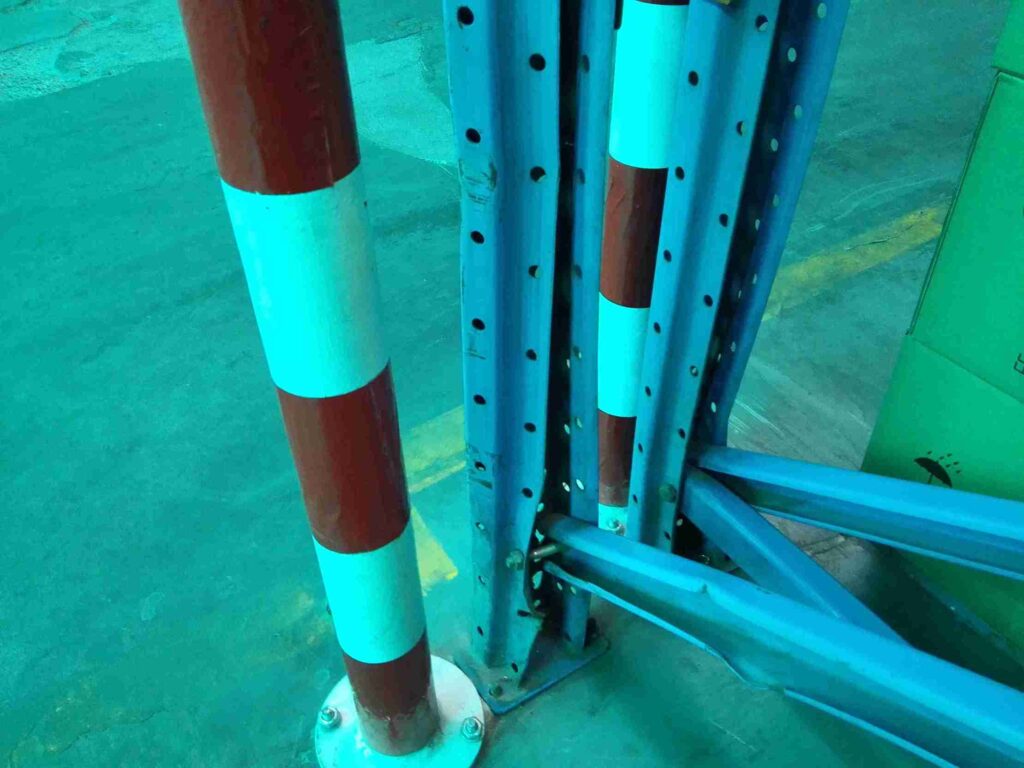
Upright Frame Analysis: Every upright is examined. Critical attention is paid to the “connector zone”—the area where beams connect. Dents here dramatically reduce load capacity. Inspectors use a Rack Damage Assessment Gauge to precisely measure dent depth and location, quantifying the damage against RMI/FEM allowable thresholds. The plumb of each frame is measured with laser levels, going far beyond the scope of basic pallet rack leveling instructions.
Beam and Connector Integrity Audit: Each beam end connector (tear-drop, bolt-on, or wedge) is inspected for full engagement, cracking, or deformation. Beam deflection is measured to ensure it has not exceeded the safe limit (typically L/180). Loose or missing beam safety locks are cataloged.
Foundation and Anchorage Verification: The interface between the rack and the building is scrutinized. Floor flatness and levelness are measured. Anchor bolts are checked for proper type, embedment depth, and torque. This often uncovers the root cause of misalignment that simple pallet rack leveling instructions attempt to mask—a failing anchor or floor settlement.
Ancillary and Protection Component Check: The presence, condition, and effectiveness of upright guards, column protectors, end-of-aisle barriers, and row spacers are evaluated. Their role in preventing the damage that later requires pallet rack leveling instructions is assessed.
Phase 3: The Operational Load and Configuration Compliance Audit
Perhaps the most revealing phase. Auditors physically audit a significant sample of stored loads. Pallet weights are verified against scale data or manifests. Load distribution on beams is analyzed. This frequently uncovers dangerous mismatches: beams loaded with 3,000 kg when their rated capacity is 2,500 kg; point loads from heavy items crushing beam decks; or uneven loading that induces twisting forces. No amount of following pallet rack leveling instructions can compensate for chronic, systemic overloading.
Phase 4: The Actionable, Prioritized Reporting
The findings are synthesized into a formal, legal-grade report. Each defect is photographically documented, mapped to a rack location, and assigned a risk-criticality code (Red/Immediate, Amber/Urgent, Green/Monitor). The report does not just list problems; it provides a prioritized corrective action plan with timelines. It becomes the master document for transforming warehouse safety from an abstract concept into a managed, actionable project.
Phase 5: The Path Forward: Repair, Retrofit, and Re-education
The audit’s value is realized in this phase. For “Red” items, immediate offloading and repair protocols are activated. For systemic issues, engineered solutions are proposed: retrofitting with higher-capacity beams, installing seismic bracing for regions like the Pacific Rim, or redesigning a bay with impact-resistant upright guards. Critically, the audit informs a tailored training program for warehouse staff, moving them from a mindset of looking for pallet rack leveling instructions to one of understanding damage prevention and daily inspection protocols.
The Automation Imperative: Why Audits are Non-Negotiable for AGV and AS/RS Integration
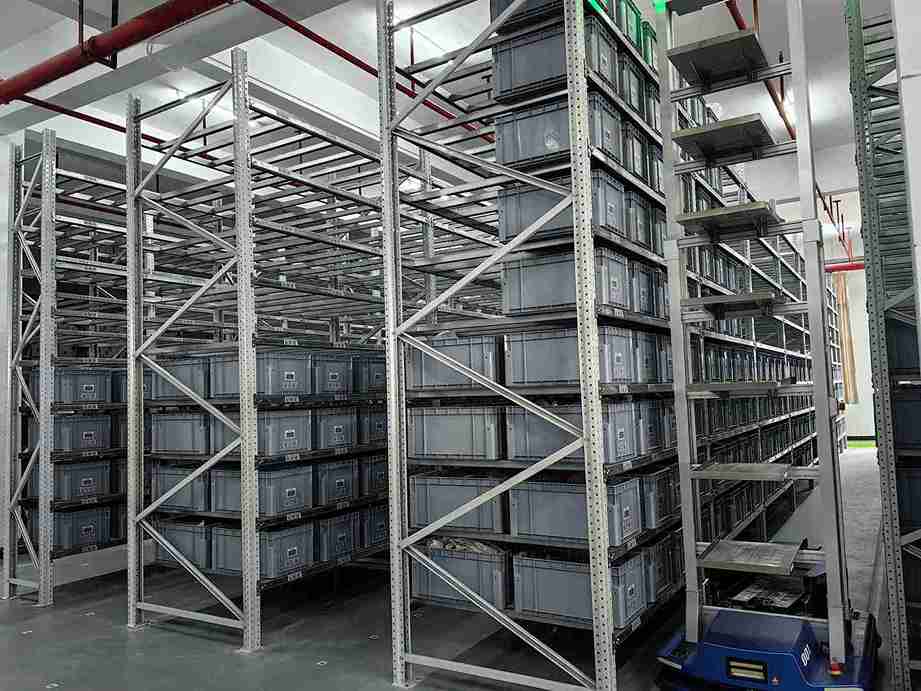
For operations investing in the future with Automated Guided Vehicles (AGVs), automated forklifts, or high-density automated storage systems, the professional rack audit transitions from “highly recommended” to “absolutely mandatory.” The margin for error in an automated warehouse approaches zero.
Precision Navigation Requirements: AGVs follow pre-programmed paths with centimeter-level accuracy. A rack upright that has leaned 5 cm into an aisle due to unremediated damage—damage that might have been temporarily “fixed” with shoddy pallet rack leveling instructions—becomes a collision hazard. This can derail an entire fleet’s operations, causing massive downtime.
AS/RS Tolerance and Reliability: Mini-load AS/RS, unit load AS/RS, and pallet shuttle systems depend on near-perfect rack alignment. The mast of a stacker crane or the shuttle rails require precise clearances. Misalignment from undetected damage or poor installation (issues not resolved by generic pallet rack leveling instructions) can cause shuttle jams, mast collisions, and catastrophic system failures, damaging millions of dollars in automation hardware.
Dynamic Load and Vibration Analysis: Automated equipment introduces new dynamic forces and vibration frequencies into the rack structure. A professional audit for an automated facility includes an assessment of the rack system’s ability to withstand these unique stresses, ensuring the integration is not just functional but inherently safe and durable.
An audit prior to automation integration acts as a certification of infrastructure readiness. It ensures your multi-million-dollar investment in robotics is built upon a foundation that is verified, sound, and engineered for the specific demands of high-tech operation.
From Theory to Warehouse Floor: Real-World Audit Scenarios and Engineered Solutions
Consider these common scenarios uncovered in audits, which illustrate the limitation of relying on pallet rack leveling instructions:
Scenario A: The Chronic Lean
Observation: A recurring lean in multiple uprights along a frequently trafficked aisle. Staff repeatedly apply pallet rack leveling instructions, shimming the base plates every few months.
Audit Discovery: The audit’s floor survey reveals significant settling of the warehouse slab in that zone. The leveling instructions were treating a symptom (the lean) caused by a moving foundation. Furthermore, the audit’s impact assessment finds thinning column metal from repeated, low-level forklift grazes.
Engineered Solution: The audit prescribes: 1) A structural engineer’s assessment of the slab. 2) Repair of damaged uprights. 3) Re-anchoring of the entire bay using epoxy-set anchors designed for compromised concrete. 4) Installation of a steel base plate retrofit system that allows for future micro-adjustments, and 5) Mandatory installation of high-visibility barrier posts and operator re-training. This solution addresses the root cause, not the symptom.
Scenario B: The Sagging Second Tier
Observation: Beams on the second level show visible sagging. The initial thought is to check pallet rack leveling instructions for frame alignment.
Audit Discovery: The load compliance audit reveals that the operation routinely stores pallets of resin powder weighing 2,200 kg on beams rated for 2,000 kg. The sag is not an alignment issue; it is plastic deformation from chronic overloading. The basic pallet rack leveling instructions are irrelevant to this failure mode.
Engineered Solution: The audit mandates: 1) Immediate offloading of overloaded beams. 2) Replacement of all plastically deformed beams. 3) Implementation of a load weight verification and tagging program at receiving. 4) As a longer-term solution, the audit provides engineering for a beams reinforcement retrofit kit or the design for a new high-capacity selective racking zone for heavy products.
Scenario C: The New Installation with Immediate Problems
Observation: A newly installed narrow aisle racking system has alignment issues, preventing smooth operation of the VNA forklifts. The installers are referencing pallet rack leveling instructions but cannot achieve stable correction.
Audit Discovery: The post-installation audit finds that anchor bolts were not torqued to specification, beam connectors are not fully engaged, and the floor in the area has a significant slope not accounted for in the design.
Engineered Solution: The audit report serves as a powerful punch-list for the installer, demanding: 1) Complete re-torquing of anchors to certified specs. 2) Disassembly and reassembly of improperly connected beams. 3) Use of precision leveling base plates (shims designed for racking) approved by the rack engineer, rather than field improvisations. This ensures the system meets its designed performance and safety criteria from day one.
Building the Pillars of a Safety-First Culture: The Audit as a Foundational Tool
The ultimate goal of a professional audit is to catalyze a transformation in organizational culture. It moves safety from a poster on the wall to an embedded, operational principle.
Knowledge Transfer and Empowerment: A key audit deliverable is the training of designated in-house personnel. They are taught not just to look for damage, but to understand it—to know when a dent requires a work order versus when it requires an immediate evacuation and a call to the safety manager. This empowers the team beyond searching for pallet rack leveling instructions.
Process Institutionalization: The audit leads to the creation of formal Standard Operating Procedures (SOPs) for: Daily/Weekly visual inspections, Post-Impact reporting protocols, and scheduled periodic professional re-audits. The pallet rack leveling instructions become a small, controlled part of a much larger maintenance playbook.
Creating a Living Safety Ledger: The initial audit report is the baseline. Subsequent annual or biannual audits measure progress, track the rate of new damage, and validate the effectiveness of implemented safety measures. This creates a continuous improvement loop, constantly elevating the operation’s safety maturity.
Conclusion: The Strategic Investment That Defines Market Leadership
In the competitive, fast-paced, and risk-laden world of global logistics, the approach to warehouse racking safety is a defining characteristic of operational maturity. Relying on pallet rack leveling instructions as a primary strategy is a reactive, tactical fix that leaves an organization vulnerable to immense, layered risks. Embracing a program of regular, professional rack audits is a proactive, strategic investment in human safety, asset protection, operational resilience, and brand integrity.
For businesses driving growth in the dynamic markets of the Middle East, Southeast Asia, Africa, and Latin America, this is not merely a technical decision. It is a leadership decision. It signals to partners, insurers, and employees that the company is managed with foresight, diligence, and an unwavering commitment to excellence. It ensures that the physical infrastructure supporting your supply chain is not the weakest link, but a verified, robust, and optimized asset.
The question for executive leadership is not, “Can we afford a professional rack audit?” The truly pertinent question is, “Given the catastrophic costs of failure, can we afford not to have one?” Move beyond the cycle of reactive fixes. Elevate your safety and operational standards from following basic pallet rack leveling instructions to implementing a science-based, engineered audit protocol. It is the ultimate safeguard for your people, your profitability, and your future.
Frequently Asked Questions (FAQs)
1. We have a very diligent maintenance team that performs regular checks. Isn’t that enough?
A diligent internal team is crucial for day-to-day vigilance and is a sign of a strong safety culture. However, internal checks, while valuable, are not a substitute for a professional audit. Certified auditors bring specialized, objective expertise, advanced diagnostic tools, and a deep understanding of complex engineering interdependencies (like how a floor settlement affects load distribution on a beam three levels up). They also provide the legally defensible documentation that is often required for insurance and regulatory compliance. Think of it this way: you change the oil in your car regularly (internal check), but you still need a certified mechanic for an annual safety inspection and diagnostic scan (professional audit).
2. What specific qualifications should we look for in a rack audit provider?
Seek providers with inspectors certified by recognized industry bodies. Key credentials include: Certification under the Rack Manufacturers Institute (RMI) “Professional Auditor” program, training aligned with FEM 10.2.02 or SEMA (Storage Equipment Manufacturers’ Association) standards, and engineers with relevant structural or mechanical engineering degrees. Ask for sample reports, proof of insurance (professional liability), and case studies from similar facilities or regions. Avoid providers who offer only a cursory “checklist” inspection without detailed metrology and reporting.
3. How does an audit account for local environmental factors, like seismic activity in our region?
A competent audit provider will tailor their assessment to your specific locale. In seismic zones (e.g., parts of Southeast Asia, Latin America, and the Middle East near fault lines), the audit will include a specific evaluation of the rack system’s seismic resilience. This involves checking for the presence and adequacy of seismic bracing (both down-aisle and cross-aisle), assessing the strength of connections and anchors under lateral load scenarios, and verifying that loads are secured. The audit report will provide specific recommendations for seismic retrofitting if the system is found to be non-compliant with local building codes or relevant seismic design standards.
4. After the audit and repairs, what kind of ongoing monitoring should we implement?
The audit report will recommend a re-inspection frequency, typically annually for most active warehouses. Beyond this, you should implement a structured three-tier system: 1) Daily/Operator Level: Forklift drivers and floor staff trained to report any visible damage or impacts immediately. 2) Weekly/Monthly Facility Level: A designated supervisor performing a structured walk-through using a simplified checklist derived from the audit. 3) Annual/Professional Level: The scheduled follow-up audit by the external certified provider. This layered approach ensures continuous monitoring between comprehensive professional assessments.
5. Can an audit help us optimize storage density and efficiency, not just safety?
Absolutely. A comprehensive audit is a holistic health check of your storage asset. While safety is paramount, the findings often directly inform efficiency gains. The audit may reveal opportunities to reconfigure bays to facilitate better workflow, identify under-utilized vertical space that could be accessed with the right equipment, or recommend upgrading to high-density systems like drive-in racking or pallet flow systems in specific areas to increase storage density within the existing footprint. By ensuring your racking is safe and properly utilized, you create a foundation for optimized, efficient material handling.
If you require perfect CAD drawings and quotes for warehouse racking, please contact us. We can provide you with free warehouse racking planning and design services and quotes. Our email address is: jili@geelyracks.com