📐 "First 50 Enterprise Queries Get Custom 3D Warehouse Design" Plan


Integrating Advanced Technology with Traditional Rack Safety
The evolution of warehouse safety is inextricably linked to technological advancement. Modern pallet rack fall protection is no longer just about passive barriers; it’s becoming an intelligent, data-driven component of the broader warehouse ecosystem. For a warehouse manager in Mexico City or an operations director in Singapore, leveraging this technology is key to achieving a competitive edge in safety and efficiency.
The Role of IoT and Sensor Integration
Imagine a pallet rack upright that can communicate its health status. With the advent of Industrial Internet of Things (IIoT) sensors, this is now a reality. Low-profile impact sensors can be discreetly mounted on critical uprights and column guards. Following a forklift or AGV collision—even a minor one that would traditionally go unreported—the sensor immediately transmits an alert to the facility manager’s dashboard. This triggers a mandated inspection of that specific component, ensuring damage is never overlooked. This proactive approach transforms fall protection from a reactive measure into a predictive maintenance protocol, fundamentally strengthening the entire rack system.
Digital Twin and Simulation for Proactive Planning
Before a single beam is installed or a new fall protection barrier is mounted, its performance can be tested in a virtual environment. Using Digital Twin technology, engineers can create a precise virtual model of the proposed warehouse layout. They can then simulate various scenarios: the force of a 3,000-pound pallet falling from the third tier onto a mesh panel, the stress distribution on a column guard during a 6 mph impact, or even the effects of seismic activity on the interconnected safety system.
This allows for the optimization of pallet rack fall protection designs for specific load types and operational risks unique to markets in, say, the mining sector in Chile or the pharmaceutical storage in Dubai, ensuring the highest level of safety and cost-effectiveness before installation begins.
Warehouse Management System (WMS) and Safety Interlocks
The most sophisticated pallet rack fall protection integrates seamlessly with the warehouse’s central nervous system—the WMS. In high-density, high-throughput environments using Very Narrow Aisle (VNA) racking, physical safety gates at the aisle entry can be equipped with electronic interlocks. The gate only releases when the WMS assigns a task to that specific aisle and confirms the correct forklift or order-picker is present. This prevents unauthorized access and accidental entry into active picking aisles, a common point of impact and potential collapse. This integration ensures that safety protocols are not a separate checklist but are baked into every operational workflow.

The Human Factor: Training and Culture in a Protected Environment
Engineered fall protection systems are only as effective as the people who operate within them. A comprehensive pallet rack fall protection strategy must include a robust and ongoing human element. Instilling a culture of safety where every employee, from the forklift operator to the warehouse supervisor, is an active participant is non-negotiable.
Operator Training that Goes Beyond the Basics
Training for forklift and AGV operators in facilities with advanced pallet rack fall protection must include specific modules on the purpose and limitations of the installed systems. Operators should understand that while a column guard is designed to absorb impact, it is not a bumper to be routinely touched. They need training on the “clear zone” around racks, the importance of reporting any contact immediately (a practice reinforced by sensor technology), and how to visually inspect mesh panels and barriers as part of their pre-shift routine. This turns operators from potential sources of risk into the first line of defense for rack integrity.
Creating Visual Management and Safety Communication
Effective pallet rack fall protection uses visual cues to reinforce safe behavior. This includes:
Color-Coding: Using bright yellow for all impact protection devices like column guards and post protectors.
Clear Labeling: Installing signage at safety gate entrances that reiterate procedures.
Zone Marking: Using floor tape and signage to delineate high-risk zones, pedestrian walkways, and MHE traffic areas, making the layout of the safety system intuitive.
When employees understand the why behind the steel mesh and barriers—that it is there to protect them, their colleagues, and their livelihood—compliance shifts from being mandated to being valued. A warehouse in Johannesburg or Manila with a strong safety culture, supported by visible and respected fall protection infrastructure, will experience fewer incidents, lower turnover, and higher overall productivity.
Material and Design Innovation for Extreme Environments
Suppliers serving global markets must account for vastly different environmental challenges. The pallet rack fall protection specified for a climate-controlled food storage facility in the Netherlands will differ profoundly from that required for an open-sided raw material warehouse in Saudi Arabia or a port-side logistics hub in Vietnam.
Corrosion Resistance for Coastal and Tropical Climates
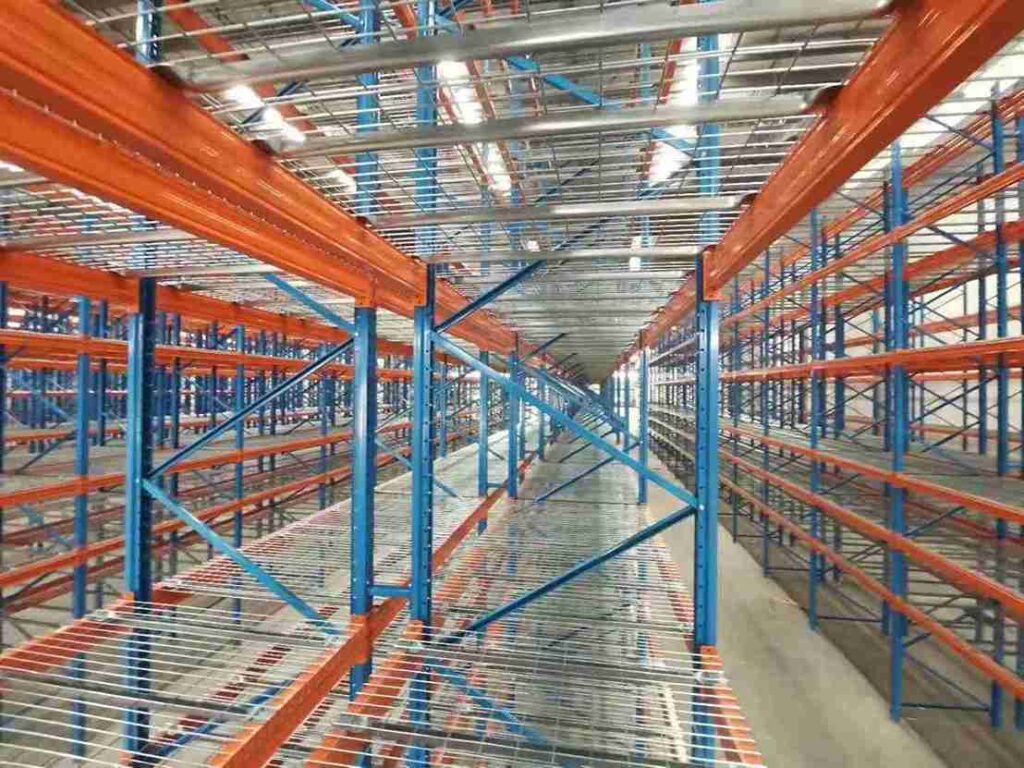
In the high-humidity, salt-rich air of coastal regions in Southeast Asia, Africa, and Latin America, standard galvanized steel can succumb to corrosion over time. For these environments, superior pallet rack fall protection specifications are critical:
Hot-Dip Galvanizing to Specific Standards: Specifying a minimum zinc coating thickness (e.g., 600 g/m²) to ensure decades of service life.
Stainless Steel Components: Utilizing 316-grade stainless steel for all fasteners, brackets, and connection hardware in highly aggressive environments. This prevents galvanic corrosion and ensures the structural connections of the safety system remain sound.
Polymer-Based Solutions: For certain barrier applications, high-density polyethylene (HDPE) or powder-coated aluminum systems offer excellent corrosion resistance where steel may be compromised.
Seismic and Wind Load Considerations
In seismically active regions like parts of Indonesia, the Philippines, Chile, and Central Asia, pallet rack fall protection takes on an additional critical function: preventing progressive collapse during an earthquake. Standard fall protection mesh, when properly engineered and anchored, can act as a lateral bracing element, helping to distribute seismic forces and prevent the “unzipping” of rack frames. Specialized seismic fall arrest panels with reinforced framing and connection points are designed for this exact purpose, meeting stringent local building codes that go far beyond basic OSHA guidelines.
Fire Rating and Containment
In the Middle East and other regions with strict fire codes, fall protection can be engineered to contribute to fire compartmentalization. Special fire-rated mesh or solid panels can help slow the spread of flames and smoke through rack structures, buying critical time for evacuation and firefighting efforts. This dual-purpose approach to pallet rack fall protection—addressing both accidental impact and fire safety—delivers exceptional value and compliance for facility managers.
Financial Modeling and the Total Cost of Ownership (TCO) for Safety
For the CFO or procurement head evaluating a significant investment in pallet rack fall protection, the decision must be grounded in clear financial logic. Moving beyond simple ROI, a Total Cost of Ownership analysis reveals the profound long-term value.
Avoiding Direct Catastrophic Costs
The most immediate financial argument for robust pallet rack fall protection is the avoidance of a single catastrophic event. The costs of a major collapse are multifaceted and devastating:
Inventory Loss: Total loss of product value in the collapsed bays and adjacent areas damaged by falling debris.
Business Interruption: The cost of shutting down operations for days or weeks to clear debris, conduct structural assessments, repair racks, and restock. For a third-party logistics (3PL) provider, this can mean breaching service-level agreements and losing key clients.
Regulatory Fines and Legal Liability: Fines from local safety authorities can be substantial. Furthermore, lawsuits from injured employees or contractors can result in multimillion-dollar settlements.
Insurance Consequences: A major claim inevitably leads to dramatically increased premiums and potentially higher deductibles for years to come. In some cases, insurers may refuse renewal without proof of upgraded safety systems.
Quantifying Indirect and Operational Benefits
A sophisticated TCO model also captures the positive operational impacts of a superior pallet rack fall protection system:
Reduced Insurance Premiums: Proactive risk mitigation through engineered safety solutions can lead to immediate discounts of 10-20% on property and casualty insurance.
Lower Maintenance and Repair Costs: Preventing impacts reduces the frequency and cost of rack beam replacement, upright straightening, and component repairs.
Enhanced Operational Efficiency: As demonstrated in the Indonesian case study, employees working in a visibly safe environment are less apprehensive, more focused, and demonstrate higher picking accuracy and speed. Reduced product damage from contained falls also improves inventory accuracy.
Asset Longevity and Residual Value: A well-protected rack system maintains its structural integrity and load capacity for its full designed lifespan. This protects the capital investment in the storage infrastructure itself. Should the facility be sold or repurposed, a warehouse with a certified, modern fall protection system commands a higher asset value.
For a multinational corporation standardizing its warehouses across Brazil, Nigeria, and Thailand, investing in a uniformly high standard of pallet rack fall protection is not an operational expense; it is a strategic capital expenditure that protects the entire supply chain investment.
The Future Horizon: Autonomous Systems and Adaptive Safety
The end-state of warehouse automation is the lights-out, fully autonomous facility. As the industry marches toward this reality, pallet rack fall protection must evolve in tandem. The systems installed today should be future-proofed to integrate with tomorrow’s technology.
Protection for Fully Robotic Environments
In a facility where mobile robots, robotic palletizers, and automated cranes operate without human intervention, pallet rack fall protection serves a slightly different primary purpose: ensuring absolute system uptime. Here, the focus shifts to protecting the rack structure from any potential robot navigation error or mechanical failure that could cause an impact. The safety barriers and column guards are designed with smooth, flush surfaces to avoid snagging, and are often combined with LiDAR and proximity sensors that feed directly into the robotic control system, creating a real-time feedback loop for collision avoidance.
Modular and Reconfigurable Safety Architectures
The demand for warehouse flexibility is paramount. The next generation of pallet rack fall protection will be inherently modular. Imagine clip-on, tool-less mesh panels and quickly re-locatable barrier posts that allow a warehouse team in Bogotá or Kuala Lumpur to reconfigure a storage zone over a weekend without compromising safety. This adaptability ensures that fall protection is never a bottleneck to operational change, but an enabler of it.
Conclusion: The Inseparable Link Between Protection and Performance
In the final analysis, for any business involved in material handling and storage—from automotive parts in Thailand to perishable goods in Kenya to e-commerce fulfillment across Mexico—the distinction between safety and efficiency is an artificial one. A warehouse compromised by the ever-present risk of falling loads and rack collapse is a warehouse operating with a fundamental brake on its potential. True operational excellence is built on a foundation of absolute integrity.
Comprehensive, intelligently engineered pallet rack fall protection is the cornerstone of that foundation. It is the critical system that allows automation to thrive, empowers employees to perform at their peak, protects vital capital, and ensures business continuity. It transforms the warehouse from a cost center fraught with hidden risk into a resilient, reliable, and high-performing asset.
For decision-makers across the globe evaluating their storage infrastructure, the imperative is clear. Partnering with an expert who understands the intricate dance between global engineering standards, local environmental challenges, and cutting-edge safety technology is the first strategic step. It is an investment that pays dividends not only on the balance sheet but in the sustained well-being of the enterprise and its people. The most efficient warehouse is, unequivocally, the safest warehouse.
Frequently Asked Questions (FAQs)
1. How does the design of pallet rack fall protection differ for drive-in racking compared to selective pallet racking?
Drive-in racking systems present unique hazards as forklifts operate within the rack structure. Therefore, pallet rack fall protection for these systems focuses heavily on internal safety. Key differences include reinforced internal guide rail protectors to prevent damage from forklift masts, specialized safety gates at the entrance of each lane to prevent unauthorized entry, and often, overhead containment netting above the drive-in lanes to catch any pallets dislodged from the highest levels during deep-row access. The design is far more integrated with the rack’s operational function compared to the perimeter-focused protection of selective racking.
2. We have older, existing racking. Can an effective pallet rack fall protection system be retrofitted, or does it require a full rack replacement?
A significant advantage of modern pallet rack fall protection solutions is their designed retrofittability. Professional safety suppliers specialize in engineering systems that integrate with existing rack structures, regardless of age or manufacturer. The process begins with a certified rack inspection to ensure the underlying structure is sound. From there, custom-fabricated mesh panels, bolt-on column guards, and adaptable barrier systems can be installed without the need for welding or major structural modification. Retrofitting is not only possible but is a highly cost-effective strategy to immediately upgrade the safety of a legacy warehouse.
3. What are the key maintenance and inspection routines for a pallet rack fall protection system?
A pallet rack fall protection system requires a scheduled maintenance routine to ensure ongoing effectiveness. This should be integrated into the overall rack inspection program. Key tasks include:
Monthly Visual Checks: Warehouse staff should look for obvious damage, dents, or loose connections on mesh panels and barriers.
Quarterly Detailed Inspections: A supervisor or safety officer should check all fastener tightness, inspect for corrosion (especially in coastal areas), and ensure safety gates and latches function smoothly.
Annual Professional Audit: A certified inspector should conduct a full assessment, measuring any deformation in column guards, verifying mesh integrity, and ensuring the entire system still complies with the original design specifications and any updated local regulations.
4. Are there specific pallet rack fall protection solutions for warehouses storing hazardous materials?
Absolutely. Warehouses storing chemicals, flammable liquids, or other hazardous materials require pallet rack fall protection that addresses secondary containment. This often involves solid sheet metal panels (which may be chemical-resistant coated) instead of mesh to contain any liquid spillage from damaged containers. Additionally, these panels are often integrated with spill containment sumps at the base. The design must also facilitate safe access for emergency responders and align with regulations like OSHA 1910.106 (Flammable Liquids) or their international equivalents.
5. How do we calculate the required strength and density of mesh panels for our specific inventory?
This is a core engineering task and should not be guessed. The specification depends on the “design load” of potential falling objects. An engineer will consider the weight, size, and fragility of your typical unit load (e.g., a 2,000 lb pallet of bagged powder versus a case of wine bottles). Heavier, denser loads require a smaller mesh aperture (e.g., 50mm x 50mm) and a thicker wire gauge (e.g., 5mm).
Lighter, bulkier loads may be safely contained with a larger aperture. The calculation also factors in the drop height and the potential kinetic energy. Reputable suppliers perform these load calculations as a standard part of their design proposal, ensuring your pallet rack fall protection is neither under- nor over-engineered for your specific inventory profile.
If you require perfect CAD drawings and quotes for warehouse racking, please contact us. We can provide you with free warehouse racking planning and design services and quotes. Our email address is: jili@geelyracks.com