📐 "First 50 Enterprise Queries Get Custom 3D Warehouse Design" Plan
















In the high-stakes world of modern logistics and manufacturing, where every second and every square foot counts, operational excellence is non-negotiable. Companies relentlessly invest in sophisticated automation—Automated Guided Vehicles (AGVs), Automated Storage and Retrieval Systems (ASRS), and high-speed conveyors—to streamline the movement of goods. Yet, a critical, human-centric component is often relegated to an afterthought: the infrastructure that allows personnel to safely and efficiently interact with this automated ecosystem. This is where the modular stair platform system emerges as a game-changing strategic asset.
Far more than a simple set of stairs, a professionally engineered modular stair platform system represents a foundational pillar for achieving unparalleled warehouse safety, driving measurable workflow efficiency, and ensuring seamless integration with advanced automation. This comprehensive exploration delves into the multifaceted value proposition of a custom-designed modular stair platform system, positioning it as an indispensable investment for any facility targeting world-class performance and robust safety compliance across global markets like Southeast Asia, the Middle East, Africa, and Latin America.

Why the Modern Warehouse Demands a Modern Access Solution: The Limitations of Traditional Infrastructure
The legacy of warehouse design often includes fixed, welded staircases and ladders—solutions that are inherently rigid and increasingly incompatible with dynamic industrial environments. These traditional structures are plagued by significant drawbacks. They are permanent fixtures in a landscape that demands flexibility, often creating obstructive dead space and forcing inefficient worker travel paths. A worker needing to access a control panel on an automated conveyor may be forced to walk dozens of meters to a fixed staircase, resulting in cumulative hours of lost productivity. Furthermore, their static nature makes them obstacles to future expansion or reconfiguration of racking and machinery.
In stark contrast, a modular stair platform system is conceived with adaptability as its core principle. This approach to industrial access recognizes that a warehouse is a living, evolving entity. The inherent flexibility of a modular stair platform system allows it to be strategically positioned at the exact point of need, directly aligning with high-frequency workflows and maintenance points. This strategic placement is not merely a convenience; it is a fundamental redesign of human workflow within a technology-driven space. The immediate gains in both warehouse safety and efficiency are tangible and significant, delivering a rapid return on investment from the moment the first components are assembled.
Anatomy of Excellence: Deconstructing the Core Components of a Superior Modular Stair Platform System
To truly appreciate the value of a premium modular stair platform system, one must understand the engineering and quality inherent in its core components. The market offers a wide spectrum of quality, and the long-term performance, safety, and durability of the installation are direct reflections of the materials and design philosophies employed.
<h3>Heavy-Duty Structural Framing: The Unseen Backbone of Safety and Stability</h3>
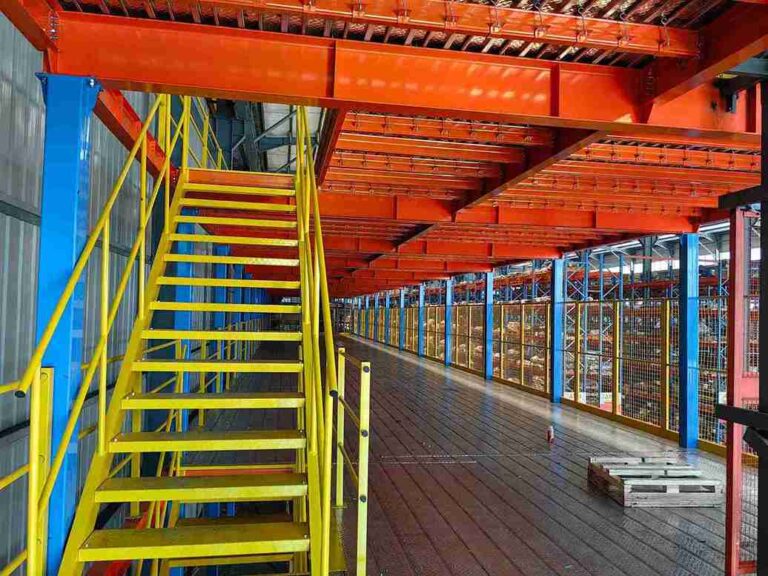
The structural frame is the skeleton upon which everything else depends. A commercial-grade modular stair platform system utilizes high-tensile, cold-rolled steel sections, engineered with a minimum yield strength that significantly surpasses standard industrial benchmarks. These profiles are meticulously designed to support substantial live loads—often exceeding 1,000 pounds—with minimal deflection, ensuring a solid, vibration-free feel underfoot regardless of traffic intensity. Critical connection points are fortified with reinforced gussets and precision laser-cut for a perfect fit, guaranteeing the entire structure’s rigidity and long-term structural integrity. This robust foundation is what separates a professional-grade modular stair platform system from a less reliable alternative.
<h3>Advanced Anti-Slip Tread Technology: Proactively Engineering Out Fall Hazards</h3>
The walking surface is the most frequent point of interaction and, consequently, the primary defense against slips and falls. A high-caliber modular stair platform system will feature treads made from solid serrated bar grating or heavy-duty perforated plate. Both options are specifically engineered to provide an exceptional anti-slip surface, delivering superior traction even in challenging conditions involving moisture, oil, or dust. The open-design grating offers the additional benefit of allowing light, dust, and debris to pass through, maintaining the tread’s anti-slip properties and contributing to a cleaner environment. This focus on tread technology is a non-negotiable aspect of a safety-first modular stair platform system.
<h3>Industrial-Grade Handrails, Mid-Rails, and Toe-Kicks: A Comprehensive Fall Protection Ecosystem</h3>
Safety in a modular stair platform system extends far beyond the steps. A fully integrated fall protection system is paramount. This includes robust tubular steel handrails, continuous mid-rails, and critical toe-kick plates. The handrails are designed to withstand significant lateral force, providing dependable support for personnel. The often-overlooked toe-kick is a vital safety feature, preventing tools, components, or small parts from being accidentally dislodged from the platform, thereby protecting workers and equipment operating below. This 360-degree protective envelope ensures compliance with the most stringent international safety standards, including OSHA and ISO, making a properly designed modular stair platform system a cornerstone of any corporate safety program.
<h4>The Defense Against Decay: Superior Finishing for Long-Term Asset Protection</h4>
The industrial environment can be punishing. Humidity in Southeast Asia, coastal salt air in the Middle East and Africa, and chemical exposure in manufacturing facilities all pose a threat to longevity. A premium modular stair platform system is protected by an advanced finishing process. Components undergo a multi-stage pretreatment (phosphating) to ensure optimal coating adhesion, followed by an electrostatically applied epoxy-polyester powder coat. This creates a exceptionally durable, chemically resistant finish that resists chipping, scratching, and UV degradation, ensuring the modular stair platform system remains structurally sound and visually professional for its entire operational lifespan.
The Tangible Payoff: Quantifying the Link Between Modular Stairs and Operational Excellence
The decision to invest in a high-quality modular stair platform system is driven by its direct and measurable impact on two of the most critical operational metrics: safety and efficiency. These are not isolated benefits; they are synergistically linked, each reinforcing the other.
<h3>Systematically Eradicating Slip, Trip, and Fall Hazards</h3>
Slips, trips, and falls from height remain a leading cause of serious occupational injury and financial loss. A well-designed modular stair platform system is engineered to systematically eliminate these risks. The consistent and code-compliant rise and run of the stairs, combined with the uniformly high-traction treads, create a predictable and secure walking surface.
This is crucial for personnel who may be carrying items or navigating the structure under time pressure. The unwavering presence of robust handrails provides continuous confidence and support. By implementing a modular stair platform system, companies make a demonstrable commitment to their employees’ well-being, simultaneously reducing the devastating downtime and costs associated with workplace accidents.
<h3>Driving Productivity by Optimizing Human Workflow</h3>
In logistics, efficiency is relentlessly pursued, often measured in seconds saved per task. When a technician needs to access a mezzanine-level pick station, a control panel on a sorter, or a maintenance point on a vertical lift module, the most direct path is the most productive. A fixed staircase, by its immutable nature, often forces long, inefficient detours. A strategically placed modular stair platform system, however, can be positioned to provide direct, immediate access.
This elimination of unnecessary travel can save hundreds of feet of walking per employee, per day. Scaled across a workforce and over a year, this translates into thousands of reclaimed man-hours, allowing staff to focus on value-adding activities rather than inefficient transit. This is a powerful, yet often overlooked, productivity lever that a modular stair platform system directly provides.
The Automation Nexus: Integrating Your Modular Stair Platform System with AGV and ASRS Environments
This is where the functional role of a modular stair platform system transcends basic access and becomes a critical enabler for automation. Robotic systems, while highly autonomous, require human oversight, maintenance, and occasional intervention. The access infrastructure must facilitate this, not hinder it.
<h3>Providing Unobstructed, Safe Access to Critical Automation Nodes</h3>
AGV maintenance bays, ASRS crane runways, and conveyor drive unit locations are all nerve centers that require regular human access. A fixed staircase can often be located in a position that obstructs the very automation it is meant to service. This is where the concept of custom solutions for AGV/ASRS integration becomes paramount. A professionally engineered modular stair platform system is designed with the automation’s operational footprint as a primary input.
The result is a platform that offers safe, clear, and ergonomic access for technicians without impeding the defined paths of AGVs or the movement of robotic cranes and shuttles. This foresight in design ensures that routine maintenance and emergency interventions can be performed quickly and safely, directly minimizing costly system downtime and maximizing the uptime of high-value automated assets.
<h3>Future-Proofing Your Material Handling Investment</h3>
Change is the only constant in a competitive warehouse. Racking configurations are updated, new automation is integrated, and process flows are optimized. A welded staircase is a permanent liability in this fluid environment, often becoming an expensive obstruction that must be worked around or expensively demolished. The modular stair platform system, by its fundamental design, is inherently relocatable and reconfigurable.
When a facility reconfigures its layout, the modular stair platform system can be disassembled, moved, and reassembled in a new optimal location with minimal cost and operational disruption. This attribute future-proofs the investment, ensuring that the access solution remains aligned with operational needs for decades, protecting and enhancing the long-term value of the entire material handling system.
The Bespoke Advantage: Engineering Custom Solutions for Unique Operational Challenges
Standard, off-the-shelf solutions rarely fit the complex realities of a modern industrial facility. A world-class provider operates on the principle that every operational challenge is unique, requiring a collaborative and engineering-led approach to deliver a truly effective modular stair platform system.
<h3>Comprehensive Pre-Project Engineering and Dynamic Site Assessment</h3>
The process for deploying an optimal modular stair platform system begins with an in-depth consultation and a thorough site assessment. Engineers analyze the specific access requirements: What equipment is being accessed? What is the frequency and purpose of access? What are the spatial constraints and clearances? What existing structures or utilities must be navigated? This data-centric approach ensures that the final modular stair platform system is not a generic product, but a precision-engineered solution tailored to the facility’s exact operational DNA.
<h3>Mastering Complex Spatial and Workflow Challenges</h3>
Leading providers have extensive portfolios demonstrating the adaptability of a modular stair platform system in the most demanding scenarios. These bespoke creations include:
Wrap-Around and Corner-Mounted Platforms: Designed to navigate existing columns, machinery, and tight corners without sacrificing structural integrity or safety.
Multi-Level and Mezzanine-Linking Systems: Creating continuous, safe vertical access between multiple elevated workstations or storage levels within a single, coherent structure.
Platforms with Integrated Safety Gates: Featuring interlocked gates that prevent access to hazardous areas when machinery is in operation, a critical feature for ASRS aisles.
Specialized Tread Coatings and Materials: For extreme environments, such as food-grade facilities requiring NSF-compliance or areas with exposure to aggressive chemicals.
This bespoke engineering capability ensures that the final installation of the modular stair platform system is a perfect fit, both functionally and spatially, appearing as an integral part of the original facility design.
Global Implementation Expertise: Delivering Robust Solutions for Diverse Regional Challenges
A provider with genuine global experience understands that a one-size-fits-all approach is inadequate. The successful deployment of a modular stair platform system across diverse regions like Southeast Asia, the Middle East, Africa, and Latin America requires nuanced understanding of local conditions.
Southeast Asia & Coastal Africa: Specifications for a modular stair platform system in these regions must account for high humidity and salt-laden air, necessitating enhanced corrosion protection protocols in the finishing process.
The Middle East: The engineering for a modular stair platform system must consider extreme thermal cycling and pervasive fine dust, requiring designs that accommodate expansion and seal critical components.
Latin America: The provider must offer scalable solutions for a modular stair platform system, from massive port logistics centers to agile manufacturing plants, understanding the varied economic and industrial landscapes.
This regional expertise ensures that every modular stair platform system delivered is not only high-quality but also context-appropriate, guaranteeing long-term performance and reliability in its specific operating environment.
The Installation Imperative: Precision, Speed, and Minimizing Operational Disruption
Warehouses and distribution centers cannot afford prolonged shutdowns. The modular methodology provides a distinct and critical advantage during the installation phase of a modular stair platform system.
<h3>The Bolted Advantage: Precision, Quality, and Unmatched Flexibility</h3>
High-quality systems are predominantly bolted, not welded. This methodology offers profound benefits. Firstly, it allows for precision manufacturing in a controlled factory environment. All components are pre-drilled, cut, and finished with extreme accuracy, ensuring a perfect fit during on-site assembly. Secondly, it drastically reduces on-site labor time and complexity. A skilled installation crew can assemble a significant modular stair platform system structure in days rather than weeks, causing minimal interference with ongoing operations. The elimination of hot-work (welding) on-site also dramatically enhances safety during the installation process, reducing fire risks and insurance liabilities.
The Holistic Ecosystem: Integrating Your Modular Stair Platform System with Broader Storage & Automation
A modular stair platform system rarely functions in isolation. It is a synergistic component within a broader material handling ecosystem. A visionary provider designs these access solutions to work in perfect harmony with other storage and automation products.
Direct Integration with Pallet Racking: A modular stair platform system can be designed to provide direct, safe access to high-level beams within a racking system for inventory counting, cycle checks, or maintenance tasks.
Primary Access for Mezzanine Floors: These systems serve as the main or secondary access point to elevated storage or work areas created by structural mezzanines, seamlessly blending with the structure.
Maintenance Access for Conveyor Systems: A strategically placed modular stair platform system provides safe and ergonomic access for technicians servicing drive units, transfer points, and sortation loops, ensuring high conveyor uptime.
This integrated, holistic approach to warehouse design ensures that all elements—storage, automation, and human access—function as a single, highly optimized organism, with the modular stair platform system acting as a vital connective tissue.
The Strategic Investment: Analyzing the Compelling Long-Term ROI of a Modular Stair Platform System
Viewing a modular stair platform system as a simple capital expense is a strategic misstep. It is, in fact, an investment with a clear and compelling financial return that extends far beyond the initial purchase price.
Risk Mitigation and Insurance Optimization: Demonstrating a proactive commitment to safety through an engineered modular stair platform system can lead to favorable reassessments from risk managers and potentially lower workplace liability insurance premiums.
Downtime Avoidance and Cost Savings: Preventing a single serious fall-related incident can save a company from immense direct and indirect costs, including medical expenses, lost productivity, regulatory fines, and potential litigation.
Quantifiable Productivity Gains: The cumulative time saved from optimized access routes, as enabled by a well-planned modular stair platform system, directly translates into higher operational throughput and a lower cost per task.
Asset Longevity and Adaptability: The relocatable and reconfigurable nature of a modular stair platform system means it never becomes obsolete, adapting alongside the facility for decades and providing continuous value, thus avoiding repeated capital outlays on new access solutions.
When these factors are holistically analyzed, the payback period for a premium, custom-engineered modular stair platform system is often remarkably short, solidifying its status as a shrewd and strategic business investment.
Conclusion: Elevating Your Operational Infrastructure with Engineered Access
In the fiercely competitive arena of global supply chains, marginal gains are the key to leadership. While investments in automation like AGVs and ASRS are essential for moving goods with unprecedented speed, an equivalent investment in the infrastructure that supports your people is equally critical. A professionally engineered modular stair platform system is that essential investment.
It is the vital bridge connecting your workforce to your automated systems, transforming safety protocols into practical, daily reality, and enabling a static layout to become a dynamic, future-proof facility. To overlook the strategic importance of a robust modular stair platform system is to leave a critical gap in your operational armor. Forward-thinking companies are now recognizing that the path to peak performance is built on a foundation of safety and efficiency, a foundation best provided by a custom-engineered modular stair platform system.
Frequently Asked Questions (FAQs)
1. How does the long-term maintenance cost of a modular stair platform system compare to a traditional welded staircase?
A high-quality modular stair platform system typically incurs significantly lower long-term maintenance costs. The hot-dip galvanized or powder-coated finishes are highly durable, reducing the need for frequent repainting. More importantly, if a specific section is damaged, only that individual module or component needs replacement, which is a straightforward process. Repairing a welded structure often requires expensive on-site welding, grinding, and refinishing, causing greater disruption and cost.
2. Can a modular stair platform system be designed to accommodate non-standard loads, such as heavy machinery or pallet jacks being rolled onto a platform?
Absolutely. This is a key advantage of an engineered modular stair platform system. During the design phase, engineers can specify heavier gauge steel, reinforce the structural framing, and design wider platforms and landings to accommodate specific, non-standard loads. The modular stair platform system can be customized with reinforced treads and landings to support the weight and point loads of machinery or the movement of manual pallet jacks, making it a versatile solution for diverse operational needs.
3. What specific design considerations are needed for integrating a modular stair platform system in a cold storage or freezer warehouse environment?
Cold storage applications present unique challenges for a modular stair platform system. Key considerations include:
Specialized Treads: Using an extreme anti-slip tread pattern, such as grit-impregnated or expanded metal, to combat ice and condensation.
Material Selection: Specifying steels that retain impact resistance at low temperatures.
Thermal Breaks: Designing connections that minimize thermal bridging to reduce ice formation and energy loss.
Finish Compatibility: Ensuring the powder coat or other finish remains flexible and adherent at sub-zero temperatures.
4. How does the procurement and installation process typically work for an international client in a region like Africa or Latin America?
For international clients, a streamlined process is crucial. It typically involves:
Detailed Remote Consultation to understand requirements.
Creation of a Custom Proposal with 3D drawings and a fixed-price quote.
Efficient Logistics Planning where the provider manages the packaging and shipment of the complete modular stair platform system kit, with all necessary hardware and assembly instructions.
On-Site Support Options ranging from detailed virtual guidance for local crews to sending a supervised installation team to ensure perfect assembly. This flexible approach ensures a successful deployment anywhere in the world.
5. Beyond basic safety, are there specific design features that can enhance the everyday usability and ergonomics of a modular stair platform system?
Yes, a user-centric modular stair platform system incorporates several ergonomic features. These can include:
Optimal Stair Pitch: Designing a comfortable rise and run to reduce fatigue during frequent use.
Ample Landing Space: Providing generous landing areas for rest, tool placement, or temporary storage.
Tool Rails or Shelving: Integrating small shelves or rails on landings to hold tools or parts during maintenance tasks.
Enhanced Lighting: Designing the modular stair platform system to facilitate the easy integration of task lighting for poorly lit areas, further enhancing safety and usability.
Welcome to contact us, if you need warehouse rack CAD drawings. We can provide you with warehouse rack planning and design for free. Our email address is: jili@geelyracks.com