📐 "First 50 Enterprise Queries Get Custom 3D Warehouse Design" Plan
















For decision-makers in logistics, manufacturing, and distribution, the relentless pressure to do more with less is a constant. Physical space is constrained, inventory volatility is the new normal, and the pace of automation is accelerating. In this environment, the foundational choice of a storage system becomes the single most critical factor determining operational agility and long-term profitability. The solution lies in moving beyond conventional pallet racking to a sophisticated, engineered system: a modular platform for heavy equipment.
This is not merely a collection of beams and uprights; it is a fully integrated, structural ecosystem designed from the ground up to be both inherently strong and infinitely scalable. This comprehensive guide delves into the engineering excellence, strategic advantages, and tangible return on investment that a true modular platform for heavy equipment delivers, providing the blueprint for building a genuinely future-proof warehouse.

(H2) Beyond Racking: Deconstructing the Engineered Excellence of a Modern Modular Platform for Heavy Equipment
The term “racking” often conjures images of simple, bolt-together shelving. A modular platform for heavy equipment represents a quantum leap in design philosophy and execution. It is a system where every component is precision-engineered to work in perfect harmony, creating a unified structure whose performance far exceeds the sum of its parts. This distinction is crucial for anyone responsible for storing high-value, heavy-load inventory.
The Metallurgy of Strength: High-Tensile Steel and Structural Integrity
The journey to a reliable modular platform for heavy equipment begins at the atomic level. The use of high-tensile, cold-rolled steel is a non-negotiable standard. The cold-rolling process fundamentally enhances the steel’s grain structure, resulting in a material with superior yield strength and resistance to deformation compared to hot-rolled alternatives. This material science advantage allows for the design of components that are both exceptionally robust and strategically slender. The outcome is a modular platform for heavy equipment that maximizes usable storage volume without compromising its core mandate: safely bearing immense loads for decades. This inherent strength is the first pillar supporting a future-proof warehouse.
The Connection Point: Where Superior Engineering Meets Unshakable Stability
If the steel is the muscle of the system, the beam-to-column connection is its nervous system—the critical point that determines overall stability. Standard teardrop and bolt-based connections are potential points of failure, susceptible to loosening under dynamic stress and offering limited resistance to lateral forces. The engineering hallmark of an advanced modular platform for heavy equipment is a patented, structural boltless connection.
This innovative design creates a moment-resistant frame, effectively fusing upright frames and beams into a single, rigid entity. This capability to handle dynamic forces—from the impact of a forklift to the rhythmic vibration of machinery—is what separates a basic storage solution from a truly strong modular platform for heavy equipment. Resources from the Rack Manufacturers Institute (RMI) outline the critical standards that inform these advanced engineering principles.
The Safety Buffer: Engineering Redundancy with a Generous Factor of Safety
Responsible engineering is predicated on planning for the unexpected. The Factor of Safety (FoS) is a calculated measure of a system’s load-bearing capacity beyond its stated maximum. For a modular platform for heavy equipment designed for demanding environments, a minimum FoS of 1.67:1, often exceeding industry standards, is essential. This built-in redundancy is a silent guardian, accounting for real-world variables that theoretical calculations cannot:
Imperfect Loads: Palletized goods are rarely perfectly balanced, creating uneven stress distribution.
Dynamic Shock: The kinetic energy transferred during loading and unloading operations.
Long-Term Fatigue: The gradual effects of constant loading and unloading cycles over years of service.
Operational Hazards: Low-speed impacts from material handling equipment.
This engineering conservatism ensures that the stated capacity of the modular platform for heavy equipment is a safe, reliable, and durable working limit, not a precarious edge.
(H2) The Scalability Imperative: Architecting a Warehouse That Grows With Your Business
Scalability is the lifeblood of a modern supply chain. A future-proof warehouse must be an adaptable asset, not a fixed liability. A best-in-class modular platform for heavy equipment is designed for multi-dimensional growth, allowing a facility to evolve seamlessly with business demands.
Mastering the Vertical Dimension: The Untapped Potential of Cube Utilization
For most operations, the most cost-effective expansion is vertical. A strong modular platform for heavy equipment is engineered to safely and efficiently conquer this vertical frontier. With upright frames capable of reaching heights of 40 feet or more and beams with commensurate load capacities, businesses can dramatically increase storage density without the prohibitive cost of physical expansion.
This strategic use of vertical air rights is a primary benefit of a scalable modular platform for heavy equipment. When this vertical density is paired with an Automated Storage and Retrieval System (ASRS), it creates a high-bay, high-throughput storage paradigm that is the epitome of a future-proof warehouse. Discover the synergy between structure and robotics on our dedicated page for ASRS and Warehouse Robotics Integration.
Horizontal Reconfigurability: The Agility to Pivot Overnight
Market demands are fluid. A successful product launch, a seasonal peak, or a new efficiency strategy can render a static storage layout obsolete. A conventional system forces operational compromises. In contrast, a modular platform for heavy equipment is designed for change. The standardized, boltless design allows for rapid reconfiguration. Beams can be unclipped and repositioned in minutes; entire sections can be dismantled and rebuilt in new locations.
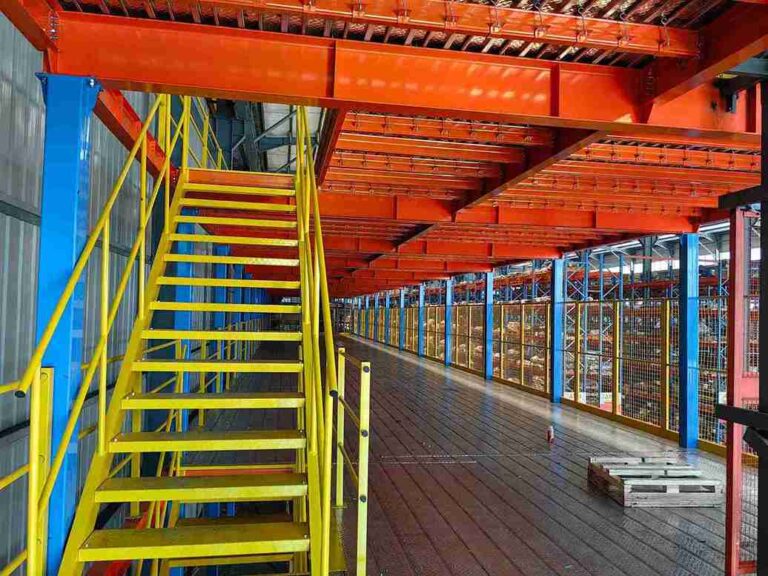
This transforms storage layout from a capital-intensive construction project into a simple operational task. A company can transition from wide-aisle to very-narrow-aisle (VNA) storage, create dedicated zones for cross-docking, or integrate a mezzanine level—all utilizing the same core modular platform for heavy equipment. This flexibility is the definitive feature of a scalable modular platform for heavy equipment.
(H2) The Financial Calculus: Quantifying the ROI of a Scalable & Strong Modular Platform for Heavy Equipment
The investment in a superior modular platform for heavy equipment must be justified by a clear and compelling financial narrative. The return on investment (ROI) extends far beyond the initial purchase price, delivering continuous value across the system’s entire lifecycle.
Converting Future CAPEX into Saved OPEX and Avoided Costs
A common strategic error is viewing storage infrastructure as a simple capital expenditure (CAPEX). A forward-thinking analysis reveals that investing in a scalable & strong modular platform for heavy equipment is a powerful tool for financial optimization.
Avoided CAPEX: The most significant savings often come from deferring or eliminating the need for a new warehouse build or additional leased space, a multi-million dollar decision.
Saved OPEX: The ability to conduct in-house reconfigurations with minimal labor and downtime saves substantial costs associated with third-party installers, prolonged operational shutdowns, and disposal fees for old systems.
The Unbeatable Advantage of a Lower Total Cost of Ownership (TCO)
The true cost of a storage system is measured by its Total Cost of Ownership (TCO). An inexpensive, lightly engineered system will inevitably incur a higher TCO due to:
Premature Obsolescence: The inability to adapt leads to a complete system replacement long before its theoretical lifespan is reached.
High Maintenance Costs: Frequent repairs, part replacements, and straightening of damaged components create ongoing expenses.
Operational Inefficiencies: A rigid layout perpetuates hidden costs in wasted labor, slower throughput, and underutilized space.
A professionally engineered modular platform for heavy equipment is designed for a service life exceeding 25 years. Its strength ensures longevity, and its scalability ensures continued relevance. The initial investment is amortized over decades of reliable, adaptable service, resulting in a TCO that is fundamentally lower than any alternative.
(H2) The Automation-Ready Foundation: Integrating a Modular Platform for Heavy Equipment with Robotic Systems
The modern warehouse is increasingly a symphony of human and robotic collaboration. This symphony requires a perfectly tuned and unshakable stage. A standard racking system is insufficient for the precision demands of automation. A true modular platform for heavy equipment is, by design, the ideal foundation for AGVs (Automated Guided Vehicles), AMRs (Autonomous Mobile Robots), and ASRS.
Precision Engineering for ASRS: The Non-Negotiable Tolerance
An ASRS operates within millimeter-level tolerances. Any deviation, beam sag, or misalignment in the storage structure can lead to system malfunctions, damaged goods, and catastrophic downtime. The manufacturing precision of a high-quality modular platform for heavy equipment is paramount. Laser-cut components and rigid, boltless connections guarantee perfect alignment and prevent deflection.
This ensures that every single pallet location is exactly where the warehouse management system (WMS) expects it to be, making the modular platform for heavy equipment a critical, enabling component of the automation ecosystem. Explore the requirements for a fully integrated facility in our guide to Automated Warehouse Infrastructure.
Durability for Human-Robot Interaction: Built for a Dynamic Environment
Even in highly automated facilities, interaction between robots, forklifts, and the storage structure is a reality. A robust modular platform for heavy equipment is designed with this in mind, featuring:
Integrated Column Protection: Reinforced guards or optional armor plating to withstand low-speed impacts from AGVs and forklifts, preserving structural integrity.
Configurable Aisle Specifications: The inherent strength of the system allows for optimized aisle widths, whether for VNA forklifts or free-roaming AMRs, without sacrificing stability.
Mounting Integration: The structure can be designed with pre-configured points for attaching guidance systems, sensors, and communication hardware for automated equipment.
(H2) Real-World Transformations: Case Studies in Deploying a Modular Platform for Heavy Equipment
Theoretical benefits are one thing; tangible results are another. The following scenarios illustrate how businesses have leveraged a modular platform for heavy equipment to solve critical challenges and achieve transformative outcomes.
Case Study: E-Commerce Fulfillment Center Overcomes Seasonal Volatility
A rapidly growing e-commerce fulfillment provider was struggling with the seasonal influx of SKUs and severe inefficiencies in their pick-and-pack operations. Their static shelving was a bottleneck. The implementation of a versatile modular platform for heavy equipment was a game-changer. It allowed them to:
Reconfigure carton flow shelves and pallet locations within hours to accommodate promotional products.
Create multi-level pick modules that doubled their active picking face within the same footprint.
Seamlessly integrate a zone-routing system by providing a stable, predictable structure for conveyor mounts.
The result was a 50% reduction in order cycle time and the elimination of storage-related constraints on their growth.
Case Study: Automotive Parts Distributor Achieves High-Density Storage for Bulky Items
An automotive distributor dealing with bulky exhaust systems, body panels, and tires was facing a severe space crunch. Their previous solution of stacking items on the floor was unsafe and inefficient. The deployment of a custom-configured modular platform for heavy equipment, which included a combination of standard pallet levels and heavy-duty cantilever arms, provided the answer.
This specialized modular platform for heavy equipment enabled high-density, organized storage of irregularly shaped items, improved inventory control, and enhanced worker safety. The project increased their storage capacity by over 70% and streamlined their order fulfillment process.
(H2) The Implementation Roadmap: A Phased Approach to Your Future-Proof Warehouse
Selecting and deploying the right storage infrastructure is a strategic partnership. The process for a modular platform for heavy equipment is meticulous, collaborative, and designed to guarantee success.
Phase 1: Deep-Dive Operational and Capacity Audit
The foundation of a successful project is data. The process begins with a comprehensive audit that goes far beyond basic weight specifications. This includes analysis of:
The full spectrum of load weights, dimensions, and turnover rates (ABC analysis).
Material Handling Equipment (MHE) types, traffic patterns, and clearances.
Specific business growth plans and potential process changes.
Any current or future automation roadmaps.
This intelligence is fed into advanced design software to create a digital twin of the optimal modular platform for heavy equipment for the facility.
Phase 2: Digital Twin Simulation and Virtual Layout
Before any metal is cut, clients receive a full 3D simulation of the proposed modular platform for heavy equipment within their warehouse. This model is an engineering and simulation tool that validates load capacities, analyzes potential bottlenecks, and optimizes workflow. Stakeholders can virtually “walk through” the new layout, ensuring it meets all operational requirements before installation begins.
Phase 3: Certified Installation and Lifecycle Support
A perfectly designed system must be perfectly installed. Work is carried out by certified installation partners who adhere to strict engineering protocols, followed by a formal load test and system certification. The partnership continues long after with ongoing support services, including layout optimization consulting and a readily available parts program, ensuring the modular platform for heavy equipment performs optimally for its entire lifespan.
(H2) The Intelligent Ecosystem: Software and Services for a Dynamic Modular Platform for Heavy Equipment
The physical structure of the modular platform for heavy equipment is empowered by a suite of digital tools and services that amplify its value and extend its capabilities.
Seamless Warehouse Management System (WMS) Integration
In a modern operation, every physical pallet location in the modular platform for heavy equipment has a digital counterpart in the WMS. Ensuring seamless communication between the two is critical. A best-in-class modular platform for heavy equipment provider will ensure their system’s data structure is compatible with leading WMS platforms, enabling advanced functionalities like dynamic slotting, which automatically assigns inventory to the most efficient location based on real-time turnover data.
Cloud-Based Layout Management and the Digital Twin
The digital twin of the installed modular platform for heavy equipment becomes a living asset. Clients can be provided with access to cloud-based layout tools. This allows facility managers to plan and test new configurations in a risk-free virtual environment. The tool can generate a precise bill of materials and reconfiguration instructions, turning a complex physical change into a manageable, predictable process. This capability is the ultimate expression of a scalable modular platform for heavy equipment.
Conclusion
The strategic pursuit of a future-proof warehouse is an operational necessity in an unpredictable world. It is realized by making a foundational investment in an infrastructure that embodies resilience and adaptability. A scalable & strong modular platform for heavy equipment is that critical foundation. It is the enabling technology that allows businesses to confidently navigate market shifts, adopt new technologies, and drive aggressive growth strategies, all within the confines of their existing facility.
It redefines storage from a static, depreciating liability into a dynamic, value-generating asset. The pivotal question for logistics leaders is no longer about the cost of implementing such a system, but about the far greater cost of being left without one. The future of logistics is modular, strong, and scalable. The time to build that future is now.
1. How does the structural integrity of a boltless modular platform for heavy equipment compare to welded storage structures in high-seismic zones?
A properly engineered boltless modular platform for heavy equipment is often superior to a welded structure in seismic events. Welded frames can be brittle and prone to cracking under repeated flexing. The moment-resistant, bolted connections in a high-quality modular platform for heavy equipment are designed to absorb and dissipate seismic energy through controlled flex, acting as a unified, resilient structure. This design is specifically engineered to meet and exceed stringent seismic codes, making it a safer choice for seismic zones.
2. What specific surface treatments or coatings are recommended for a modular platform for heavy equipment operating in a cold-storage or corrosive environment?
For harsh environments, the standard powder coating is insufficient. A superior modular platform for heavy equipment specified for cold storage or corrosive settings should undergo a specialized pre-treatment process, often involving a zinc phosphate or chromate conversion coating, followed by an epoxy-polyester hybrid powder coat. For highly corrosive environments (e.g., chemical storage, marine ports), a hot-dip galvanized finish provides the highest level of protection against rust and corrosion, ensuring the long-term structural integrity of the modular platform for heavy equipment.
3. Beyond pallets and ASRS, what are some unconventional applications for a heavy-duty modular platform for heavy equipment?
The flexibility of a modular platform for heavy equipment makes it suitable for numerous applications beyond traditional pallet storage. These include: creating heavy-duty mezzanine work platforms for assembly or maintenance; supporting overhead conveyor systems and monorails; serving as the structural framework for automated robotic mobile fulfillment systems (RMFS); and being configured as in-process storage buffers within manufacturing cells, handling raw materials or work-in-progress with extreme durability.
4. Can your design process for a modular platform for heavy equipment incorporate a finite element analysis (FEA) for our specific, unique load conditions?
Yes, for non-standard applications with complex or concentrated loads, our engineering team utilizes advanced Finite Element Analysis (FEA) software. This computer-based simulation allows us to model the proposed modular platform for heavy equipment design and subject it to your exact load scenarios, identifying stress concentrations and potential points of deflection before fabrication. This provides a peer-reviewed level of confidence in the system’s safety and performance for your unique application.
5. What is the typical process and timeline for expanding an existing modular platform for heavy equipment installation two or three years after the initial setup?
The process is designed for simplicity. The client would use the cloud-based digital twin to model the new layout. The system generates a list of additional components required. Once ordered and delivered, the expansion can typically be integrated by the client’s own maintenance team following the provided instructions, or a certified installer can be dispatched for larger projects. This process can often be completed in a matter of days, not weeks, with minimal disruption, perfectly illustrating the scalable nature of the initial investment.
Welcome to contact us, if you need warehouse rack CAD drawings. We can provide you with warehouse rack planning and design for free. Our email address is: jili@geelyracks.com