🐍 "先着50社のエンタープライズ・クエリーにカスタム3Dウェアハウス・デザインをプレゼント" プラン















Maximize Storage Efficiency with Gravity Flow Racking: The Ultimate Guide for Fast-Moving Warehouses
In the high-stakes arena of modern logistics, where speed and accuracy directly dictate profitability, the choice of storage infrastructure is a strategic decision. This comprehensive guide explores how Gravity Flow Racking establishes itself as the foundational element for achieving unparalleled storage efficiency in fast-moving warehouses. The article delves into the engineering precision, operational advantages, and seamless integration capabilities of these dynamic systems.
It provides a detailed examination of how a custom-configured 重力流ラッキング solution directly enhances order picking velocity, optimizes spatial footprint, and automates inventory rotation. For operations managers, warehouse planners, and business owners looking to gain a decisive competitive edge, this resource offers the depth of insight necessary to leverage 重力流ラッキング as a transformative tool for operational excellence.
<h2>The Inevitable Bottleneck: Why Traditional Storage Falls Short in the Modern Era</h2>
The landscape of distribution and fulfillment has undergone a seismic shift. The rise of e-commerce, the demand for same-day delivery, and the volatility of supply chains have exposed the critical limitations of static storage solutions like selective pallet racking or standard shelving. These conventional systems create a paradigm of high labor dependency and inefficient space utilization. Workers in such environments can spend the majority of their shift traversing vast aisles, a non-value-added activity that cripples productivity and inflates operational costs.
The challenge is not merely storing goods; it is about creating a system where inventory is in a constant, fluid state of motion, poised for immediate dispatch. It is within this operational gap that the concept of 重力流ラッキング emerges not just as an alternative, but as a necessary evolution. A well-implemented 重力流ラッキング system transforms the warehouse from a static repository into a dynamic, high-velocity throughput engine, directly addressing the core inefficiencies that plague traditional setups.
<h3>The Engine of Efficiency: Deconstructing the Mechanics of Gravity Flow Racking</h3>
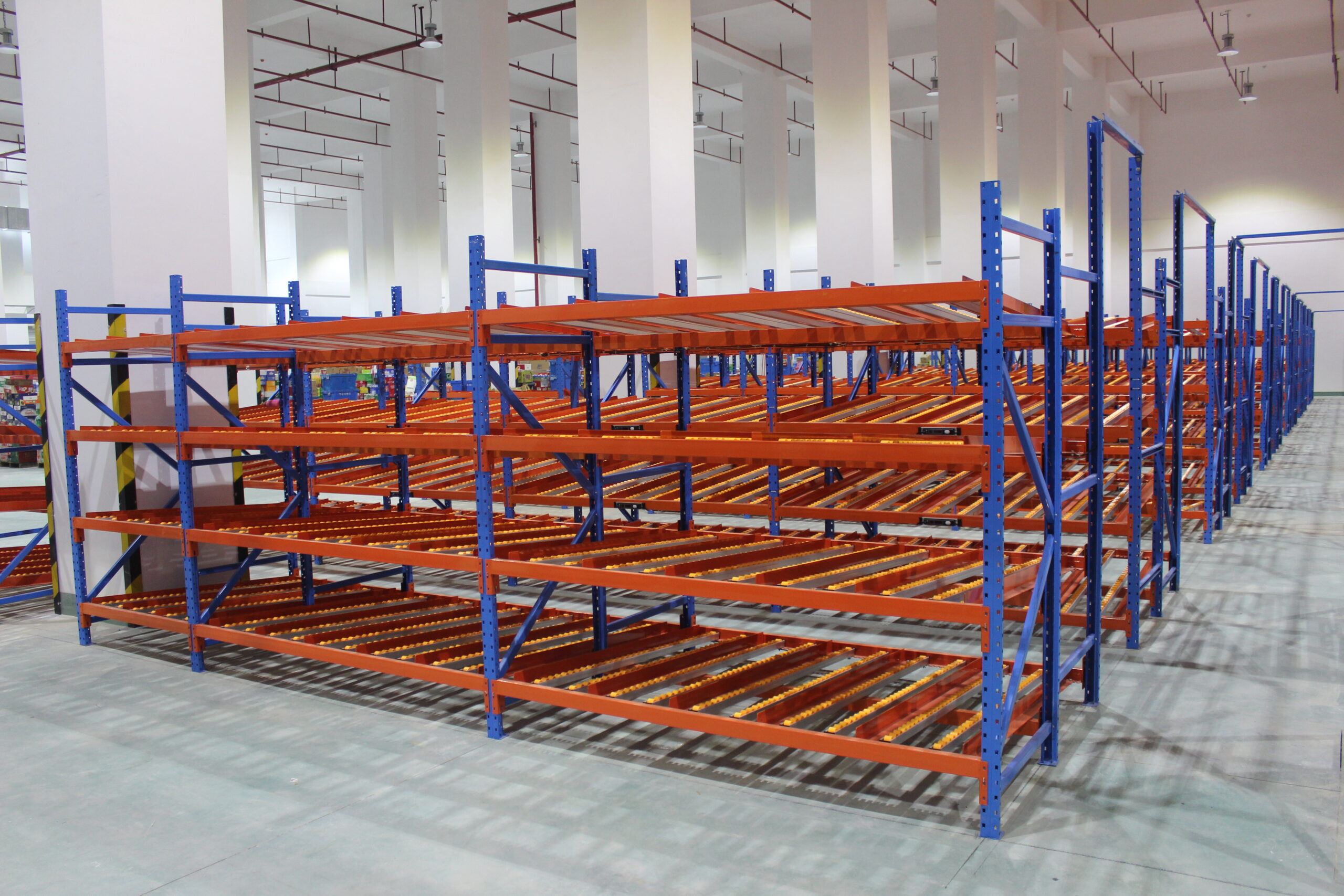
その核心は 重力流ラッキング system is a masterclass in applied physics, leveraging the constant force of gravity to create a self-regulating flow of materials. The elegance of the system lies in its simplicity and reliability. Every component within a 重力流ラッキング installation is precision-engineered for a specific purpose, working in concert to ensure smooth, uninterrupted operation. The fundamental components include:
The High-Strength Steel Framework: This is the skeleton of the 重力流ラッキング system. Constructed from robust, cold-formed steel, the framework is designed to support immense loads across multiple elevated levels. The integrity of this structure is paramount, as it must withstand the constant static and dynamic forces of loaded lanes while maintaining perfect alignment for the flow tracks.
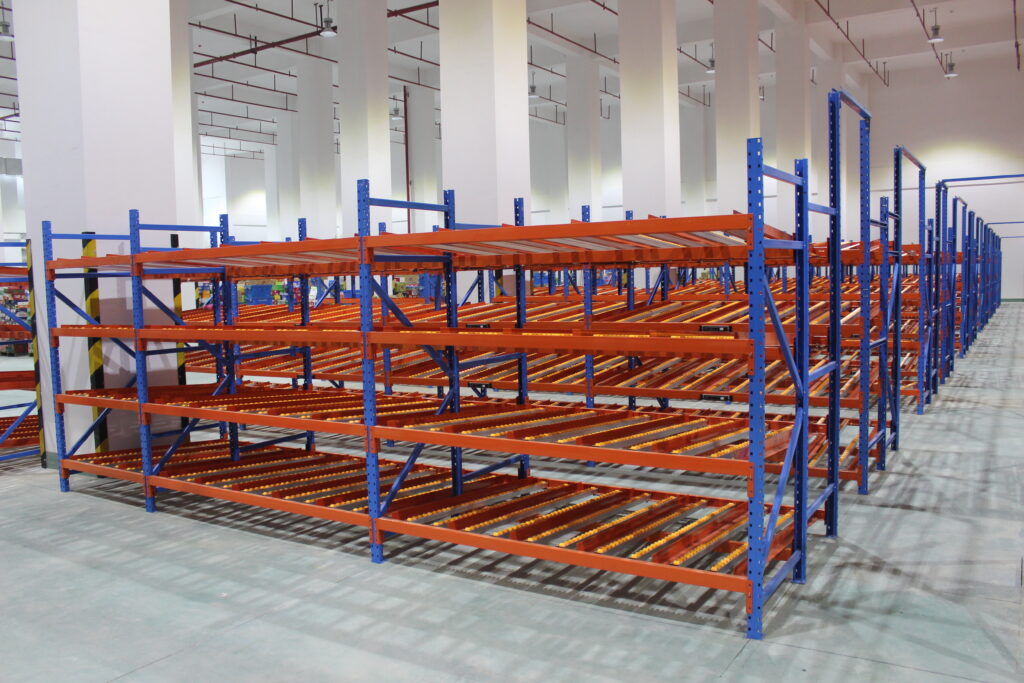
The Precision Inclined Flow Tracks: These are the arteries of the system. Comprising either rollers or wheels, these tracks are set at a meticulously calculated decline. The choice between rollers and wheels is a critical engineering decision based on the load’s characteristics. Rollers are typically specified for heavier, rigid loads like pallets or solid-bottom cartons, as they offer lower rolling resistance. Wheels are often used for lighter, uniform loads and can be more cost-effective for certain applications. The incline angle is not arbitrary; it is calibrated based on the weight, dimensions, and bottom surface of the unit load to guarantee a consistent, controlled movement without excessive acceleration.
The Advanced Speed Control and Braking System: This is the intelligent nervous system of the 重力流ラッキング setup. To prevent items from gaining dangerous momentum and colliding at the discharge end, a range of speed controllers is employed. These can include regenerative brakes, which absorb kinetic energy, or friction-based dampeners. This ensures that products, whether a delicate carton of electronics or a heavy pallet of canned goods, arrive gently at the pick face, safeguarding both inventory and personnel.
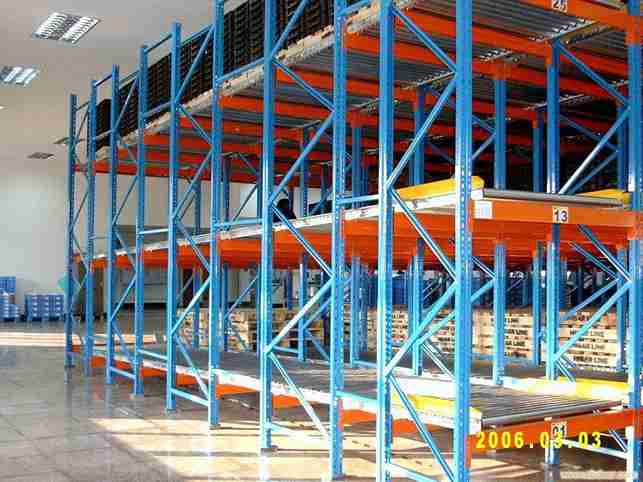
The operational principle enforced by 重力流ラッキング is the gold standard for inventory management: 先入れ先出し(FIFO). Pallets or cartons are loaded into the elevated rear of the lane. The natural force of gravity then propels them forward smoothly until they are halted by the preceding load or the end stop. When a picker removes the front-most item from the pick face, the entire column of products advances instantaneously, presenting the next SKU in sequence. This creates a continuous, hands-free product advancement that eradicates the need for workers or machinery to enter the storage aisles, fundamentally redefining the picking process.
<h2>A Multifaceted Powerhouse: The Tangible Benefits of Gravity Flow Racking</h2>
への投資を決定した。 重力流ラッキング system is justified by a compelling array of operational, financial, and safety benefits. For businesses handling high-turnover SKUs in sectors like e-commerce, pharmaceuticals, or consumer packaged goods, the impact is transformative and immediately measurable.
<h3>Revolutionizing Labor Productivity and Order Accuracy</h3>
The most immediate impact of a 重力流ラッキング installation is observed in the order picking process. By consolidating all picking activities to a compact, ergonomic “golden zone,” the system eliminates non-productive walk time. Pickers no longer navigate labyrinthine aisles; instead, they remain stationary or move minimally along a concentrated pick face, with SKUs continuously presented to them. This operational refinement can lead to a staggering 50% to 70% increase in picking productivity.
Furthermore, the inherent FIFO discipline of 重力流ラッキング drastically reduces picking errors. Workers always select from the oldest stock at the front, eliminating the risk of accidentally picking newer items and leaving older inventory to become obsolete. This enhancement in accuracy directly reduces the costs associated with returns, reshipments, and inventory write-offs.
<h3>Unlocking Maximum Storage Density and Cubic Space Utilization</h3>
In warehouse economics, space is a premium asset. Traditional racking requires wide aisles to accommodate the turning radius of forklifts, effectively rendering vast portions of the facility’s footprint non-productive for storage. A 重力流ラッキング system ingeniously solves this problem by eliminating the need for multiple access aisles. The design requires only a single loading aisle at the rear and a single, narrow picking aisle at the front.
The result is a dramatic increase in storage density, often achieving up to 80% more storage capacity within the same floor area compared to selective pallet racking. This high-density characteristic of 重力流ラッキング allows companies to store more inventory in their existing facility, deferring the need for costly expansion or relocation, and fully leveraging their building’s cubic volume.
<h3>Fortifying Workplace Safety and Enhancing Ergonomics</h3>
Warehouse environments are inherently fraught with potential hazards, including forklift-pedestrian interactions, falls from height, and musculoskeletal disorders from repetitive manual handling. A 重力流ラッキング system directly mitigates these risks. By segregating the loading and picking functions and removing the need for personnel to enter the storage lanes, it creates a safer, more organized workflow. The ergonomic benefits are equally profound. The pick face is designed to present items at an optimal waist-to-shoulder height, eliminating the constant bending, stretching, and reaching deep into shelves that characterize traditional picking. This leads to a reduction in worker fatigue, a lower incidence of workplace injuries, and higher overall job satisfaction, which in turn reduces absenteeism and staff turnover.
<h3>Automating Inventory Control and Ensuring Product Integrity</h3>
For a vast range of industries—from food and beverage to pharmaceuticals and chemicals—maintaining strict FIFO inventory rotation is not a matter of preference but a regulatory and quality imperative. Gravity flow racking automates this critical process. The system’s very design ensures that the first item loaded is the first item dispatched, removing any possibility of human error or oversight that can lead to stock spoilage or obsolescence. This automated inventory management provides peace of mind and ensures consistent product quality for the end-customer, protecting the brand’s reputation and integrity.
<h2>The Art of Engineering: Customizing Your Gravity Flow Racking Solution</h2>
The notion of an “off-the-shelf” 重力流ラッキング system is a misnomer. The true potential of this technology is only realized through a process of meticulous analysis and custom engineering. A leading provider doesn’t just supply components; they architect a solution tailored to the unique DNA of a client’s operation.
<h3>Foundational Design Considerations for Optimal Performance</h3>
The engineering process for a 重力流ラッキング system begins with a deep dive into the client’s operational data and physical constraints. Key factors include:
Unit Load Analysis: Every detail of the pallet, carton, or tote is scrutinized—its weight, dimensions, bottom surface condition (critical for roller/wheel selection), and stability. This data dictates the required load capacity per lane and the precise incline angle.
Throughput Velocity and SKU Profiling: Understanding the velocity of each SKU is crucial. High-turnover items are allocated to the most accessible lanes within the 重力流ラッキング system, while slower-movers might be positioned differently. The depth and number of lanes are calculated to maintain a continuous flow without causing bottlenecks at the loading or picking ends.
Site-Specific Infrastructure Assessment: The existing warehouse environment is thoroughly evaluated. Column spacing, clear ceiling height, floor flatness, and the location of sprinkler systems and lighting all influence the final design of the 重力流ラッキング layout, ensuring a seamless and compliant integration.
<h3>Specialized Configurations for Diverse Operational Needs</h3>
The versatility of 重力流ラッキング is demonstrated through its various configurations, each designed to address specific challenges:
Pallet Flow Racking: This heavy-duty variant of 重力流ラッキング is engineered for full pallet loads of fast-moving goods. It is ideal for consolidating buffer stock adjacent to shipping docks or for supporting high-volume production lines in manufacturing plants, ensuring a continuous supply of materials.
Carton Flow Racking: As the backbone of case-picking and piece-picking operations, this is the most common application of 重力流ラッキング in e-commerce fulfillment and distribution centers. It typically uses lighter-duty wheels or rollers and can be configured in multi-level designs to store a vast number of SKUs in a minimal footprint.
Multi-Level and Mezzanine-Integrated Systems: For operations requiring extreme storage density for smaller items, 重力流ラッキング can be incorporated into multi-level mezzanine structures. This approach effectively doubles or triples the available storage capacity within the same building footprint, creating a highly organized, high-density picking module.
<h2>The Connected Warehouse: Integrating Gravity Flow Racking with Automation</h2>
While a standalone 重力流ラッキング system delivers immense value, its capabilities are magnified exponentially when it is integrated as a core component within a broader automated storage and retrieval system (ASRS). In this context, 重力流ラッキング evolves from a storage solution into a dynamic engine for a goods-to-person (G2P) workflow.
<h3>Orchestrating Workflow with AGVs and Autonomous Mobile Robots</h3>
The replenishment process for a 重力流ラッキング system can be fully automated through integration with a fleet of AGVs (Automated Guided Vehicles) or autonomous mobile robots. In this scenario, these robotic carriers are responsible for transporting pallets or totes from a bulk storage area or receiving dock to the loading end of the 重力流ラッキング lanes. This creates a “lights-out” replenishment cycle, operating around the clock without human intervention. The human workforce is then strategically deployed at the pick face, focused exclusively on the high-value, precision task of order fulfillment. This synergy between 重力流ラッキング and robotic material handling creates a powerful, scalable, and highly efficient operational model.
<h3>Creating a Seamless Flow with Conveyor and Sortation Systems</h3>
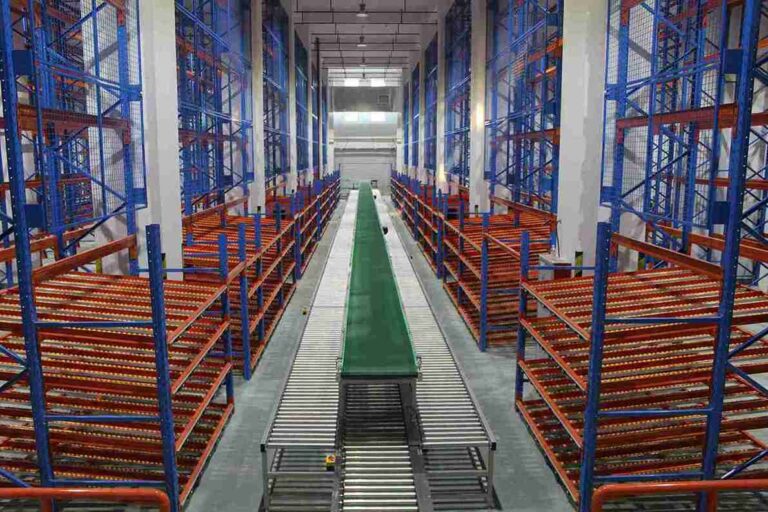
On the output side, the 重力流ラッキング system can be seamlessly connected to conveyor and automated sortation systems. Once an item is picked from the flow lane, it can be placed directly onto a take-away conveyor. This conveyor transports the item to a centralized packing station or directly into a high-speed cross-belt or tilt-tray sorter that routes it to the appropriate shipping lane. This end-to-end integration, with 重力流ラッキング at its heart, creates a continuous, frictionless river of goods from the moment it enters the warehouse until it is dispatched to the customer. It minimizes manual handling, accelerates order cycle times to meet aggressive service-level agreements (SLAs), and provides unparalleled visibility and control over the entire fulfillment process.
<h2>Proven Impact: Gravity Flow Racking in Action Across Industries</h2>
The practical application of 重力流ラッキング systems provides compelling evidence of their transformative power. Industry leaders rely on these systems to solve their most pressing logistical challenges.
E-commerce and Omni-Channel Fulfillment Centers: In an environment defined by vast SKU counts and extreme peaks, 重力流ラッキング is indispensable. It ensures that high-velocity products are always accessible at the pick face, enabling the rapid order cycling required for next-day and same-day delivery promises. During mega-sales events, the productivity gains from 重力流ラッキング are the difference between meeting demand and operational collapse.
Temperature-Controlled Cold Storage Facilities: In these high-energy-cost environments, maximizing storage density is not just an efficiency goal—it’s an economic imperative. The high-density nature of 重力流ラッキング minimizes the volume of refrigerated air required, leading to significant energy savings. Furthermore, the strict FIFO compliance is critical for managing the shelf life of perishable food items and pharmaceuticals, ensuring product safety and compliance.
Just-in-Time (JIT) Manufacturing and Assembly Plants: Gravity flow racking systems are perfectly suited for line-side sequencing and kitting operations. They deliver components to assembly workers in the exact sequence and quantity required, supporting lean manufacturing principles and minimizing work-in-progress (WIP) inventory.
Air Cargo and Parcel Logistics Hubs: For the rapid sorting and temporary storage of time-sensitive freight, 重力流ラッキング provides a high-speed, organized buffer. It allows for the efficient consolidation and de-consolidation of shipments, ensuring that air freight maintains its tight schedule.
<h2>Selecting a Partner, Not Just a Supplier: The Hallmarks of a True Expert</h2>
The successful implementation of a high-performance 重力流ラッキング system is contingent upon the expertise of the provider. A partner with deep industry experience and a comprehensive service offering is essential for achieving the desired return on investment.
Holistic, End-to-End Project Management: A superior provider manages the entire project lifecycle, from initial consultation and data analysis through 3D simulation, detailed engineering, manufacturing, and professional installation. This single-point accountability ensures quality and consistency from concept to completion.
Global Engineering Standards with Localized Application: The provider should adhere to international structural and safety standards (e.g., FEM, RMI) in their 重力流ラッキング designs. Simultaneously, they must possess the project management expertise to navigate local logistics, building codes, and operational practices in diverse markets across Southeast Asia, the Middle East, Africa, and Latin America.
A Forward-Looking, Scalable Design Philosophy: 優れたデザイン 重力流ラッキング system is an investment for the future. A reputable partner designs with scalability in mind, creating a modular system that can be easily expanded or reconfigured as the client’s business grows and evolves, protecting the long-term value of the investment.
Conclusion: Elevating Operational Infrastructure to a Strategic Asset
In conclusion, the implementation of a custom-engineered 重力流ラッキング system represents a fundamental strategic upgrade to a company’s logistics infrastructure. It is a decision that transcends mere equipment procurement; it is an investment in building a more resilient, responsive, and efficient operation.
The evidence is clear: by harnessing the simple, relentless power of gravity, a 重力流ラッキング system delivers profound gains in productivity, accuracy, and space utilization while simultaneously fostering a safer and more ergonomic work environment. In an era where supply chain performance is a key differentiator, deploying a sophisticated 重力流ラッキング solution is not just an operational improvement—it is the cultivation of a formidable competitive advantage, positioning a business for sustainable growth and market leadership.
1. What is the typical lifespan and long-term durability of a gravity flow racking system?
A professionally engineered and installed 重力流ラッキング system is a long-term capital asset. With proper use and routine maintenance, the structural framework can last for decades. The flow tracks (rollers or wheels) are the wearing components and are designed for easy replacement. Depending on the volume and weight of goods, these may need servicing or replacement after several years of high-intensity use, but the core 重力流ラッキング structure remains intact, ensuring a long service life and an excellent return on investment.
2. How does the cost of a gravity flow racking system compare to other high-density storage options, like push-back or drive-in racking?
While the initial investment in a 重力流ラッキング system can be higher than selective racking, it is often competitive with or even more cost-effective than other high-density systems when total cost of ownership is considered. Unlike push-back or drive-in racking, 重力流ラッキング requires no complex forklift attachments or specialized operator training. Its primary operational cost saving comes from dramatically reduced labor requirements for picking. Therefore, the ROI for 重力流ラッキング is often superior, as it simultaneously addresses both space and labor cost centers.
3. Can gravity flow racking handle a wide variety of product sizes and weights simultaneously?
Yes, a key strength of a well-designed 重力流ラッキング system is its flexibility. Within a single framework, different lanes can be configured with different types of rollers, wheels, and incline angles to accommodate a diverse product mix. For instance, one lane might be set up for heavy pallets, while the adjacent lane is configured for small, lightweight cartons. This modularity allows the 重力流ラッキング installation to be perfectly tailored to a complex and evolving SKU profile.
4. What kind of foundation or floor requirements are necessary for installing gravity flow racking?
A 重力流ラッキング system is a high-density storage solution that concentrates significant weight. Therefore, the warehouse floor must have adequate load-bearing capacity. As part of the initial site survey, a professional provider will assess the concrete slab specification. In most modern warehouses, the floor is sufficient, but in older facilities, a structural engineer may be consulted. The floor should also be relatively level to ensure the consistent performance of the inclined flow tracks.
5. How does the loading and replenishment process work at the rear of the system, and does it require specialized equipment?
Replenishment is typically performed using a standard forklift or an automated guided vehicle (AGV). The loading aisle at the rear of the 重力流ラッキング system must be wide enough to accommodate the turning radius of this equipment. The forklift operator places the new load onto the elevated end of the lane. The design of the 重力流ラッキング system includes sturdy guide rails and entry ramps to facilitate smooth and safe loading. For operations seeking maximum efficiency, this process is a prime candidate for automation using 無人フォークリフト または 無人搬送車.
If you need warehouse racking CAD drawings, we can do warehouse racking planning and design for free, you can consult us. Our email: jili@geelyracks.com.