📐 "First 50 Enterprise Queries Get Custom 3D Warehouse Design" Plan


The Definitive Guide to Professional Heavy-Duty Racking Installation for Uncompromised Safety and Space Optimisation
In the high-stakes world of logistics and warehousing, the storage infrastructure is the silent, indispensable workhorse of the entire operation. It is the structural lattice upon which profitability, efficiency, and human safety are balanced. When the discussion turns to heavy-duty racking installation, the conversation must elevate from simple assembly to one of critical engineering and precision execution. This is not a task for general labor; it is a specialized discipline where the margin for error is zero.
A professionally executed heavy-duty racking installation is the bedrock of a resilient warehouse, directly enabling maximum load safety and the most efficient space use possible. This comprehensive resource delves deeper than any other, exploring the multifaceted process, the engineering imperatives, and the long-term value of entrusting this crucial task to certified experts. It is designed for warehouse managers, operations directors, and business owners across industrial sectors globally who understand that the integrity of their storage system is synonymous with the integrity of their supply chain.

The High Cost of Compromise: Why Amateur Heavy-Duty Racking Installation is a Critical Business Risk
The allure of cost-saving on a heavy-duty racking installation project can be tempting, but it is a dangerous mirage. The true cost of an unprofessional installation reveals itself not in the initial invoice, but in the subsequent failures, inefficiencies, and liabilities that plague the operation.

Structural Vulnerabilities Introduced by Improper Techniques
An unprofessional heavy-duty racking installation often suffers from flaws that are invisible to the untrained eye but catastrophic in their potential. These are not mere oversights; they are fundamental breaches of structural protocol.
Incorrect Torque Application: Every bolt in a heavy-duty racking system has a manufacturer-specified torque value. Under-torquing leads to joint loosening under dynamic load, while over-torquing can strip threads or induce metal stress fractures. A non-certified team using basic impact wrenches cannot achieve the consistent, calibrated clamping force required for long-term integrity.
Misalignment and Out-of-Plumb Uprights: Without the use of precision laser levels, upright frames can be installed out of plumb. Even a slight deviation transfers load unevenly through the structure, drastically reducing its overall capacity and resilience. This misalignment also wreaks havoc on material handling equipment, leading to difficult forklift operation and increased risk of impact.
Faulty Anchorage: The connection between the racking and the concrete slab is the system’s foundation. An improper heavy-duty racking installation may involve using the wrong anchor type, drilling incorrect hole sizes, or installing anchors with insufficient embedment depth. This compromises the entire system’s resistance to overturning, especially in seismic zones or during a forklift impact.
The Domino Effect on Warehouse Operations and Total Cost of Ownership
The repercussions of a flawed heavy-duty racking installation extend far beyond immediate safety concerns, creating a domino effect of operational inefficiencies.
Voided Manufacturer Warranties: The fine print of every major racking manufacturer’s warranty stipulates that coverage is contingent upon a certified professional heavy-duty racking installation. An amateur installation instantly nullifies this financial protection, leaving the owner fully liable for any future component failure.
Reduced System Lifespan and Increased Maintenance: A poorly installed system endures abnormal stress, leading to premature wear, bent components, and a constant need for corrective adjustments. What should be a 20-year asset becomes a 10-year liability, requiring frequent and costly interventions.
Inhibited Automation Integration: Modern warehouses are increasingly adopting AGVs and ASRS. These automated systems require millimetre-perfect alignment to function. A sub-par heavy-duty racking installation with misaligned rows and uneven faces makes the integration of such automation either impossible or prohibitively expensive to rectify later.
Deconstructing Excellence: The Methodical Pillars of a Professional Heavy-Duty Racking Installation
A superior heavy-duty racking installation is not an event; it is a meticulously planned and executed project. It follows a phased methodology that systematically eliminates risk and ensures perfection at every stage.
H3: Phase 1: Foundational Scoping and Forensic Site Evaluation
The success of any heavy-duty racking installation is determined before the first pallet of components arrives on site. This phase is about laying an unshakable foundation of knowledge and planning.
Digital Layout Validation and Laser Scanning: Experts begin by validating the CAD layout against the real-world environment. Advanced teams employ 3D laser scanning to create a precise digital twin of the empty warehouse space. This model identifies any unforeseen obstructions, floor undulations, or column placements that could affect the heavy-duty racking installation plan.
Concrete Floor Flatness and Strength Certification: The slab is the fifth wall of the warehouse. A professional heavy-duty racking installation team will conduct rigorous floor flatness (FF/FL) and compressive strength tests. An uneven floor transmits immense stress into the upright frames, a primary cause of premature failure. The report from this analysis dictates if grinding or levelling compounds are required prior to commencement.
Integration Protocol with Automation Partners: For facilities incorporating automation, a critical pre-heavy-duty racking installation workshop is held with the providers of AGVs, conveyor systems, and ASRS. This ensures that the digital models are synchronized, that clearances are agreed upon, and that the sequence of the heavy-duty racking installation aligns with the installation of guide paths and interface points.
Phase 2: The Theatre of Precision: On-Site Execution of the Heavy-Duty Racking Installation
This is where planning meets practice. The on-site phase of a heavy-duty racking installation is a controlled, systematic operation resembling a well-choreographed performance.
Specialised Tooling and Calibrated Equipment: A professional heavy-duty racking installation crew is defined by its tools. Calibrated torque wrenches are used for every structural connection. Laser levels and optical theodolites are used for alignment, ensuring rows are straight and uprights are plumb within a tolerance of less than 1/8 inch over 10 feet. Hydraulic jacks and component-specific lifting devices are used to handle heavy beams safely and position them accurately.
Sequenced Assembly and Zone Management: The warehouse is divided into logical work zones. The heavy-duty racking installation proceeds in a pre-defined sequence that maintains structural stability throughout the build process. This phased approach also allows for safer co-existence with ongoing warehouse operations in live environments, a common challenge during retrofits or expansions.
In-Process Quality Control (IPQC): Unlike a final inspection, IPQC is continuous. The lead installer, who acts as a quality officer, conducts checks at every critical milestone: after the first bay is erected, at the completion of a row, and before moving to the next zone. This real-time validation catches and corrects any deviation immediately, preventing the compounding of errors.
Phase 3: Commissioning, Certification, and Knowledge Transfer
The completion of physical assembly marks the beginning of the final, crucial phase of the heavy-duty racking installation lifecycle.
Final As-Built Survey and Load Testing: A comprehensive survey is conducted to produce “as-built” drawings, documenting the final installed configuration. For critical applications, a proof load test may be performed, where test weights are placed on the beams to physically validate the system’s performance under load, providing ultimate confidence in the heavy-duty racking installation.
Formal Client Handover and Operational Training: The handover is a formal ceremony of trust. The client receives a comprehensive dossier containing as-built drawings, torque logs, anchor certification, and manufacturer documentation. More importantly, the heavy-duty racking installation team conducts a training session with the client’s warehouse staff, educating them on the system’s safety features, proper loading techniques, and what to look for during their own routine inspections. This empowers the client and fosters a shared culture of safety.
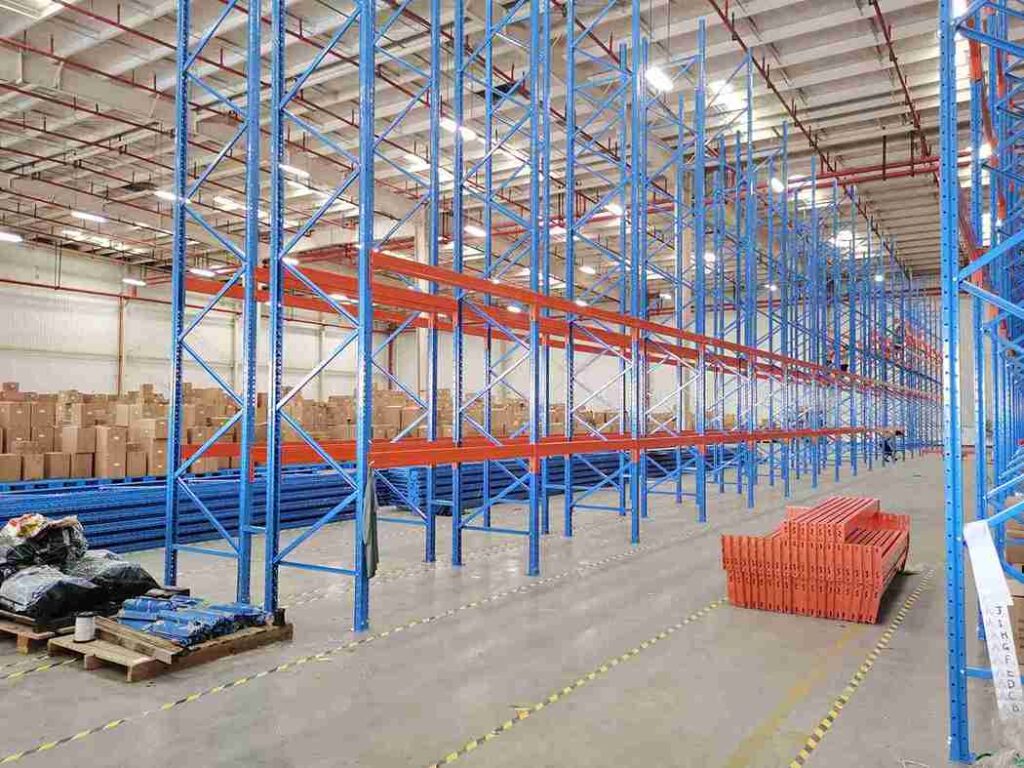
The Science of Load Safety: Engineering a Bulletproof Storage Environment
The term “load safety” in the context of a heavy-duty racking installation transcends the simple ability to hold weight. It encompasses the system’s resilience to the dynamic, unpredictable forces of a real-world warehouse.
Accounting for Dynamic Loads and Seismic Activity
A static load is a pallet at rest. The reality of a warehouse is one of constant motion and force.
Forklift Impact and Pallet Dynamics: The act of a forklift placing or retrieving a pallet imparts significant dynamic and impact forces. A professional heavy-duty racking installation ensures that all safety locks are engaged, beams are fully seated, and the structure has the designed rigidity to absorb these repeated shocks without degrading.
Seismic and Environmental Force Considerations: For warehouses in regions like Southeast Asia, Latin America, or the Middle East, local building codes may mandate specific seismic design. A professional heavy-duty racking installation will incorporate these details, which can include special braced frames, moment-resisting connections, or base plate designs that allow for controlled movement, dissipating seismic energy and preventing a catastrophic collapse.
The Unsung Hero: The Criticality of Precision Anchorage in Heavy-Duty Racking Installation
The entire heavy-duty racking installation is anchored to the world through a series of carefully placed fasteners. This is arguably the most technically sensitive part of the entire process.
Engineered Anchor Selection: The choice of anchor—be it chemical, mechanical wedge, or undercut—is an engineering decision based on concrete strength, load requirements, and proximity to slab edges. A one-size-fits-all approach is a recipe for disaster in a heavy-duty racking installation.
The Art and Science of Drilling and Setting: Professional installers use rotary hammer drills with vacuum attachments to create clean, precise holes without causing concrete “spalling” around the edges, which compromises strength. Each anchor is then installed and torqued according to its specific technical data sheet, a level of diligence that defines a world-class heavy-duty racking installation.
The Art of Space Maximisation: How Precision Installation Unlocks Cubic Potential
In warehouse economics, every cubic foot of unused space is a drain on profitability. A precision heavy-duty racking installation is the key that unlocks this latent potential, transforming empty volume into high-density, accessible storage.
Alignment as the Precursor to High-Density Systems
The feasibility of advanced storage solutions is entirely dependent on the quality of the initial heavy-duty racking installation.
Narrow-Aisle and Very-Narrow-Aisle Racking: These systems rely on perfectly straight aisles to allow specialized forklifts to operate. A misaligned heavy-duty racking installation creates pinch points and risks, rendering the narrow-aisle concept ineffective and dangerous.
Dynamic and Push-Back Racking Systems: Systems like push-back racking or pallet flow live storage have incredibly tight mechanical tolerances. A professional heavy-duty racking installation ensures that the carriage rails, guide wheels, and structural supports are perfectly aligned. Any deviation here results in pallet jams, system downtime, and frustrated operators, negating the efficiency benefits these systems were designed to provide.
The Automated Warehouse: Where Heavy-Duty Racking Installation Meets Robotic Precision
The future of warehousing is automated, and the tolerance for error in the supporting infrastructure evaporates. The heavy-duty racking installation becomes the physical guide and support for a seamless digital workflow.
H3: The Symbiosis Between Racking and Robotics
In an ASRS or AGV-based warehouse, the racking is no longer a passive structure; it is an active component of the automated control system.
Millimetre-Accuracy for ASRS Cranes: The rails for automated cranes must be installed on the racking with absolute precision. The entire heavy-duty racking installation must be level, plumb, and square to prevent crane misalignment, which can lead to system shutdowns and costly damage.
Interface Points for AGV Forklifts and Conveyors: The heavy-duty racking installation must account for the precise locations where AGVs will dock to transfer loads and where conveyor systems will interface with the racking for sortation. This requires a level of cross-disciplinary coordination that is only possible with an installer who understands the full ecosystem, not just the metalwork.

A Global Standard with Local Expertise: Heavy-Duty Racking Installation Across Continents
From the humidity of Vietnam to the dust of the Middle East and the seismic activity of Chile, a one-size-fits-all approach to heavy-duty racking installation is inadequate. A truly professional service brings international standards but adapts its execution to local environmental conditions, supply chain realities, and regulatory frameworks. This global perspective ensures that a heavy-duty racking installation in Jakarta is executed with the same unwavering commitment to safety and quality as one in Dubai or Mexico City, providing clients with a consistent, reliable outcome anywhere they operate.
Conclusion
The selection of a partner for a heavy-duty racking installation is a strategic decision with decades-long implications. It is a choice between a short-term cost saving and a long-term investment in safety, efficiency, and operational excellence. By prioritizing a methodical, engineering-led, and precision-focused heavy-duty racking installation, businesses do not just erect storage; they build a resilient, high-performance asset that drives profitability and protects their most valuable resources: their inventory and their people.
The integrity of the entire supply chain often rests on the integrity of the racks that hold it. Therefore, the commitment to a professional heavy-duty racking installation is, in essence, a commitment to the foundation of the business itself.
Frequently Asked Questions (FAQs)
1. How long does a typical large-scale heavy-duty racking installation project take from start to finish?
The timeline is highly variable, depending on the project’s scale and complexity. A 5,000-pallet position system might take a professional crew 2-3 weeks for the core heavy-duty racking installation, but the overall project timeline, including planning, site prep, and commissioning, could be 8-12 weeks. A detailed project schedule is always provided during the quotation phase.
2. What specific documentation should we expect to receive after the heavy-duty racking installation is complete?
You will receive a comprehensive “As-Built Dossier.” This includes final CAD drawings, a signed-off installation checklist, torque logs for all critical connections, certification for the anchors used, product manuals, and a formal sign-off certificate from the lead installer. This package is vital for your safety audits and future maintenance.
3. Our warehouse floor has significant wear and tear. Can you still perform a safe heavy-duty racking installation, or is repair required first?
Our pre-installation site survey includes a rigorous floor assessment. We will provide a detailed report on the slab’s condition and its suitability for a safe heavy-duty racking installation. If the floor does not meet the required flatness or strength tolerances, we will specify the necessary repairs (e.g., grinding, topping compound) and can often manage that subcontractor process for you to ensure the foundation is correct before we begin.
4. How does your heavy-duty racking installation process differ when working with used or existing racking components?
Installing used racking requires an even higher degree of diligence. The process begins with a 100% component inspection to identify any bent, cracked, or corroded pieces that must be discarded. The heavy-duty racking installation then proceeds with the same precision, but with the added complexity of working with components that may have slight dimensional variations from wear. We highly recommend replacing all critical connection hardware like bolts and safety locks with new, manufacturer-approved parts.
5. We are planning a phased warehouse expansion. How can we ensure a seamless heavy-duty racking installation for the new section that matches the old?
This requires expert planning. We will conduct a full survey of your existing system to document its specifications and current condition. The new heavy-duty racking installation will be designed to integrate perfectly, ensuring matching beam levels, row spacing, and load capacities. We will plan the phased heavy-duty racking installation to minimize disruption, often building the new section while your existing operation continues, and then creating a seamless tie-in point.
If you require perfect CAD drawings and quotes for warehouse racking, please contact us. We can provide you with free warehouse racking planning and design services and quotes. Our email address is: jili@geelyracks.com