📐 "First 50 Enterprise Queries Get Custom 3D Warehouse Design" Plan


The Definitive Guide to Automation-Ready Heavy-Duty Industrial Racking for AGVs & AS/RS
For decades, the backbone of any warehouse was its heavy-duty industrial racking. This robust storage solution, designed to hold immense weights, has been a constant in a world of manual labor and forklift traffic. However, the logistics landscape is undergoing a seismic shift. The warehouses and distribution centers setting the global standard are no longer static storage facilities; they are dynamic, interconnected ecosystems of efficiency.
In this new paradigm, the storage structure itself must evolve from a passive container into an active, intelligent participant in the material handling process. This evolution is embodied in Automation-Ready Heavy-Duty Industrial Racking. This is not merely a variant of standard pallet racking; it is a fundamentally different class of heavy-duty industrial racking, engineered from the ground up to serve as the precise, reliable, and resilient backbone for Automated Guided Vehicles (AGVs) and Automated Storage and Retrieval Systems (AS/RS). Investing in this specialized infrastructure is a strategic decision that directly upgrades a facility’s operational core, delivering a quantifiable boost in efficiency of 50% or more.
This comprehensive guide will explore the critical shortcomings of conventional heavy-duty industrial racking in automated environments and detail how a purpose-built, automation-focused heavy-duty industrial racking system becomes the cornerstone of modern logistics success.
The Critical Flaw: Why Conventional Heavy-Duty Industrial Racking Fails in Automated Systems
A pervasive and costly assumption in warehouse automation is that existing, conventional heavy-duty industrial racking can be repurposed for use with new AGVs or AS/RS. The logic seems sound—if the heavy-duty industrial racking is strong enough for forklifts, it should handle robots. This line of thinking is fundamentally flawed and represents the single greatest point of risk for an automation project. Standard heavy-duty industrial racking is engineered for the forgiving, adaptive nature of human operators, not the rigid, precise demands of automated systems. The entire operational tolerance envelope is different.
The Precision Chasm: Why “Close Enough” is a Catastrophe in Automation
A seasoned forklift driver operates with a blend of visual cues, spatial awareness, and real-time adjustments. They can compensate for a slightly bent beam, an upright that is a few degrees out of plumb, or a floor with minor inconsistencies. An AGV or an AS/RS crane, however, is devoid of this adaptability. It functions based on a pre-programmed digital map and requires millimeter-level accuracy to operate effectively and safely. This is where conventional heavy-duty industrial racking falls short.
Load Beam Deflection Under Dynamic Loads: All heavy-duty industrial racking beams deflect, or sag, under load. Standard racking is designed with deflection tolerances that are acceptable for manual operations, where a human can adjust. In an automated system, this sag can be catastrophic. It can disrupt the laser guidance systems of an AGV, causing it to misalign its forks.
For an AS/RS shuttle, even a few millimeters of deflection can prevent the proper engagement with a pallet, leading to a failed retrieval attempt and a system stoppage. True Automation-Ready Heavy-Duty Industrial Racking employs beams that are engineered for significantly reduced deflection, often using box-beam designs or internal stiffeners. This ensures a consistently level and predictable target for automated equipment, cycle after cycle.
Upright Alignment and Long-Term Plumb: Over time, any heavy-duty industrial racking system can be nudged out of perfect alignment through minor impacts or floor settling. A forklift driver subconsciously corrects for this. An AGV, following a fixed guide path, cannot. A misaligned upright can cause a pallet to be placed askew, creating a safety hazard and potentially damaging both the racking and the inventory.
Automation-Ready Heavy-Duty Industrial Racking is installed with laser-guided precision, and the uprights themselves are often designed with greater resistance to torsional forces, maintaining the critical alignment that automated systems demand for their entire operational life.
The Structural Integrity Crisis: Managing Invisible Dynamic Forces
Automated systems introduce a new set of physical forces that traditional heavy-duty industrial racking was never designed to endure. It’s the difference between a structure designed to hold a static load and one designed to interact with moving machinery.
The Cumulative Effect of Repetitive Micro-Impacts: The interaction between an AGV and the heavy-duty industrial racking is a study in precision and repetition. Each approach, pickup, and departure transmits a small, specific force into the racking structure. Over thousands of cycles per day, these micro-impacts act like a constant, low-grade hammering on the racking’s connectors and bolts.
In standard heavy-duty industrial racking, this can lead to bolt loosening, connection fatigue, and premature structural wear. Automation-Ready Heavy-Duty Industrial Racking addresses this with reinforced connection points, specialized locking bolt technology, and often, moment-resisting frame designs that create a more monolithic, vibration-resistant structure.
System-Wide Vibration from High-Speed Machinery: An AS/RS system is a symphony of high-speed movement. The cranes and shuttles moving at incredible speeds through narrow aisles generate constant, low-frequency vibration that resonates through the entire heavy-duty industrial racking structure. Conventional heavy-duty industrial racking can amplify these vibrations, leading to accelerated metal fatigue, noise pollution, and a general loosening of the entire system.
The engineering behind Automation-Ready Heavy-Duty Industrial Racking for AS/RS incorporates dynamic load analysis and often uses specialized bracing and dampening techniques to dissipate this vibrational energy, ensuring long-term stability and quiet operation.
The Anatomy of Excellence: The 5 Engineering Pillars of Automation-Ready Heavy-Duty Industrial Racking
What specific attributes transform standard heavy-duty industrial racking into a system worthy of integration with high-cost automation? The answer lies in five non-negotiable engineering pillars that work in concert to create a seamless, reliable, and high-throughput storage environment.
Pillar 1: Uncompromising Dimensional Accuracy and Tolerance Control from Factory to Floor
The journey of superior heavy-duty industrial racking begins on the manufacturing floor. Precision is not just a goal; it is a requirement embedded in every step of the production process.
Robotic Fabrication for Flawless Components: Unlike standard heavy-duty industrial racking, which may involve significant manual welding and cutting, automation-ready systems are typically manufactured using CNC laser cutters and robotic welders. This eliminates human error from the fabrication process, guaranteeing that every connection hole on an upright is in the exact same position and every beam end is perfectly square. This interchangeability is critical for maintaining system-wide precision.
Laser-Guided Installation and Anchoring: The most perfectly manufactured heavy-duty industrial racking can be rendered ineffective by a poor installation. The deployment of Automation-Ready Heavy-Duty Industrial Racking is a surgical procedure. Installers use digital transits and laser levels to ensure the entire structure is perfectly level and plumb across the vast expanse of the warehouse floor. The anchoring systems used are engineered not only for vertical uplift but to resist the specific lateral and torsional forces exerted by the relentless movement of automated systems.
Pillar 2: Enhanced Structural Design for a Dynamic Environment
The load capacity rating on a piece of heavy-duty industrial racking tells only part of the story—the static part. Automation introduces dynamic forces that require a more robust design philosophy.
Impact-Resistant Upright Profiles: The lower levels of the heavy-duty industrial racking are the primary interaction zone for AGVs. This area requires enhanced protection. Automation-Ready Heavy-Duty Industrial Racking often features uprights made from heavier-gauge steel or with specially formed, closed-column designs that offer superior resistance to impact. This design consideration is not just for catastrophic collisions, but for the inevitable gentle contacts that occur over years of high-frequency operation.
Advanced Beam Technology to Combat Deflection: As discussed, beam deflection is a primary enemy of automation. The heavy-duty industrial racking beams used in these applications are in a class of their own. Box-beam designs, where the beam is formed into a rectangular tube, provide a massive increase in stiffness and moment of inertia compared to standard step-beams. This results in a near-negligible deflection, providing the rock-solid, predictable shelf that automated machinery requires for flawless operation.
Pillar 3: Integrated Guidance and Navigation Interfaces
In a smart warehouse, the heavy-duty industrial racking does more than hold weight; it actively guides the machines. It becomes part of the navigation infrastructure.
Pre-Engineered Surfaces for Navigation Reflectors: For laser-guided AGVs, the warehouse environment is mapped by reflecting lasers off strategically placed reflectors. Automation-Ready Heavy-Duty Industrial Racking is designed with perfectly flat, pre-drilled mounting plates at precise intervals on the uprights. This ensures the AGV’s onboard computer always receives a clear, unambiguous signal from reflectors mounted in a known, consistent pattern on the heavy-duty industrial racking itself.
Seamless Integration with Embedded Guide Paths: For AGVs that follow magnetic or wire guides embedded in the floor, the installation of the heavy-duty industrial racking must be perfectly coordinated. The anchoring system is designed to avoid interfering with these critical guide paths, and the entire layout is modeled in advance to ensure the heavy-duty industrial racking configuration optimizes the AGV’s travel routes, minimizing deadheading and maximizing throughput.
Pillar 4: Specialized Load Support and Handling Surfaces
The point of physical transfer—where the machine meets the racking—is where efficiency is won or lost. Standard decking and supports are not sufficient.
AGV-Optimized Pallet Supports and Decks: Standard wire mesh decking can catch AGV forks, causing misalignments and damage. For Automation-Ready Heavy-Duty Industrial Racking, we offer a range of specialized interfaces. These include low-friction roller decks that guide the pallet smoothly into position and sloped entry guides that act as a funnel for the AGV’s forks, ensuring perfect alignment every time and reducing cycle time.
Precision Integration Kits for AS/RS: When integrating with unit-load cranes or shuttle-based AS/RS, the heavy-duty industrial racking provides the critical runway and docking points. This involves supplying and installing precision rails, hardened load stops, and fine-alignment guides that are calibrated to work perfectly with the specific automated retrieval equipment. This turns the heavy-duty industrial racking from a storage structure into an integral part of the machine itself.
Pillar 5: Sophisticated Safety and Damage Containment Systems
Safety in an automated facility is paramount, and the heavy-duty industrial racking system is a primary component of the overall safety strategy.
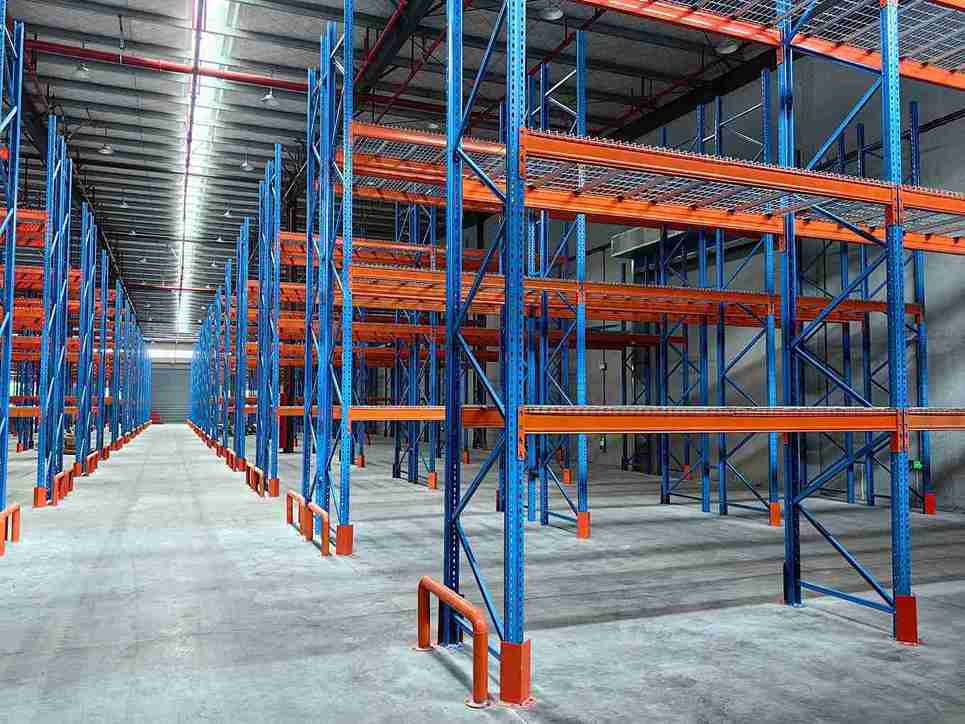
Heavy-Duty End-of-Aisle and Column Protection: The ends of aisles are high-risk zones. Automation-Ready Heavy-Duty Industrial Racking systems are outfitted with ultra-robust guard rails and column protectors designed to withstand a direct impact from a fully loaded AGV. Their purpose is to contain the damage to a replaceable component, thereby preventing a cascade failure that could compromise the structural integrity of the entire heavy-duty industrial racking bay.
Continuous Beam Designs for Structural Integrity: In high-throughput, high-density AS/RS applications, a continuous load beam that runs the full length of the aisle may be specified. This design ties all the upright frames together, creating a “ladder” effect that distributes any impact or unbalanced load across multiple frames. This localized damage containment is a key safety feature of advanced heavy-duty industrial racking systems, ensuring a single incident does not lead to a catastrophic collapse.

The AGV-Specific Blueprint: Engineering Heavy-Duty Industrial Racking for a Mobile Fleet
AGVs represent modular and flexible automation. Their routes can be changed, and they can often be deployed in existing facilities. The heavy-duty industrial racking that supports them must be equally adaptable and robust.
Optimizing Aisle Width and Turn Radius for Maximum Density
Designing heavy-duty industrial racking for AGVs is a holistic process that involves the racking, the vehicles, and the space between them. Through detailed modeling and simulation, engineers can determine the narrowest possible aisle widths that a specific AGV model can safely navigate. This optimization, which is only possible with the precision of Automation-Ready Heavy-Duty Industrial Racking, directly increases storage density and is a major contributor to the overall efficiency gains. The heavy-duty industrial racking layout is no longer a generic template; it is a custom-designed road map for an automated fleet.
Designing High-Frequency Pickup and Deposit (P&D) Stations
The P&D stations are the bustling intersections of the AGV network. These points on the heavy-duty industrial racking endure more traffic and interaction than any other. Their design is critical.
Reinforced Decking and Structure: The heavy-duty industrial racking at P&D stations is specifically reinforced to handle the constant loading and unloading. This often involves thicker decking materials or additional structural supports to prevent deformation over time.
Precision Alignment and Guidance: To ensure swift and accurate transfers, P&D stations are equipped with integrated guides and funnels that ensure the AGV always presents and retrieves the load from the exact same position. This reduces cycle time and prevents damaging misalignments.
Integrated Data Capture Points: The heavy-duty industrial racking at these stations provides the perfect mounting point for barcode scanners or RFID readers. This allows for automatic confirmation of inventory movement at the very moment of transfer, ensuring real-time data accuracy for the Warehouse Management System (WMS).

Engineering for AS/RS: When Heavy-Duty Industrial Racking Becomes the Machine’s Guide Rail
In an Automated Storage and Retrieval System (AS/RS), the distinction between the racking and the machine blurs. The heavy-duty industrial racking is no longer a passive storage structure; it is the precision guide rail and support structure for the entire automated system. The tolerances here are the most extreme in the industry.
Serving as the Precision Runway for Cranes and Shuttles
In a unit-load AS/RS, the heavy-duty industrial racking supports the rails upon which the storage cranes run. Therefore, the accuracy of the heavy-duty industrial racking installation directly dictates the performance of the crane.
Absolute Vertical Alignment for Frictionless Travel: Any deviation from perfect vertical alignment in the heavy-duty industrial racking introduces friction, increases wear on the crane’s wheels and guides, and forces the crane’s drive motors to work harder, consuming more energy and reducing its operational life. The installation of AS/RS heavy-duty industrial racking is a pinnacle of precision engineering, ensuring near-perfect verticality to minimize resistance and maximize speed and longevity.
Flatness and Camber Control for Smooth Operation: The crane rails supported by the heavy-duty industrial racking must be perfectly flat and free of any horizontal bend (camber). A flaw of just a few millimeters over a long aisle can cause the crane to bind or vibrate. The engineering and connection systems of ASRS-specific heavy-duty industrial racking are designed to prevent the settling or shifting that can introduce these fatal flaws into a system over time.
Maximizing Cubic Space with Very Narrow Aisle (VNA) Configurations
For AS/RS that utilize man-up turret trucks or fully automated VNA cranes, the heavy-duty industrial racking can soars to extreme heights, often exceeding 40 meters. At these heights, the heavy-duty industrial racking is subjected to immense dynamic forces and must possess incredible stability.
Back-to-Back Tied Rows for System-Wide Stability: Individual rows of tall heavy-duty industrial racking are vulnerable to sway. In these applications, rows are tied together at the top with specialized structural tie-backs, transforming multiple rows of heavy-duty industrial racking into a single, incredibly stable monolithic structure that can resist the sway induced by the high-speed movement of the cranes at altitude.
Custom Engineered Structural Sections: For the tallest systems, standard roll-formed heavy-duty industrial racking profiles may not be sufficient. Instead, the heavy-duty industrial racking may be constructed from custom-designed, built-up structural steel sections. These sections are engineered to provide the exact strength-to-weight ratio required to safely reach these extreme heights while supporting massive dynamic loads.

The Tangible Return on Investment: How Automation-Ready Heavy-Duty Industrial Racking Unlocks the 50% Efficiency Promise
The claim of a 50% boost in efficiency is a compelling headline, but it is backed by a concrete aggregation of performance improvements across the entire operation. The ROI of Automation-Ready Heavy-Duty Industrial Racking is calculated through multiple channels of value creation.
Near-Elimination of Product and System Damage: By removing the human element from the repetitive task of storing and retrieving pallets, the primary source of damage to both inventory and the heavy-duty industrial racking itself is eliminated. This results in direct savings on replaced goods, reduced insurance claims, and the elimination of downtime for racking repair.
Unlocking 24/7 “Lights-Out” Operation: A human workforce requires shifts, breaks, and holidays. An automated system, running on a foundation of reliable heavy-duty industrial racking, can operate for 22 or more hours per day. This massive increase in operational uptime is a direct multiplier on throughput capacity and asset utilization.
Optimized Inventory Turnover and Accuracy: With real-time WMS integration and 100% accurate robotic transactions, inventory records approach perfect accuracy. This allows for a dramatic reduction in safety stock levels, lowering capital tied up in inventory. It also enables more advanced fulfillment strategies like cross-docking, which further accelerates inventory turnover.
Strategic Labor Reallocation and Upskilling: Automating the physically demanding and repetitive tasks of pallet movement allows companies to reassign their skilled workforce to higher-value functions such as system supervision, data analysis, quality control, and exception management. This improves employee satisfaction and adds a layer of strategic intelligence to the operation.
The Implementation Journey: A Phased Partnership for Guaranteed Success
Deploying a system of this complexity is not a simple transaction; it is a collaborative partnership that follows a meticulous, phased approach to de-risk the project and ensure optimal outcomes.
Phase 1: Deep-Dive Discovery and Digital Twin Creation: The process begins with a thorough analysis of business goals, SKU profiles, peak throughput targets, and future growth plans. Advanced tools like 3D laser scanning are often used to create a perfect digital twin of the existing facility, ensuring the new heavy-duty industrial racking system design is perfectly tailored to the space.
Phase 2: Collaborative System Design and Performance Simulation: Engineers work as an integrated team with the client and the automation provider. The heavy-duty industrial racking layout is designed in concert with the AGV travel paths or AS/RS crane operational patterns. Advanced simulation software models the entire system’s performance, identifying and resolving potential bottlenecks long before installation begins.
Phase 3: Precision Manufacturing and Kitted Logistics: Once the design is finalized, the custom components of the heavy-duty industrial racking system are manufactured in a controlled environment. Components are often pre-assembled into larger modules and kitted for just-in-time delivery to the site, streamlining the installation process.
Phase 4: Certified Installation and Systems Integration: A crew of certified installers, specifically trained in the requirements of automated environments, erects the heavy-duty industrial racking system with surgical precision. They work hand-in-hand with the automation team to ensure perfect physical and operational integration between the heavy-duty industrial racking and the automated equipment.
Phase 5: Lifetime Support and Proactive Maintenance: The relationship extends beyond the commissioning of the system. Comprehensive support packages, including scheduled inspections, spare parts management, and ongoing engineering consultation, are provided to ensure the heavy-duty industrial racking system continues to perform at its peak for its entire operational lifecycle.
Case Study: Transforming a Regional Distribution Center with Precision Heavy-Duty Industrial Racking
A tangible example illustrates the transformative power of this approach. A major consumer goods distributor in Southeast Asia was struggling with a 20% error rate in order picking and consistent failure to meet its 24-hour shipping SLA. Its existing conventional heavy-duty industrial racking was frequently damaged by forklifts, creating a vicious cycle of downtime and inefficiency.
The Solution: The distributor partnered with us to completely replace their conventional storage with a custom-designed Automation-Ready Heavy-Duty Industrial Racking system. This new heavy-duty industrial racking infrastructure was seamlessly integrated with a fleet of pallet-handling AGVs and a new, modern WMS.
The Quantifiable Results:
Order picking accuracy soared to 99.97%, virtually eliminating costly errors.
Overall throughput capacity increased by 60%, allowing the distributor to not only meet but exceed its SLAs and confidently accept new business.
Labor costs associated with the picking operation were reduced by 45%, with staff reassigned to more valuable supervisory, planning, and system optimization roles.
Damage to both inventory and the heavy-duty industrial racking infrastructure became a non-issue, resulting in significant annual savings.
This case is not an anomaly; it is the predictable and repeatable outcome of applying the correct foundational technology—precision heavy-duty industrial racking—to an automation challenge.

Conclusion
The future of warehousing and logistics is unequivocally automated. The competitive edge will belong to those who build the most resilient, efficient, and intelligent operations. In this new era, the storage infrastructure cannot be an afterthought. Selecting conventional heavy-duty industrial racking for an automated project is a strategic misstep that guarantees underperformance and increased risk.
Automation-Ready Heavy-Duty Industrial Racking is the indispensable, intelligent backbone that enables AGVs and AS/RS to achieve their full potential. It is the product of a rigorous engineering discipline that transforms the promise of a 50% efficiency boost from a bold claim into a measurable, daily reality. The warehouses that will lead tomorrow are being built today on a foundation of precision-engineered, robust, and fully integrated heavy-duty industrial racking.
Frequently Asked Questions (FAQs)
1. Can our existing standard heavy-duty industrial racking be retrofitted or reinforced to be “automation-ready”?
While minor reinforcements are sometimes possible, it is generally not cost-effective or safe to attempt a full retrofit. The core deficiencies of standard heavy-duty industrial racking—namely, its lack of inherent precision, its tolerance for deflection, and its design for static loads—cannot be economically corrected after installation.
Retrofitting cannot replicate the monolithic integrity and millimeter-level accuracy of a heavy-duty industrial racking system designed and manufactured from the ground up for automation. A full system replacement is almost always the only path to guaranteed performance, safety, and a positive return on investment.
2. How does the cost of automation-ready heavy-duty industrial racking compare to standard heavy-duty industrial racking?
There is a recognizable premium for Automation-Ready Heavy-Duty Industrial Racking, typically ranging from 15% to 30% depending on the system’s complexity and height. However, this must be evaluated as a value-based investment, not a simple cost comparison. The premium is rapidly offset by the dramatic gains in operational efficiency, the near-total elimination of product and system damage, and the crucial protection it offers to the much larger investment in the AGVs or AS/RS themselves. The return on investment period for the heavy-duty industrial racking is often remarkably short, frequently calculated at under 24 months.
3. What kind of lead times are involved for a large-scale automation-ready heavy-duty industrial racking project?
Lead times are inherently longer than for standard heavy-duty industrial racking due to the extensive custom engineering, precision manufacturing, and rigorous quality control processes involved. For a large-scale distribution center project, a timeline of 14 to 20 weeks from final design sign-off to the commencement of site installation is typical. This extended timeline underscores the critical importance of engaging with an experienced provider early in the automation planning process to ensure the heavy-duty industrial racking does not become a bottleneck on the critical path.
4. Do you work directly with our chosen automation equipment provider (AGV/AS/RS vendor)?
Yes, we insist on a fully collaborative partnership, often termed the “Marriage of the Systems.” Success is contingent on seamless integration. We require detailed interface specifications from the automation provider and routinely hold joint design and planning reviews. This ensures that the heavy-duty industrial racking layout, the interface points, and the operational tolerances are perfectly synchronized with the capabilities of the automated machinery, creating a unified and high-performing system.
5. What are the ongoing maintenance requirements for this type of heavy-duty industrial racking?
While Automation-Ready Heavy-Duty Industrial Racking is engineered for superior durability and resistance to wear, a proactive and scheduled inspection regimen is essential for long-term reliability and safety. We recommend and can provide semi-annual or annual inspections conducted by certified technicians. These inspections focus on the integrity of all connections, the tightness of anchor bolts, the condition of safety locks, and the continued alignment of the entire heavy-duty industrial racking structure. The data collected during these inspections can be used for predictive maintenance, addressing potential issues long before they impact operations.
If you require perfect CAD drawings and quotes for warehouse racking, please contact us. We can provide you with free warehouse racking planning and design services and quotes. Our email address is: jili@geelyracks.com