📐 "First 50 Enterprise Queries Get Custom 3D Warehouse Design" Plan


Solving Warehouse Layout Challenges: The Definitive Guide to Expert Industrial Pallet Racking Design
The modern warehouse is a dynamic, pulsating center of commerce, and its efficiency is paramount. For operations spanning from e-commerce fulfillment in Southeast Asia to manufacturing hubs in Latin America, the physical layout of the storage facility is a critical determinant of profitability. A flawed design leads to tangible, daily frustrations: congested aisles, slow order picking, wasted space, and frustrating inventory inaccuracies.
The root cause of these pervasive issues is frequently traced back to a single, foundational element—the industrial pallet racking design. This comprehensive guide delves into the intricate science of transforming a warehouse from a cost center into a strategic asset through masterful industrial pallet racking design, offering a deep, practical exploration that moves far beyond basic product specifications.
This resource is crafted from decades of field experience across global markets, addressing the unique challenges and opportunities faced by operations in emerging economies. It integrates the critical interplay between industrial pallet racking and material handling equipment like AGVs and forklifts, underscores the strategic use of data analytics in layout planning, and provides a clear-eyed view of the financial models that justify a superior design’s return on investment. For any logistics manager, warehouse operator, or business owner looking to solve pressing layout challenges, this masterclass provides the necessary framework.
The Strategic Imperative: Why Industrial Pallet Racking Design Dictates Operational Success
A common and costly misconception is viewing industrial pallet racking as a simple commodity—a passive metal structure to hold goods. In reality, the design of this industrial pallet racking system forms the fixed skeleton upon which all warehouse processes must flow. A poorly conceived industrial pallet racking layout creates systemic friction, while an expertly planned one fosters a seamless, fluid, and highly productive environment. The correlation between the industrial pallet racking design and the company’s bottom line is direct and undeniable.
Consider the operational and financial impact:
Labor Cost Inflation: A flawed industrial pallet racking design that forces pickers to traverse excessive distances for a single order can inflate labor costs by 30% or more. Given that labor is often the largest ongoing expense, the industrial pallet racking layout becomes a primary lever for controlling it.
Real Estate Utilization: In premium industrial zones from Dubai to Mexico City, the cost of space is significant. Vertical space is frequently the most underutilized asset. An industrial pallet racking design that fails to capitalize on the full clear ceiling height is tantamount to discarding capital.
Throughput Constraints: The maximum speed for receiving, storing, picking, and shipping orders is physically constrained by the aisle widths, picking levels, and logical flow paths dictated by the industrial pallet racking system.
Safety and Risk Management: An inadequately specified industrial pallet racking system, with overloaded beams or dangerously narrow aisles, presents a significant safety hazard. The integrity of the industrial pallet racking is foundational to preventing catastrophic accidents, inventory loss, and substantial liability.
Therefore, investing in an expert industrial pallet racking design is not a mere expense; it is a strategic capital investment with a clear and calculable ROI. It is the essential foundation for future automation and predictable business scaling.
The High Cost of Compromise: Analyzing Real-World Industrial Pallet Racking Failures
Moving from theory to practice illuminates the domino effect of a flawed industrial pallet racking design. These real-world scenarios, common in growth markets, highlight the critical need for professional planning.
Case Study 1: The Congested Distribution Center.
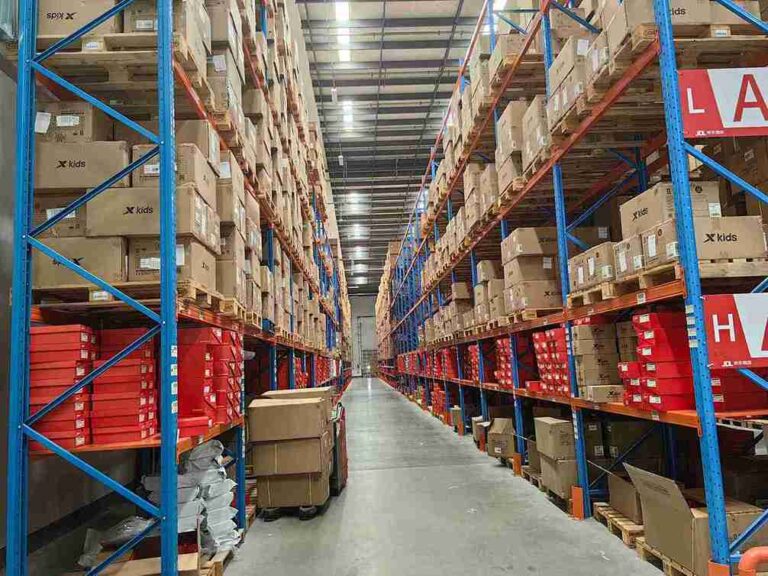
A mid-sized distributor in Vietnam faced chronic order delays. Their facility, equipped with a standard selective industrial pallet racking system, featured aisles too narrow for efficient forklift traffic. The result was persistent congestion and operational gridlock. Furthermore, their fastest-moving SKUs were stored in illogical locations, forcing order pickers to crisscross the entire facility.
The diagnosis was clear: a fundamental industrial pallet racking design problem. The solution involved a hybrid approach, integrating a narrow aisle racking system to increase density and create one-way traffic flows, combined with a data-driven slotting strategy for the selective industrial pallet racking. The outcome was a 40% reduction in pick times and the elimination of shipping delays, showcasing the transformative power of a corrected industrial pallet racking plan.
Case Study 2: The Manufacturer with Wasted Cubic Airspace.
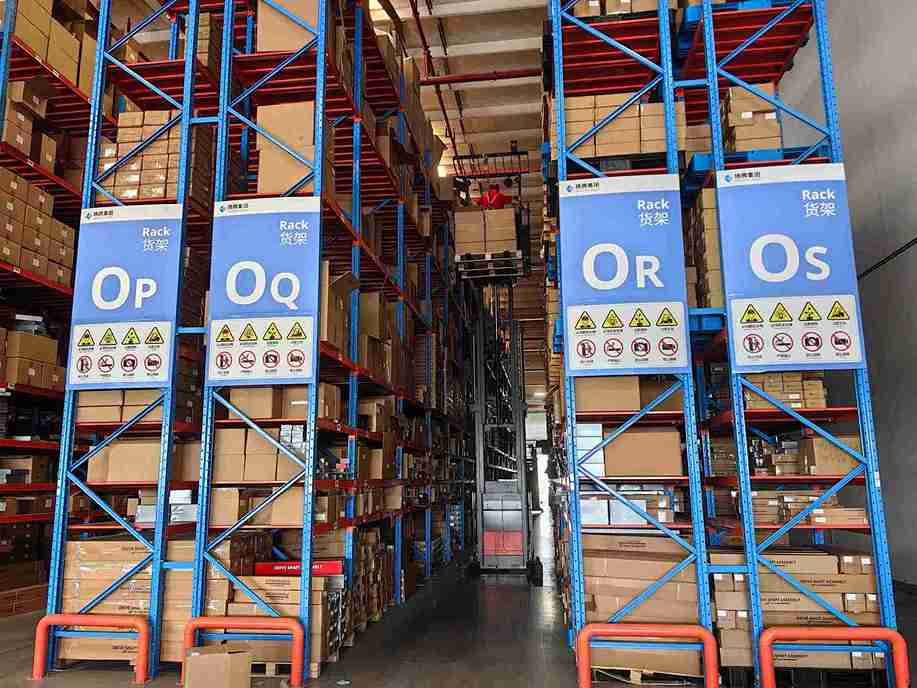
A food and beverage manufacturer in Nigeria operated a warehouse with an 8-meter clear height, but their existing industrial pallet racking only reached 5 meters. They were effectively paying for airspace they did not use, resulting in a sprawling, inefficient layout. The solution was a custom-designed very narrow aisle (VNA) pallet racking system that safely extended storage to 7.5 meters, paired with high-reach forklifts. This strategic overhaul of their industrial pallet racking increased storage capacity by over 50% without expanding the building’s footprint, dramatically improving their cost-per-pallet-stored metric and proving the value of a vertically optimized industrial pallet racking design.
The Four Pillars of a World-Class Industrial Pallet Racking Design
Constructing a resilient and high-performing warehouse layout is a precise science, resting on four interdependent pillars. Neglecting any single pillar compromises the entire system’s integrity and performance.
Pillar 1: Forensic Data Analysis and Inventory Profiling
An effective industrial pallet racking design cannot be created in an information vacuum. The first, non-negotiable step is a forensic-level analysis of inventory and operational data, which extends far beyond a simple SKU count.
ABC Velocity and Cube Analysis: Every SKU must be categorized based on its movement velocity (pick frequency) and its physical cube (size and weight). ‘A’ items (fastest moving) must be positioned in the “Golden Zone” of the industrial pallet racking—between knee and shoulder height, closest to dispatch areas. Conversely, slow-moving ‘C’ items belong in higher or more remote locations within the industrial pallet racking system.
Inventory Turnover and Seasonality: Understanding the dynamic flow of goods informs the design’s flexibility. High-turnover inventory necessitates an industrial pallet racking layout that facilitates rapid put-away and picking. Furthermore, the design must account for seasonal peaks and business growth forecasts, ensuring the industrial pallet racking system is scalable.
Actionable Tool: The SKU Velocity-Cube Matrix
This practical tool is fundamental to creating an optimized industrial pallet racking plan. By plotting every SKU on a matrix with velocity on one axis and cube size on the other, definitive decisions can be made regarding the optimal storage medium. Small, fast-moving items might be best suited for carton flow racks integrated with the main industrial pallet racking structure, while large, slow-moving pallets belong in bulk storage areas of the industrial pallet racking.
Pillar 2: Seamless Material Handling Integration
This is a critical and frequent point of failure. The industrial pallet racking and the equipment that moves goods within it must be engineered as a single, cohesive system. The specifications of one directly dictate the requirements of the other.
Forklift and Aisle Width Synergy: The turning radius and dimensions of forklifts, AGVs, or unmanned forklifts directly determine the minimum aisle width in the industrial pallet racking layout. A narrow aisle (NA) racking system demands a specialized narrow aisle forklift, while a very narrow aisle (VNA) system requires a turret truck or other guided vehicle.
AGV and Automation Readiness: Planning for automation imposes even more stringent requirements on the industrial pallet racking design. AGV systems require millimeter-precision in racking placement, consistent floor flatness, and navigational guides. The entire industrial pallet racking structure must be conceived as “AGV-ready.”
Load Beam Engineering: The vertical spacing of beams in the industrial pallet racking must perfectly align with the lift heights of the material handling equipment and the stacking patterns of the inventory. A beam level that is inaccessible to a forklift, or one that creates dead airspace above a pallet, represents a fundamental flaw in the industrial pallet racking design.
Pillar 3: The Strategic Balance: Space, Accessibility, and Throughput
The core challenge of warehouse layout is balancing the competing demands of storage density, product accessibility, and operational throughput. An expert industrial pallet racking design finds the optimal equilibrium based on specific business priorities.
The Fundamental Trade-Off: Standard selective industrial pallet racking offers 100% accessibility but lower storage density. Conversely, drive-in racking offers high density but severely restricted accessibility (LIFO). Push-back racking strikes a middle ground, offering good density with better accessibility (LIFO with multiple depth levels).
Throughput as the Deciding Factor: For a high-throughput e-commerce fulfillment center, accessibility and speed are paramount, favoring a selective industrial pallet racking system or dynamic solutions like carton flow. For a cold storage facility where space is expensive and product rotation is managed in batches, a high-density drive-in racking system integrated into the overall industrial pallet racking plan might be the most cost-effective choice.
Pillar 4: Structural Integrity and a Proactive Safety Culture
Safety is the non-negotiable bedrock of any industrial pallet racking design. This involves both rigorous initial engineering and the implementation of ongoing operational protocols.
Professional Load Calculation & Seismic Compliance: In seismically active regions like Central Asia and parts of South America, the industrial pallet racking design must include professional structural engineering calculations. These calculations are based on specific load weights, local building codes, and seismic zone requirements, ensuring the industrial pallet racking system is inherently safe.
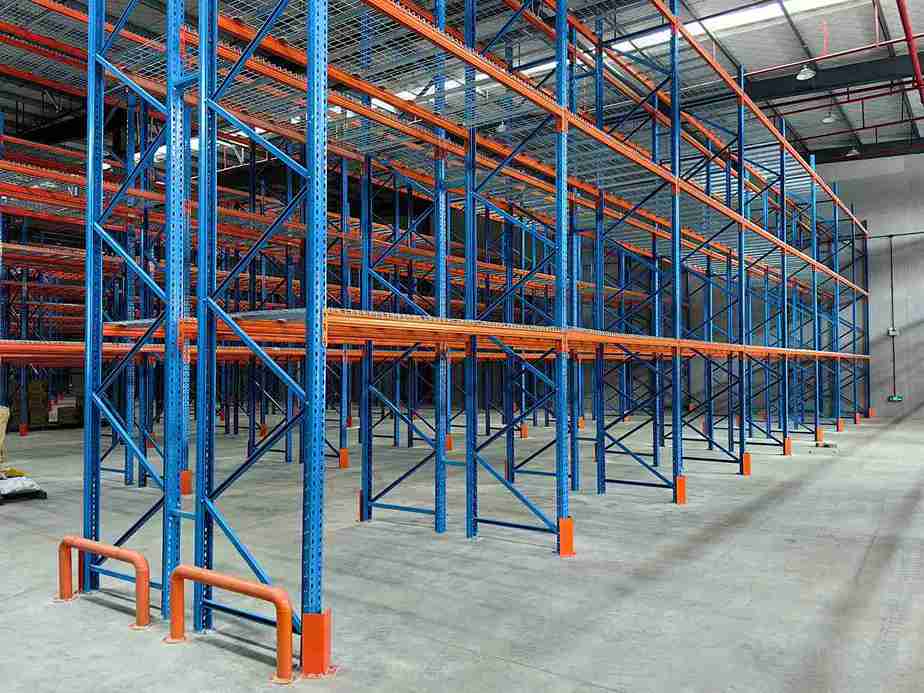
Integrated Impact Protection: In a busy warehouse, forklift impacts are inevitable. A robust industrial pallet racking design incorporates column guards, aisle end protectors, and wire mesh decking not as optional accessories, but as integral safety components that protect both personnel and the structural integrity of the industrial pallet racking itself.
Clear and Enforced Load Signage: Every bay of the industrial pallet racking must be clearly and permanently labeled with its maximum permissible load capacity. This simple, critical step prevents dangerous overloading by warehouse staff, preserving the safety and longevity of the industrial pallet racking system.
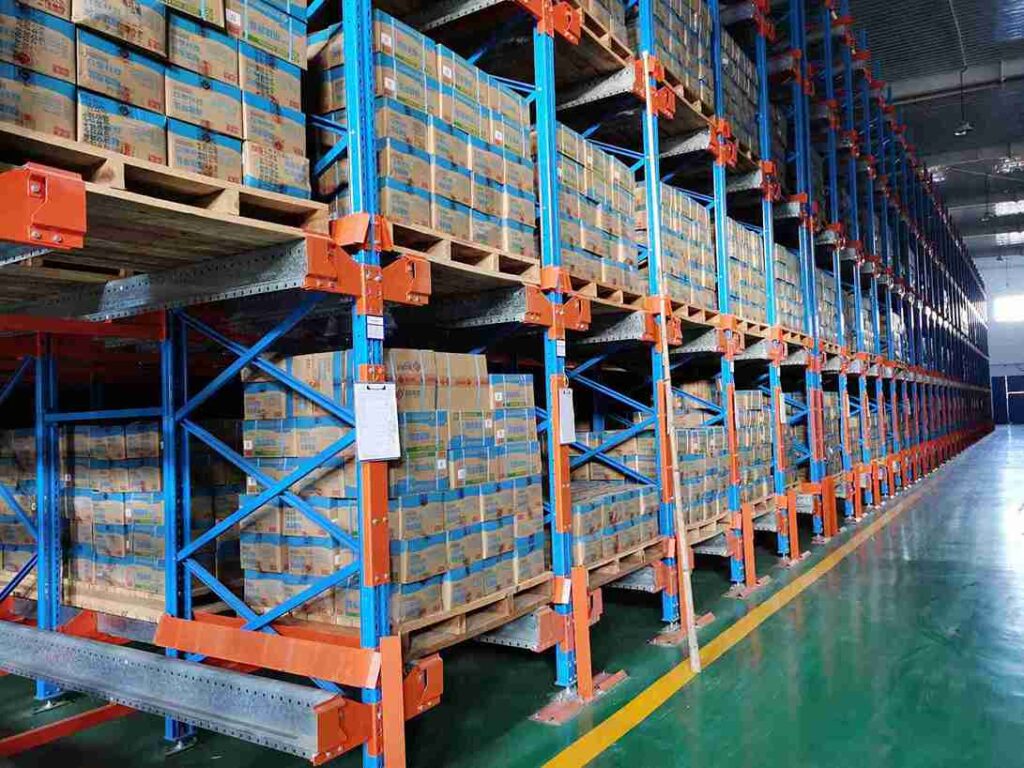
Advanced Layout Strategies: Engineering Your Industrial Pallet Racking for Specific Operations
With the four pillars established, the focus shifts to advanced strategies that form the functional blueprint of the warehouse. The selection of the right type of industrial pallet racking is paramount to success.
Strategy 1: The Cross-Docking and Fast-Moving Goods Blueprint
For businesses like perishable goods distributors or high-volume retailers, the primary goal is to minimize storage time. The layout, and therefore the industrial pallet racking configuration, must prioritize fluid movement over static storage.
Key Racking Types: Selective industrial pallet racking with wider aisles for rapid truck unloading and staging is often integrated with pallet flow racks for perfect FIFO (First-In, First-Out) rotation. The entire industrial pallet racking system is configured for speed.
Layout Focus: A straight-line, “I-shaped” or “L-shaped” flow from receiving to shipping. The industrial pallet racking is arranged to create minimal, highly efficient travel paths for both man and machine.
Strategy 2: The High-Density, Slow-Moving Inventory Blueprint
For businesses storing raw materials, archival goods, or seasonal products, maximizing the number of pallets per square meter is the primary objective. The industrial pallet racking system is chosen specifically for density.
Key Racking Types: Drive-in racking, push-back racking, or mobile pallet racking (where entire rows of racks move on rails). These specialized forms of industrial pallet racking can increase storage density by up to 80% compared to standard selective racking.
Layout Focus: The design blocks out large, dedicated areas for these high-density industrial pallet racking systems, with careful consideration for fire safety regulations and sprinkler requirements within the dense storage blocks.
Strategy 3: The Multi-Channel Fulfillment & E-Commerce Blueprint
This represents the most complex modern challenge, requiring a single industrial pallet racking layout to handle full-pallet, case-pick, and single-item “each” picking simultaneously.
Key Racking Types: A multi-tiered, hybrid approach is essential. Bulk industrial pallet racking in the rear for reserve storage, carton flow racking for medium-velocity case picking, and shelving or bin systems integrated with the main industrial pallet racking structure for slow-moving items or kit assembly.
Layout Focus: A “U-shaped” or “Modular” layout creates distinct zones for different activities. The industrial pallet racking in each zone is specifically selected for its task. The integration of a conveyor system or automated sortation is often critical to tie these industrial pallet racking zones together efficiently.
The Future-Proof Warehouse: Designing Industrial Pallet Racking for Automation and Scalability
The most costly warehouse is one that cannot adapt. A truly expert industrial pallet racking design is inherently flexible and forward-thinking.
Building an AGV-Ready and Automation-First Foundation
When planning for AGVs or automated storage and retrieval systems (AS/RS), the industrial pallet racking is no longer a passive structure; it becomes an active component of the automated machine.
Dimensional Precision: Tolerances for racking placement become extremely tight to ensure automated vehicles can interface with the industrial pallet racking with perfect, repeatable accuracy.
Structural Enhancements: The industrial pallet racking specified for AS/RS often requires heavier-duty beams, columns, and bracing to withstand the constant, high-speed interaction with retrieval machines.
Human-System Interface Points: The design must include clearly defined pick stations and interface points where the automated industrial pallet racking system and human operators seamlessly exchange goods.
The Modular Design Philosophy: Planning for Phased Business Growth
A sophisticated approach involves a “building block” philosophy for the industrial pallet racking system. This means creating a master plan that can be executed in strategic phases. Phase 1 of the industrial pallet racking installation might cover immediate needs, with Phases 2 and 3 clearly mapped out to expand the system laterally or vertically as the business grows, all without causing major disruption to ongoing operations. This modular approach to industrial pallet racking ensures long-term viability and protects the initial investment.
Conclusion: Elevating Industrial Pallet Racking from Commodity to Strategic Cornerstone
Solving warehouse layout challenges transcends the act of purchasing the least expensive industrial pallet racking available. It is a strategic business initiative that demands a deep synthesis of data, processes, equipment capabilities, and growth ambitions. It is about making an informed, expert-led investment in the very infrastructure that drives operational efficiency, customer satisfaction, and ultimately, profitability.
A professionally engineered industrial pallet racking design pays for itself many times over through quantifiable gains in labor efficiency, real estate utilization, throughput capacity, and safety compliance. It is the solid, scalable, and intelligent ground upon which a resilient and market-leading logistics operation is built, fully prepared to meet the demands of today and the opportunities of tomorrow.
Frequently Asked Questions (FAQs)
(H3) 1. What is the typical project lead time for a comprehensive warehouse redesign and industrial pallet racking installation?
Lead times are project-dependent, but a realistic timeline ranges from 12 to 20 weeks from initial concept to final installation. This encompasses 2-3 weeks for deep-dive data analysis and conceptual industrial pallet racking design, 2-3 weeks for detailed engineering and client approval, 6-10 weeks for industrial pallet racking manufacturing and shipping (longer for complex international logistics), and 2-4 weeks for on-site installation by certified technicians. A detailed critical path schedule is provided at the project’s outset.
(H3) 2. How does the design process account for non-standard load shapes or particularly fragile products within the industrial pallet racking system?
Non-standard loads are a common challenge that requires custom engineering solutions within the industrial pallet racking framework. For unusually shaped items, our team designs and sources specialized supports, cantilever arms, or custom decking. For fragile products, we integrate solutions like full-width wire mesh decking for superior stability and specify high-performance beam-to-column locks to prevent accidental dislodgement. A thorough pre-design audit of all product types is conducted to ensure the industrial pallet racking system is perfectly tailored to the specific inventory.
(H3) 3. Can the proposed industrial pallet racking design integrate with our existing Warehouse Management System (WMS)?
Seamless integration is a critical component of a modern industrial pallet racking design. The physical layout of the industrial pallet racking should be a direct reflection of your WMS logic. We collaborate closely with your IT team or WMS provider to ensure the layout, slotting, and zoning designed into the industrial pallet racking plan are perfectly mirrored in your system’s digital logic. This synergy is crucial for unlocking the full efficiency gains, particularly for complex processes like wave picking, dynamic slotting, and cycle counting.
(H3) 4. What are the recommended ongoing maintenance and inspection protocols for a large-scale industrial pallet racking installation?
We advocate for a rigorous, two-tiered maintenance protocol for all industrial pallet racking systems. First, daily visual inspections should be conducted by trained warehouse staff to identify any obvious damage, impacts, or leaning. Second, a formal, documented professional inspection by a qualified engineer must be performed at least annually. We provide all clients with a comprehensive industrial pallet racking inspection checklist and often offer annual service contracts to ensure the long-term structural integrity and safety of the investment.
(H3) 5. Are high-density storage solutions viable for a warehouse with a very low ceiling height?
Absolutely. While vertical expansion is not an option, the focus shifts to maximizing floor-level density through intelligent industrial pallet racking selection. Solutions like push-back racking (accommodating 2-5 pallets deep) or mobile pallet racking (which eliminates multiple aisles) are exceptionally effective in low-clearance environments. These specialized forms of industrial pallet racking can dramatically increase pallet positions without requiring any additional building height, making them a smart solution for space-constrained facilities.
If you require perfect CAD drawings and quotes for warehouse racking, please contact us. We can provide you with free warehouse racking planning and design services and quotes. Our email address is: jili@geelyracks.com