📐 "First 50 Enterprise Queries Get Custom 3D Warehouse Design" Plan


Streamline ESD-Safe Storage & Picking: The Ultimate Guide to Custom Mezzanine Racking for Electronics Assembly
In the high-stakes, precision-driven world of electronics assembly, the warehouse is far more than a passive storage area; it is the dynamic, central nervous system of the entire production operation. Inefficiencies here create a cascade of problems: production delays, costly component damage, and logistical bottlenecks that strangle growth and profitability. For managers and plant engineers grappling with cramped floorspace, the ever-present threat of Electrostatic Discharge (ESD) destroying sensitive printed circuit boards (PCBs), and frustratingly slow picking cycles, the solution demands a strategic, three-dimensional approach.
The industry’s most effective answer is the implementation of custom mezzanine racking for electronics facilities. This is not a simple shelving unit; it is an engineered, purpose-built platform that creates a secure, second-level operational zone dedicated entirely to the high-value, ESD-sensitive components that are the lifeblood of modern electronics manufacturing. This comprehensive guide will explore how a strategically designed mezzanine racking for electronics installation serves as a transformative investment, directly enhancing efficiency, guaranteeing safety, and delivering a powerful return on investment by streamlining ESD-safe storage and picking processes.
Why Conventional Storage Systems Are a Critical Failure in Electronics Warehousing
To fully appreciate the engineered solution, one must first understand the profound shortcomings of conventional pallet racking and standard shelving in the context of the electronics sector. The unique physical and electrical characteristics of electronic components necessitate a storage environment that is both spatially intelligent and electromagnetically controlled.
The Silent Profit-Killer: Understanding the True Cost of Electrostatic Discharge (ESD)
Electrostatic Discharge represents one of the most insidious and costly threats in electronics manufacturing. A static spark as low as 10 volts—far below the threshold of human perception—can instantly vaporize a delicate integrated circuit or cause latent damage that weakens a component, leading to premature field failure. The financial impact is multifaceted, extending far beyond the cost of the single component itself. It encompasses the labor for diagnostic and rework, costly production line downtime, potential warranty claims, and long-term damage to brand reputation and customer trust.
Standard painted steel shelving and racking are conductors of static electricity. Storing ESD-sensitive devices on such surfaces without a comprehensive protection system is an unacceptably high risk. A properly engineered ESD-protected mezzanine racking for electronics is conceived and constructed with this primary threat as its core design parameter, integrating a continuous grounding system directly into its very structure.
The Spatial Squeeze: Leveraging Cubic Airspace When Floor Space is Exhausted
The electronics industry is characterized by an immense proliferation of Stock Keeping Units (SKUs). From microscopic 0201 resistors and BGA chips to larger LCD displays, power supplies, and metal housings, the inventory is incredibly diverse and consumes a significant amount of space. The traditional, reactive response to growth has often been to lease additional warehouse space—a massively capital-intensive, logistically disruptive, and often geographically unfeasible undertaking.
A custom mezzanine racking for electronics system confronts this challenge directly by leveraging the vast, unused cubic airspace of the existing facility. It effectively doubles, or even triples, the usable floor area without requiring a single additional square meter of land, fundamentally transforming storage capacity and indefinitely postponing the need for a costly and complex facility relocation.
The Picking Bottleneck: How Inefficient Layouts Strangle Productivity
In a disorganized, single-level warehouse reliant on standard storage, order pickers can spend up to 70% of their shift simply walking. When the components for a single assembly kit or production order are scattered across different aisles and zones, the picking process becomes inherently slow, prone to errors, and physically exhausting for staff. This inefficiency directly throttles production line velocity and compromises on-time order fulfillment rates.
A mezzanine racking for electronics solution, when expertly designed, consolidates all ESD-sensitive inventory into a single, multi-level, and highly organized environment. This strategic consolidation drastically reduces travel time and creates a logical, flow-optimized workflow that is simply unattainable with a sprawling, single-level layout.

The Engineered Solution: Deconstructing the Anatomy of a Custom ESD-Safe Mezzanine Rack
A true high-performance ESD-safe mezzanine racking for electronics is an integrated system where every single component, from the primary structural frame to the smallest accessory, is selected and specified for its contribution to performance, protection, and productivity.
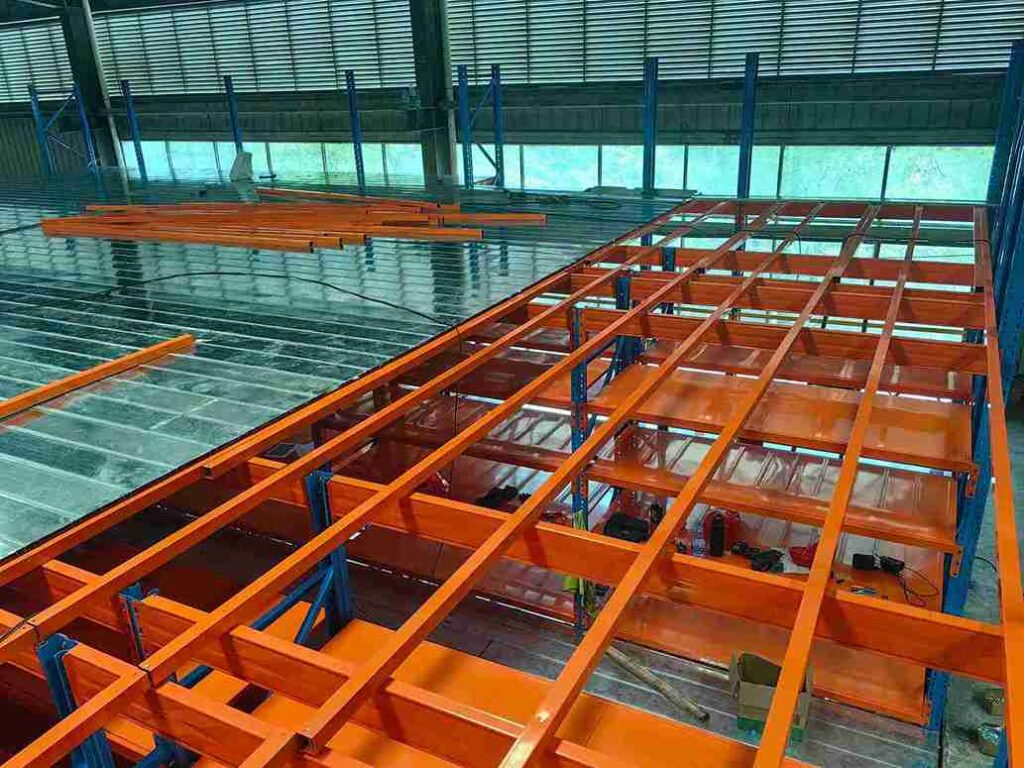
The Foundation: Robust Structural Frame and ESD-Safe Decking Systems
The foundation of any system is a heavy-duty, cold-formed or structural steel frame, meticulously engineered to specific load-bearing requirements, often exceeding 150 lbs per square foot for heavy-component storage. The critical differentiator for electronics assembly is found in the decking and flooring.
Strategic Decking Selection: Experts typically recommend a solid steel plate for areas requiring maximum load-bearing or the integration of automation, or a high-density, anti-slip particle board for general storage areas. The pivotal factor is that this substrate is then overlaid with a permanent, institutional-grade ESD-safe flooring system.
ESD Flooring Systems Explained: This is typically a static-dissipative or conductive vinyl or rubber tile, installed with specialized conductive adhesives. This entire surface is permanently bonded to the mezzanine’s integrated grounding system, creating a continuous, protected plane that safely and instantly dissipates any static charge from personnel, equipment, or mobile carts across the entire platform surface.
Comprehensive Point-of-Use Grounding: All structural columns and shelving bays are equipped with multiple, clearly designated grounding points, using brass plugs or terminals, ensuring that every element of the mezzanine racking for electronics installation is tied into the facility’s central earth ground, creating a unified protective environment.
Integrated ESD-Protected Storage Media: The Heart of the System
The mezzanine structure provides the stage, but the specialized storage media are the performers that enable the workflow. A superior mezzanine racking for electronics system integrates shelving and containers engineered explicitly for electronic components.
ESD-Safe Shelving and Racking: Instead of standard shelving, installers use units with a conductive, carbon-loaded powder coating. These shelves are then systematically bonded to the mezzanine’s grounding system via braided copper straps, ensuring a continuous “Faraday Cage”-like protective envelope for all stored items. This approach is fundamental to a reliable mezzanine racking for electronics design.
Component-Specific Bins, Dividers, and Handling Equipment: The system utilizes static-dissipative polypropylene bins, tote boxes, and drawer cabinets from leading suppliers like Stanley Vidmar or Lista. These prevent the triboelectric charge generation and accumulation on the containers themselves, adding a vital secondary layer of security for the most sensitive micro-components. ESD-safe trolleys and mobile carts are also integral for material movement on the platform.
Safety and Access: Staircases, Guardrails, and Vertical Material Lifts
Operational safety is non-negotiable in any industrial setting. A custom mezzanine racking for electronics is built to and often exceeds the highest international safety standards, including OSHA and ISO requirements.
Industrial Staircases: Wide, sturdy industrial-grade staircases with non-slip, ESD-safe treads and robust handrails provide safe and ergonomic access for personnel throughout the workday.
Full-Height Guardrails: Heavy-duty, full-height guardrails, often with mid-rails and toe-kicks, are installed around the entire perimeter and any open edges to prevent falls, a critical consideration for any multi-level mezzanine racking for electronics installation.
Integrated Material Lifts: For transporting heavier reels, tote boxes, or kit carts between levels, dedicated material lifts or vertical reciprocating conveyors (VRCs) are integrated. This not only prevents manual lifting injuries but also dramatically improves the speed and efficiency of vertical logistics, making the mezzanine racking for electronics system a fully fluid operational layer.
Transforming Your Operational Workflow: Advanced Picking and Storage Strategies
With the physical structure and ESD protections in place, the true transformational power of the mezzanine racking for electronics system is realized through its workflow design. The layout is meticulously engineered to mirror and optimize the facility’s specific operational patterns and production rhythms.
Implementing a “Golden Zone” Picking Strategy on the Mezzanine
The “Golden Zone” is the ergonomic area between a picker’s knees and shoulders where they can most comfortably and efficiently access items without stretching or bending. On a custom mezzanine racking for electronics platform, the shelving and bin layout is specifically designed to maximize the utilization of this zone. High-turnover, fast-moving components—such as common resistors, capacitors, and popular ICs—are strategically placed within this ideal reach area. Slower-moving or bulkier items are stored higher or lower. This ergonomic-centric design significantly reduces physical fatigue, minimizes the risk of repetitive strain injuries, and can increase picking speed and accuracy by up to 30%, a key benefit of a well-planned mezzanine racking for electronics project.
Optimizing for Zone and Wave Picking Methodologies
The mezzanine level itself can be logically segmented into distinct zones based on product family, value, or specific assembly line requirement. This segmentation enables the highly efficient implementation of zone picking, where dedicated operators become experts in their specific section, leading to faster pick rates and fewer errors. For operations fulfilling kitted orders for surface-mount technology (SMT) lines, wave picking within the condensed, multi-level space of a mezzanine racking for electronics system is exceptionally efficient, as all required components are consolidated into a dense, logically organized area, drastically reducing the picker’s travel path.
Centralizing Kitting and Line-Side Feeding Operations
The clean, controlled, and secure environment of an ESD-safe mezzanine racking for electronics platform is the ideal centralized location for a dedicated kitting operation. Here, specialized personnel can accurately assemble all the components required for a specific production run or sales order into a single, labeled kit. These pre-verified kits are then dispatched to the assembly line, either manually or via AGV, ensuring the right parts are available at the right time, drastically reducing line-side clutter, and virtually eliminating component-related production errors. This makes the mezzanine racking for electronics area the active preparation hub for the factory floor.
The Automated Frontier: Integrating Smart Technologies for a Lights-Out Warehouse
For forward-thinking electronics manufacturers aiming for Industry 4.0 standards, the custom mezzanine racking for electronics system provides the perfect physical infrastructure to host and support advanced automation technologies, creating a truly smart warehouse environment.
Employing AGVs and AMRs for Seamless Horizontal Transport
Automated Guided Vehicles (AGVs) or the more flexible Autonomous Mobile Robots (AMRs) can be programmed to autonomously transport picked orders or completed kits from the dispatch area of the mezzanine racking for electronics level directly to the point of use on the production line. This creates a seamless, hands-off material flow that operates around the clock, synchronizing warehouse and production logistics and freeing highly skilled personnel for value-added tasks.
Installing Automated Storage and Retrieval Systems (AS/RS) on the Mezzanine Deck
For the ultimate in storage density, speed, and accuracy, integrators can install mini-load AS/RS or vertical lift modules (VLMs) directly onto the solid deck of the mezzanine racking for electronics structure. These “goods-to-person” systems automatically bring the required bin or tray to an ergonomic workstation, eliminating walking entirely, maximizing space utilization, and increasing picking accuracy to near 100%. This represents the pinnacle of efficiency for ESD-safe storage and picking and is a powerful application of mezzanine racking for electronics infrastructure.
Case in Point: A Real-World Transformation in an SMT Contract Manufacturing Facility
Consider a real-world application: a mid-sized contract manufacturer specializing in high-mix, low-volume Surface-Mount Technology (SMT). Their existing warehouse was a single-level, chaotic environment that led to frequent, costly line stoppages while technicians searched for missing reeled components, alongside a troubling rate of ESD-related failures on high-value PCBs.
The solution was a custom two-tier ESD-safe mezzanine racking for electronics designed and installed by a specialist firm. The ground floor was reconfigured for receiving, raw material bulk storage, and shipping. The new mezzanine level became the dedicated, high-security heart of their component management:
Comprehensive ESD-Safe Environment: The entire upper level featured a conductive vinyl tile floor and exclusively grounded, static-dissipative shelving units.
Logically Optimized Layout: Reels and tape-and-reel components were stored in a logical sequence that directly mirrored their feeder assignments in the SMT machines.
Dedicated Kitting Workstations: Designated, well-lit stations on the mezzanine were used to prepare and verify entire feeder carts for specific production jobs before they were dispatched to the shop floor.
The Quantifiable Results:
99.9% Elimination of ESD-Related Failures.
45% Reduction in Picking Time for SMT line setup and changeover.
100% Increase in Storage Capacity within the original building footprint.
Zero Production Stoppages due to missing components, achieving true line-side continuity.
This case powerfully demonstrates the transformative potential of a well-executed mezzanine racking for electronics project.
The Investment Analysis: Calculating the Compelling ROI of a Mezzanine System
A custom mezzanine racking for electronics system is a significant capital expenditure, but its Return on Investment (ROI) is powerful, multi-faceted, and readily calculable, making a strong business case.
Cost of Space Creation: Compare the cost-per-square-meter of adding a mezzanine level versus the cost of leasing, building, or buying new industrial space. The mezzanine racking for electronics solution is almost invariably a fraction of the cost—often less than one-third.
Labor Efficiency Gains: Quantify the reduction in picking times, the increase in orders or kits processed per labor hour, and the reduction in walking distance. These translate into direct, recurring payroll savings and enhanced throughput.
Loss Prevention: Calculate the annual cost of ESD-related failures, rework, scrap, and associated downtime. A proper ESD-safe mezzanine racking for electronics system can virtually eliminate this category of loss, providing a direct and substantial contribution to the bottom line.
Productivity and Opportunity Gains: The value of preventing production line stoppages is immense, directly translating into higher machine utilization, greater throughput, and guaranteed on-time deliveries, which in turn strengthens customer relationships.
When modeled holistically, the payback period for a strategically designed mezzanine racking for electronics system is typically a compelling 12 to 24 months, after which it generates continuous operational profit.
Selecting the Right Integration Partner: A Decision of Strategic Importance
Selecting a supplier based solely on the lowest price per kilogram of steel is a critical and costly error. The implementation of a mezzanine racking for electronics system requires a partner who possesses a deep, proven understanding of the unique challenges of the electronics assembly sector.
Demonstrable ESD Expertise: Prospective clients must ask for detailed case studies and request specifics on their ESD protection methodologies, grounding techniques, and material specifications. Do they offer a turnkey, guaranteed ESD system?
In-House Engineering Capability: Ensure the provider has certified structural engineers who can provide full structural calculations and stamped engineering drawings, which are essential for local permit applications and long-term safety compliance.
Holistic, Consultative Approach: The best partners act as consultants, not just vendors. They conduct a thorough analysis of the entire workflow—from goods-in to line-side delivery—to ensure the mezzanine racking for electronics system delivers not just storage, but a comprehensive operational transformation.
Conclusion: Elevate Your Electronics Assembly Operation, Literally and Figuratively
In the high-stakes, fast-paced, and precision-critical world of electronics assembly, a company’s storage strategy can no longer be an operational afterthought. It is a core determinant of competitive advantage, directly influencing product quality, operational agility, and profitability. A Custom ESD-Safe Mezzanine Racking system stands as the definitive, engineered solution to the trifecta of space constraints, ESD risks, and workflow inefficiencies. It is a strategic capital investment that creates a protected, high-density, and highly efficient nerve center for a company’s most valuable production assets—its components.
By consolidating and securing inventory within a vertically optimized, intelligent space, businesses are not merely storing parts; they are building a resilient foundation for accelerated production cycles, unimpeachable quality control, and scalable, sustainable growth. The pivotal question for decision-makers is therefore no longer if they can afford to implement a sophisticated mezzanine racking for electronics system, but how much longer they can afford the mounting costs of not doing so.
Frequently Asked Questions (FAQs)
1. Can an ESD-safe mezzanine racking for electronics be retrofitted into our existing warehouse, or does it require a new building?
The vast majority of our ESD-safe mezzanine racking for electronics projects are retrofits into existing facilities. Our engineering team conducts a comprehensive site survey to verify that the existing concrete floor slab can support the dynamic and static loads and that the building’s clear height is sufficient for a safe and functional multi-level operation. We design the structure to fit precisely within your current building envelope, making it a supremely effective solution for modernizing and expanding an older warehouse without relocation.
2. How do you handle fire safety and sprinkler system requirements for a multi-level mezzanine racking for electronics?
Fire safety is a non-negotiable, critical part of our design process for any mezzanine racking for electronics installation. We work in full compliance with local building codes and in consultation with fire safety engineers. This invariably involves extending the building’s existing sprinkler system to provide compliant coverage both above and below the mezzanine deck, as per NFPA or equivalent local standards. We also design in clear, marked aisles and mandated emergency egress points, such as additional staircases, to ensure full occupant safety.
3. What is the typical lead time from design to installation for a project of this scale?
Lead times vary based on the project’s size, complexity, and level of customization, but a typical end-to-end timeline for a mezzanine racking for electronics project is 10-16 weeks. This includes 2-4 weeks for detailed engineering and design approval, 6-10 weeks for manufacturing of all custom components (including ESD elements), and 2-3 weeks for on-site installation by our certified, experienced erection team. A detailed, phase-gated project plan is provided from the outset for complete transparency.
4. Beyond ESD protection, what other industry-specific customizations are possible for a mezzanine racking for electronics system?
We regularly implement a wide range of customizations to meet precise operational needs. These include: dedicated climate-controlled enclosures for hygroscopic components like moisture-sensitive devices (MSDs), specialized cantilever racking for storing PCB panels vertically to prevent bending and warping, secure, caged areas with restricted access for high-value chips and processors, and fully integrated, ESD-safe workbenches with power and data for QC inspection, programming, and labeling directly on the mezzanine level.
5. How does the maintenance of an ESD-safe mezzanine racking for electronics differ from a standard one?
The primary maintenance focus is on preserving the ESD integrity of the system. This involves scheduled, periodic testing of the flooring and shelving’s surface resistivity using a dedicated megohmmeter to ensure they remain effectively grounded and within the required resistance range (typically 10^6 to 10^9 ohms). It also requires comprehensive staff training to use only ESD-safe stools, trolleys, and equipment on the platform and to avoid placing common insulating materials (like standard cardboard or non-dissipative plastics) directly on the ESD surfaces. The structural and general maintenance is similar to any other heavy-duty industrial equipment, involving periodic inspection of bolts and connections.
Welcome to contact us, if you need warehouse rack CAD drawings. We can provide you with warehouse rack planning and design for free. Our email address is: jili@geelyracks.com