📐 "First 50 Enterprise Queries Get Custom 3D Warehouse Design" Plan















In the precision-driven pharmaceutical industry, the storage infrastructure is a critical control point, directly impacting product integrity, patient safety, and operational viability. Standard industrial storage solutions are fundamentally inadequate for the stringent demands of housing active pharmaceutical ingredients (APIs), excipients, and finished drug products. This authoritative guide examines the engineering, regulatory, and operational imperatives of deploying superior shelf racking for pharmaceutical applications.
It articulates why a strategic, custom-engineered approach to shelf racking for pharmaceutical storage is not an expense but a vital investment in regulatory compliance, supply chain integrity, and operational scalability. From material science and structural design to integration with automated logistics, this resource provides a comprehensive blueprint for pharmaceutical logistics managers, plant engineers, and quality assurance professionals seeking to optimize their storage environments.
(H2) The Non-Negotiable Case for Specialized Shelf Racking for Pharmaceutical Warehouses
The use of conventional pallet racking in a pharmaceutical context introduces untenable risks. The stakes extend far beyond simple organization, touching upon legal compliance and public health. A failure in the storage system can lead to product contamination, regulatory action, and devastating recalls.
A Compliance Imperative: Regulatory frameworks like FDA’s cGMP and the EU’s GDP mandate specific storage conditions. These include unambiguous segregation to prevent mix-ups, environments that preclude contamination, and facile cleaning protocols. Standard shelf racking for pharmaceutical use must be re-engineered; generic racking, with its crevices, bolt holes, and rough surfaces, is a reservoir for dust, microbes, and particulates, making compliance audits a constant challenge. The entire design philosophy for shelf racking for pharmaceutical facilities must be rooted in audit-readiness.
Safeguarding Product Integrity: Pharmaceutical products are vulnerable to physical and environmental damage. Inadequate load capacity or seismic resilience in racking can lead to structural failure, container damage, and catastrophic cross-contamination. Furthermore, the materials used in the construction of the shelf racking for pharmaceutical products must be inert, non-shedding, and resistant to corrosion to avoid introducing any contaminants into the stored products.
Operational Excellence and Traceability: In an industry where full traceability is mandated, an inefficient storage layout creates significant operational drag. Locating specific batches on suboptimal shelf racking for pharmaceutical inventory becomes time-consuming and error-prone. Implementing reliable FIFO (First-In, First-Out) or FEFO (First-Expired, First-Out) systems is mechanically difficult without a storage solution designed to support these principles, leading to costly write-offs of expired goods.
(H2) Foundational Engineering Principles for Pharmaceutical Shelf Racking
Designing effective shelf racking for pharmaceutical environments is a multidisciplinary endeavor, merging structural engineering, materials science, and a deep comprehension of pharmaceutical logistics. The following principles are the bedrock of any successful installation.
(H3) Material Selection: The Science Behind Steel and Coatings
The intrinsic properties of the racking materials form the first and most critical line of defense for product safety.
High-Strength, Low-Carbon Steel: Reputable manufacturers specify steel with a high yield strength. This allows for robust load-bearing capacity without excessively bulky components, resulting in narrower upright profiles that maximize valuable aisle space. However, the raw steel is only the starting point.
Advanced Epoxy and Powder Coatings: A high-performance, FDA-compliant epoxy resin powder coating is not an aesthetic upgrade; it is a functional requirement for any shelf racking for pharmaceutical application. This coating must possess several key characteristics:
Non-porous and Non-shedding: The surface must be seamless and impermeable to prevent the harboring of microorganisms and the shedding of particulate matter, a critical aspect of shelf racking for pharmaceutical cleanliness.
Chemically Resistant: The coating must withstand repeated exposure to aggressive cleaning agents, sanitizers, and potential chemical spills without degrading, blistering, or peeling.
Exceptional Durability: The finish must be highly resistant to chipping and abrasion caused by pallet impacts to maintain its protective barrier against corrosion. A compromised coating on shelf racking for pharmaceutical use represents a significant compliance deviation. Light colors, such as pharmaceutical white or off-white, are standard as they enhance light reflectivity and make contaminants more visible.
(H3) Structural Design for Uncompromised Cleanability and Compliance
The physical geometry of the racking components is engineered to support a sterile or controlled environment.
Radiused Corners and Sealed Welds: Modern shelf racking for pharmaceutical warehouses eliminates sharp 90-degree corners and exposed bolt threads. Designs feature smooth, radiused corners and continuously welded connections to eradicate microscopic dirt traps where contaminants can accumulate.
Minimized Horizontal Surfaces: Wide, flat beam surfaces act as ledges for dust settlement. Advanced designs for shelf racking for pharmaceutical applications often employ beams with a sloped top surface or a tubular profile to prevent dust accumulation and facilitate cleaning.
Plinth-Style Sealed Bases: Upright frames are mounted on fully sealed, plinth-style bases. This design prevents debris, spilled liquids, and contaminants from collecting underneath the racking, a common and problematic flaw in standard industrial racking that is wholly unacceptable for shelf racking for pharmaceutical storage.
(H2) Advanced Configurations for Modern Pharmaceutical Logistics
A singular approach to storage is obsolete. Different product types and logistical workflows demand specialized configurations of shelf racking for pharmaceutical facilities.
(H3) Engineered Selective Pallet Racking: The Adaptable Foundation
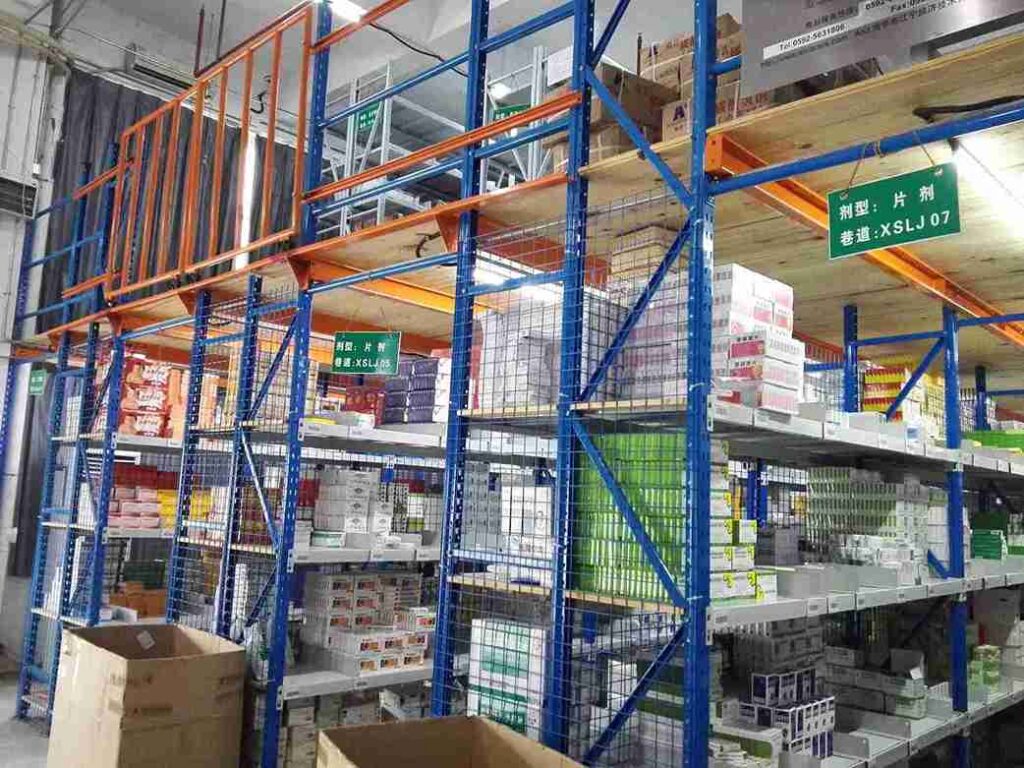
While selective racking is a common sight, the version used for shelf racking for pharmaceutical applications is engineered to a superior standard. It provides direct access to every pallet, making it ideal for facilities with a high number of SKUs. This versatility is enhanced with custom wire mesh decking for improved air circulation and safety, and integrated, dedicated label holders for flawless lot tracking and inventory control.
(H3) High-Density Storage Systems: Maximizing the Storage Cube
Pharmaceutical raw materials and packaged goods often require high-density storage, making spatial efficiency a primary concern. The choice of shelf racking for pharmaceutical high-density applications is critical for operational flow.
Drive-In/Drive-Through Racking: This configuration is ideal for the bulk storage of a limited number of SKUs with high turnover, such as specific packaging materials or APIs. It significantly increases storage density by eliminating individual access aisles for each row of shelf racking for pharmaceutical inventory. Safety protocols and precise integration with a Warehouse Management System (WMS) are paramount in this setup.
Push-Back Racking: This system offers high density while maintaining better stock selectivity than drive-in systems. Pallets are stored on nested carts on a slight incline. When a pallet is retrieved, the next one rolls gently forward. This system is excellent for FIFO operations with medium-to-high-throughput products and is a popular choice for modern shelf racking for pharmaceutical distribution centers.
(H3) The Apex of Automation: Integration with Automated Storage and Retrieval Systems (ASRS)
For the ultimate in accuracy, security, and throughput, custom shelf racking for pharmaceutical warehouses forms the core structure of Automated Storage and Retrieval Systems (ASRS).
Pallet ASRS: These massive, fully automated systems utilize single or double-deep shelf racking for pharmaceutical structures that are engineered to millimeter tolerances to interface with robotic cranes. They are typically housed in enclosed, climate-controlled environments, providing the highest level of product protection for high-value, temperature-sensitive pharmaceuticals. The shelf racking for pharmaceutical ASRS is the gold standard for inventory control.
Mini-Load ASRS: For smaller components, such as clinical trial materials, vial components, or promotional literature, mini-load systems utilize narrow, high-rise shelf racking for pharmaceutical configurations to store and retrieve small bins or totes automatically. This technology is transformative for ensuring 100% traceability and eliminating picking errors in areas requiring the highest precision.
(H2) Beyond Static Storage: Integrating Racking with Pharmaceutical Workflows
A racking system must function as the enabling foundation for seamless and compliant operational workflows. The right shelf racking for pharmaceutical logistics can streamline entire processes.
(H3) Enforcing FIFO and FEFO with Dynamic Flow Racking
Also known as gravity flow racking, this system uses wheeled tracks and a gentle decline to allow cartons or pallets to flow from the loading (rear) end to the picking (front) end automatically. This provides the most reliable physical method to enforce FIFO/FEFO inventory management, which is crucial for managing product shelf-life and preventing expensive waste from expiration. Integrating flow racking as a component of your shelf racking for pharmaceutical strategy is a direct investment in waste reduction.
(H3) Supporting Lean Operations with Structural Mezzanines
When floor space is limited, a structural mezzanine built within the footprint of your shelf racking for pharmaceutical installation can effectively double the usable area. This is ideal for creating dedicated spaces for value-added processes like kitting, re-packaging, or quarantine without requiring a separate room, all while maintaining inventory within the controlled storage environment. This innovative use of shelf racking for pharmaceutical space demonstrates a deep understanding of lean logistics.
(H2) The Critical Link: Cold Chain Storage Racking
A significant proportion of modern pharmaceuticals, including biologics, vaccines, and specialty drugs, require unbroken temperature control. The shelf racking for pharmaceutical cold chain must be engineered to perform reliably under these demanding conditions.
Material Performance at Low Temperatures: Standard steel can become brittle in ultra-low temperature environments, such as -20°C or -80°C freezers. Manufacturers of shelf racking for pharmaceutical cold storage specify steels and coatings that are tested and certified for performance in these harsh conditions to prevent structural failure.
Active Airflow Optimization: The design of the shelf racking for pharmaceutical cold room must not impede the airflow of the refrigeration system. Blocked airflow creates dangerous hot spots that can compromise an entire batch of product. Expert designs are optimized to work in concert with the room’s cooling system, ensuring uniform temperature distribution across all stored products.
Condensation and Corrosion Resistance: The constant thermal cycling between cold storage and warmer ambient environments during loading operations creates persistent condensation. High-quality shelf racking for pharmaceutical cold storage solutions utilize advanced coatings and stainless-steel components in critical areas to resist the accelerated corrosion this moisture causes.
(H2) The Partner Selection Process: Beyond a Simple Transaction
Selecting a provider for your shelf racking for pharmaceutical project is a strategic partnership. The chosen firm must demonstrate more than just manufacturing capability; it must possess a deep understanding of the pharmaceutical regulatory and operational landscape.
Demonstrable Regulatory Expertise: Can the provider articulate how their design meets the requirements of GMP/GDP? Do they provide comprehensive documentation, including material certifications and design rationales, that will satisfy a regulatory auditor? Their expertise in shelf racking for pharmaceutical standards must be evident.
Robust Engineering and CAD Capabilities: A professional partner will provide detailed CAD layouts and structural load calculations. This is not an area for estimation; the integrity of the entire shelf racking for pharmaceutical system depends on precise engineering.
Meticulous Project Management and Installation: The installation team must be thoroughly trained in working within controlled environments, adhering strictly to protocols for cleanliness, gowning, and safety to avoid disrupting ongoing GMP operations. The installation of shelf racking for pharmaceutical facilities is a critical phase that requires meticulous planning.
Proven Automation Integration Capability: For facilities considering or planning for automation, the shelf racking for pharmaceutical partner must have a documented history of successful collaboration with automation vendors. This ensures the mechanical racking system and the automated control systems work in perfect, reliable harmony.
(H2) A Future-Proof Investment: Analyzing the Total Cost of Ownership (TCO)
While the initial capital outlay for a custom, compliant shelf racking for pharmaceutical system is higher than for standard racking, a true TCO analysis reveals a different financial picture.
Risk Mitigation and Liability Reduction: The cost of a single product recall, a failed regulatory audit, or a liability lawsuit can be orders of magnitude greater than the total investment in a properly engineered shelf racking for pharmaceutical system.
Quantifiable Operational Efficiency Gains: Faster picking times, perfect inventory accuracy, and the elimination of product loss from damage or expiration directly enhance profitability. A well-designed shelf racking for pharmaceutical layout is an engine of efficiency.
Inherent Scalability and Flexibility: A properly designed system for shelf racking for pharmaceutical use can be reconfigured, expanded, and adapted as product portfolios and business needs evolve. This scalability protects the capital investment for the long term, making it a truly future-proof asset.
(H2) Case in Point: Transforming a Generic Drug Manufacturer’s Warehouse
A mid-sized generic drug manufacturer faced escalating challenges with its outdated storage system. Their existing, standard industrial racking was difficult to clean, leading to repeated observations during internal audits. Picking errors were frequent due to poor lot segregation, and FIFO management was largely manual and unreliable. The company engaged a specialist to redesign their central warehouse with a focus on compliant shelf racking for pharmaceutical products.
The solution involved a hybrid system: high-density push-back shelf racking for pharmaceutical raw materials to maximize space and enforce lane-based FIFO, combined with selective pallet racking with wire mesh decks for finished goods. All shelf racking for pharmaceutical components were finished with a high-grade, white epoxy coating. The result was a 40% increase in storage capacity, a 60% reduction in time spent on cycle counts, and the successful passage of a rigorous FDA pre-approval inspection without a single observation related to storage. This case underscores the transformative impact of dedicated shelf racking for pharmaceutical solutions.
(Conclusion)
Within the exacting pharmaceutical industry, storage infrastructure is a pivotal element of quality assurance and supply chain resilience. It is the silent guardian of product efficacy, the foundation of distribution efficiency, and a decisive factor in maintaining a state of continuous regulatory compliance. Settling for generic storage solutions for shelf racking for pharmaceutical applications is an untenable risk in the modern landscape.
By collaborating with an expert provider to implement a custom-engineered shelf racking for pharmaceutical system, organizations make a strategic, data-driven investment that yields continuous returns in safety, compliance, and operational performance. It is the process of transforming a warehouse from a passive cost center into a dynamic, robust, and competitive advantage, all built upon the right shelf racking for pharmaceutical foundation.
(H2) Frequently Asked Questions (FAQs)
1. How does the design of your shelf racking for pharmaceutical use directly support a successful audit from bodies like the FDA?
Our designs are intrinsically audit-ready. Features such as sealed upright bases, smooth, radiused corners with continuous welds, and non-porous, non-shedding coatings directly address common audit findings related to cleanability and contamination control. We provide a comprehensive documentation package, including material certifications and design rationale, to demonstrate that the shelf racking for pharmaceutical installation is a validated and controlled environment.
2. Can your shelf racking for pharmaceutical systems be seamlessly integrated with our existing Warehouse Management System (WMS)?
Yes, integration is a standard part of our design process. We engineer the shelf racking for pharmaceutical layout to be “WMS-optimized,” ensuring clear, consistent, and logical locations for barcode labels and RFID tags. We collaborate with your IT and logistics teams to ensure the physical storage logic aligns perfectly with your system’s digital logic for optimal inventory put-away, picking, and cycle counting.
3. What is the typical lead time for a custom shelf racking for pharmaceutical project from design to installation?
Lead times are project-dependent, but for a medium-scale shelf racking for pharmaceutical warehouse, a typical timeframe is 10 to 16 weeks. This period encompasses detailed engineering and CAD design, manufacturing with the specific pharmaceutical-grade coatings, and careful project scheduling. We prioritize precision engineering and quality control over speed to ensure a flawless and compliant final installation for your shelf racking for pharmaceutical needs.
4. Our facility has low ceiling clearances. Are high-density storage solutions for shelf racking for pharmaceutical still a viable option?
Absolutely. While high-bay warehouses maximize vertical space, we offer several high-density solutions perfect for lower-clearance facilities. Push-back racking (typically 2-5 pallets deep) and the strategic use of structural mezzanines within the shelf racking for pharmaceutical footprint are excellent methods to dramatically increase storage capacity without the need for new construction.
5. How is the installation process managed within our live, operational GMP warehouse to avoid disruption?
We approach installation in a live GMP environment with the utmost diligence. Our project plan includes a phased installation schedule, the use of temporary physical containment where necessary, and strict adherence to your site’s specific SOPs for gowning, material movement, and cleaning. Our installation teams are trained in GMP protocols to ensure there is zero impact on your product quality, ongoing operations, or regulatory status during the installation of your new shelf racking for pharmaceutical system.
Welcome to contact us, if you need warehouse rack CAD drawings. We can provide you with warehouse rack planning and design for free. Our email address is: jili@geelyracks.com