📐 "First 50 Enterprise Queries Get Custom 3D Warehouse Design" Plan
















The Unseen Engine of Warehouse Efficiency: A Deep Dive into Pallet Rack Labels
In the intricate ecosystem of modern wehousing and logistics, where speed and accuracy are the ultimate currencies, a seemingly mundane component exerts disproportionate influence: the pallet rack label. More than a simple sticker, a professionally engineered pallet rack label is the fundamental data capture point, the silent guide for every warehouse task, and the non-negotiable foundation for any automation ambition.
For operations across Southeast Asia, the Middle East, Africa, and Latin America—regions experiencing explosive logistics growth—overlooking this critical element is a costly strategic error. This definitive resource moves beyond superficial advice, delivering a masterclass in how a meticulously planned and executed pallet rack labeling system directly catalyzes a near-total eradication of picking errors and a dramatic, instantaneous acceleration in operational velocity. The thesis is unequivocal: mastering your pallet rack labels is the highest-return, lowest-complexity investment a logistics manager can make today.

The High Stakes of Ambiguity: How Poor Pallet Rack Labels Cripple Profitability
The financial hemorrhage caused by inadequate pallet rack labels is both profound and insidious. It manifests not in a single catastrophic event but in a daily drip of minor failures that aggregate into massive annual losses. Consider the workflow in a facility relying on handwritten, faded, or inconsistently placed racking labels. A forklift operator tasked with put-away spends precious minutes deciphering a smudged code, ultimately placing a pallet in the wrong bay.
This initial error—a direct failure of the pallet rack label—triggers a cascade. The Warehouse Management System (WMS) now records an incorrect location. Later, a picker, guided by this corrupted data, fails to find the needed SKU, resulting in a mis-pick, a delayed shipment, an irate customer, and a costly reverse logistics process.
Industry analyses consistently trace over 60% of all warehouse errors to failures in basic identification and data capture—the very domain of the pallet rack label. The cost of a single mis-pick, when factoring in labor for correction, expedited shipping, inventory reconciliation, and potential lost business, can easily exceed several hundred dollars. In a medium-sized warehouse experiencing just a handful of such incidents daily, the annual toll runs into hundreds of thousands of dollars in pure waste.
Furthermore, the impact on picking speed is equally devastating. Workers transform from efficient executors into investigators, spending up to 30% of their shift walking, searching, and verifying instead of moving product. This operational drag, directly attributable to unclear pallet rack labels, throttles throughput and strangles scalability. In emerging markets where labor costs are rising and competitive pressure is intensifying, this inefficiency is a luxury no business can afford.

Deconstructing Excellence: The Anatomy of a High-Performance Pallet Rack Label
To understand how pallet rack labels can become a transformative tool, one must first appreciate their engineered composition. A best-in-class pallet rack label is a durable data vessel designed for a harsh industrial environment.
The Foundation: Substrate and Adhesive Science. This is where cheap, off-the-shelf solutions fail catastrophically. In the high-humidity climates of Vietnam or Indonesia, paper-based labels will curl, delaminate, and fall. In the dust-laden environments of Saudi Arabia or the UAE, a polypropylene or vinyl face with a UV-resistant laminate is mandatory to ensure legibility. The adhesive is not merely glue; it is a permanent, high-tack acrylic formula engineered to bond tenaciously to painted or powder-coated steel, resisting plasticizer migration that causes other adhesives to fail. It must perform consistently across temperature extremes, from the chill of a cold chain facility to the heat under a corrugated roof.
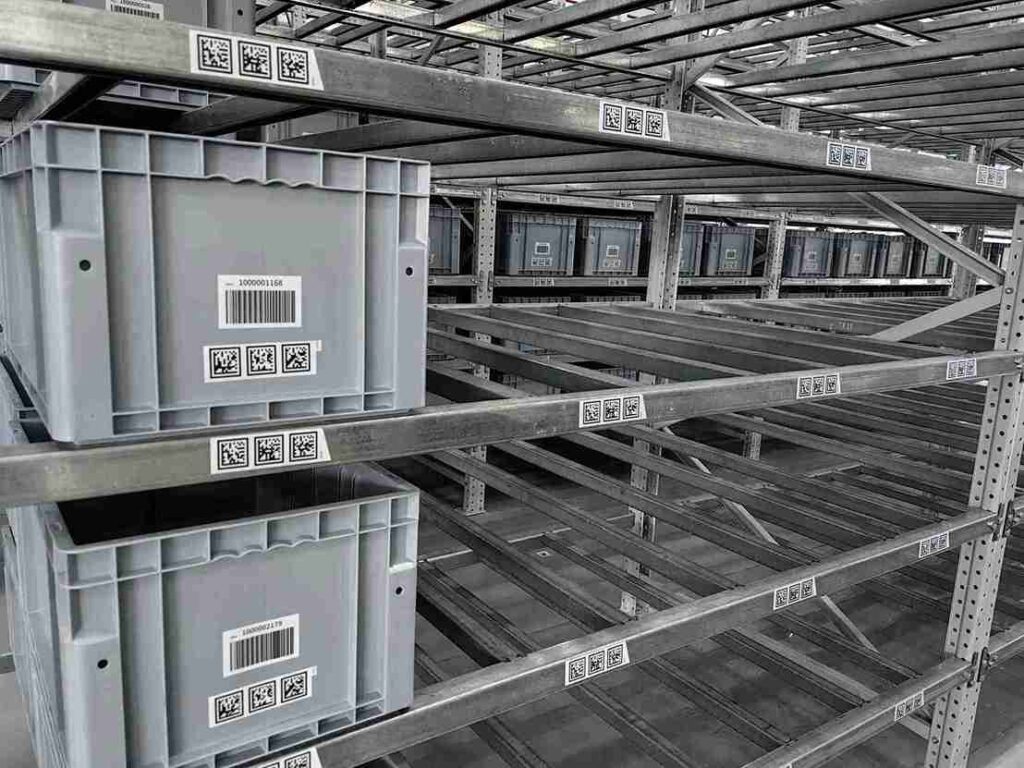
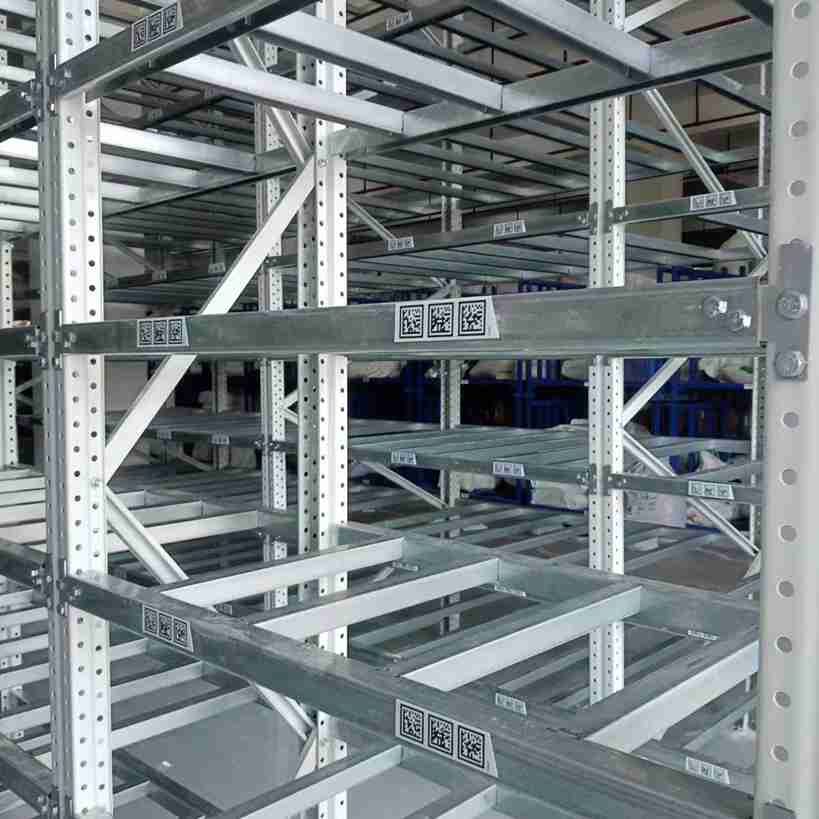
The Data Layer: Barcode Integrity and Human-Readable Clarity. The barcode—typically a high-density Code 128 or a data-rich QR Code—is the machine interface. Its print quality, quiet zones, and size are critical. A barcode on a pallet rack label must be scannable from the operational position of the equipment, whether that’s a forklift driver seated several meters away or an order picker at ground level. The human-readable text, however, is the essential fail-safe. It must present the location ID (e.g.,
A-05-02-01) in a high-contrast, sans-serif font with a logical hierarchy, ensuring instant comprehension even if a scanner is unavailable or malfunctions.The Psychology of Placement: Consistency is King. The physical placement of the pallet rack label is perhaps the most violated yet critical rule. Every label must be positioned in a consistent, predictable location on the rack upright. The global standard is on the face of the upright, at the left-hand side of the bay opening (from the operator’s perspective), at a height aligned with the beam for that level. This consistency builds muscle memory and scanning rhythm. Inconsistent placement of pallet rack labels across aisles forces workers to “hunt,” reintroducing the very search time the system aims to eliminate.
A Blueprint for Transformation: The Phased Implementation of a Fault-Tolerant Labeling System
Achieving the promised 90% error reduction is a systematic engineering project, not an artisanal endeavor. Leading logistics consultants deploy a rigorous, multi-phase methodology adaptable to any global market’s unique challenges.
Phase 1: The Diagnostic Audit – Quantifying the Status Quo
The journey begins with a clear-eyed assessment. A comprehensive audit, such as the offered Free Warehouse Labeling Audit, moves beyond a visual check. It involves quantifiable metrics:
Label Health Index: A statistical sampling to determine the percentage of existing pallet rack labels that are missing, damaged, unscannable, or non-compliant with a proposed standard.
Process Error Baseline: Analyzing historical pick accuracy reports and conducting real-time shadow picks to establish a pre-implementation error rate.
Time-Motion Analysis: Measuring the average time taken for workers to complete locate-scan-verify cycles with the old pallet rack labels versus the potential with an optimized system.
This data creates an undeniable business case, pinpointing the exact cost of inaction.
Phase 2: Strategic Scheme Design and Material Selection
Here, the warehouse’s addressing system is architected. The labeling scheme must be logical, hierarchical, and infinitely scalable.
Logical Hierarchy: A typical scheme flows from macro to micro:
[Aisle]-[Bay/Section]-[Level]-[Position]. This structure must mirror the warehouse’s logical layout in the WMS.Scalability: The scheme must accommodate future expansion. Using alphanumeric characters for aisles (A, B, AA, AB) allows for insertions. The design of the pallet rack labels themselves must also be future-proof, perhaps incorporating space for RFID inlays or using formats compatible with emerging scanning technologies.
Material Specification: Based on the audit, a “label prescription” is issued. For a food-grade facility, this might be a white polypropylene label with NSF-certified adhesive. For a heavy-industrial setting, it could be a metallic polyester label resistant to oils and solvents. The choice of pre-printed serialized rolls versus on-demand printing is also made here, balancing consistency, cost, and flexibility.
Phase 3: Execution: The “Big Bang” or Controlled Rollout
Implementation is a logistical operation. For a “Big Bang” overhaul, a specialized crew works during a scheduled shutdown, systematically replacing every pallet rack label in the facility according to master maps. This approach delivers immediate, universal clarity. For 24/7 operations, a phased, zone-by-zone rollout is executed. Each zone is completely relabeled, its WMS data reconciled, and its staff trained before moving to the next, ensuring no operational discontinuity. In both scenarios, each new pallet rack label is scanned upon application to validate its inclusion in the digital master database.
Phase 4: System Integration – Creating the Digital Twin
The physical pallet rack labels are only half of the solution. The other half is their perfect digital counterpart in the WMS. This phase involves meticulous data work: purging ghost locations from the system, uploading the new, clean location master file, and verifying that every scan of a physical pallet rack label returns the correct digital location profile. This creates a true “digital twin” of the storage infrastructure, where the physical and virtual worlds are in absolute sync.
Phase 5: Sustaining Peak Performance: Governance and Culture
The final phase ensures the gains are permanent. It involves:
Structured Training: Educating all personnel not just on how to use the new pallet rack labeling system, but why it exists and how it benefits their daily work.
Governance Protocol: Appointing “Label Stewards” responsible for weekly audits, managing the on-site label printer for repairs and additions, and controlling the change management process for any rack reconfiguration. A damaged pallet rack label is treated with the same urgency as a broken forklift—it is a direct threat to productivity.
Performance Monitoring: Establishing ongoing KPIs like first-pass scan rate and pick accuracy to monitor the health of the pallet rack label ecosystem.
The Direct Link to Accelerated Picking Speed
The mechanism by which superior pallet rack labels instantaneously boost picking speed is rooted in cognitive ergonomics and process streamlining. A picker equipped with an RF scanner and a task list no longer engages in a visual search. The WMS directs them to a precise coordinate, e.g., F-12-03-01. The picker proceeds to Aisle F, Section 12, and finds the pallet rack label for Level 3, Position 1 exactly where expected—consistent in placement, pristine in condition, and instantly scannable from a distance.
The “search-and-verify” loop is eliminated. The worker’s task transitions from problem-solving to simple, rapid execution. This reduction in non-value-added activity routinely translates to a 25-40% increase in picks per hour, a gain realized from the very first shift after implementation. The pallet rack label, in this context, acts as a high-precision signpost in a previously confusing landscape.
Pallet Rack Labels as the Cornerstone of Automation
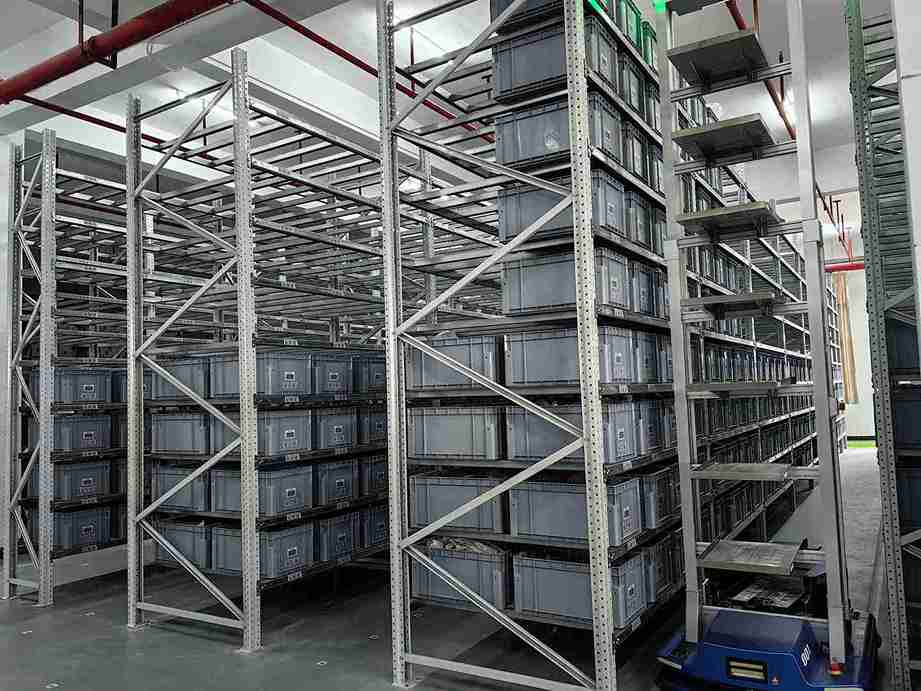
For businesses investing in AGVs (Automated Guided Vehicles), AS/RS (Automated Storage and Retrieval Systems), or robotic picking arms, the role of the pallet rack label evolves from guide to essential data landmark. An AGV does not interpret its surroundings like a human; it follows a digital map to a specific coordinate. That coordinate must be physically validated.
Machine-vision-guided AGVs or drones often use the pallet rack labels themselves as fiducial markers—high-contrast, precisely positioned visual targets—to confirm their location and correct for minute navigational drift. Similarly, in a semi-automated picking system, a robot might be directed to G-07-04-02 and will use a visual scan of the pallet rack label at that position to confirm alignment before extending its gripper. Therefore, the quality, consistency, and machine-readability of the pallet rack labels directly impact the reliability and uptime of the automation. They form the indispensable physical layer of the Internet of Things (IoT) within the smart warehouse.
The Compelling Economics: Total Cost of Ownership vs. Cost of Chaos
The financial argument for a professional pallet rack labeling system is overwhelmingly persuasive when framed as an avoidance of cost rather than an expenditure. A detailed Total Cost of Ownership (TCO) analysis contrasts two scenarios for a typical 50,000-sq.-ft. distribution center:
Scenario A: The Cost of Chaos (Annual)
Error Correction: 8 mis-picks/day x $250 avg. cost x 260 days = $520,000
Labor Inefficiency: 15 FTEs x $18/hr x 25% wasted search time x 2,080 hrs = $140,400
Extended Cycle Counts: 3 extra days of full-staff counting x 20 staff x $15/hr = $7,200
Total Annual Avoidable Cost: $667,600
Scenario B: Investment in a Professional Pallet Rack Labeling System
Audit & Design: $7,000
Industrial-Grade Labels & Materials (for 8,000 locations): $15,000
Professional Installation Labor: $10,000
WMS Integration & Data Cleansing: $12,000
Training & Governance Setup: $6,000
Total One-Time Investment: ~$50,000
The Return on Investment (ROI) is calculated not over years, but often within a single quarter. The subsequent years realize pure profit gain from the eliminated waste. The pallet rack labels, in this light, are not an expense but the highest-yielding asset on the balance sheet.
Innovation on the Horizon: The Next Generation of Pallet Rack Labels
The evolution of the pallet rack label continues, integrating with broader Industry 4.0 trends.
RFID-Enabled Labels: These labels embed a passive UHF RFID tag alongside the barcode. This allows for lightning-fast, bulk inventory checks without line-of-sight scanning. A worker with a handheld reader can walk down an aisle and capture every tagged location and its associated pallet content in seconds, revolutionizing inventory accuracy.
Dynamic E-Ink Displays: In highly dynamic, shared storage environments, fixed pallet rack labels can be supplemented with low-power, wireless e-ink displays. These digital labels can change the displayed SKU or lot number information via the WMS, providing ultimate flexibility for maximized space utilization.
Augmented Reality (AR) Integration: A QR code on a standard pallet rack label can serve as an AR anchor. When viewed through smart glasses or a tablet, the label “comes alive,” overlaying digital instructions, graphics, or safety information onto the worker’s field of view, blending the physical and digital worlds seamlessly.
Conclusion
In the complex equation of warehouse optimization, the variable with the highest leverage is unequivocally the pallet rack label. It is the fundamental conduit of information between the physical inventory and the digital management system. A strategic, engineered approach to pallet rack labeling is the most direct and proven path to radical error reduction and dramatic gains in picking productivity. It is the essential prerequisite for any meaningful automation and the bedrock of a scalable, resilient logistics operation.
For businesses in the dynamic markets of Southeast Asia, the Middle East, Africa, and Latin America, investing in a world-class pallet rack labeling system is not a tactical improvement; it is a strategic imperative that separates market leaders from the rest. The journey to operational excellence begins with the deliberate, expert application of a simple, yet profoundly powerful, tool: the pallet rack label.
Frequently Asked Questions (FAQs)
1. How do you determine the optimal scan range and size for the barcodes on our pallet rack labels?
The specification is driven by the scanning technology and typical operational distances. For forklift-mounted scanners, the barcode on the pallet rack label must be legible from 10-15 feet away. This requires calculating the minimum “X-dimension” (bar width) based on the scanner’s capability. A professional audit will measure these distances and specify a barcode size (often 4-6 inches wide) and a quiet zone margin to ensure a 99.9%+ first-pass scan rate. Using a lower-density symbology like Code 128 instead of Code 39 also enhances long-range readability.
2. Our warehouse uses multiple storage media besides pallet racking, like bulk floor storage and mezzanines. How does the labeling scheme unify these?
A comprehensive labeling system must encompass all storage locations under a single, logical umbrella. The scheme for pallet rack labels forms the core (e.g., R- prefix for Racking). Bulk floor locations can be assigned a F- prefix with grid coordinates (e.g., F-A-12). Mezzanine levels might use M1- or M2- as a prefix before adopting a similar bay-level-position logic. The key is that all labels, regardless of media, follow a consistent format and data structure, creating a unified “address book” for the entire facility within the WMS.
3. What is the expected lifespan of these industrial-grade pallet rack labels, and what is the replacement protocol?
High-quality polyester or polypropylene pallet rack labels with proper laminate and adhesive, installed in a standard indoor environment, have a functional lifespan of 8-12 years. Replacement is typically driven by physical damage (forklift impact) or major reconfiguration, not by degradation. The governance protocol should include a process for reporting damaged labels. The on-site label printer is then used to produce an exact replica using the saved template and serialized data, ensuring the replacement pallet rack label is identical to the original, maintaining system integrity.
4. Can this system work in a warehouse with very low literacy rates or multilingual workforces?
Absolutely. In fact, a well-designed pallet rack labeling system reduces dependency on language skills. The primary interface is the scannable barcode, which requires no literacy. The human-readable text uses a universal, logical numbering system (e.g., 01-02-03) that is easier to recognize and communicate than descriptive text. Training focuses on the process (scan the location, then scan the item) rather than reading. The consistency and visual clarity of the pallet rack labels themselves become the universal language of the warehouse floor.
5. We are implementing a new WMS concurrently. Should we do the pallet rack labeling project before or after the WMS go-live?
The ideal sequence is to execute the pallet rack labeling project immediately before the WMS go-live. The new, clean, and accurate physical labeling scheme should be fully deployed and validated. This clean physical data set then becomes the foundation for populating the location master file in the new WMS. Migrating to a new system with an ambiguous or flawed physical layout dooms the project from the start. Implementing pristine pallet rack labels first ensures the new WMS is built on a “single source of truth,” dramatically accelerating user adoption and realizing the promised ROI of the software much faster.
If you require perfect CAD drawings and quotes for warehouse racking, please contact us. We can provide you with free warehouse racking planning and design services and quotes. Our email address is: jili@geelyracks.com