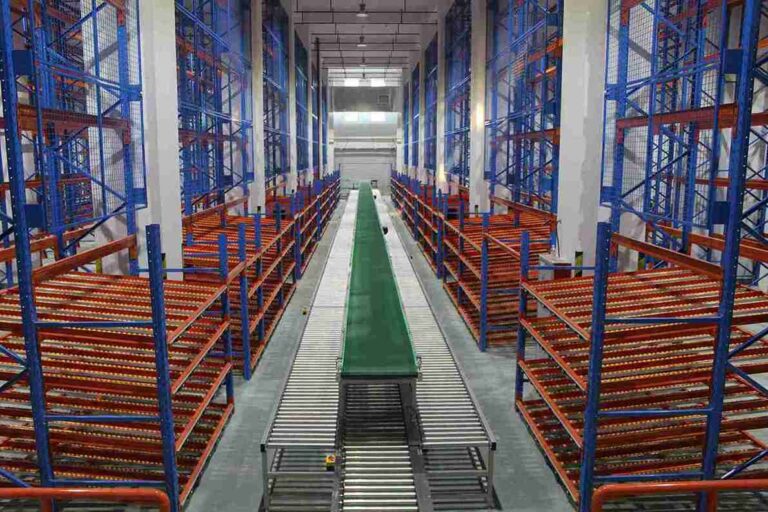
📐 "First 50 Enterprise Queries Get Custom 3D Warehouse Design" Plan
















The Unbeatable Logic of Pallet Flow Racking: Engineering Peak Performance for Modern Distribution
Article Summary:
This definitive resource explores the operational supremacy of pallet flow racking in high-velocity environments. Dismissing superficial overviews, it delivers a master-level exposition on the physics, economics, and strategic implementation of gravity-flow storage systems. Readers will gain an exhaustive understanding of how pallet flow racking enforces flawless inventory rotation, unlocks profound labor efficiencies, and forms the indispensable high-density backbone of scalable fulfillment networks.
The discourse extends into advanced integration with warehouse technology, meticulous design methodologies, and long-term operational calculus, providing logistics decision-makers with the actionable intelligence required to justify, specify, and leverage this transformative technology for a dominant market position.

The Inevitable Evolution: Why Static Storage Is a Strategic Liability
In the arithmetic of contemporary logistics, static storage represents a compounding liability. Every minute a picker spends walking, searching, or waiting for replenishment is a direct tax on throughput and profitability. For operations burdened by thousands of SKUs, the volatility of consumer demand, and the non-negotiable requirement for perfect stock rotation, conventional shelving and pallet racking are fundamentally misaligned with operational goals.
They institutionalize waste: waste of space, waste of time, and waste of product. The shift to dynamic storage is not merely an upgrade; it is a necessary correction to a flawed model. Herein lies the compelling case for pallet flow racking, a system that replaces rigid structure with intelligent movement, transforming the warehouse floor from a repository into a kinetic, optimized engine of distribution.
The Mechanics of Mastery: A Deep Dive into Gravity-Flow Design
To appreciate the output, one must understand the machinery. A pallet flow racking system is a symphony of precision-engineered components, each critical to its relentless, reliable operation.
The Inclined Plane: Each lane is a carefully calibrated slope. This incline is not arbitrary; it is calculated based on the weight range and bottom condition of the specific pallets to be stored. The fundamental principle is that the gravitational force component pulling the pallet down the lane must exceed the rolling resistance of the carriage system.
The Carriage System: This is the heart of the flow racking. Two primary types dominate:
Wheel Carriages: Utilizing rows of tapered, high-capacity wheels, these are ideal for uniform, flat-bottomed pallets (e.g., solid wood, GMA). They offer very low rolling resistance, facilitating smooth movement.
Roller Carriages: Employing robust steel rollers, these systems are better suited for pallets with irregular bottoms (e.g., stringer pallets, block pallets) or heavier, more rigid loads. They provide a larger contact surface and superior durability.
The Speed Regulation System: This is the brain of the operation. Without it, gravity would accelerate pallets to an unsafe impact at the pick face. Braking systems, either mechanical friction brakes or precision hydraulic dampers, are installed at the discharge end. They ensure pallets decelerate and arrive at the pick position gently and predictably, regardless of load weight, guaranteeing safety for personnel and product integrity.
Lane Separators and Guides: These critical components maintain the defined path of the pallet, preventing lane intrusion and ensuring smooth, aligned travel from load to pick face.
This orchestrated interaction between slope, carriage, and brake is what defines high-performance pallet flow racking. It is this engineered reliability that allows operations to run with unwavering confidence in the system’s behavior.
The FIFO Imperative: How Pallet Flow Racking Eliminates Human Error and Financial Waste
First-In, First-Out is a simple accounting principle that becomes notoriously difficult to enforce in a chaotic warehouse. Relying on signage, training, and WMS alerts is a defensive, fallible strategy. Pallet flow racking makes FIFO an inherent, physical law of the storage medium. The lane structure itself is a one-way street. A newer pallet loaded at the rear cannot physically pass an older pallet ahead of it. This architectural guarantee is transformative for industries like food and beverage, pharmaceuticals, cosmetics, and chemicals, where shelf life is paramount.
The financial impact is direct and substantial. It obliterates the costly cycle of discovering expired, obsolete stock during inventory counts—stock that must be written off. It ensures customers never receive product nearing its expiration, protecting brand reputation. Furthermore, it streamlines cycle counting and inventory audits. The inventory record in the WMS perfectly mirrors the physical sequence in the lane, reconciling the digital and physical worlds with unprecedented accuracy. This built-in compliance is a cornerstone of the value proposition for pallet flow racking systems.
Deconstructing Productivity Gains: The Multiplicative Effect on Labor Efficiency
The promise of a 30%+ reduction in picking time is a composite of several synergistic efficiencies generated by a pallet flow racking installation. It is not a single improvement but a cascade of them:
The Eradication of Non-Value Travel: In a conventional pick-to-order operation from static racks, a picker’s route is a inefficient scatter plot. With pallet flow racking, the “goods-to-person” principle is partially realized. The pick face becomes a condensed, linear workstation. Travel is reduced to walking along a line of presented SKUs, harvesting items in a continuous, fluid motion. This is the most significant contributor to time savings.
The Elimination of Search and Verification: Cognitive load is a hidden productivity killer. A picker hunting for a location label, confirming a SKU, or digging for the right case is not picking. In a pallet flow racking bay, the product is always in the exact, expected position at the front. This allows pickers to operate on muscle memory and visual confirmation, dramatically speeding up the pick cycle and reducing errors.
The Decoupling of Replenishment from Picking: This is a strategic advantage often underestimated. Replenishment activities, typically involving forklifts and heavy loads, are inherently disruptive to the fine-tuned rhythm of order picking. Pallet flow racking spatially separates these functions. Forklifts load from the rear aisle, while pickers work undisturbed from the front aisle. This parallel processing eliminates downtime and conflict, allowing both functions to operate at their maximum potential throughput simultaneously.
Enhanced Ergonomics and Safety: By presenting pallets at an optimal, consistent height at the pick face, pallet flow racking minimizes bending, stretching, and climbing. This reduces physical fatigue, lowers the risk of musculoskeletal injuries, and contributes to higher morale and sustained productivity over a full shift. A safer, more comfortable worker is a more efficient and reliable asset.
When these factors are combined—less travel, zero search, parallel processes, and better ergonomics—the cumulative gain routinely meets and exceeds the 30% benchmark, fundamentally altering the labor cost structure of the operation.
The Design Phase: Where Science Meets Operational Reality
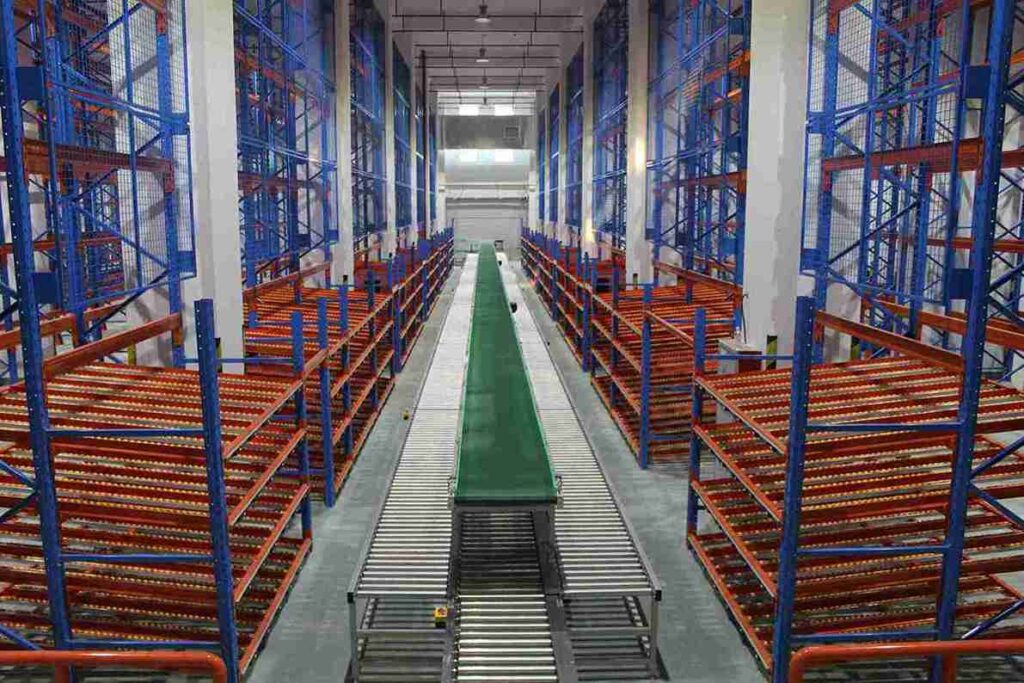
Purchasing pallet flow racking is not a transactional event; it is the commencement of an engineering partnership. The system’s performance is entirely predicated on a design rooted in the client’s specific operational data. A professional provider will insist on a deep-dive analysis encompassing:
SKU Stratification (ABC Analysis): Not all inventory deserves a prime position in a pallet flow racking lane. A rigorous analysis categorizes SKUs by velocity (units moved per period). “A” items, the fastest movers, are assigned to the most accessible lanes. “B” and “C” items may be allocated to deeper lanes or alternative storage media. This stratification ensures the high-cost, high-benefit flow racking real estate is reserved for the inventory that will generate the highest return.
Lane Depth Optimization: The choice between a 4-pallet-deep lane and a 10-pallet-deep lane carries significant operational implications. Deeper lanes offer higher storage density and less frequent replenishment but require a larger commitment to a single SKU per lane. The optimal depth is a calculated balance between inventory turn rate, available warehouse space, and desired replenishment labor frequency. Sophisticated modeling is used to determine this critical parameter.
Throughput Capacity Modeling: Each lane in a pallet flow racking system has a maximum sustainable throughput based on the roll speed and pick face clearance time. The overall system design must ensure the number of lanes per SKU and the pick face accessibility can handle peak order volumes without creating a bottleneck. This requires simulating pick waves and replenishment cycles against the physical configuration.
The Digital Symbiosis: Integrating Pallet Flow Racking with WMS and Automation
A pallet flow racking system operates in perfect harmony with a modern Warehouse Management System (WMS). The WMS is the conductor; the flow racking is the orchestra. The WMS dictates the put-away location based on its FIFO logic and inventory profiling, directing the forklift operator to the correct rear-load lane. At the pick face, the integration becomes even more powerful. Pick-to-light systems can be mounted directly on the pallet flow racking structure, guiding pickers with unerring accuracy and validating each pick. Voice-picking systems seamlessly direct workers along the condensed pick path.
For operations incorporating higher levels of warehouse automation, pallet flow racking serves as the perfect high-density buffer. It can be the source lane for an automated depalletizing cell, or the destination for an Automated Guided Vehicle (AGV) performing automated replenishment. The predictable, organized output of a pallet flow racking system is the ideal feedstock for any downstream automated sortation or packing system. This interoperability makes it a future-proof investment, acting as a performance multiplier within a broader automated ecosystem.
The Implementation Crucible: Why Professional Commissioning is Non-Negotiable
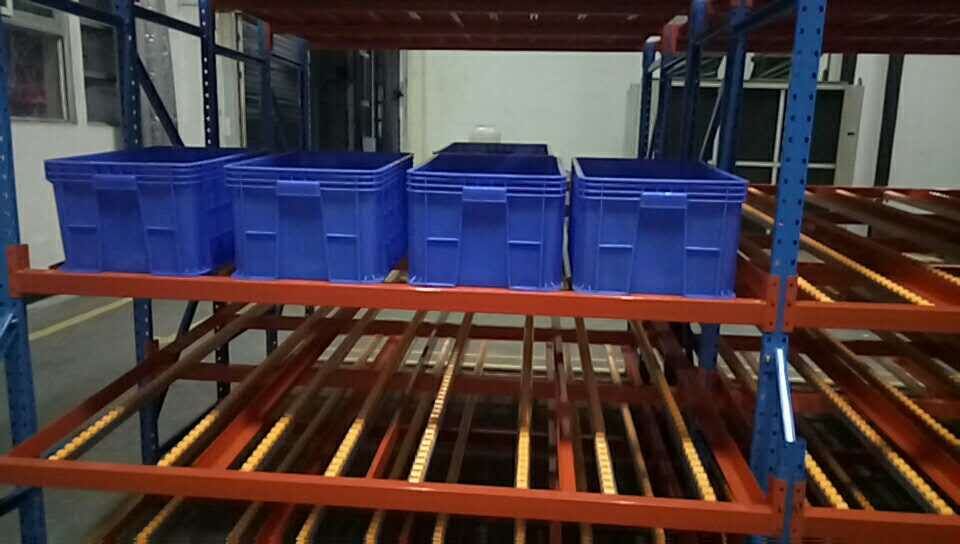
The final, and often most critical, phase of a pallet flow racking project is commissioning. This is where theoretical design meets physical reality. The system’s performance hinges on the precise calibration of the incline and braking system for the actual pallets and products in use.
A professional team does not simply bolt the racks together and leave. They conduct a structured load-in and testing procedure:
Pallet Sampling: Testing begins with a representative sample of the client’s pallets, loaded with typical product weight.
Dynamic Calibration: The braking system is adjusted lane-by-lane to ensure a consistent, controlled descent. The goal is a smooth arrival at the pick face without impact, regardless of whether the lane is fully loaded or nearly empty.
Performance Validation: The entire lane is loaded and cycled to simulate real-world operation, verifying that pallets flow reliably without jamming, stalling, or causing cross-lane interference.
This meticulous, hands-on commissioning is the definitive factor that separates a system that works in a catalog from one that delivers flawless, day-one operational performance. It is an indispensable service that safeguards the client’s investment.
Conquering the Returns Vortex: Applying Flow Logic to Reverse Logistics
The returns processing area is frequently the neglected underbelly of e-commerce, a chaotic space where efficiency vanishes. Pallet flow racking offers a powerful tool to bring order to this chaos. Dedicated flow racking lanes can be established in the Returns Merchandise Authorization (RMA) zone. As returned cartons or pallets are received, they are placed into assigned lanes. The gravity-flow principle then organizes the workflow: items move toward inspection and sorting stations in a controlled FIFO sequence.
This ensures returns are processed promptly for credit issuance, prevents the formation of chaotic piles, and efficiently channels restockable items back into the forward-pick pallet flow racking lanes. It applies the same principles of density, access, and rotation to transform a cost center into a streamlined recovery operation.
The Financial Calculus: Quantifying the Return on Investment (ROI)
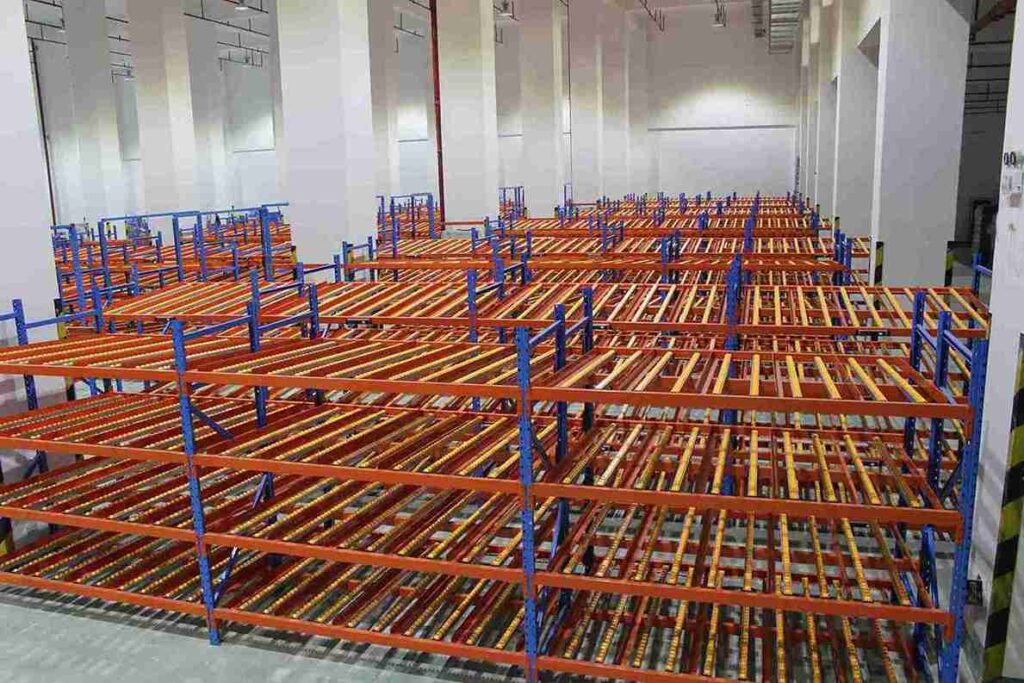
Justifying the capital expenditure for a pallet flow racking system requires a robust financial model that captures both hard and soft benefits. A comprehensive ROI analysis will quantify:
Direct Labor Savings: Calculated from the measurable reduction in pick times and the consolidation of pick paths.
Space Savings: The increased storage density of pallet flow racking (often a 40-60% improvement over selective racking) can defer or eliminate the need for costly warehouse expansion.
Inventory Shrinkage Reduction: The elimination of expired and lost stock through enforced FIFO directly improves gross margin.
Accuracy Improvement: Reduced picking errors lower the cost of returns processing, re-shipping, and customer service remediation.
Safety Cost Avoidance: A reduction in ergonomic injuries and forklift-pedestrian conflicts translates into lower insurance premiums and lost-time incidents.
When these variables are modeled over a 5-7 year period, the payback timeline for a pallet flow racking system is frequently compelling, often falling between 18 to 36 months, after which the system generates continuous annual operational savings.
Navigating Standards and Safety: The Compliance Framework
A high-density pallet flow racking installation is subject to rigorous industry standards and local building codes. Reputable manufacturers design and certify their systems to comply with standards set by bodies like the Rack Manufacturers Institute (RMI) and the Federation Européenne de la Manutention (FEM). Key considerations include:
Seismic Design: In active zones, the dynamic forces on tall, dense racking must be meticulously engineered.
Fire Protection: Systems exceeding certain height thresholds will mandate in-rack sprinkler systems. The design of the pallet flow racking must incorporate necessary clearances and mounting points for these life-safety systems from the outset.
Load Notices and Inspections: Professional installers provide clear load capacity notices. Furthermore, they recommend and often provide training for regular, documented rack inspection protocols to ensure ongoing structural integrity.
Engaging a supplier with deep expertise in these regulatory landscapes is not optional; it is a fundamental aspect of risk management and operational continuity.
The Strategic Verdict: Building an Unassailable Competitive Advantage
In the final analysis, the decision to implement pallet flow racking transcends equipment procurement. It is a strategic commitment to operational excellence. In sectors where logistics performance is a primary competitive differentiator—e-commerce, retail distribution, third-party logistics, and manufacturing—the ability to move more product, with greater accuracy, in less time, and with lower operational risk is the definition of market leadership.
A well-designed pallet flow racking system provides the physical infrastructure for that leadership. It enforces discipline in inventory management, liberates latent labor capacity, and creates a scalable platform for growth and technological integration. It is a proven, reliable technology that continues to deliver unrivaled value in the dynamic world of material handling. For executives and managers charged with optimizing the supply chain, mastering the application of pallet flow racking is not a tactical choice; it is a strategic imperative for those intending to lead, not merely participate, in the market.
FAQs: Smart Pallet Flow Racking Systems
1. What level of ongoing maintenance does a pallet flow racking system require, and what does it entail?
A properly commissioned pallet flow racking system requires minimal but essential preventive maintenance. It is not a “install and forget” asset. A quarterly inspection regimen is recommended, focusing on: checking for and removing debris from rollers/wheels; inspecting brake cartridges for wear and proper function; verifying that lane dividers and guide rails are secure and undamaged; and ensuring structural bolts remain tight. Most components are modular and can be replaced individually without dismantling an entire lane. The simplicity of the system is a key maintenance advantage; there are no motors, drives, or software to maintain, only mechanical components that are easily inspected and serviced.
2. How does pallet flow racking perform in cold storage or food-grade environments?
Pallet flow racking is exceptionally well-suited for harsh environments. For cold storage applications, systems are constructed from high-grade steel with appropriate low-temperature finishes to prevent embrittlement. Specialty lubricants are used in braking systems to ensure consistent performance at sub-zero temperatures. For food-grade and pharmaceutical facilities, systems can be designed with fully sealed, wash-down compatible rollers and brakes, and constructed with stainless steel or specially coated steels that resist corrosion from cleaning agents. The smooth surfaces and lack of catch points also facilitate hygiene protocols.
3. Can a pallet flow racking system be reconfigured if our product profile or business needs change?
A significant advantage of modular pallet flow racking is its inherent flexibility. Lanes can be reconfigured in depth by adding or removing carriage sections. The racking framework itself, if designed with adaptability in mind, can often be adjusted in beam heights and re-bayed to accommodate different lane layouts. While not as easily rearranged as standalone shelving, a competent systems provider can often execute significant reconfigurations during planned downtime, allowing the storage system to evolve alongside the business without requiring a complete rip-and-replace.
4. What is the realistic lifespan of a professionally installed pallet flow racking system?
With proper installation, loading, and basic preventive maintenance, a high-quality pallet flow racking system has an exceptionally long operational lifespan, often exceeding 20-25 years. The structural racking itself, if not physically damaged, can last the life of the facility. The wearable components—the rollers, wheels, and brake cartridges—are subject to wear based on cycle frequency but are designed as replaceable items. The long-term value is profound; the system represents a one-time capital investment that delivers operational savings for decades, with only minor ongoing parts replacement costs.
5. How do we accurately compare quotes from different pallet flow racking suppliers?
A true comparison must move beyond price-per-lane-foot. Scrutinize the specification sheet: compare the gauge and grade of structural steel, the load capacity and brand/type of rollers or wheels, the technology and adjustability of the braking system, and the corrosion resistance of finishes. Critically, evaluate the services included: Does the quote encompass detailed design engineering, professional commissioning/load testing, and comprehensive installation drawings? A lower upfront cost that excludes these critical services often leads to higher total cost and performance issues. Finally, assess the supplier’s industry experience and project references specific to your sector, as this directly informs the quality of their design recommendations.
If you require perfect CAD drawings and quotes for warehouse racking, please contact us. We can provide you with free warehouse racking planning and design services and quotes. Our email address is: jili@geelyracks.com