📐 "First 50 Enterprise Queries Get Custom 3D Warehouse Design" Plan















Double Deep Pallet Racking: The Definitive Technical and Strategic Guide for Maximizing Warehouse Capacity in Growth Markets
Executive Summary: A Paradigm Shift in Storage Strategy
For logistics managers, warehouse operators, and business owners across the bustling industrial landscapes of Southeast Asia, the Middle East, Africa, and Latin America, the equation is relentlessly challenging: inventory requirements are climbing, but physical space and capital for expansion are constrained. The solution for countless forward-thinking operations lies not in costly outward expansion, but in a fundamental redesign of internal storage architecture.
At the forefront of this internal optimization movement is double deep pallet racking. This comprehensive guide, crafted from decades of field engineering and strategic implementation, delves beyond superficial specifications to explore how a properly engineered double deep pallet racking system can systematically increase usable storage density by 40% or more. It dissects the intricate interplay between structural design, material handling equipment (MHE), warehouse management software (WMS), and regional operational realities.
The objective is to equip decision-makers with the nuanced understanding required to evaluate double deep pallet racking not as a mere commodity purchase, but as a transformative capital investment that redefines storage efficiency, operational throughput, and long-term scalability.
Chapter 1: The Anatomy of Inefficiency in Conventional Warehousing
The traditional warehouse, often reliant on single-deep selective racking, is a landscape dominated by empty space. Aisles, necessary for forklift access to every single pallet position, can consume 45% to 55% of the total floor area. This design, while offering maximum selectivity and direct access to every SKU, represents a significant underutilization of valuable real estate. For a distribution center in Manila or a raw materials warehouse in Johannesburg, this translates to paying premiums for lighting, cooling, and security on space that stores nothing but air.
The geometric inefficiency is stark. Each storage lane, holding one pallet deep, is flanked by access aisles on both sides in a typical configuration. The proliferation of these aisles is the primary antagonist in the battle for density. The double deep pallet racking system enters this scenario as a tactical redesign, attacking the problem of aisle proliferation at its root. By configuring storage lanes to hold two pallets deep, the double deep pallet racking design immediately halves the number of required access aisles. This simple yet profound shift in layout philosophy is the cornerstone of the dramatic space recovery that makes double deep pallet racking a compelling investment for space-starved operations globally.
Chapter 2: Structural and Functional Mechanics of Double Deep Systems
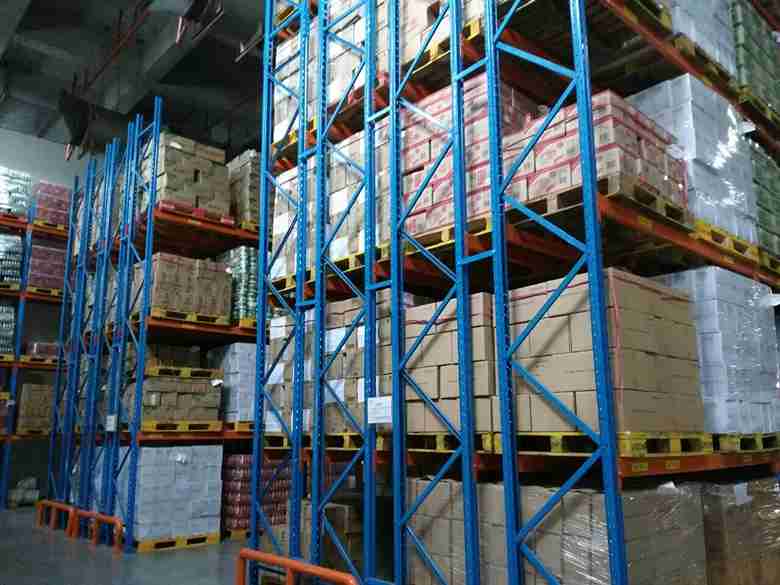
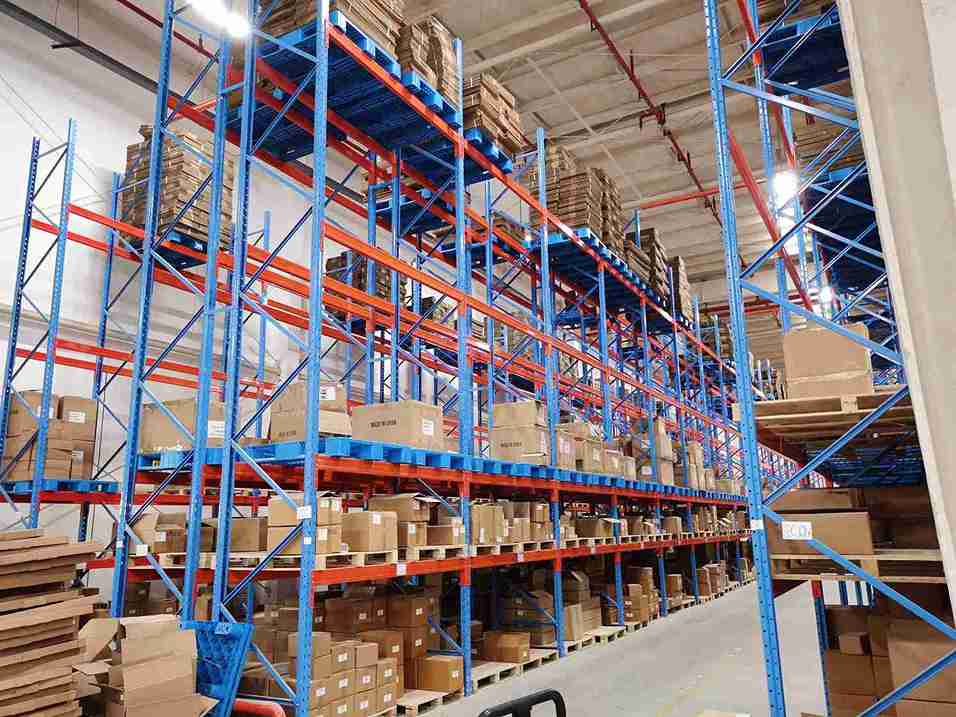
A double deep pallet racking structure is characterized by its continuous lane design. Upright frames are spaced and connected by load beams to create storage openings that are two standard pallets deep. Unlike drive-in racking, there is no internal guide structure for forklifts; the integrity of the double deep pallet racking system relies on the precision of the pallet placement and the specialized equipment used for handling.
The operational heart of any double deep pallet racking installation is the retrieval mechanism. Standard counterbalance forklifts are rendered obsolete in this environment. The primary solutions are:
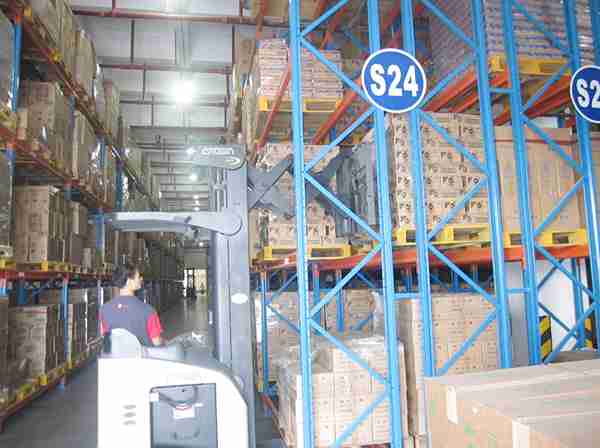
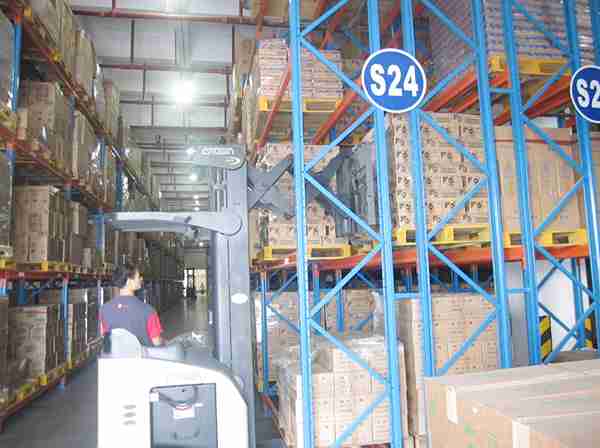
Deep-Reach (Double-Reach) Forklifts: These are the most common and versatile partners for a double deep pallet racking system. Equipped with a telescoping fork mechanism, the forklift remains in the main aisle while its forks extend past the first pallet to engage and retrieve the second. The mast design allows for operation at height, making the double deep pallet racking system effective even in high-bay warehouses.
Pallet Shuttles (Semi-Automated): For operations prioritizing speed, FIFO inventory management, or cold storage environments, shuttle systems integrate seamlessly with double deep pallet racking. A battery-powered shuttle is placed by a standard forklift into the lane of the double deep pallet racking system. The shuttle then transports pallets to and from the rear position autonomously, significantly reducing cycle times and operator workload.
The choice between these methods is a critical strategic decision that impacts the efficiency, cost, and inventory flow of the entire double deep pallet racking operation.
Chapter 3: The Density Dividend: A Mathematical and Operational Reality
The promised 40%+ increase in storage density from a double deep pallet racking system is not a marketing hyperbole; it is a predictable outcome of warehouse geometry. Consider a practical scenario in a 12,000 square meter facility in Thailand, used for storing consumer packaged goods.
Baseline (Selective Racking): With 3.5-meter aisles for counterbalance forklifts, aisles consume ~50% of floor space. Effective storage footprint: ~6,000 sqm. With 6-high racking, total positions may reach ~9,500.
Optimized with Double Deep Pallet Racking: Aisle count is halved. Aisle width for deep-reach trucks can be reduced to ~2.8 meters. Aisle footprint drops to ~35-38% of total area. Effective storage footprint jumps to ~7,500 sqm. Within the same cube, the double deep pallet racking configuration can achieve approximately 13,600 pallet positions.
This net gain of over 4,100 positions represents a 43% increase in storage capacity within the same four walls. For a 3PL in the UAE or a manufacturing plant in Mexico, this density dividend can delay multi-million dollar expansion projects for years, offering an exceptional return on investment (ROI). The double deep pallet racking system effectively monetizes previously wasted aisle space.
Chapter 4: Synergy with Automation: The Next Evolution of Double Deep Racking
The true potential of a double deep pallet racking system is unlocked when integrated with modern automation, creating a highly dense yet dynamically accessible storage solution. This synergy is particularly relevant for markets experiencing rapid e-commerce growth and labor cost inflation.
AGV and Unmanned Forklift Integration: The layout of a double deep pallet racking warehouse—with its defined, reduced number of long aisles—is ideal for automated navigation. Laser-guided unmanned forklifts or AGVs equipped with deep-reach mechanisms can service double deep pallet racking lanes 24/7. The WMS dispatches retrieval tasks, and the vehicle navigates to the exact lane, executes the reach operation, and delivers the pallet to a transfer point. This integration transforms the double deep pallet racking area from a static storage zone into a high-throughput, automated buffer, minimizing labor costs and maximizing uptime.
Warehouse Management System (WMS) as the Conductor: The efficiency of any double deep pallet racking system is heavily dependent on software intelligence. A robust WMS must perform advanced lane profiling. It knows the exact contents and load dates of both the front and rear pallet in every lane of the double deep pallet racking system. It directs put-away to optimize space and minimize future access conflicts, and sequences retrieval orders to reduce “shuffling” or blocking. The WMS ensures the physical double deep pallet racking structure operates at its logical peak.
Gateway to Automated Storage: For many companies, a fully automated AS/RS is a capital hurdle too high. An automated double deep pallet racking system with shuttle robots represents a scalable middle ground. It offers much of the density and goods-to-person efficiency of an AS/RS but with a modular, often more affordable, entry point. This makes advanced automation accessible for mid-sized distributors in Vietnam or Chile looking to gain a competitive edge.
Chapter 5: Critical Evaluation: When Double Deep Racking is the Optimal Choice
A double deep pallet racking system is a powerful tool, but not a universal panacea. Its superiority is context-dependent on specific operational profiles.
Ideal Candidate Profile: The double deep pallet racking system excels where SKU variety is low to medium, but the quantity per SKU is high. Industries such as beverage distribution, packaged food, certain pharmaceuticals, and bulk automotive parts are classic beneficiaries. The system is perfect for housing reserve or buffer stock of fast and medium-moving SKUs, with picking faces located elsewhere in a forward pick zone.
Inventory Rotation Imperative: The primary operational constraint of a standard double deep pallet racking lane is its inherent LIFO (Last-In, First-Out) flow. This is perfectly acceptable for non-perishable, non-date-sensitive goods. Implementing true FIFO within a double deep pallet racking system requires additional technology, such as the aforementioned pallet shuttles or a disciplined “lane-depth cycling” process managed by the WMS.
Throughput and Accessibility Trade-off: While density soars, instantaneous access to every pallet is sacrificed. Retrieving a specific pallet from the rear position requires moving the front pallet if it is a different SKU. Therefore, operations with a very high order line count per SKU or chaotic stock movement may find the access time prohibitive. A detailed activity analysis is crucial before committing to a double deep pallet racking design.
Chapter 6: Regional Engineering Adaptations for Durability and Performance
The successful implementation of a double deep pallet racking system in Jakarta differs markedly from one in Doha or Lagos. Engineering specifications must be tailored to environmental and infrastructural realities.
Southeast Asia – Humidity and Seismicity: In the corrosive, humid climates of Indonesia, Malaysia, and the Philippines, double deep pallet racking components must feature hot-dip galvanized (HDG) corrosion protection as a non-negotiable standard. Furthermore, in seismically active zones, the structural design of the double deep pallet racking system must incorporate seismic bracing and connections rated for local seismic codes. The dynamic forces during an event on a tall, dense double deep pallet racking structure require specialized engineering.
Middle East – Dust and Heat: Fine abrasive dust is a pervasive challenge in GCC countries. For double deep pallet racking systems integrated with automation, shuttle mechanisms and AGV sensors require enhanced sealing and filtration. Additionally, climate control for battery charging rooms serving electric MHE fleets must be engineered to handle extreme ambient temperatures exceeding 45°C (113°F).
Africa – Robustness and Adaptability: Solutions must be durable and sometimes less reliant on consistent grid power. A double deep pallet racking system paired with versatile, easy-to-maintain reach trucks can be a robust solution. The design focus is on mechanical simplicity and structural over-specification to handle sometimes unpredictable load conditions or less-than-ideal operator environments.
Latin America – Scalability and Flexibility: Growing industries require scalable solutions. A double deep pallet racking system can be designed in phases. A company in Colombia might start with a manual reach truck operation, with the racking structure and aisle layout pre-configured to accept AGVs or shuttles in Phase 2. This future-proofing is a key value proposition of a well-planned double deep pallet racking project.
Chapter 7: Comparative Analysis: Double Deep Racking in the Storage Spectrum
Positioning double deep pallet racking against other high-density solutions clarifies its unique value proposition.
vs. Drive-In/Drive-Through Racking: While drive-in systems offer even greater depth (6+ pallets), they require the forklift to enter the rack structure, creating safety risks, slower throughput, and enforcing strict LIFO or FIFO by lane. The double deep pallet racking system offers a superior balance, providing significant density without sacrificing aisle-based safety and with faster access times.
vs. Push Back Racking (3-5 deep): Push back systems offer better selectivity within a lane (each depth level is accessible) but at a higher cost per pallet position due to the intricate carriage and rail system. For a two-deep application, a double deep pallet racking system is generally more cost-effective and mechanically simpler, offering comparable density for 2-deep storage needs.
vs. Mobile Pallet Racking: Mobile systems achieve supreme density by eliminating all but one moving aisle. However, they carry a high initial cost, require exceptionally flat floors, and have slower access times (waiting for aisles to open). The double deep pallet racking system provides faster, simultaneous access to multiple aisles at a lower capital and maintenance cost.
vs. Selective Pallet Racking: This is the core trade-off: the double deep pallet racking system sacrifices direct, 100% selectivity for a 40%+ gain in density. The business case rests on whether the value of the recovered space outweighs the marginal increase in retrieval complexity.
Chapter 8: The Financial Calculus: ROI and Total Cost of Ownership (TCO)
Evaluating a double deep pallet racking project requires a holistic financial model that looks beyond the racking price per pallet position.
Capital Expenditure (CapEx): This includes the double deep pallet racking structure itself, the specialized MHE (deep-reach trucks or shuttles), any required WMS upgrades, and installation costs.
Operational Expenditure (OpEx) Savings: This is where the ROI materializes. Savings are generated from: 1) Deferred or avoided costs of building expansion (land, construction); 2) Reduced energy costs for lighting and HVAC over a smaller effective area; 3) Potential reduction in MHE fleet size (fewer trucks servicing a denser layout); 4) Lower labor costs per pallet stored/retrieved, especially if automation is integrated.
The Intangible Value: The strategic value of increased agility—being able to handle more volume within an existing facility—provides a competitive advantage and business continuity that is difficult to quantify but immensely valuable.
A detailed pro-forma analysis, often provided as part of a professional double deep pallet racking consultation, will project the payback period and lifetime value, clearly demonstrating that the double deep pallet racking system is an asset that pays for itself.
Chapter 9: Implementation Protocol: From Vision to Operational Reality
The transition to a double deep pallet racking system is a significant operational change. A phased, meticulous approach is critical for success.
Phase 1: Data-Driven Feasibility Audit. This involves a deep analysis of inventory data (SKU velocity, cube, weight), current operational metrics, and growth forecasts. Simulation software models different double deep pallet racking layout scenarios against the current baseline.
Phase 2: Collaborative Design Engineering. The optimal double deep pallet racking layout is co-created with client input. This stage finalizes racking specifications, MHE selection, aisle dimensions, and integration points with other warehouse zones. Detailed 3D visualizations and flow simulations are produced.
Phase 3: Specification and Procurement. All components of the double deep pallet racking system are specified, including steel grade, finish, safety accessories, and matching MHE. Orders are placed with lead times synchronized.
Phase 4: Staged Installation and Commissioning. Installation is scheduled to minimize operational disruption. The double deep pallet racking structure is erected, MHE is delivered and tested, and the WMS is configured with the new logic profiles. Load testing and safety certifications are completed.
Phase 5: Knowledge Transfer and Optimization. Comprehensive training is provided for operators, supervisors, and IT staff on the new double deep pallet racking environment and its procedures. Performance is monitored post-go-live, and fine-tuning adjustments are made to WMS rules or workflows to hit target KPIs.
Chapter 10: The Strategic Trajectory: Future-Proofing the Investment
A well-conceived double deep pallet racking installation is a platform for future growth, not a terminal solution.
Modular Expandability: The double deep pallet racking system can often be extended laterally or reconfigured using standardized components if product profiles shift.
Automation-Ready Design: Even if starting with manual operations, the double deep pallet racking layout can be engineered with the precise tolerances, aisle widths, and data points required for a future AGV or shuttle upgrade. This protects the initial investment.
Hybrid Warehouse Strategy: The most advanced warehouses employ a hybrid approach. Fast-moving, high-pick-frequency SKUs reside in carton flow or selective racking in a separate area. The bulk of medium and slow-moving inventory resides in the high-density double deep pallet racking zone, often serviced by automation. This creates a holistic, optimized storage ecosystem where the double deep pallet racking system plays a critical, defined role.
Conclusion: Reclaiming Your Cube, Redefining Your Potential
The relentless pressure to do more within existing confines is the defining challenge of modern logistics in growth economies. The double deep pallet racking system stands as a proven, powerful, and pragmatic response to this challenge. It represents a calculated move from storage sprawl to storage intelligence. By mastering the geometry of the warehouse cube and integrating seamlessly with both human skill and automated systems, a double deep pallet racking solution delivers the tangible, quantifiable asset of recovered space.
For operations in Manila or Mumbai, in Dubai or Santiago, the journey toward a 40% density gain begins with a partnership that combines global engineering expertise with local operational acumen. It requires a collaborator who views the double deep pallet racking system not as an isolated product, but as the central component of a reimagined material flow. The resulting operation is not just denser; it is leaner, more resilient, and strategically positioned for the demands of tomorrow’s supply chain.
Frequently Asked Questions (FAQs)
1: How does the weight capacity of a double deep pallet racking beam differ from a selective racking beam?
The load beams in a double deep pallet racking system must be rated for the combined weight of potentially two pallets, though they are typically not loaded simultaneously in a way that doubles the point load. However, due to the extended reach and potential for uneven loading during retrieval, beams are often specified with a higher safety factor and deflection tolerance. Professional design always involves calculating the Uniformly Distributed Load (UDL) and point load requirements specific to the pallet weights and MHE used with the double deep pallet racking installation.
2: Can double deep racking be used effectively with wooden or non-standard pallets?
Caution is advised. The efficiency and safety of a double deep pallet racking system rely heavily on consistent, robust pallets. Warped, damaged, or undersized wooden pallets can jam in the lane, fail during the extended reach operation, or cause instability. For optimal performance of a double deep pallet racking system, the use of standardized, GMA-spec or similarly robust pallets is strongly recommended. A pallet quality audit is a prudent pre-implementation step.
3: What are the fire safety and sprinkler considerations for a denser double deep racking layout?
Increased density alters fire load and can challenge standard sprinkler systems. The design of a double deep pallet racking warehouse must be reviewed with fire safety engineers. Solutions often include in-rack sprinkler heads installed within the double deep pallet racking structure itself, at multiple levels, to ensure water can penetrate the dense storage array. Local building and fire codes will dictate specific requirements for the double deep pallet racking installation.
4: How is damage to the rear upright frames prevented in a double deep system?
Prevention is multi-layered. First, operator training on the unique sightlines and handling of deep-reach trucks is critical. Second, physical protections are installed. Column protectors (heavy-duty guard rails) are fitted to the front uprights of the double deep pallet racking system. For the rear uprights, which are vulnerable during the extended reach, some designs use protective plates or specify that the rear upright is a heavier gauge. High-visibility markings and guide lines on the floor further aid operator precision.
5: Is a double deep racking system suitable for a warehouse with a very low ceiling height?
The primary advantage of any high-density system, including double deep pallet racking, is maximizing cube utilization. In a very low-ceiling facility (e.g., under 6 meters), the vertical space recovery is minimal. While the double deep pallet racking system will still reduce aisle space, the absolute gain in pallet positions may not justify the cost of specialized MHE. A cost-benefit analysis comparing double deep pallet racking to simpler solutions becomes even more crucial in low-clearance environments. The system’s benefits scale dramatically with available height.
If you require perfect CAD drawings and quotes for warehouse racking, please contact us. We can provide you with free warehouse racking planning and design services and quotes. Our email address is: jili@geelyracks.com