📐 "First 50 Enterprise Queries Get Custom 3D Warehouse Design" Plan
















Warehouse Racking Height Guidelines: The Definitive Data-Driven Framework for Maximizing Cube and ROI
In the high-stakes world of logistics and supply chain management, the vertical dimension of a warehouse represents a vast, and often underutilized, financial asset. The decision surrounding warehouse racking height is one of the most consequential a logistics manager, warehouse designer, or business owner will make. Far too often, this critical choice is relegated to simple rules of thumb or based on the height of a previous facility, leaving immense value trapped in the unused cubic airspace above.
This comprehensive guide establishes a new, rigorous standard for warehouse racking height guidelines, moving beyond anecdotal advice to a data-driven methodology that directly links vertical storage decisions to tangible gains in storage density, operational throughput, and bottom-line profitability. Adhering to these advanced warehouse racking height guidelines is not merely about stacking pallets higher; it is about strategically engineering a storage ecosystem where every foot of elevation contributes directly to a stronger return on investment.

H2: Why Conventional Warehouse Racking Height Guidelines Are Obsolete
Traditional approaches to determining storage height often hinge on a single data point: the building’s clear ceiling height. This “build to the eaves” mentality is a recipe for either wasted potential or unforeseen operational bottlenecks. Outdated warehouse racking height guidelines fail to account for the complex interplay between inventory characteristics, material handling technology, and total cost of ownership. They create two prevalent and costly scenarios:
The Under-Utilized Cube: Here, the racking is significantly lower than the building’s potential. This results in paying for expensive industrial airspace that generates zero return. The wastage is continuous, reflected in every rent or mortgage payment, utility bill, and tax invoice. Following simplistic warehouse racking height guidelines that ignore cubic utilization is akin to leasing a 40,000-square-foot building but only using 30,000 square feet.
The Over-Optimized Pitfall: Conversely, some operations push height to its absolute structural maximum without a holistic analysis. This can lead to a system that is dense but dangerously inefficient. Slower order picking times, increased energy costs for specialized lighting, higher equipment capital expenditure, and potential safety risks can erode any benefit gained from the additional storage positions. Effective warehouse racking height guidelines must balance density with velocity.
The modern alternative is a holistic framework where warehouse racking height guidelines are intrinsically linked to SKU-level data, equipment capabilities, and financial modeling. These are not passive suggestions but active, foundational principles for design.
H2: The Four Pillars of Modern Warehouse Racking Height Guidelines
Any world-class storage strategy is built upon four non-negotiable pillars of data and analysis. These pillars form the analytical core of contemporary warehouse racking height guidelines.
H3: Pillar 1: Deep-Dive Inventory and SKU Analytics
The nature of the inventory itself is the most critical input for any meaningful warehouse racking height guidelines.
A superficial understanding of stock-keeping units (SKUs) leads to a fundamentally flawed storage design. A deep-dive analysis must include:
Comprehensive Velocity Profiling (ABC Analysis): Categorizing every SKU by its movement frequency is paramount. ‘A’ items (fast-moving) should be positioned in the most accessible “goldilocks zone,” typically from waist to eye level, regardless of the ultimate system height. ‘C’ items (slow-moving) are prime candidates for the higher, less accessible locations within the racking system. Warehouse racking height guidelines that do not prioritize slotting based on velocity will create a high-density but low-throughput environment.
Dimensional and Weight Data Integrity: Precise measurements of pallet footprints, heights, and weights are non-negotiable. This data directly informs the vertical beam spacing and load capacity of the racking structure. Inaccurate data here can lead to catastrophic failures or inefficient use of space. Robust warehouse racking height guidelines mandate a complete and verified unit load database.
Inventory Turnover and Seasonality: A facility with a high annual inventory turnover rate has different needs than one storing long-term archival goods. Similarly, warehouse racking height guidelines must account for peak season surges and forecasted business growth over a 5 to 10-year horizon. Designing a system for today’s volume is a strategic misstep.
H3: Pillar 2: Rigorous Structural and Infrastructural Audits
Theoretical height optimizations are meaningless if the physical building cannot support them. A rigorous audit is a cornerstone of practical warehouse racking height guidelines.
True Clear Ceiling Height Measurement: This goes beyond measuring to the roof deck. The critical measurement is to the lowest overhead obstruction: sprinkler heads, light fixtures, HVAC ducting, and structural trusses. This defines the absolute maximum envelope for any warehouse racking height guidelines.
Floor Slab Capacity and Condition: Taller, heavier racking systems impose tremendous point loads on the floor. The existing slab’s compressive strength and condition must be professionally evaluated. Core samples are often required. Ignoring this step in warehouse racking height guidelines can lead to sinkage and structural instability.
Column Grid and Obstruction Mapping: The placement of structural columns can dictate aisle placement and racking configuration. Modern warehouse racking height guidelines must integrate the column grid into the layout to avoid inefficient space pockets.
Code-Mandated Fire Protection Systems: This is a major cost driver. Local building codes, often based on IBC and NFPA standards, require in-rack sprinkler systems for storage exceeding specific height thresholds. The cost and complexity of these systems increase exponentially with height and must be a primary consideration in the financial model of any warehouse racking height guidelines.
H3: Pillar 3: The Material Handling Equipment (MHE) Symbiosis
Racking and MHE are two halves of a whole system; a change in one dictates the options for the other. The choice of equipment is a direct function of the warehouse racking height guidelines being developed.
Counterbalance Forklifts: Typically limited to applications under 20 feet and require very wide aisles (11-13 feet). They are generally incompatible with warehouse racking height guidelines focused on maximizing cube and are better suited for loading docks and horizontal transport.
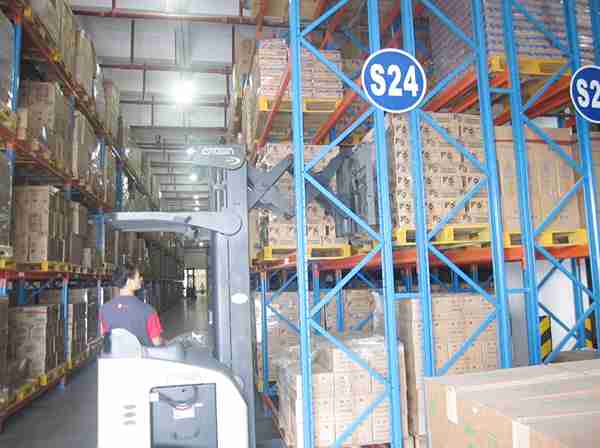
Reach Trucks: The standard for many operations, capable of working efficiently up to 30-35 feet in aisles around 8-9 feet wide. They represent a solid balance of capability and cost for a wide range of warehouse racking height guidelines.
Very Narrow Aisle (VNA) Trucks: This category includes turret trucks and side-loaders that operate in aisles as narrow as 5-6 feet. They are essential for warehouse racking height guidelines targeting systems from 30 feet to over 50 feet. They often require guidance wires or rails for stability and represent a significant step up in both capability and investment.
Automated Storage and Retrieval Systems (AS/RS): This is the pinnacle of cube utilization. Automated cranes operate in aisles only slightly wider than the load itself, reaching heights of 100 feet or more. Warehouse racking height guidelines that incorporate AS/RS are fundamentally different, focusing on system software, integration, and unparalleled density and throughput with minimal labor.
H3: Pillar 4: The Financial Modeling and ROI Justification
This is where data transforms into a compelling business case. Sophisticated warehouse racking height guidelines are worthless without a clear financial justification. A detailed model must compare multiple scenarios.
For instance, consider a facility with a 32-foot clear height. The analysis might compare a 26-foot system using reach trucks against a 40-foot system (in a new build or with a building modification) using VNA trucks.
Scenario A (26-foot System):
CapEx: Racking, 3x Reach Trucks.
OpEx: Labor for 4 operators, standard maintenance.
Storage Positions: 12,000
Throughput: 250 pallets/day
Scenario B (40-foot VNA System):
CapEx: Heavier/taller racking, 2x VNA Trucks, guidance system, enhanced WMS, potential building cost.
OpEx: Labor for 2.5 operators (higher efficiency), higher energy for lighting, specialized maintenance.
Storage Positions: 20,000
Throughput: 400 pallets/day
The model would project the Net Present Value (NPV) and Internal Rate of Return (IRR) of the additional investment in Scenario B. The benefits quantified by these advanced warehouse racking height guidelines include:
Value of Deferred Capital Expenditure: The avoided cost of a new facility by maximizing the existing one.
Labor Productivity Savings: Higher throughput with fewer operators.
Increased Throughput Revenue: The ability to handle more business without expansion.
Reduced Product Damage and Improved Accuracy: Advanced systems typically yield significant savings in these areas.
If the IRR exceeds the company’s hurdle rate, the taller system is financially justified. These warehouse racking height guidelines provide the framework to prove it.
H2: Advanced Applications: Integrating Automation into Warehouse Racking Height Guidelines
For operations where labor, speed, and accuracy are paramount, the conversation evolves. Modern warehouse racking height guidelines must encompass automated solutions.
H3: AS/RS and the Reimagining of Cube Utilization
An Automated Storage and Retrieval System (AS/RS) represents the most rigorous application of data-driven warehouse racking height guidelines. These systems achieve densities unthinkable with manned equipment. The warehouse racking height guidelines for an AS/RS are deeply integrated with the control software, which uses real-time SKU and order data to dynamically optimize the location of every item. The physical height of the system is a direct function of the throughput requirements and the inventory profile analyzed during the planning phase.
H3: The Role of AGVs and AMRs in Dynamic Warehouse Racking Height Guidelines
While AGVs (Automated Guided Vehicles) and AMRs (Autonomous Mobile Robots) typically operate on the horizontal plane, their integration is a key consideration in next-generation warehouse racking height guidelines. These robots can work in concert with high-bay AS/RS or serve vertical storage areas by transporting loads to and from the racking interfaces. This creates a seamless, goods-to-person workflow. The warehouse racking height guidelines in such an automated ecosystem are part of a larger system design focused on total system throughput, not just static storage.
H2: The Indispensable Role of the Warehouse Management System (WMS)
As racking systems grow taller and more complex, a sophisticated Warehouse Management System (WMS) transitions from a helpful tool to an absolute necessity. It is the digital brain that makes a high-density warehouse operable. Advanced warehouse racking height guidelines are inseparable from a WMS strategy, as the software executes critical functions:
Dynamic Slotting Optimization: The WMS automatically assigns incoming goods to the optimal location based on the very ABC velocity analysis that informed the warehouse racking height guidelines. It ensures fast-movers are easily accessible, maximizing the ROI of the physical layout.
Task Interleaving: In a high-bay warehouse, empty travel is a primary cost. The WMS can combine tasks—for example, directing an operator to perform a put-away on the top tier immediately followed by a replenishment pick on a lower level—dramatically increasing productivity.
Cycle Counting and Inventory Integrity: With thousands of locations out of direct line of sight, the WMS directs cycle counts based on velocity and value, ensuring the system’s digital twin matches the physical reality. This is a critical component of reliable warehouse racking height guidelines.
H2: Navigating the Regulatory Labyrinth: Safety and Compliance in Warehouse Racking Height Guidelines
Going higher introduces greater risks and regulatory scrutiny. Safety and compliance must be baked into the core of all warehouse racking height guidelines.
OSHA and RMI Standards: The Occupational Safety and Health Administration (OSHA) and the Rack Manufacturers Institute (RMI) provide specific standards for the design, installation, and protection of storage racking. This includes mandatory use of column guards, load capacity signs, and strict adherence to clearance tolerances. Any professional warehouse racking height guidelines must strictly conform to these standards.
In-Rack Sprinkler Mandates: As height increases, the requirement for in-rack sprinklers becomes inevitable. These systems are complex and expensive but are essential for life safety and property protection in high-bay facilities. The specific warehouse racking height guidelines for fire protection should be developed in consultation with a fire protection engineer.
Seismic Design Considerations: In geographically active regions, the warehouse racking height guidelines must incorporate stringent seismic design criteria, which can significantly impact the racking structure’s design and cost.
H2: A Phased Implementation Roadmap for New Warehouse Racking Height Guidelines
Translating these guidelines into reality requires a disciplined, phased approach.
Cross-Functional Team Assembly: This is not solely a logistics project. It requires warehouse operations, finance, facilities/real estate, and senior management.
Comprehensive Data Harvesting: Execute the deep-dive SKU profiling and the rigorous physical audit as outlined in the warehouse racking height guidelines.
Conceptual Scenario Development: Create 2-3 distinct design scenarios with varying heights, equipment, and levels of automation, all based on the core warehouse racking height guidelines.
Detailed Financial Modeling and ROI Analysis: Build a robust financial model for each scenario to objectively compare the return on investment.
Vendor Selection and Detailed Engineering: Partner with reputable racking manufacturers and systems integrators to finalize the design, ensuring it adheres to all safety and structural warehouse racking height guidelines.
Phased Implementation and Change Management: Roll out the system in manageable phases. Invest heavily in training and change management to ensure workforce adoption and safe operation.
Continuous Performance Monitoring: Use the WMS and other data tools to continuously monitor key performance indicators (KPIs) against the projections, allowing for ongoing refinement of the slotting and processes within the established warehouse racking height guidelines.
Conclusion
The decision surrounding warehouse racking height is a strategic inflection point with decades-long repercussions. Outdated, simplistic approaches are a liability in a competitive landscape. By adopting a comprehensive, data-driven framework for warehouse racking height guidelines—one that synthesizes deep inventory analytics, structural realities, equipment symbiosis, and rigorous financial modeling—organizations can transform their warehouse cube from a static cost center into a dynamic, profit-generating engine. These advanced warehouse racking height guidelines provide the blueprint for building a storage system that is not only dense but also intelligent, efficient, and relentlessly focused on delivering a superior return on investment. The vertical frontier awaits, and it is time to conquer it with precision and insight.
Frequently Asked Questions (FAQs)
Beyond the obvious cost of racking, what are the most frequently overlooked cost factors in high-bay warehouse racking height guidelines?
Often overlooked are the “soft costs”: the significant increase in energy consumption for specialized high-level lighting, the potential need for enhanced climate control, the cost of more powerful RF/Wi-Fi infrastructure for coverage, higher insurance premiums, and the ongoing, specialized training required for operators of high-reach equipment. A holistic view of warehouse racking height guidelines must account for these.How do the warehouse racking height guidelines differ for a cold storage facility versus a dry warehouse?
The warehouse racking height guidelines for cold storage are drastically more critical and complex. The immense cost of refrigerated cubic foot makes maximizing cube a paramount financial imperative. However, this must be balanced with the need to maintain air circulation, the increased structural demands on equipment in sub-zero temperatures, and the severe challenges of installing and maintaining in-rack sprinkler systems in a freezer environment. The ROI calculation is often more compelling, but the engineering hurdles are higher.What is the role of a mezzanine in relation to these warehouse racking height guidelines?
A mezzanine is a fantastic tool for creating a multi-level structure within a warehouse, but it serves a different purpose than the vertical racking discussed in these warehouse racking height guidelines. A mezzanine typically creates a second or third floor for activities like value-added services, offices, or small-item storage. However, it does not utilize the cubic space above the mezzanine deck. For pure pallet storage, applying these warehouse racking height guidelines to build upwards almost always provides superior cubic utilization.Can existing racking be economically “uprighted” to follow new warehouse racking height guidelines, or is replacement required?
“Uprighting” existing racking is sometimes possible but is far from a simple bolt-on operation. It requires a professional structural analysis by a qualified engineer to assess the capacity of the existing upright frames, the strength of the current floor anchorage, and the condition of the slab. Often, the cost and risk of uprighting an older system approach that of a new, engineered solution designed with modern warehouse racking height guidelines in mind.How frequently should a company revisit its warehouse racking height guidelines?
A formal review of the storage strategy and warehouse racking height guidelines should be conducted in tandem with any major business change, such as a significant shift in product mix, a 15-20% growth in volume, or the acquisition of new automation technology. Even in a stable environment, a bi-annual review is prudent to ensure the system continues to align with business objectives and operational data.
Welcome to contact us, if you need warehouse rack CAD drawings. We can provide you with warehouse rack planning and design for free. Our email address is: jili@geelyracks.com