📐 "First 50 Enterprise Queries Get Custom 3D Warehouse Design" Plan















The Strategic Imperative: Upgrading to Automated High-Density Industrial Racking for an 80% Efficiency Boost with AGV/ASRS Integration
The landscape of modern logistics is undergoing a seismic shift, moving away from labor-intensive, space-inefficient warehouses toward intelligent, automated hubs of productivity. Central to this transformation is the strategic implementation of high-density industrial racking systems, synergistically integrated with robotic material handling technologies. This comprehensive exploration details how the fusion of Automated Guided Vehicles (AGVs) and Automated Storage and Retrieval Systems (ASRS) with advanced high-density industrial racking creates a operational paradigm capable of delivering an 80% or greater increase in efficiency.
The discussion will extend beyond mere equipment specification, delving into the tangible benefits of radical space optimization, flawless inventory accuracy, and the creation of a safer, scalable, and data-driven warehouse environment. For decision-makers in growing markets across Southeast Asia, the Middle East, Latin America, and Africa, this integration represents more than an upgrade; it is a fundamental re-engineering of the supply chain backbone for sustained competitive advantage.
The Unsustainable Legacy: Why Conventional Warehousing Is a Bottleneck to Growth
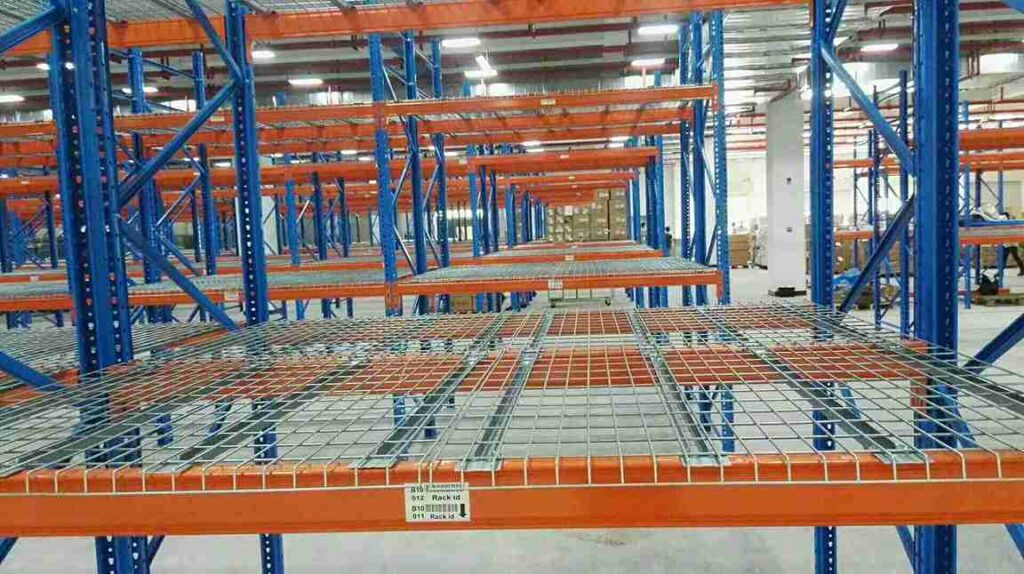
The traditional warehouse, characterized by static shelving and wide aisles designed for manned forklifts, has become a significant liability. Operations managers in these facilities grapple with a constant battle against spatial and operational inefficiency. The fundamental flaw of conventional layouts is the massive footprint dedicated to access aisles, which can consume over 50% of the total floor space. This design directly contradicts the primary economic driver of warehousing: maximizing storage capacity per square meter.
The limitations are multifaceted. Labor dependency introduces high costs, training overheads, and vulnerability to workforce shortages. The physical strain of navigating congested aisles leads to operator fatigue, which in turn increases the risk of product damage and workplace accidents. Furthermore, inventory management in such an environment is inherently reactive and prone to error. Manual cycle counts and paper-based picking systems result in discrepancies that ripple through the supply chain, causing stockouts, overstocking, and profound customer dissatisfaction. In this context, continuing with a conventional system is not merely a choice to avoid change; it is a conscious decision to incur escalating costs and operational fragility.
The Direct and Hidden Costs of Outdated Storage Methods
Capital Drain on Real Estate: A significant portion of a company’s logistics budget is spent on leasing or maintaining space that is functionally empty. Every meter occupied by an aisle is a meter that could be generating revenue through stored inventory. The adoption of high-density industrial racking is the most direct countermeasure to this relentless financial drain.
Productivity Lost to Travel Time: Studies in warehouse ergonomics consistently show that pickers in conventional setups spend the majority of their shift walking, not handling goods. This non-value-added activity represents a colossal sunk cost in labor and time.
The Profit Erosion of Human Error: A picking inaccuracy rate of even 1% can have devastating consequences in high-volume environments, leading to shipping corrections, returned goods, and lost customer trust. The precision of an automated system integrated with high-density industrial racking virtually eliminates this category of loss.
The Throughput Ceiling: Congestion creates a hard cap on a facility’s output. During peak seasons, this bottleneck can prevent a business from capitalizing on market demand, effectively capping revenue growth.
Deconstructing the 80% Efficiency Benchmark: A Realistic Outcome of Strategic Integration
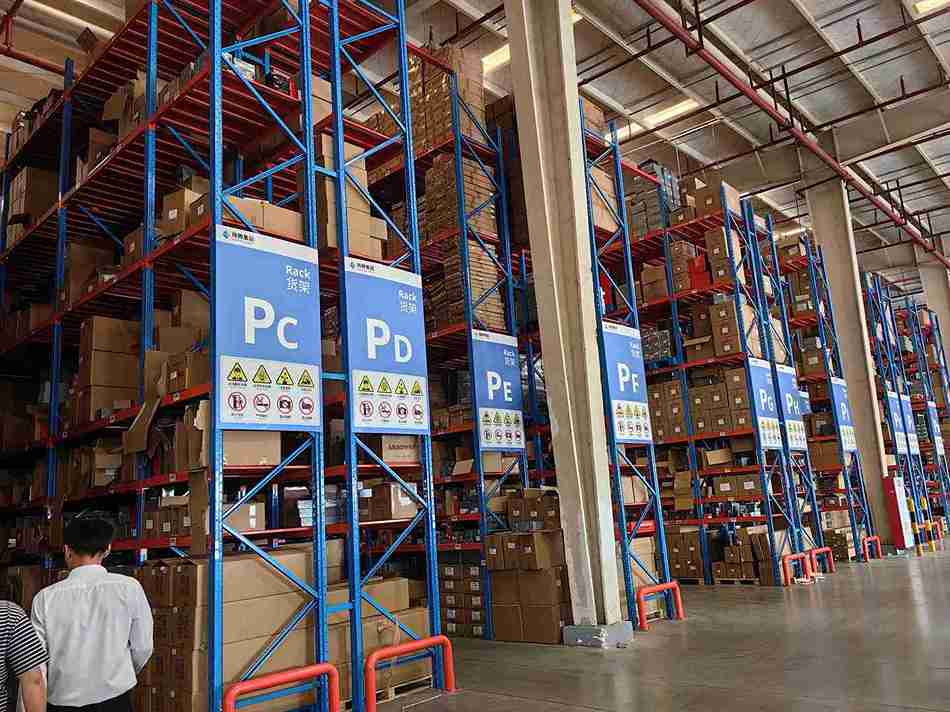
The claim of an 80% boost in operational efficiency is a composite metric derived from performance data across multiple implemented systems. It is not a speculative figure but a reflection of cumulative gains across several key performance indicators (KPIs). This level of improvement is only achievable when high-density industrial racking is not seen as a standalone product, but as the physical substrate for a fully integrated automated ecosystem.
The Multiplicative Effect on Core Warehouse Functions
The Virtual Elimination of Non-Value-Added Travel: An ASRS crane or a retrieval shuttle within a high-density industrial racking system moves directly to the designated location on a optimized path. AGVs follow the most efficient route from point A to point B. This eliminates the human element of travel, which is the single largest consumer of time in manual operations.
Uninterrupted Operational Cadence: Automation operates beyond the constraints of shift patterns, breaks, and holidays. A facility powered by AGVs and ASRS can achieve a near-24/7 operational model, dramatically increasing daily throughput without a linear increase in variable costs.
Radical Acceleration of Order Cycle Times: The warehouse management software orchestrates a symphony of coordinated movements. From the moment an order is received, the system simultaneously tasks the ASRS with retrieving a tote and dispatches an AGV to the pickup point. This parallel processing slashes the time from order to dispatch.
The Pursuit of Perfection in Inventory Accuracy: Integrated barcode scanners or RFID readers at every touchpoint within the high-density industrial racking system create an immutable digital trail. Error rates plummet from industry-average human levels to fractions of a percent, ensuring financial and supply chain integrity.
Dynamic, Data-Driven Optimization: The software controlling the system provides a real-time, perfect view of all inventory. It can employ AI-driven slotting strategies, automatically positioning fast-moving SKUs in the most accessible locations within the high-density industrial racking matrix to further enhance picking velocity.
The Architectural Core: A Deep Dive into High-Density Industrial Racking Systems
The term high-density industrial racking encompasses a family of engineered storage solutions designed with one overriding goal: to store the maximum amount of inventory in the minimum possible footprint. The selection of the specific type of high-density industrial racking is a critical decision, dictated by the client’s product profile, inventory rotation strategy (FIFO, LIFO), and throughput requirements.
The Spectrum of High-Density Industrial Racking Solutions
Pallet Flow Racks (FIFO): This system utilizes inclined rails and wheel tracks, allowing pallets to glide from the loading (back) to the picking (front) face by gravity. It is the quintessential high-density industrial racking solution for high-volume perishable goods or any product with a strict first-in-first-out requirement. The dynamic nature of the system ensures perfect stock rotation.
Carton Live Flow Racks: A smaller-scale adaptation of the pallet flow principle, this high-density industrial racking is the engine of modern e-commerce and case-picking operations. Individual cartons flow forward, providing constant stock presentation to pickers and dramatically increasing pick rates.
Push Back Racking (LIFO): A system where pallets are stored on nested carts that ride on inclined rails. When a new pallet is loaded, it pushes the previous pallet back. This LIFO (last-in-first-out) high-density industrial racking allows for storage of multiple pallets deep, with only a single aisle for access, offering an excellent balance of density and selectivity.
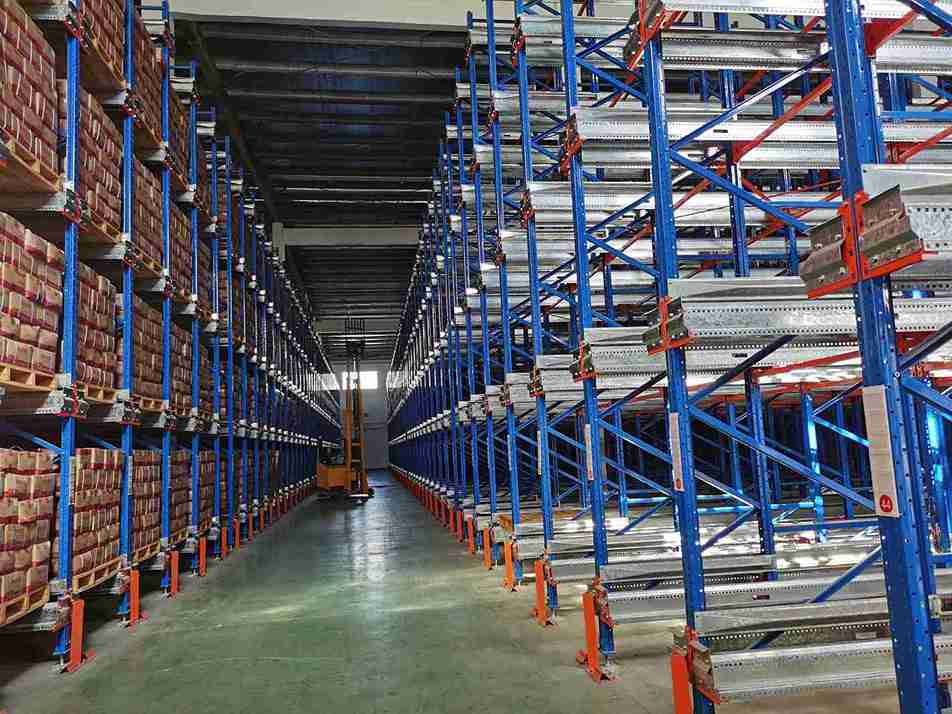
Mobile Pallet Racking: Perhaps the most space-efficient form of static high-density industrial racking, this system involves entire rows of racking mounted on electrically driven bases that move on rails. This design eliminates all but one “access” aisle, which opens up where needed. This can effectively double storage capacity within the same building footprint, making it a revolutionary form of high-density industrial racking for operations with a high number of SKUs but lower overall turnover.
ASRS-Compatible Racking: This is not a distinct type of racking but a performance-specified classification. This high-density industrial racking is structurally engineered to the highest tolerances to interface with automated cranes and shuttles. It is the essential, non-negotiable backbone of any automated storage and retrieval system, designed to withstand constant, high-speed mechanical interaction.
The Neural and Muscular Layers: AGVs and ASRS as the System’s Activators
Automation technology is what transforms the static potential of high-density industrial racking into dynamic, measurable throughput. These systems provide the intelligence and the motion.
Automated Guided Vehicles (AGVs): The Horizontal Logistics Fleet
Modern AGVs are a far cry from the tape-following robots of the past. Today’s unmanned forklifts and pallet trucks utilize sophisticated LiDAR and natural feature navigation, creating a dynamic map of the facility and navigating with centimeter-level precision without any physical guidance. Their role in an integrated system with high-density industrial racking is to serve as the flexible horizontal link between processes—from receiving docks to the ASRS input stations, and from ASRS output stations to dispatch. Their deployment creates a continuous, predictable flow of materials, freeing up human workers for more cognitive tasks.
Automated Storage and Retrieval Systems (ASRS): The Vertical Productivity Engines
ASRS are the high-speed, high-bay specialists that bring the full potential of high-density industrial racking to life.
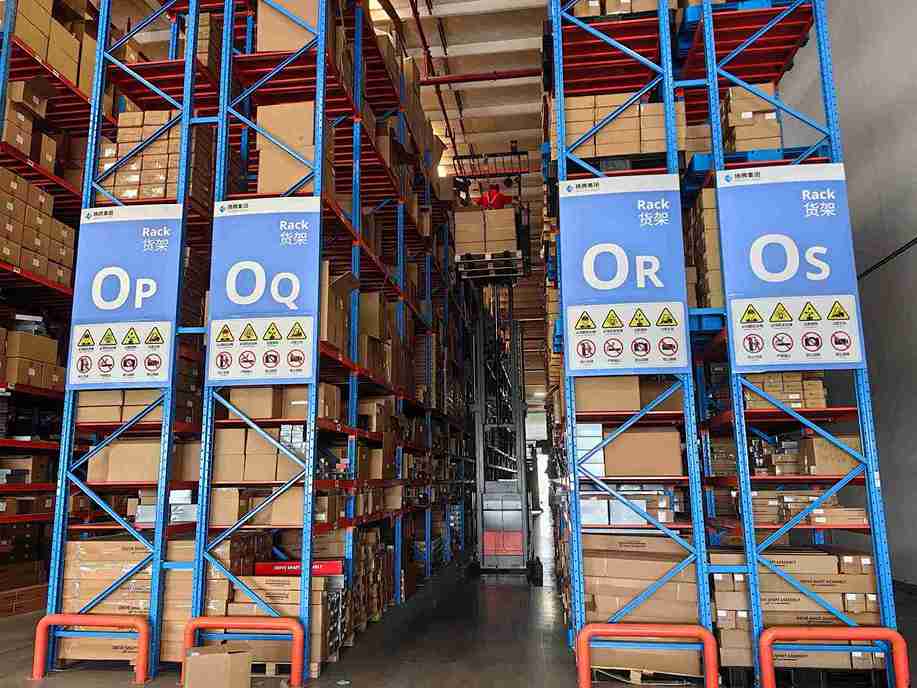
Unit-Load ASRS: These are the titans of automation, designed to handle full pallet loads within high-density industrial racking structures that can soar to over 45 meters. A single or double mast crane travels within the aisle, storing and retrieving pallets with absolute precision and at incredible speeds.
Mini-Load ASRS: Designed for smaller loads stored in totes or bins, this system is the workhorse of distribution centers for electronics, pharmaceuticals, and spare parts. It operates within a specialized high-density industrial racking structure, providing incredibly high-speed access to thousands of individual items.
Autonomous Vehicle-Based Storage and Retrieval Systems: This newer class of technology, often using autonomous robotic shuttles that operate within the high-density industrial racking structure itself, offers unparalleled flexibility and scalability. Shuttles can move between levels and aisles, providing a highly redundant and resilient system.
The Symphony of Integration: How AGVs and ASRS Unlock the Full Potential of High-Density Industrial Racking
The true 80% efficiency gain is not realized by simply installing AGVs and ASRS alongside high-density industrial racking. It is achieved through their deep, software-driven integration into a single, cohesive organism.
A Step-by-Step Walkthrough of an Integrated Operation
Intake and Identification: A pallet arrives at the receiving dock. Its barcode or RFID tag is scanned, and its dimensions and weight may be automatically captured.
Cognitive Decision-Making by the WMS/WCS: The Warehouse Management System (WMS), in concert with the Warehouse Control System (WCS), receives the data. It identifies the product, checks it against the purchase order, and uses its intelligent logic (considering factors like velocity, product affinity, and expiration date) to determine the optimal storage location within the high-density industrial racking matrix.
AGV Dispatch for Horizontal Transport: The WCS dispatches the nearest available unmanned forklift AGV to the receiving station. The AGV collects the pallet and navigates the most efficient path to the designated input conveyor or transfer station for the ASRS.
ASRS Execution of Vertical Storage: The ASRS crane, having received its指令 from the WCS, automatically picks up the pallet from the transfer station and transports it at high speed to the exact, pre-determined location within the high-density industrial racking structure. The system’s inventory database is updated in real-time.
The Reverse Flow for Order Fulfillment: Upon order receipt, the WCS identifies the required items. It tasks the ASRS to retrieve the specific tote or pallet from the high-density industrial racking and deliver it to an output station. Simultaneously, it dispatches an AGV to that station. The AGV collects the load and transports it directly to the packing or shipping staging area, completing a seamless, touch-light process.
The Indispensable Role of the Software Brain: WMS and WCS
The WMS and WCS are the central nervous system. The WMS handles the higher-level business logic—inventory management, order waving, and reporting. The WCS is the real-time traffic controller, translating WMS commands into instantaneous, optimized instructions for every AGV and ASRS crane. This software layer is what makes the complex dance between the high-density industrial racking and the automation possible, ensuring no machine waits on another and that every movement contributes to the overall goal of maximum throughput.
The Compelling Financial Calculus: Quantifying the ROI of Automated High-Density Industrial Racking
Justifying the capital expenditure for an integrated high-density industrial racking and automation project requires a clear-eyed analysis of both tangible and strategic returns.
Direct and Quantifiable Financial Benefits
Labor Cost Transformation: Companies typically see a 50-70% reduction in direct labor required for storage and retrieval tasks. This does not necessarily mean layoffs; it often allows for the reallocation of staff to value-added roles in quality control, kitting, or system management.
Real Estate Optimization or Deferral: By doubling or tripling storage capacity within the existing footprint, the immediate pressure to acquire or lease additional warehouse space is alleviated. This represents a massive capital expenditure avoidance.
Throughput-Linked Revenue Enhancement: An 80% efficiency gain means the facility can process a significantly higher volume of orders with the same or fewer fixed resources. This directly increases revenue capacity without a proportional increase in overhead.
The Hard Cost Savings of Accuracy: Eliminating mis-picks, lost inventory, and the administrative burden of reconciliations translates into hundreds of thousands of dollars saved annually for a medium-to-large operation.
Asset and Insurance Economics: The dramatic reduction in forklift-to-rack and forklift-to-product collisions lowers damage to both the high-density industrial racking and the inventory. This can lead to lower insurance premiums and extended asset life.
The Intangible Strategic Advantages That Define Market Leaders
Unmatched Scalability and Flexibility: A well-designed system based on modular high-density industrial racking and scalable automation can grow incrementally. Adding more AGVs, shuttle bots, or additional ASRS bays is a structured process, allowing the operation to expand in lockstep with business growth.
Resilience to Market Volatility: The operation becomes less vulnerable to labor market fluctuations, seasonal hiring challenges, and absenteeism. This provides a stable, predictable operational base.
The Power of a Data Asset: The system generates a treasure trove of data on every aspect of the operation. This data can be analyzed to drive continuous improvement, optimize supply chain logistics, and provide unparalleled visibility to customers.
A Formidable Competitive Moat: The ability to offer faster, more accurate, and more cost-effective logistics service becomes a powerful differentiator in any market, attracting and retaining key clients.
A Blueprint for Emerging Markets: Tailoring High-Density Industrial Racking and Automation for Global Growth
The principles of efficient storage are universal, but their application must be tailored to regional realities. The solution provided by integrated high-density industrial racking and automation is uniquely suited to address the specific challenges and opportunities in Southeast Asia, the Middle East, Latin America, and Africa.
Leapfrogging Legacy Infrastructure: Many regions are not burdened by entrenched, outdated warehouse systems. This allows businesses to “leapfrog” directly to state-of-the-art high-density industrial racking and automation, just as many countries skipped landlines for mobile networks.
Mitigating Skilled Labor Shortages: Finding and retaining certified forklift operators can be a significant challenge. Automation mitigates this risk by creating a system that relies on a smaller, more technically oriented maintenance and management team.
Optimizing for Rapid, Volatile Growth Cycles: The economies in these regions often experience rapid growth spurts. The inherent scalability of an automated high-density industrial racking system allows businesses to scale their logistics capacity aggressively to capture market share without the lead times and risks of building new facilities.
Robust Performance in Demanding Environments: High-quality high-density industrial racking and automation equipment is engineered to perform reliably in conditions of high heat and humidity, which are common in many of these markets, ensuring consistent uptime and performance.
The Implementation Journey: A Phased Roadmap from Assessment to Optimization
A successful transition to an automated high-density industrial racking ecosystem is a marathon, not a sprint. It requires a disciplined, phased approach managed by experienced professionals.
Phase 1: Discovery and Data-Driven Design: This foundational phase involves a deep dive into the client’s operation. Experts analyze SKU data, order histories, seasonality patterns, and growth forecasts. The output is not a generic proposal but a digital twin—a 3D simulation of the new facility that models throughput and proves the ROI before installation begins.
Phase 2: Detailed Engineering and Customization: Every component, from the specific grade of steel in the high-density industrial racking to the software interfaces between the WMS and the client’s ERP, is specified and engineered. This phase ensures the system is tailor-made for the client’s unique operational and business needs.
Phase 3: Staged Installation and Commissioning: Installation is carefully sequenced to minimize disruption to ongoing business. A section of the new high-density industrial racking may be erected and brought online while the old system is still partially operational, ensuring a smooth transition.
Phase 4: Comprehensive Knowledge Transfer and Go-Live: The client’s team is trained not just to operate, but to understand and manage the system. This includes training for operators, maintenance technicians, and system administrators, empowering the client to be self-sufficient.
Phase 5: Continuous Partnership and Performance Enhancement: The relationship continues after go-live with ongoing support agreements, spare parts management, and software updates. Performance is continuously monitored to identify opportunities for further optimization within the high-density industrial racking and automation system.
Beyond the Horizon: The Future-Proof Warehouse with High-Density Industrial Racking at its Core
To truly build a warehouse that remains competitive for the next decade, leaders must consider technologies that build upon the foundation of high-density industrial racking and automation.
AI and Machine Learning for Predictive Optimization: Beyond dynamic slotting, AI can predict order surges, optimize warehouse layout in real-time, and even predict equipment maintenance needs before a failure occurs.
The Integration of Advanced Robotics: Robotic arms for palletizing, depalletizing, and even piece-picking can be integrated at the start and end of the automated flow, creating a truly lights-out process for certain product categories.
Sustainability and Energy Intelligence: Modern ASRS cranes use regenerative drives that capture energy during descent and braking, feeding it back into the system. LED lighting that only activates in occupied aisles within the high-density industrial racking further reduces the carbon footprint and operational costs.
Blockchain-Enabled Transparency: The immutable data from the automated high-density industrial racking system could be written to a blockchain, providing suppliers and customers with verifiable, real-time proof of custody and stock levels.
Conclusion: The Defining Decision for Modern Logistics Leadership
The convergence of high-density industrial racking, AGVs, and ASRS represents the most significant advancement in warehouse operations in half a century. The promise of an 80% efficiency gain is a tangible, achievable outcome of a properly designed and integrated system. This is not a mere incremental improvement but a strategic reinvention that directly impacts profitability, scalability, and market agility.
In the fast-growing and competitive landscapes of emerging global markets, the decision to upgrade is no longer a question of “if” but of “when.” The most forward-thinking companies are already making this strategic pivot, recognizing that a future-proofed logistics operation, built on a foundation of intelligent high-density industrial racking and seamless automation, is the ultimate competitive advantage. The journey begins with a single, decisive step toward a comprehensive operational assessment.
Frequently Asked Questions (FAQs)
1. How does the system’s software handle unexpected events, like a pallet being misaligned on an AGV?
The system is built with multiple layers of fault tolerance. AGVs and ASRS cranes are equipped with a suite of sensors (lasers, vision systems, torque sensors). If a pallet is misaligned beyond a safe threshold, the AGV will stop immediately and send an alert to the control system and the operations team. The system can often place the task on hold and reassign it to another vehicle, while a human operator is dispatched to resolve the single exception. This isolates the problem without halting the entire operation.
2. We have a very diverse product mix, from heavy palletized goods to small, slow-moving items. Can one system handle this?
Absolutely. This is a common scenario best addressed with a multi-modal high-density industrial racking strategy. A facility might utilize unit-load ASRS for full pallets in one zone, a mini-load ASRS for small parts in another, and perhaps a section of mobile high-density industrial racking for bulky, slow-moving items. The AGVs and the overarching WMS seamlessly connect these different zones, creating a unified but highly specialized storage environment.
3. What is the typical lead time from project signing to full operational go-live for a system of this scale?
Lead times vary significantly based on the project’s scale and complexity, but a realistic timeline for a medium-sized system is typically 9 to 18 months. This includes the detailed design and simulation phase (2-3 months), manufacturing and shipping of the high-density industrial racking and equipment (4-8 months), and on-site installation, commissioning, and testing (3-7 months). A phased approach can sometimes see the first modules of the high-density industrial racking system operational earlier.
4. How does the ongoing maintenance for this automated high-density industrial racking system compare to maintaining a fleet of traditional forklifts?
The maintenance profile is different but often more predictable and manageable. It shifts from reactive repairs (fixing a damaged forklift) to scheduled, preventive maintenance (lubricating rails, checking sensors, updating software). While specialized technical knowledge is required, the overall maintenance burden is often lower, and the predictability prevents catastrophic, unplanned downtime. Most providers offer comprehensive service contracts to ensure peak performance.
5. Our facility has unique physical constraints, such as irregular floor flatness or low ceiling clearances. Can high-density industrial racking and automation still be implemented?
Yes, but it requires expert engineering. High-density industrial racking for ASRS requires very high floor flatness tolerances, which can be achieved with corrective flooring compounds. For low-clearance facilities, while the dramatic height advantage of ASRS is lost, the density and efficiency gains from solutions like push-back racking or mobile high-density industrial racking integrated with AGVs can still be immense. A professional consultation would model the ROI for these specific site conditions.
If you require perfect CAD drawings and quotes for warehouse racking, please contact us. We can provide you with free warehouse racking planning and design services and quotes. Our email address is: jili@geelyracks.com