📐"前 50 个企业查询可获得定制 3D 仓库设计" 计划
















A Strategic Deep Dive: Navigating the Critical Choice Between Narrow Aisle Racking and Standard Racking for Global Supply Chain Advantage
For logistics managers, warehouse operators, and business leaders across the vibrant industrial landscapes of Southeast Asia, the Middle East, Africa, and Latin America, one operational dilemma consistently rises to the top: the fundamental choice between narrow aisle racking vs standard pallet racking. This decision is far more than a simple procurement exercise; it is a cornerstone of warehouse strategy with profound implications for volumetric efficiency, operational agility, and total logistics cost.
The classic standard selective racking 系统, with its wide aisles and universal compatibility, offers a familiar solution. In direct contrast, a well-implemented 窄巷式货架 系统 presents a transformative approach to storage density, systematically converting non-productive aisle space into lucrative storage positions. This comprehensive analysis delves beyond surface-level comparisons, offering a granular, expert-level examination of the narrow aisle racking vs standard debate. It provides a decision-making framework grounded in real-world application, tailored to the unique challenges and opportunities found in growth markets worldwide.

The Global Imperative for Intelligent Storage Density
In regions experiencing rapid economic expansion, the pressure on logistics infrastructure is intense. Urban industrial land costs in Jakarta, Bangkok, or Dubai are soaring. Construction timelines for new facilities are lengthy and capital-intensive. Consequently, the most strategic lever for capacity growth is not outward expansion, but inward optimization—maximizing the utility of every cubic meter within existing four walls. The primary battle for efficiency is waged in the aisles. A standard racking layout, designed for versatile counterbalance forklifts, typically dedicates 3.5 meters or more of width to each access corridor.
In many facilities, these aisles consume nearly half of the total floor space, representing an enormous asset lying fallow. The core proposition of 窄巷式货架 is the radical reduction of this aisle width to between 1.6 and 2.0 meters, achieved through specialized handling equipment. This single change can increase storage capacity by 30% to over 50% within the same footprint. When evaluating narrow aisle racking vs standard, one is fundamentally evaluating the cost of floor space against the investment in specialized equipment and racking precision. For operations where real estate is a premium or a fixed constraint, the density advantage of 窄巷式货架 often delivers an unbeatable return on investment.
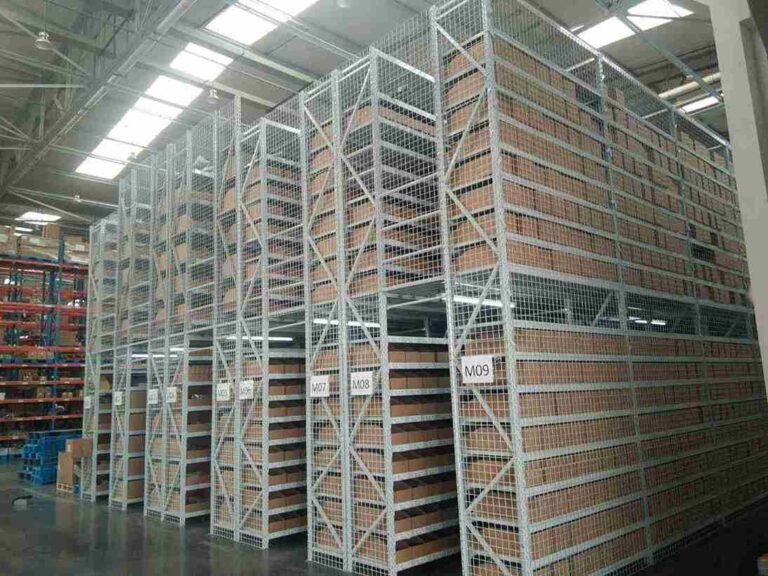
Deconstructing the Contenders: A Technical Overview
To intelligently weigh narrow aisle racking vs standard, one must first understand their distinct engineering and operational philosophies.
Standard Selective Pallet Racking: The Flexible Workhorse
The ubiquitous standard racking system is defined by its accessibility and adaptability. It is a non-powered, beam-and-upright structure where every pallet position is directly (or “selectively”) reachable by a standard forklift. Its operation relies on the counterbalance forklift, a robust and versatile vehicle that requires ample space—typically 3.2m to 3.5m—to maneuver safely, turn 90 degrees, and approach the rack face. This requirement is the defining characteristic and the primary spatial limitation of the standard racking 系统.
The system excels in environments with a high degree of SKU variability and unpredictable access patterns. It is easier to reconfigure, requires less stringent floor conditions, and leverages a widely available equipment operator skillset. However, in the debate of narrow aisle racking vs standard, this flexibility comes at the direct, quantifiable cost of lower storage density.
Narrow Aisle and Very Narrow Aisle (VNA) Racking: The Precision Density Engine
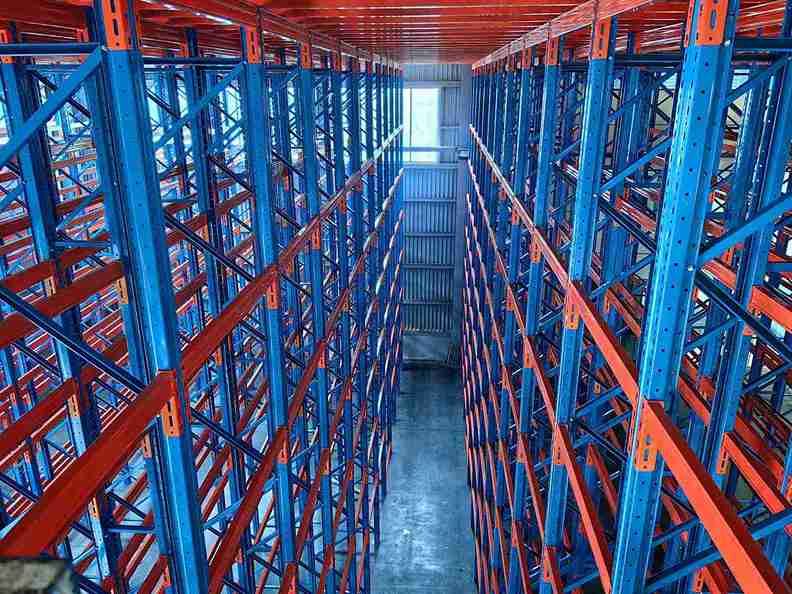
Conversely, a 窄巷式货架 system is an integrated ecosystem of structure, equipment, and often, guidance technology. The racking itself is engineered to higher tolerances, with heavier-gauge uprights frequently specified to withstand the precise, repeated interactions with guided vehicles. The revolutionary difference lies in the material handling equipment. Narrow aisle forklifts feature rotating forks or pivoting masts, allowing the truck to travel straight down the aisle while the forks articulate to store or retrieve pallets.
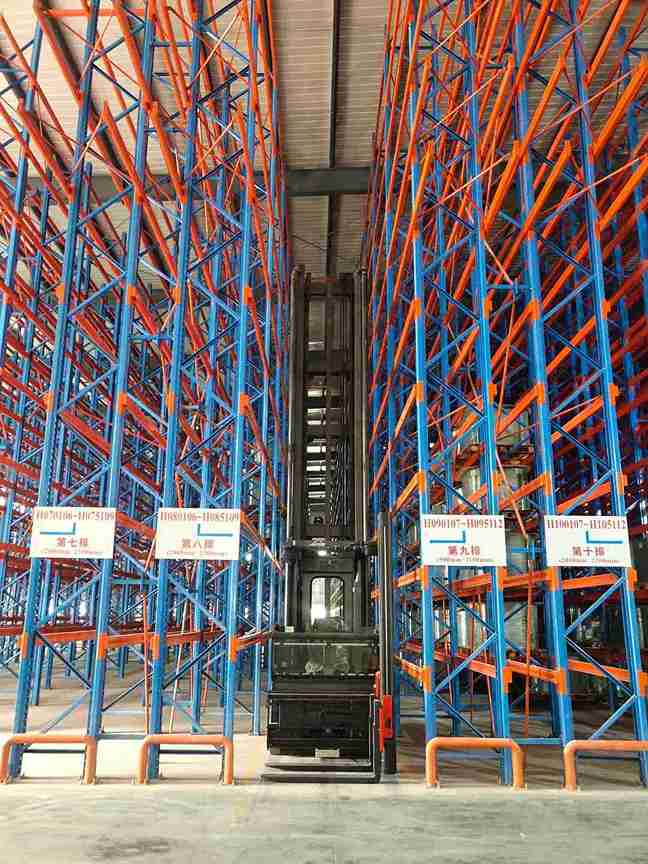
For the ultimate in density, Very Narrow Aisle (VNA) trucks operate in aisles as tight as 1.6 meters, guided by an embedded wire in the floor or an optical system. This guidance eliminates operator steering error, enabling higher travel speeds, exceptional positioning accuracy, and a significant reduction in costly rack damage. Therefore, a comparison of narrow aisle racking vs standard must account for this symbiotic relationship between racking and a more sophisticated, integrated handling solution.
The Decision Matrix: Key Factors in the Narrow Aisle Racking vs Standard Evaluation
Choosing between these systems is not a matter of identifying the “better” option, but the optimal one for a specific operation. The following matrix outlines the critical variables in the narrow aisle racking vs standard decision process.
Inventory Profile & SKU Rationalization: Operations with a high number of SKUs but low pallet depth per SKU (high variety, low depth) often benefit from the random accessibility of standard racking. Conversely, operations with medium variety but medium-to-high depth per SKU—common in manufacturing buffer storage or distribution centers for fast-moving consumer goods—are prime candidates for the density of 窄巷式货架. A thorough ABC analysis of inventory movement is the essential first step in the narrow aisle racking vs standard 分析。.
Throughput Velocity and Order Profile: "(《世界人权宣言》) standard racking system offers good, general-purpose throughput. However, for high-volume operations with predictable stock movement, the 窄巷式货架 system can dramatically increase throughput. VNA trucks travel faster down straight, guided aisles, and “man-up” order pickers can combine storage and retrieval with picking tasks, drastically reducing cycle times. The narrow aisle racking vs standard debate here hinges on the balance between absolute accessibility and speed for a defined set of goods.
Real Estate Economics and Facility Parameters: This is often the decisive factor. The cost per square meter of warehouse space—whether as rent, mortgage, or the avoided cost of expansion—must be calculated. In markets like Singapore, Mumbai, or Panama City, where space is at a supreme premium, the financial equation of narrow aisle racking vs standard overwhelmingly favors the former. Furthermore, building clear height is a multiplier: the taller the building, the greater the cubic space reclaimed by a 窄巷式货架 system’s dense layout.
Total Cost of Ownership (TCO) and Capital Expenditure: The initial capital outlay for a 窄巷式货架 system is typically higher. This includes not only the racking but also the specialized trucks, potential floor preparation (requiring laser-leveled flatness), and a robust Warehouse Management System (WMS). A standard racking system has a lower entry cost for both structure and commonly available forklifts. However, the TCO analysis over a 5-10 year period often reveals a different story. The 窄巷式货架 system, by maximizing capacity within a smaller footprint, reduces ongoing real estate, utility, and tax costs. This long-term financial perspective is crucial for an accurate narrow aisle racking vs standard appraisal.
Operational Maturity and Technology Readiness: Implementing a high-performance 窄巷式货架 system successfully demands a higher degree of operational discipline. It requires an accurate, directive WMS to manage stock location and optimize putaway/retrieval paths to prevent aisle congestion. It necessitates trained, certified operators for the specialized equipment. A standard racking system is more forgiving of process variability. Therefore, a company’s technological and procedural readiness is a vital, often overlooked, component of the narrow aisle racking vs standard selection.
Beyond the Binary: The Strategic Power of Hybrid Warehouse Design
Sophisticated warehouse operations rarely commit to a single system. The most effective strategy often involves a hybrid approach that leverages the strengths of both systems within the same facility. This transcends the simple narrow aisle racking vs standard choice and evolves into a zoning strategy.
VNA Zone (High-Density Core): Dedicate the largest contiguous block of space to Very Narrow Aisle racking for the fastest-moving, most predictable “A” items. This zone acts as the high-throughput engine of the warehouse.
Standard or Narrow Aisle Picking Zone: Utilize standard selective racking or wider 窄巷式货架 with order-picking trucks for medium-velocity “B” items or items requiring case-picking. This balances density with flexible access.
Bulk or Project Storage Zone: 使用 standard racking in its most economical form for slow-moving “C” items, bulky non-conveyables, or raw materials.
This hybrid model, master-planned from the initial design phase, resolves the narrow aisle racking vs standard dilemma not by choosing one, but by strategically deploying both. It creates a tiered storage architecture that aligns cost, accessibility, and density with the specific velocity profile of each product category.
Integration and Future-Proofing: The Automation-Ready Racking Grid
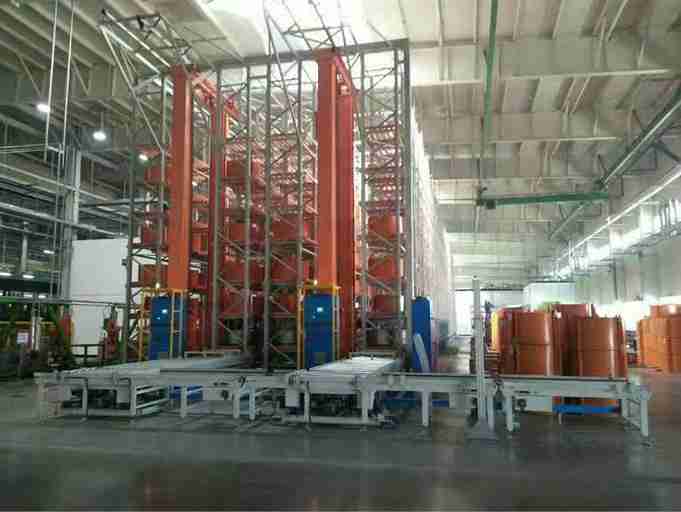
In today’s landscape, the choice between narrow aisle racking vs standard is also a choice about future adaptability. Narrow aisle racking, particularly VNA configurations, is inherently compatible with future automation. The precision racking, guidance pathways, and high-density layout are the exact prerequisites for automated storage and retrieval systems (AS/RS). A warehouse built today with a 窄巷式货架 grid can be incrementally automated tomorrow by replacing manned VNA trucks with autonomous ones or installing mini-load AS/RS for smaller items.
While standard racking can interface with automation at picking stations, its layout is not optimized for dense, automated traversal. Thus, when considering narrow aisle racking vs standard, forward-thinking managers must weigh not only current needs but also the roadmap to a more automated, data-driven operation. The investment in 窄巷式货架 can be seen as building the foundational grid for the smart warehouse of the future.
Conclusion: From Operational Choice to Strategic Advantage
The comparative analysis of narrow aisle racking vs standard is a microcosm of modern logistics strategy: it pits flexible accessibility against optimized density, upfront cost against long-term value, and present needs against future scalability. There is no universally correct answer in the narrow aisle racking vs standard deliberation. For a third-party logistics (3PL) provider in Vietnam handling a vast array of client SKUs, the flexibility of standard racking may be paramount. For a beverage distributor in Saudi Arabia needing to store vast quantities of a defined product range in a costly urban facility, the density of 窄巷式货架 is likely transformative.
The path to a definitive recommendation in the narrow aisle racking vs standard debate requires a disciplined, data-driven assessment of one’s own inventory, operations, facility, and growth trajectory. It necessitates moving beyond a simple equipment comparison and embracing a systems-level view that includes handling equipment, software, and human processes.
For businesses in the dynamic markets of Southeast Asia, the Middle East, Africa, and Latin America, making the optimal choice between narrow aisle racking vs standard is not just about storing goods more efficiently—it is about building a resilient, scalable, and cost-effective logistics backbone capable of fueling sustained competitive growth in an era where supply chain excellence is paramount. The most successful operations will be those that treat the narrow aisle racking vs standard decision not as a procurement task, but as a critical strategic initiative.
常见问题 (FAQ)
1. For a warehouse with a very low ceiling height (under 6 meters), is the debate between narrow aisle racking vs standard still relevant?
Yes, but the calculus shifts. With limited height, vertical space cannot compensate for aisle inefficiency. The density gain from 窄巷式货架 is derived purely from reducing aisle width, making it even more critical to maximize floor space utilization. In low-clearance facilities, the narrow aisle racking vs standard comparison heavily favors 窄巷式货架 to achieve viable storage capacity, though the absolute number of additional pallet positions will be less than in a taller building.
2. How does the presence of multiple loading docks and cross-docking activity influence the narrow aisle racking vs standard decision?
High cross-dock activity, where goods do not enter long-term storage, reduces the emphasis on dense storage. The primary need is for fast, flexible movement in staging areas. In such environments, standard racking in the staging zones offers superior maneuverability for diverse trailers and urgent transfers. A hybrid design using standard racking near docks and 窄巷式货架 in the reserve storage area often provides the optimal balance in the narrow aisle racking vs standard 申请。.
3. What are the specific maintenance considerations for narrow aisle equipment in harsh environments, such as coastal areas in the Middle East or dusty environments in Africa, and how does this impact the long-term cost comparison of narrow aisle racking vs standard?
Harsh environments pose a greater challenge for the sophisticated electronics and guidance systems of 窄巷 and VNA trucks. This necessitates investments in environmentally sealed components, more frequent air filter changes, and corrosion-resistant finishes. While this increases the maintenance cost premium over a rugged standard forklift, the TCO analysis of narrow aisle racking vs standard must factor in the even greater cost of the additional square meters a standard system would require in a premium industrial location. Robust service agreements and climate-controlled battery charging rooms become critical operational expenses.
4. In regions with less predictable power grids, what are the backup power considerations for a narrow aisle racking system that relies on electrically guided VNA trucks, compared to standard systems that may use LP gas or diesel forklifts?
This is a crucial regional consideration. Electrically powered VNA trucks require reliable power for both operation and battery charging. A standard racking system using internal combustion (IC) engine forklifts offers more inherent resilience to power outages. For operations opting for 窄巷式货架 in such areas, the infrastructure plan must include sufficient battery banks, fast-charging systems, and potentially a generator backup for the charging station. This adds to the infrastructure cost but ensures continuity, making it a vital line item in the site-specific narrow aisle racking vs standard feasibility study.
5. Can a warehouse successfully operate a mixed fleet (some narrow aisle trucks, some standard forklifts) to serve different zones, and what are the management complexities of this approach versus committing to one system in the narrow aisle racking vs standard choice?
A mixed fleet is the operational reality of a hybrid warehouse design and is entirely feasible. The key complexity is in labor management and traffic control. Operators typically need separate certifications for each equipment type. Aisles must be clearly designated, and the WMS must be configured to direct work to the appropriate zone and equipment type. While more complex to manage than a uniform fleet, this approach provides the greatest operational flexibility, effectively ending the narrow aisle racking vs standard debate by utilizing each system for its comparative advantage within a unified warehouse plan.
如果您需要完美的 CAD 图纸和仓库货架报价、, 请联系我们. 我们可以为您提供免费的仓库货架规划、设计服务和报价。我们的电子邮件地址是 jili@geelyracks.com