📐 "First 50 Enterprise Queries Get Custom 3D Warehouse Design" Plan


The Unseen Engineering: How Professional Pallet Racking Installation Services Forge the Foundation of Modern Warehousing
In the dynamic landscape of global supply chains, where speed and accuracy are paramount, the structural integrity of a warehouse’s storage system is the silent guardian of profitability and safety. While procurement teams meticulously select racking models and warehouse managers optimize layout software, the single most decisive factor in the system’s long-term performance is often an afterthought: the quality of the pallet racking installation services employed.
This critical phase is where blueprints are stress-tested against reality, where theoretical load capacities become physical assurances, and where the seamless integration of automation is made possible or perilous. For businesses across emerging logistics hubs in Africa, Central Asia, the Middle East, Southeast Asia, and Latin America, engaging with expert pallet racking installation services is not merely a contractual line item; it is a strategic investment in operational resilience, safety compliance, and scalable efficiency.
This definitive exploration delves into the multifaceted world of high-caliber pallet racking installation services, moving beyond the superficial notion of “assembly” to reveal the disciplined engineering, rigorous methodology, and profound impact that define a professional-grade project. The discourse will demonstrate why cutting corners on installation is a catastrophic gamble, detail the exhaustive process that distinguishes industry leaders, and articulate the direct correlation between precision installation and documented warehouse productivity gains exceeding 30%.
For decision-makers overseeing logistics, distribution, and manufacturing assets, understanding the nuances of superior pallet racking installation services is essential for specifying contracts, managing site projects, and ultimately, securing a formidable competitive advantage through a flawless storage infrastructure.
The Perilous Gap: Design Intent Versus On-Ground Reality in Storage Systems
A storage system begins its life as a design—a calculation of forces, a model of space utilization, a specification of components. The most sophisticated design for selective pallet racking, drive-in racking, or a high-bay automated storage and retrieval system (AS/RS) is only as robust as its physical manifestation. This is the chasm that only exemplary pallet racking installation services can bridge. The process is analogous to constructing a bridge; the brilliance of the architectural design is wholly dependent on the precision of the construction, the quality of the welds, and the integrity of the foundational piers.
Without professional pallet racking installation services, a host of latent defects are introduced into the system from day one. These are not always immediately visible but act as systemic weaknesses that compromise the entire operation. Upright frames that are a few degrees out of plumb create a cascading misalignment that affects every beam level. Baseplate anchors that are under-torqued or installed in compromised concrete lack the holding power to resist the dynamic forces of forklift impact or seismic activity.
Beam locking pins that are not fully engaged present a risk of catastrophic dislodgement under load. These are not theoretical failures; they are frequent outcomes when installation is treated as unskilled labor rather than a technical discipline. Therefore, procuring pallet racking installation services from a vendor with a documented engineering approach is the first and most critical risk-mitigation strategy a warehouse operator can employ.
Quantifying the Risk: The Tangible Costs of Subpar Installation
The financial and operational repercussions of inadequate pallet racking installation services are severe and multifaceted. They extend far beyond the installation budget itself, creating long-term liabilities.
Catastrophic Structural Collapse: The most dire consequence is a total or partial racking collapse. This can be triggered by a forklift impact on a poorly anchored frame, progressive overloading exacerbated by misalignment, or the cumulative failure of improperly installed components. The results are devastating: potential loss of life, destruction of high-value inventory, prolonged operational shutdown, crippling insurance claims, and irreversible reputational damage. In many jurisdictions, corporate leadership and facility managers bear personal legal liability for such safety failures. Comprehensive pallet racking installation services that adhere to FEM 10.2.02 or RMI MH16.1 standards are fundamentally designed to eliminate the root causes of such disasters.
Chronic Operational Inefficiency: A poorly installed racking system creates constant friction in daily workflows. Misaligned aisles force forklift and AGV operators to slow down, maneuver awkwardly, and risk product damage through impacts. This directly increases cycle times for put-away and picking, reducing overall throughput. Incorrect beam spacing wastes valuable vertical cube, negating the space-saving benefits of high-density storage solutions. These inefficiencies are a permanent tax on productivity, silently eroding profit margins. In contrast, precision pallet racking installation services ensure that the layout operates as the designer intended, enabling fluid, fast, and safe material movement.
Accelerated Asset Degradation and Voided Protections: The constant stress and micro-vibrations in a racking system installed without precision accelerate metal fatigue and wear. Components that should last 20+ years may fail in half the time. Furthermore, the warranties provided by racking manufacturers are almost universally contingent upon professional installation per their specifications. Utilizing uncertified or ad-hoc pallet racking installation services instantly voids these warranties, leaving the owner fully liable for all future repairs and replacements. This turns a capital asset into a financial liability.
The Anatomy of Excellence: A Deep Dive into Professional Pallet Racking Installation Services Methodology
World-class pallet racking installation services follow a meticulously orchestrated, multi-phase protocol. This process is repeatable, auditable, and designed to transfer risk from the client to the certified installer. It transforms a complex construction project into a series of controlled, verifiable steps.
Phase 1: Foundational Assessment and Engineering Validation (Pre-Installation)
This preparatory phase is what separates true professionals from mere assemblers. It often accounts for 30% of the project timeline but determines 100% of its success.
Comprehensive Site Survey and Laser Scanning: Prior to any equipment mobilization, certified project engineers conduct a thorough site assessment. This goes beyond tape measures. Advanced teams use 3D laser scanning to create a precise digital twin of the warehouse space. This model captures critical data: floor flatness (crucial for push-back racking and mobile pallet racking), column locations, ceiling clearances for sprinklers and lighting, door swing arcs, and potential obstructions. This data is indispensable for validating the racking design against real-world conditions. For clients in regions like Central Asia or Africa, where as-built drawings may be unreliable, this step is non-negotiable for any reputable provider of pallet racking installation services.
Design and Load Audit: The installation team performs a rigorous cross-check of the client’s racking design drawings. They verify that the specified components (upright frames, beams, bracing) are appropriate for the declared load profiles, pallet dimensions, and intended use. They check seismic calculations for relevant zones and confirm aisle widths for the material handling equipment (MHE) specified, be it traditional forklifts, narrow-aisle reach trucks, or automated guided vehicles (AGVs). This audit frequently uncovers discrepancies that, if unaddressed, would lead to systemic failure post-installation.
Logistical and Safety Planning: A detailed Site-Specific Safety Plan (SSSP) and Method Statement are developed. These documents outline the sequence of operations, define material staging areas, establish secure work zones with appropriate signage, and detail emergency procedures. For international pallet racking installation services, this includes planning for customs clearance of tools, sourcing local equipment, and ensuring all personnel certifications are valid for the region.
Phase 2: The Precision Installation Execution
This is the physical realization of the plan, executed with tooling discipline and quality control checkpoints.
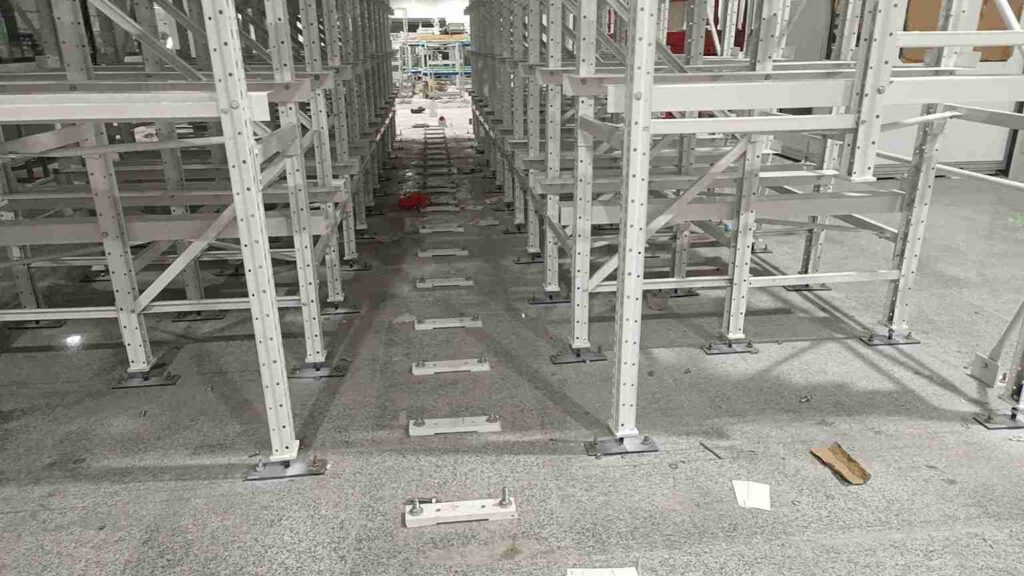
Floor Preparation and Anchor Mapping: The installation area is cleared and cleaned. Using the approved drawings and site survey data, technicians precisely mark the location of every single baseplate anchor on the floor using chalk lines or laser projection systems. This ensures perfect row alignment, squareness, and adherence to planned aisle widths—a critical step for future AGV pathway integration.
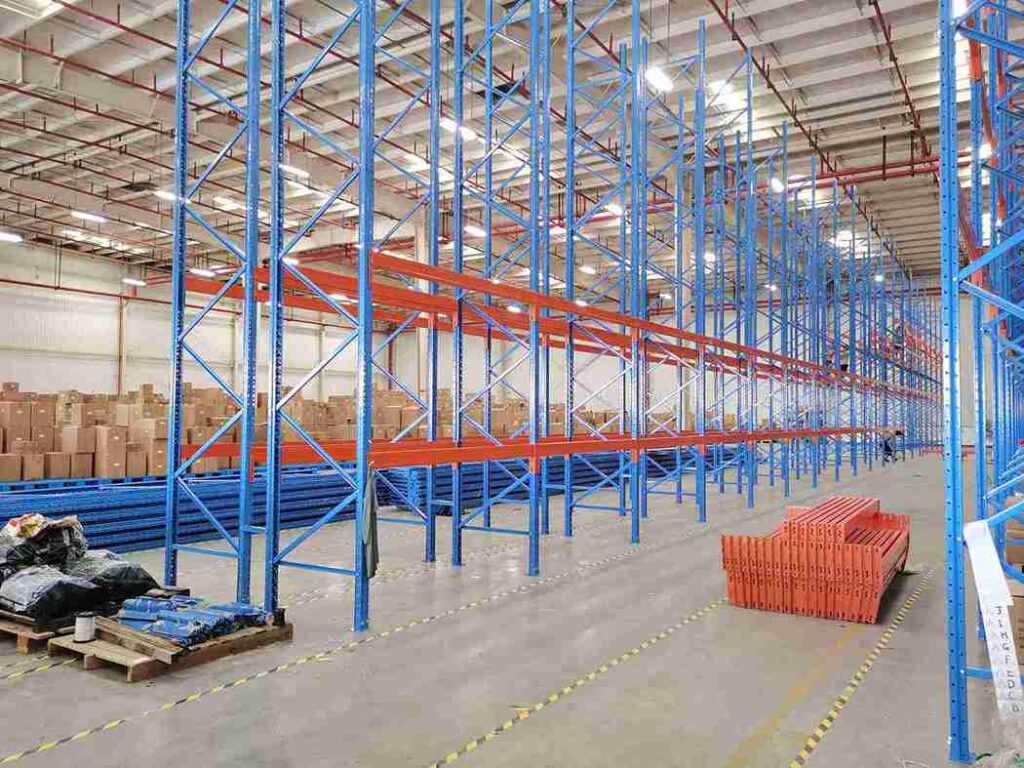
Upright Frame Placement and Squaring: Frames are carefully positioned on their marked locations. Before any anchoring, each frame is leveled and “squared” using precision spirit levels or digital inclinometers. Technicians measure diagonals across bays to ensure geometric perfection. Temporary bracing is used to hold the entire structure in this perfect alignment. This step is the bedrock of visual and functional quality in pallet racking installation services.
Structural Anchoring to Engineered Specifications: This is a critical differentiator. Professional installers use the exact anchor type (wedge, chemical, sleeve) specified for the floor’s compressive strength and the dynamic load requirements. Crucially, each anchor is installed using a calibrated torque wrench to achieve the manufacturer’s specified pre-load tension. Hitting the correct “click” on the wrench is what gives the racking its resistance to uplift and impact forces. Documentation of each anchor’s torque value is a key deliverable.
Beam, Bracing, and Ancillary Component Installation: Beams are installed at their designated heights, with positive visual and auditory confirmation that all locking pins or bolts are fully engaged. Horizontal and diagonal braces are secured, transforming individual frames into a unified, rigid structure. Installers then add decking (wire mesh, plymetal), column guards, aisle-end protectors, and pallet supports as per the design. For projects involving mezzanine floors or vertical lift modules, this phase includes the careful integration of these platforms with the primary racking structure.
Phase 3: Verification, Certification, and Knowledge Transfer
The job is not complete when the last beam is placed. The final phase ensures accountability and client readiness.
Post-Installation Inspection and Load Testing: A quality control manager, independent from the installation crew, performs a 100% audit. This includes re-checking a percentage of anchor torques, verifying every beam lock, inspecting welds on custom components, and ensuring all safety accessories are installed. For high-risk or high-capacity systems, a representative bay may undergo a proof load test with calibrated weights to verify deflection is within FEM/RMI tolerances.
System Certification and Comprehensive Documentation Handover: The client receives a formal Installation Dossier. This package includes “as-built” drawings updated with any field modifications, anchor torque certification logs, safety inspection reports, equipment manuals, and a certificate of compliance stating the installation meets relevant standards (FEM, RMI, OSHA). This dossier is essential for insurance, regulatory compliance, and future facility modifications.
Client Training and Operational Handover: Professional pallet racking installation services conclude with a formal walkthrough. Installers train the client’s warehouse supervisors on daily and weekly visual inspection routines, how to identify damage, and the importance of immediately reporting impacts. This knowledge transfer is vital for sustaining the system’s integrity and safety over its lifespan.
The Automation Imperative: Why Installation Precision is Non-Negotiable for AGVs and AS/RS
The rise of warehouse automation has exponentially increased the technical demands on pallet racking installation services. Automated systems operate within millimeter-level tolerances; the margin for error that might be acceptable in a manual warehouse is utterly unacceptable here.
Enabling Reliable AGV and Unmanned Forklift Navigation
Automated Guided Vehicles (AGVs) and unmanned forklifts rely on their onboard sensors (LiDAR, cameras) to navigate by creating a real-time map of their environment, using the racking structure as a primary reference. Inconsistent pallet racking installation services that result in wandering aisle widths, uneven rack faces, or out-of-plumb uprights corrupt this map. The consequences are severe: AGVs may experience localization errors, abruptly halt missions, require constant manual intervention, or, in worst-case scenarios, collide with the racking. This leads to downtime, reduced throughput, and damage to expensive robotic assets. Therefore, providers of pallet racking installation services working on automation-ready warehouses must employ survey-grade equipment and techniques to achieve near-perfect alignment, creating a predictable “highway” for robotic vehicles.
The Critical Interface for Automated Storage and Retrieval Systems (AS/RS)
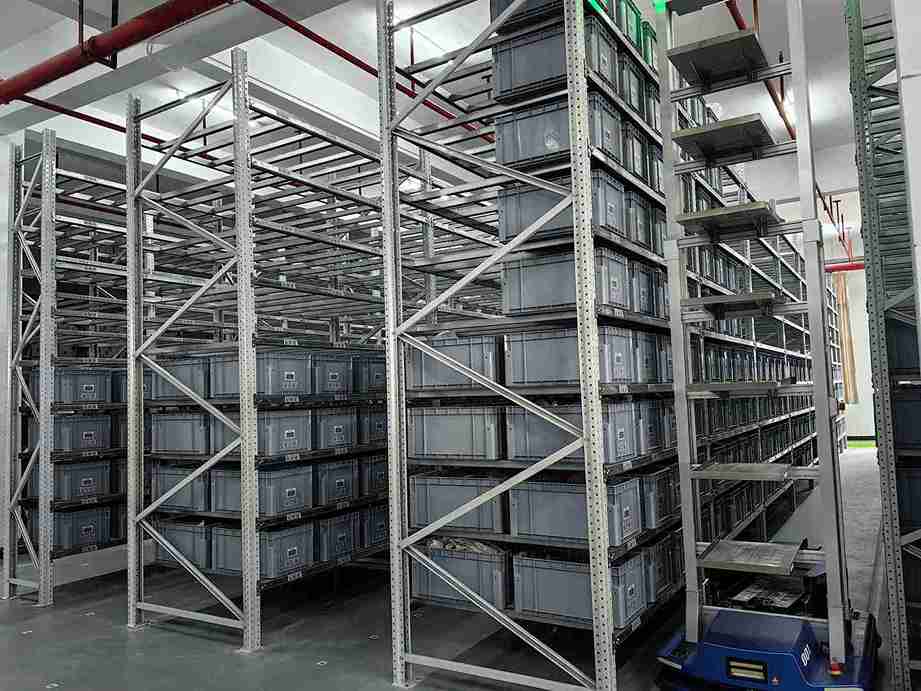
For unit-load AS/RS, pallet shuttles, and vertical lift modules (VLMs), the installation is the physical interface upon which the machine’s precision depends. The mast of a stacker crane or the extractor of a shuttle system operates with clearances often measured in mere centimeters. An upright that is out of plumb by even half a degree over its height can cause the machine to fault, drop a load, or experience a damaging collision. The integration of automated conveyor systems with racking inflow/outflow points also demands precise spatial coordination.
Only pallet racking installation services that are planned in tight collaboration with the automation integrator, and executed with machining-level precision, can ensure this seamless and reliable mechanical handshake. This synergy is where the highest value of professional pallet racking installation services is realized, turning static storage into a dynamic, high-speed inventory engine.
Conquering Regional Challenges: The Hallmark of Truly Global Pallet Racking Installation Services
A provider capable of delivering consistent quality from the Middle East to Latin America possesses unique adaptive competencies. These are not logistical footnotes but core components of their service offering.
Navigating Diverse Standards and Infrastructure Realities
In Europe or North America, installers work within well-defined regulatory ecosystems. In growth markets, the landscape is more varied. Expert pallet racking installation services providers must be adept at navigating local building codes, which may be evolving, and often choose to apply the most stringent international standard (FEM or RMI) as a baseline to guarantee safety. They also encounter a wider variety of warehouse construction types and floor conditions.
For instance, a facility in an arid region might have a different concrete composition than one in a tropical coastal zone. Professional pallet racking installation services include the expertise to test floor strength and specify the correct anchoring solution—be it mechanical, chemical, or a hybrid system—for each unique substrate, ensuring long-term holding power.
Building Local Capacity and Ensuring Project Continuity
The best international providers of pallet racking installation services do not simply fly in a crew for a single project. They invest in developing local talent through certified training programs, creating a sustainable pool of skilled technicians within the region. This approach ensures that follow-up service, maintenance inspections, and future expansion projects can be handled efficiently and responsively. For a client in Africa or Southeast Asia, this local presence, backed by global engineering oversight, offers the perfect blend of international expertise and on-the-ground accessibility. It demonstrates a commitment to the client’s long-term operational success, not just a one-time transaction.
The Tangible Return: Connecting Precision Installation to 30%+ Operational Gains
The promise of efficiency gains is not aspirational; it is the arithmetic outcome of a perfectly executed installation. When pallet racking installation services are performed to the highest standard, several performance multipliers activate simultaneously.
Maximized Storage Density: Precision in upright placement and beam leveling allows for the safe utilization of every cubic centimeter of space. There is no wasted “buffer” space necessitated by misalignment. This enables truly optimized layouts for carton flow racking or pallet flow racking systems, directly increasing the number of pallet or carton positions within the existing footprint. This density gain is a direct contributor to efficiency and return on assets.
Optimized Material Flow: Straight aisles and perfectly aligned bays allow forklift and AGV operators to work at optimal speeds with maximum confidence. There is no deceleration for corrective steering, no risk of side-impact, and no time lost maneuvering in and out of poorly aligned pallet openings. This fluidity reduces the average cycle time per storage/retrieval transaction. When multiplied across hundreds of transactions per shift, the cumulative time savings translate directly into increased throughput and the ability to handle higher order volumes with the same labor and equipment.
Dramatic Reduction in Downtime and Ancillary Costs: A correctly installed system experiences minimal unplanned downtime. There are no emergency service calls to re-secure wobbling racks or re-anchor loose uprights. Furthermore, the incidence of forklift-to-rack collisions—a major source of damage, product loss, and vehicle repair costs—plummets because the predictable environment reduces operator error and stress. The resulting savings in maintenance, repair, and operational disruption are a significant and often overlooked component of the total cost of ownership (TCO). This is the ultimate value proposition of investing in premier pallet racking installation services: they create a stable, high-performance asset that drives productivity while minimizing lifetime costs.
Beyond the Contract: The Enduring Partnership with Your Installation Service Provider
The relationship with a provider of pallet racking installation services should not end at project handover. The most forward-thinking warehouse operators view their installer as a long-term partner for asset management.
Scheduled Integrity Audits: Many top-tier pallet racking installation services companies offer annual or bi-annual inspection contracts. Their certified technicians return to perform systematic audits of the entire system, checking anchor integrity, looking for signs of damage or fatigue, and re-torquing components as necessary. These proactive audits are the equivalent of preventative healthcare for the warehouse, identifying small issues before they become catastrophic failures.
Expansion and Reconfiguration Support: As business needs evolve, storage layouts must change. Having the original installer manage any reconfiguration or expansion ensures consistency in quality and safety. They possess the original “as-built” documentation and understand the system’s engineering intimately, allowing for seamless modifications that maintain overall integrity.
Damage Assessment and Forensic Analysis: In the event of a forklift impact or other incident, the installation partner is the most qualified entity to conduct a forensic assessment. They can determine the extent of the damage, prescribe a safe repair protocol using OEM-compliant parts, and recertify the system for use. This turns a chaotic incident into a managed, engineering-led recovery process.
Conclusion: The Strategic Imperative of World-Class Installation
In the final analysis, the selection of pallet racking installation services is one of the most consequential decisions a logistics or warehouse professional will make. It is a decision that weighs the short-term allure of lower cost against the long-term imperatives of safety, efficiency, and total cost of ownership. The evidence is unequivocal: professional, engineering-led pallet racking installation services are the indispensable catalyst that transforms capital expenditure into a high-performance, resilient, and safe operational asset.
For businesses driving growth in the vibrant markets of Africa, the Middle East, Central Asia, and beyond, the foundation of their supply chain superiority will be built not just on the racking they purchase, but on the precision with which it is installed. By partnering with a provider whose methodology is rooted in international standards, adaptive to local challenges, and precise enough to enable the automated future, organizations secure more than a storage system—they secure a platform for scalable, efficient, and uninterrupted commerce. In the high-velocity world of modern logistics, that foundation is everything.
FAQs
1. How long does professional pallet racking installation take?
Most projects are completed in 1-3 days, depending on system size and complexity.
2. Can existing racks be modified after initial installation?
Yes, certified pallet racking installation services can safely reconfigure, expand, or reinforce existing systems.
3. What’s the cost difference between DIY and professional installation?
While DIY may seem cheaper, hidden risks (damage, fines, accidents) make professional pallet racking installation services far more cost-effective.
4. Do I need a permit for pallet racking installation?
Some jurisdictions require building permits for heavy-duty installations—experts handle this seamlessly.
5. How often should racks be professionally inspected?
OSHA mandates annual inspections, with additional checks after any impact or overloading incident.
If you require perfect CAD drawings and quotes for warehouse racking, please contact us. We can provide you with free warehouse racking planning and design services and quotes. Our email address is: jili@geelyracks.com