📐 "First 50 Enterprise Queries Get Custom 3D Warehouse Design" Plan


The Definitive Pallet Racking Installation Guide for AGV & AMR Integrated Warehouses: Engineering Synergy for Maximum Throughput in Emerging Markets
For logistics operators across the booming industrial corridors of Latin America, the Middle East, Southeast Asia, and Africa, the push toward automation is no longer a luxury but a necessity for competitive survival. However, the journey from a traditional warehouse to a streamlined, automated fulfillment center is fraught with hidden pitfalls, many of which are cemented during the earliest planning stages. This comprehensive pallet racking installation guide diverges fundamentally from generic manuals.
It presents a holistic, engineering-focused framework for integrating storage infrastructure with Automated Guided Vehicles (AGVs) and Autonomous Mobile Robots (AMRs) from the ground up. The core thesis is that the racking installation is not merely a storage assembly task; it is the process of constructing the primary, immutable navigation matrix for the entire automated material handling ecosystem. A failure to adopt this integrated mindset from the outset results in chronic inefficiency, safety risks, and a severely diminished return on automation investments.
This guide delves into the granular details of site preparation, racking selection, precision installation protocols, and system calibration, providing a actionable blueprint. It is designed to empower warehouse developers, operations directors, and logistics managers in markets like Brazil, Mexico, the UAE, Saudi Arabia, and Nigeria to build not just automated warehouses, but resilient, scalable, and intelligently optimized logistics assets capable of meeting the demands of the next decade.

1. The High Cost of Disconnected Planning: Why Standard Guides Fall Short
A ubiquitous and costly error in warehouse automation projects is the sequential, siloed approach: first, a standard pallet racking installation guide is followed to erect storage structures, and only subsequently is an AGV system selected and retrofitted into the existing layout. This method is fundamentally flawed. A conventional pallet racking installation guide focuses on structural integrity and load safety—which are non-negotiable basics—but typically ignores the dynamic operational interface with robotic systems. The consequence is a warehouse where the physical infrastructure actively fights against the automation, leading to a cascade of operational issues.
AGVs and AMRs perceive the warehouse environment through sensors—LiDAR, cameras, inertial measurement units. To these systems, a pallet racking upright is not just a steel column; it is a critical data point, a navigation landmark, or a physical constraint. Variations invisible to the human eye, such as an aisle width that deviates by 15mm, a beam that is 5mm out of level, or a column that is 2 degrees off plumb, become significant sources of error for robots.
These minor inaccuracies force AGVs into constant corrective maneuvers, reduce travel speed, increase wear on mechanical components, and can lead to alignment failures during high-precision pallet pickup or placement. In severe cases, systematic misalignment can cause repeated low-impact collisions, compromising both rack integrity and AGV functionality.
Therefore, the very first principle of this advanced pallet racking installation guide is a paradigm shift: The racking system must be designed and installed as the foundational and most reliable component of the automation’s navigation system. Every decision, from the master site survey to the final torqueing of a base plate anchor bolt, must be made with the AGV’s operational parameters as a primary constraint. This guide provides the methodology to enact that shift, transforming a simple storage installation into a strategic, value-multiplying infrastructure project.
2. Phase Zero: The Pre-Installation Audit and Digital Twin Foundation
Before any racking component is delivered to the site, a rigorous pre-installation audit must be conducted. This phase moves beyond the checklist of a standard pallet racking installation guide by incorporating precise geospatial and environmental data collection to create a “Digital Twin” of the empty facility.
2.1. The Critical Floor Flatness & Levelness Survey (FF/FL)
The warehouse floor is the AGV’s roadway. Its condition is the single greatest factor influencing robotic vehicle performance, stability, and positioning accuracy. A generic pallet racking installation guide might recommend a “flat and level” floor, but for AGV integration, this must be quantified to exacting standards.
Specification Standards: Rely on recognized international standards like ASTM E1155. For reliable AGV operation, especially for narrow-aisle vehicles or those with high-lift masts, a minimum Floor Flatness (FF) of 50 and Floor Levelness (FL) of 40 is recommended. High-performance systems may require FF/FL values of 60/50 or greater.
Measurement Protocol: Engage a specialist surveyor to conduct a comprehensive floor profile survey using a digital inclinometer or equivalent technology. This produces a contour map highlighting peaks, valleys, and slopes.
Rectification Requirements: Any areas failing the specification must be corrected through professional grinding, scarifying, or the application of a self-leveling topping compound. This step is non-negotiable and must be completed and re-verified before racking installation commences. In regions with high humidity or temperature swings (common in the Middle East and coastal Latin America), floor slab movement should be anticipated, and specifications may need to be even more stringent.
2.2. 3D Laser Scanning and Spatial Mapping
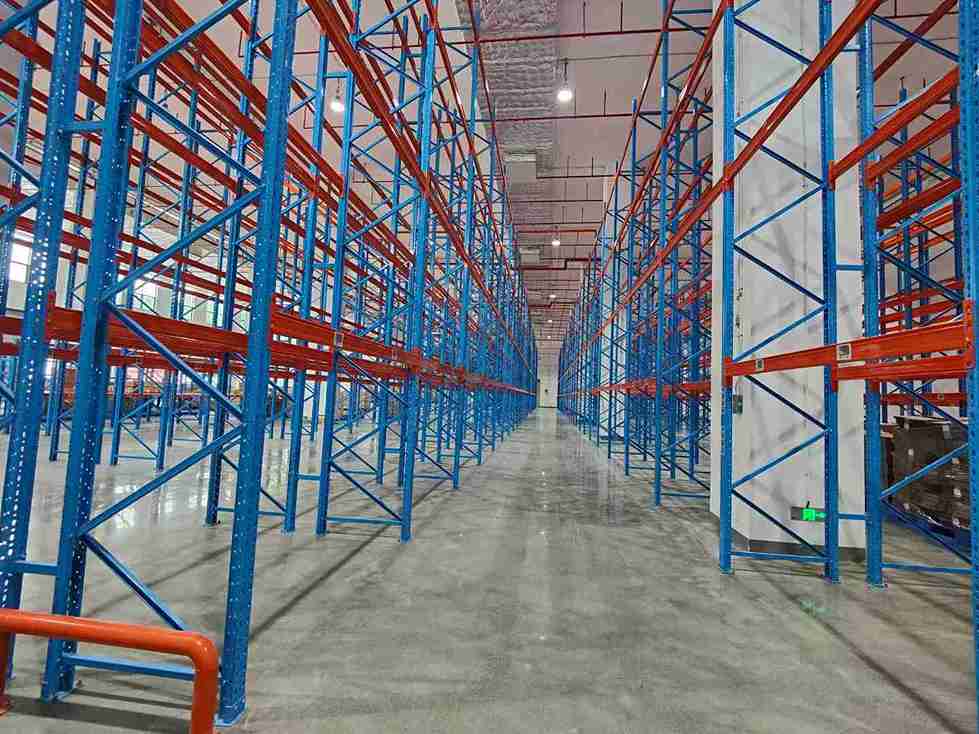
To plan effectively, one must know the environment with millimeter precision. A 3D laser scan of the empty warehouse shell captures every potential obstruction and reference point: structural columns, HVAC ducting, sprinkler heads, lighting fixtures, floor drains, and door headers.
Data Utilization: This point-cloud data is imported into warehouse design and simulation software (e.g., AutoCAD, SketchUp with specific plugins, or dedicated warehouse simulation tools). It forms the basis for all subsequent layout planning, ensuring virtual models reflect reality with perfect accuracy.
AGV Path Simulation: Within this digital twin, proposed AGV pathways, charging stations, maintenance bays, and traffic merge points can be simulated. This virtual testing identifies potential congestion points, deadlock scenarios, and inefficient travel routes long before physical construction begins. It allows planners to optimize the racking layout not just for storage density, but for optimal robotic material flow—a consideration absent from a basic pallet racking installation guide.
2.3. Defining the Operational DNA: Load, Vehicle, and Flow
This stage locks in the immutable parameters that will drive every subsequent design choice.
Load Unit Profile: Document the exact dimensions (including any overhang), weight, and type (e.g., EUR, CHEP, block-type) of all pallets or storage containers. This dictates rack beam length, vertical beam spacing, and dynamic load capacity.
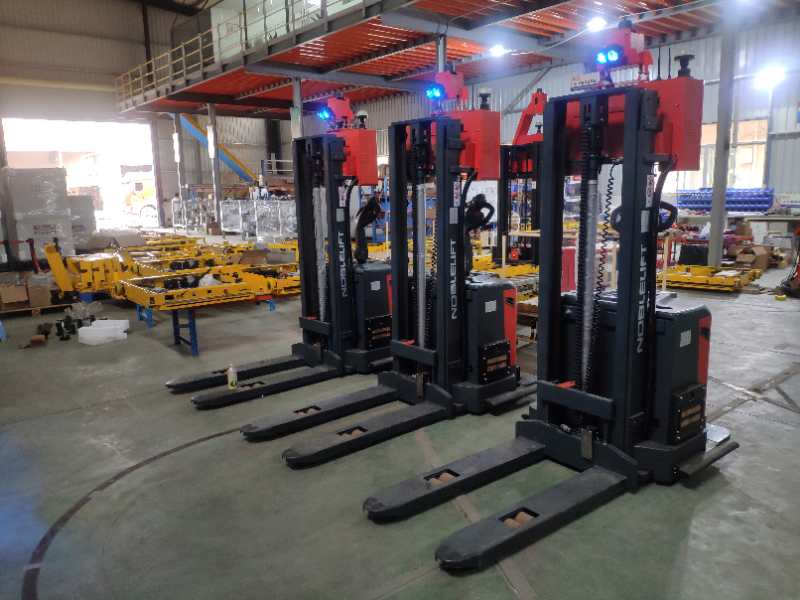
AGV/AMR Fleet Specifications: Obtain and lock in the technical specifications of the chosen automation. Critical dimensions include: overall vehicle footprint (with and without forks extended), turning radius (static and dynamic), mast height and lifting mechanism type (forks, lift table, conveyor top), and crucially, the location and field of view of all navigation and safety sensors.
Throughput and Process Mapping: Define peak and average throughput requirements (pallets/hour, cases/hour). Map out material flows from receiving, to storage, to picking, to dispatch. This determines the number of AGVs, their duty cycles, and influences whether the racking layout should favor high-density storage (e.g., push-back) or high-accessibility (selective) to support the workflow.
3. Engineering the Interface: Racking Selection and Specification for Robotics
Choosing the appropriate racking type and specifying its components with robotic interaction in mind is the next critical step. This section of the pallet racking installation guide transitions from planning to physical specification.
3.1. Racking Type Analysis for AGV Compatibility
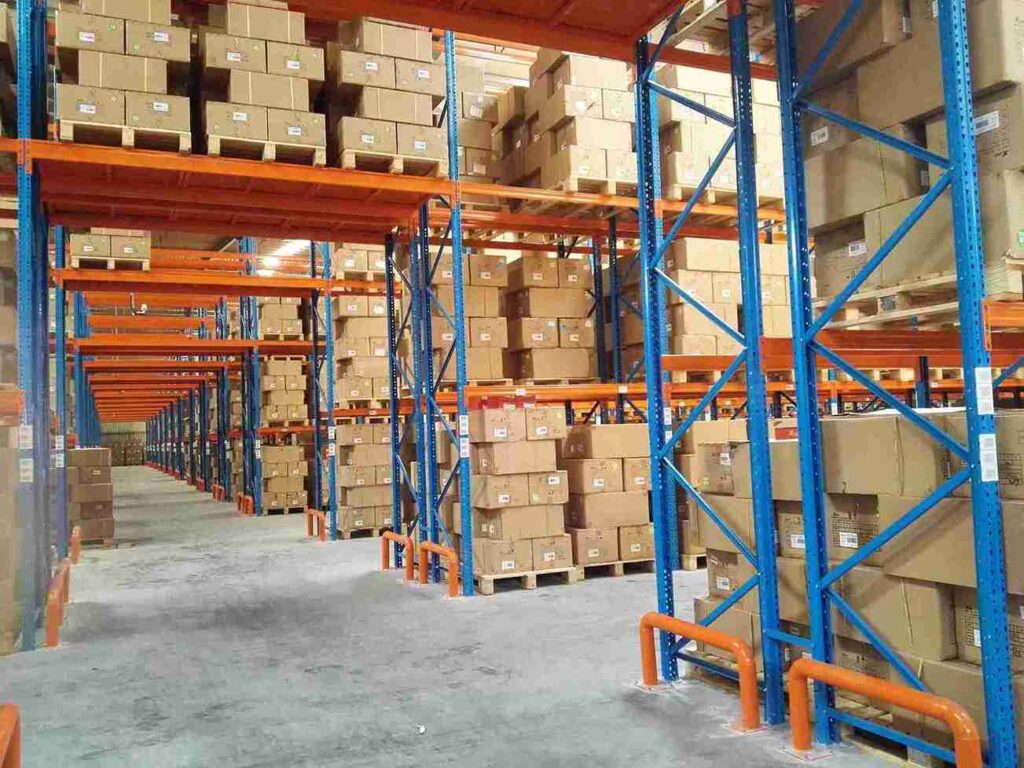
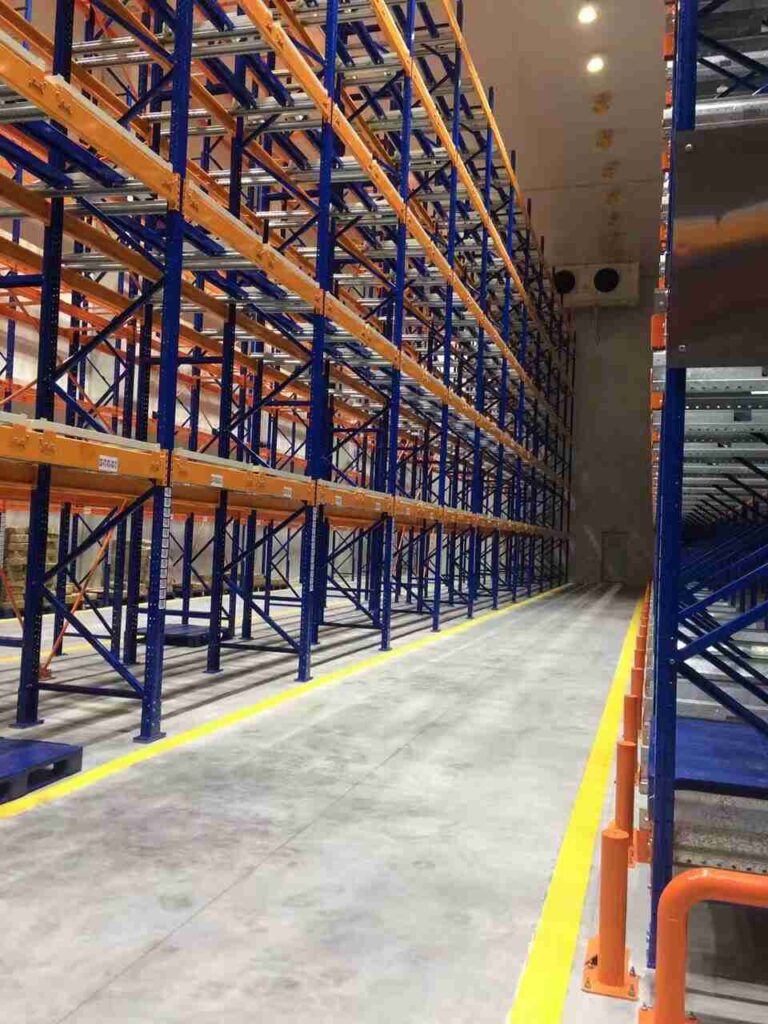
Selective Pallet Racking: The most versatile and commonly integrated type. It allows direct access to every pallet position, simplifying the AGV’s pickup/deposit logic. Key specification upgrades for AGV use include positive-locking beam connectors (to prevent dislodgment from incidental contact) and heavy-duty column guards that are bolted on for easy replacement.
Double-Deep Racking: Effectively doubles storage density but requires AGVs equipped with telescopic forks. The installation tolerance for this configuration is exceptionally high. Both rows of uprights must be in perfect parallel and vertical alignment to allow the extended forks to slide into the second pallet position without binding. This demands a pallet racking installation guide focused on laser-guided alignment.
Push-Back Racking (LIFO): A strong choice for medium-density, high-throughput lanes of similar SKUs. The AGV only interacts with the front pallet position, simplifying the interface. Specifications must emphasize extremely robust carriage systems and perfectly level rails to ensure smooth pallet movement and prevent jams that an AGV cannot diagnose.
Drive-In/Through Racking: Less common with free-navigating AGVs due to the challenge of navigating inside the rack structure. It is more suited to rail-guided vehicles. The installation focus here is on the absolute precision of the guide rails and the protective reinforcement of the entrance uprights.
3.2. AGV-Centric Design Calculations and Tolerances
This is where the integrated pallet racking installation guide provides its most distinct value, defining tolerances an order of magnitude tighter than common practice.
Aisle Width Calculation Formula:
Aisle Width = (AGV Width at Widest Point) + (Sensor Clearance Zone x 2) + (Operational Tolerance) + (Rack Upright Profile Depth) + (System Safety Margin). The “Sensor Clearance Zone” accounts for the area around the AGV where its safety lasers must remain unobstructed. The final figure often results in an aisle 150-300mm wider than the AGV’s physical width.Vertical Profile Planning: The first beam height must provide clearance for the AGV’s lifted forks or mast. Subsequent beam levels are set based on the load unit height plus clearance, but also considering the AGV’s lift mechanism increments for efficient operation. Consistency is key; every P1 position in the warehouse should present an identical vertical target.
Impact Protection and Structural Integrity: Standard upright guards are insufficient. Specify bolt-on, heavy-gauge steel column protectors (minimum 10-12 gauge) that extend from the floor to above the first beam level. For high-traffic aisle ends, consider using heavier upright profiles (e.g., 90mm x 70mm vs. 75mm x 50mm) or even structural tube columns for maximum impact resistance. Base plates should be larger, with multiple anchor bolt holes to resist torsional forces from any potential impact.
4. The Precision Installation Protocol: From Benchmark to Bolt Torque
The actual installation phase is where the digital plan becomes physical reality. The crew must operate not just as erectors, but as precision engineers building a navigation matrix. This pallet racking installation guide mandates a rigorous, documented process.
4.1. Establishing the Master Control Network
Before the first base plate is positioned, a permanent master control network is established on the warehouse floor using a high-accuracy laser transmitter or total station. These are not temporary chalk lines but precisely surveyed control points and lines that will be used throughout the installation and later for AGV world-map calibration. They define the theoretical centerlines of every aisle and row.
4.2. Step-by-Step Installation with Continuous Verification
Base Plate Positioning and Anchoring: Using the master control lines, position each base plate. Employ drilling jigs to ensure anchor bolt holes are consistent. Before anchoring, verify the diagonal measurements between opposite base plates in a bay to ensure squareness.
Upright Erection and Initial Framing: Erect two uprights and connect them with a top spacer beam. Do not fully tighten connections. This creates a stable but adjustable “gate.”
Precision Plumbing and Alignment: Using digital inclinometers, ensure each upright is perfectly plumb (tolerance: ±2mm over 3m height). Simultaneously, use a laser aligned to the master control network to verify the upright’s footprint is in its exact planned location. Shim under base plates as needed. Only once plumb and location are verified should anchor bolts be torqued to the manufacturer’s specification using a calibrated torque wrench.
Beam Installation and Level Verification: Install beams using a story pole or laser level to ensure all beams on the same level are perfectly horizontal across the entire bay and row (tolerance: ±1.5mm). This horizontal consistency is critical for AGVs that use beam levels as visual alignment cues. All beam connectors must be fully seated and torqued.
Row Completion and System Check: Assemble the full row, installing all horizontal and diagonal braces. After a row is complete, conduct a verification survey using a total station to check the position of key uprights against the master control network. This closed-loop checking catches cumulative errors early.
4.3. The “As-Built” Documentation Package
Upon completion, the installer does not simply provide a certificate of compliance. They must deliver a comprehensive As-Built Documentation Package, a critical output of this advanced pallet racking installation guide. This package includes:
Dimensional Survey Report: From a professional surveyor, listing the precise coordinates (X, Y, Z) of a sample of critical uprights relative to the master control points.
Anchor Bolt Torque Certification: Signed log showing each bolt was torqued to spec.
Final Load Test Report: Confirming structural performance.
AGV Integration Data Set: A digital file containing the coordinates of chosen rack features (e.g., specific upright-column intersections) that will serve as natural navigation landmarks for LiDAR-based AGVs. This transforms the physical installation into a ready-to-use digital map.
5. System Integration and Calibration: Bringing the Robot and Rack into Harmony
With the racking acting as the perfect, fixed landmark, the AGV system can now be calibrated to it. This phase is the culmination of all prior precision work.
5.1. Navigation Map Creation and Alignment
For natural feature/LiDAR navigation, the AGV integrator uploads the As-Built Documentation Package coordinates into their fleet management software. The chosen rack features become fixed points in the AGV’s virtual world map. The AGVs are then driven through the facility in a “teaching” run, where their onboard LiDAR units scan the environment. The software correlates the live scan data with the provided coordinates, creating a highly accurate and stable navigation map. The accuracy of this map is directly proportional to the accuracy of the racking installation.
5.2. Defining the Pick and Place Docking Sequence
Each pallet location is programmed not as a single coordinate, but as a multi-step operational sequence or “docking protocol”:
Approach Path: The predefined route the AGV takes to enter the aisle and approach the target bay.
Final Alignment Trigger: The point at which the AGV switches from general navigation to high-precision docking. This often involves activating side-looking cameras or short-range lasers that detect the relative position of the rack beams or target plates.
Micro-Adjustment and Validation: The AGV makes fine lateral or rotational adjustments (often in the sub-centimeter range) to align its forks perfectly with the pallet entry points. A sensor validates the expected opening is clear.
Fork Insertion Execution: The lift mechanism executes the lift and extension sequence at the programmed speed and depth.
This protocol, defined for a master location, can be reliably replicated across all positions only if the racking installation is consistent. Any deviation forces custom programming for that location, adding complexity and potential for error.
5.3. Safety System Synchronization with Infrastructure
The racking layout directly informs the AGV’s safety configuration. The protective fields of the AGV’s safety laser scanners are programmed relative to the rack structure. In a long, straight aisle, the warning and braking fields can be elongated, allowing higher travel speeds. At the end of an aisle or at intersections, the fields are expanded to create larger stopping zones. This dynamic safety programming, enabled by a predictable and precise infrastructure, maximizes both safety and operational efficiency.
6. Operational Excellence and Long-Term Synergy Maintenance
The integration project’s success is measured over years, not days. Maintaining the synergy between rack and robot requires a new operational discipline.
6.1. Unified Inspection and Maintenance Regimes
The maintenance schedule must be integrated. A monthly or quarterly inspection should combine:
Rack Integrity Checks: Specifically looking for new dents, scuffs, or bolt loosening that indicate AGV contact or misalignment. Use the as-built drawings as a reference for alignment checks.
AGV Performance Log Analysis: Reviewing fleet management software logs for increases in “alignment correction” events or aborted picks at specific locations, which are early warnings of rack movement or damage.
Floor Condition Monitoring: Regular checks for new settlement, cracks, or surface wear that could affect AGV travel.
6.2. Performance Analytics for Continuous Optimization
Data from the WMS and AGV Fleet Manager provides a powerful feedback loop. Heatmaps of AGV travel can identify congested pathways. Pick frequency data from the WMS can reveal that “A” movers are stored in suboptimal locations. This intelligence can inform a plan for a future, partial rack reconfiguration—a project that can be executed with minimal disruption because the original pallet racking installation guide and processes documented the master control network, allowing new racking to be integrated seamlessly into the existing AGV world map.
6.3. Adapting the Guide for Regional Challenges
An effective pallet racking installation guide for global markets must account for local conditions:
Seismic Zones (e.g., parts of Latin America): Racking design and installation must adhere to strict seismic codes (e.g., IBC, RMI), which may require specialized bracing and anchoring. AGV programming needs to include emergency “park and shutdown” procedures for seismic events.
Dust and Sand (e.g., Middle East, North Africa): AGV sensor heads and rack-mounted targets require regular cleaning schedules. Enclosed sensor housings and air-purge systems may be necessary. Dust can also affect floor friction, influencing AGV braking calculations.
High Humidity/Tropical Climates (e.g., Southeast Asia, Coastal Africa): Specifications must include corrosion-resistant finishes (e.g., powder coating standards). Floor slab moisture testing is critical to prevent coating failure and steel corrosion. Climate control in battery charging areas is essential.
Conclusion: The Integrated Installation as a Strategic Imperative
In the final analysis, the journey outlined in this pallet racking installation guide represents a fundamental evolution in warehouse implementation philosophy. For businesses targeting growth in the fast-moving markets of Latin America, the Middle East, Africa, and beyond, the ability to seamlessly merge physical infrastructure with digital automation is a core competitive competency.
The pallet racking installation ceases to be a commoditized construction task and transforms into the critical process of embedding a precise, reliable, and intelligent spatial framework into the warehouse—a framework upon which all future automation, efficiency, and scalability depend.
The meticulous steps of site audit, digital twin creation, AGV-centric specification, precision installation, and calibrated integration are not merely technical details; they are the pillars of a future-proof logistics operation.
By investing in the rigor prescribed by this integrated pallet racking installation guide, companies do more than install storage; they construct a high-performance, adaptable, and resilient engine for commerce, capable of delivering superior ROI on automation investments and thriving amidst the supply chain demands of the 21st century. The blueprint for success lies not in choosing between robust racking and smart AGVs, but in the expert, foresighted engineering of their inseparable partnership from the very first day of the project.
Frequently Asked Questions (FAQs)
1: We have an existing warehouse with standard selective racking. Is it possible to follow an integrated pallet racking installation guide retroactively, or must we start from scratch?
A retroactive integration is a complex engineering project, but often feasible. It begins with a thorough audit against the standards in this guide: a precise floor survey, 3D laser scan of the existing rack layout, and measurement of all critical tolerances (aisle width, upright plumb, beam level).
The outcome usually presents three paths:
1) Minor AGV Adaptation: If tolerances are reasonably good, AGVs can be programmed with wider tolerances and potentially slower docking speeds, accepting a trade-off in peak efficiency.
2) Racking Modification & Reinforcement: This may involve realigning and re-anchoring specific rows, adding protective features, and potentially replacing beams with ones that have positive locking connectors.
3) Phased Replacement: The most robust long-term solution, where racking in high-throughput zones is replaced following the integrated guide, while other areas operate in a hybrid mode. A detailed audit is essential to determine the most cost-effective path.
2: How does the guide’s approach differ for systems using Autonomous Mobile Robots (AMRs) for case picking versus Unit-Load AGVs?
While the core philosophy of integrated planning remains, the focus shifts. AMR-based goods-to-person systems interact with shelving, carton flow racking, or pallet racking with decant stations. The installation guide principles apply to the pick module or mezzanine structure where humans work.
Here, precision ensures stability (vibration is a concern with many moving robots below), and the layout focuses on optimizing AMR travel paths to multiple pick stations, minimizing congestion. The tolerance requirements for the storage media itself might be slightly less stringent than for AGV fork insertion, but the system-wide orchestration and interface design (e.g., conveyor transfer points) require even more meticulous simulation and planning.
3: What are the key software tools used to support the planning phases outlined in this integrated guide?
A successful project leverages a suite of specialized software:
Building Information Modeling (BIM) & CAD: Tools like AutoCAD, Revit, or SolidWorks are used for detailed racking layout and structural design.
3D Laser Scanning & Point Cloud Processing: Faro or Leica hardware and software (e.g., Faro Scene, Leica Cyclone) are used for the initial site capture.
Warehouse Simulation & Emulation: FlexSim, AnyLogic, or Siemens Tecnomatix allow for dynamic simulation of AGV traffic, pick station activity, and overall system throughput to validate designs before installation.
AGV Fleet Management Software: Proprietary software from the AGV vendor (e.g., KUKA Navigation, MiR Fleet, AutoGuide systems) is used for mapping, traffic management, and task orchestration. The as-built data feeds directly into this system.
4: For cold storage applications, what specific deviations from the standard integrated pallet racking installation guide are required?
Cold storage imposes a harsh environment on both racking and automation, demanding specific adaptations:
Material Specifications: Racking must be manufactured from low-temperature certified steel (often with a specific Charpy V-notch impact test rating) and use cold-rated lubricants and paints to prevent brittleness and flaking.
AGV Specifications: AGVs require environmental hardening: sealed and insulated electronics, heated battery compartments, and special tires that remain pliable at sub-zero temperatures. Sensor lenses may need heating elements to prevent fogging or icing.
Installation Tolerances: Allowances must be made for thermal contraction of both the racking steel and the building structure. Anchor bolt patterns and expansion joints may need adjustment.
Process Design: The guide must include planning for condensation management at temperature transition zones and may recommend wider aisles to account for potential ice buildup on floors.
5: Who are the key stakeholders that should be involved from the beginning when following this comprehensive guide?
To ensure success, form a cross-functional project team that includes:
Client Side: Warehouse Operations Director, Logistics Manager, Facilities/Engineering Manager, IT/Systems Interface Lead.
Vendor/Consultant Side: Pallet Racking Manufacturer & Certified Installation Team, AGV/AMR System Integrator, Warehouse Design Consultant (often independent), Civil/Structural Engineer (for floor and building interface), General Contractor (for site readiness).
Critical Success Factor: The racking installer and AGV integrator must be in direct, frequent communication from the initial design phase, with clear contractual interfaces defining responsibilities for data exchange (like the as-built package) and system handoff protocols. Treating them as separate vendors operating in silos is the primary risk to be mitigated by following this integrated pallet racking installation guide.
If you require perfect CAD drawings and quotes for warehouse racking, please contact us. We can provide you with free warehouse racking planning and design services and quotes. Our email address is: jili@geelyracks.com