📐 "First 50 Enterprise Queries Get Custom 3D Warehouse Design" Plan


In the high-stakes world of modern logistics and warehousing, efficiency isn’t just a goal—it’s the very foundation of profitability and competitive advantage. Two relentless pressures consistently dominate executive strategy sessions: the soaring, unpredictable cost of labor and the fixed, expensive nature of warehouse square footage. While expanding a facility’s walls is a capital-intensive and often impossible endeavor, a revolutionary solution exists within the existing footprint. The implementation of sophisticated high-density pallet flow racking systems represents a paradigm shift in storage methodology.
These are not mere storage shelves; they are dynamic, gravity-powered inventory management systems engineered to maximize storage density by leveraging the often-wasted cubic air space of a facility. Simultaneously, they enforce a flawless FIFO (First-In, First-Out) inventory rotation, directly targeting and dramatically reducing labor costs associated with order picking, stock rotation, and forklift operation. This exhaustive guide will dissect every component, consideration, and benefit of pallet flow racking systems, providing the detailed analysis necessary to make a confident, informed investment decision that will transform warehouse operations for years to come.

The Immense Pressure on Modern Warehouses: Why Density and Efficiency Are Non-Negotiable
The contemporary supply chain operates on razor-thin margins and demanding consumer expectations for rapid fulfillment. E-commerce giants have reset the standard for delivery speed, forcing every player in the logistics field to adapt or be left behind. This environment exacerbates the pain points of traditional storage solutions. Static selective pallet racking, while familiar, is notoriously inefficient. It creates a labyrinth of wide aisles that consume up to 50% or more of a facility’s total floor space—space that generates no revenue but incurs significant overhead in rent, utilities, and maintenance.
Furthermore, these layouts force forklifts to travel immense distances daily, leading to excessive fuel consumption, accelerated equipment wear-and-tear, and operator fatigue. The financial drain is compounded by the high cost of finding and retaining qualified forklift operators. In this context, the move toward high-density, dynamic storage is not a luxury; it is a strategic imperative for survival and growth. Pallet flow racking systems sit at the apex of this movement, offering an unparalleled combination of space optimization and automated product movement.
What Exactly is a Pallet Flow Racking System? A Deep Dive into Gravity-Driven Storage
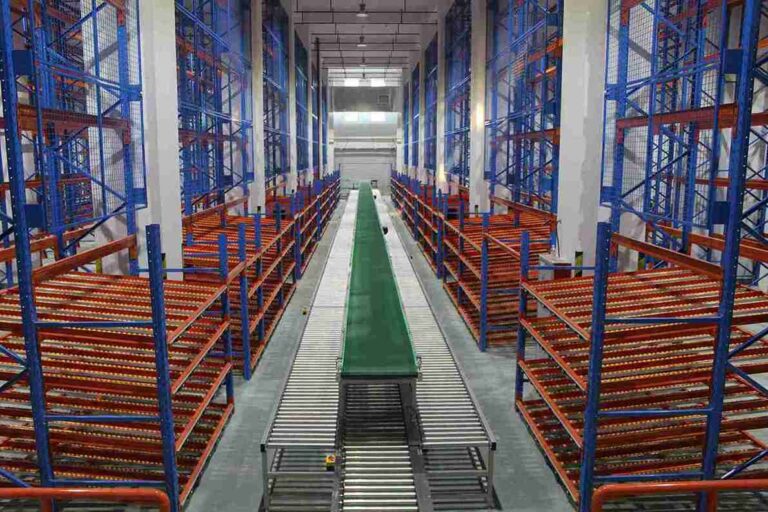
A pallet flow racking system, also commonly referred to in the industry as gravity flow racking, is a high-density live storage solution that masterfully utilizes the constant force of gravity to transport unit loads through the storage structure. The fundamental design principle is an inclined plane, meticulously calibrated to ensure consistent, controlled movement. Pallets are loaded en masse into the higher “replenishment” end of a dedicated lane.
The natural pull of gravity then gently moves each pallet forward on a bed of wheels or rollers until it meets the pallet ahead of it. When a picker removes the lead pallet from the lower “pick-face” end, the entire column of pallets advances forward by one position, automatically presenting the next pallet in sequence. This creates a continuous, self-replenishing flow of inventory that guarantees the oldest stock is always the first to be retrieved, making pallet flow racking systems the gold standard for FIFO compliance.
Core Components of a Flow Rack System: The Anatomy of Efficiency
The remarkable efficiency of a pallet flow racking system is a direct result of its precision-engineered components, each playing a critical role in the system’s overall performance and reliability.
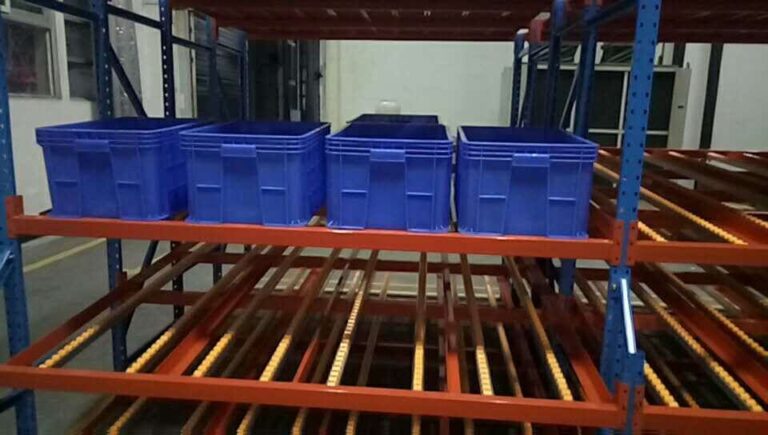
Flow Tracks/Rails: These form the very channel through which inventory flows. Constructed from high-tensile steel, these inclined rails are the foundation upon which everything else is built. The angle of decline is not arbitrary; it is a carefully calculated value determined by factors such as pallet weight, bottom surface composition, and the type of flow media used.
Wheel Cartridges or Rollers: This is the heart of the motion mechanism. Wheel cartridges are typically the preferred choice for handling heavier, rigid loads on standard wooden pallets. The wheels offer low rolling resistance, allowing gravity to effectively move substantial weight. Roller-based systems, conversely, are ideal for lighter loads, plastic pallets, or products with a softer bottom surface that might catch or snag on wheels. The choice between wheels and rollers is a crucial design decision that impacts the system’s performance and compatibility.
Braking Systems: Safety and control are paramount. Without a proper braking system, pallets could accelerate down the lane, culminating in a destructive impact at the pick face. Speed controllers, or brakes, are installed at strategic points within the lane. These devices modulate the pallet’s speed, ensuring a gentle, controlled stop that protects both the product and the structural integrity of the pallet flow racking system.
Frame Uprights and Beams: This is the robust skeletal structure that supports the entire dynamic load. Unlike standard racking, pallet flow racking systems must be designed to handle not only the static weight of the inventory but also the constant kinetic forces of moving loads. The uprights and beams are therefore typically heavier-gauge, often structural steel, and are engineered to exacting standards to ensure absolute safety and stability.
Load Separators and Stops: Located at the discharge end, these components are vital for operational safety. The load stop securely holds the first pallet in position, preventing it from accidentally rolling out onto the aisleway. It is designed to be easily released by the lift truck driver during the unloading process. Lane dividers help maintain separation between different SKUs in multi-SKU configurations.
The Unbeatable Advantages: More Than Just Saving Space
The decision to integrate a pallet flow racking system into a warehouse operation delivers a powerful cascade of interconnected benefits that directly and positively impact the company’s bottom line. The advantages extend far beyond simple space savings, touching every aspect of material handling.
1. Radical Maximization of Storage Density
This is the most visually dramatic and immediately quantifiable benefit. By consolidating multiple pallet positions into a single deep lane and eliminating numerous access aisles, facilities can achieve an increase in storage capacity of 50% to 80% or more within the exact same building footprint. This transformative approach to pallet flow racking systems effectively converts wasted vertical air space into highly valuable, revenue-generating storage positions. For companies facing capacity constraints, this density can delay or even eliminate the need for a costly facility expansion or relocation.
2. Significant Reduction in Labor Costs
The financial impact of labor savings is often where the ROI of a pallet flow racking system becomes overwhelmingly compelling. The design fundamentally redefines the workflow for forklift operators. The replenishment function is isolated to one side of the bay, while order picking is concentrated on the opposite, pick-face side. This segregation drastically reduces non-productive forklift travel time—no more navigating vast aisles to search for a specific SKU.
Operators can complete more cycles per hour with less effort. The reduction in travel time translates directly into lower labor hours, decreased energy consumption for electric forklifts, and reduced maintenance costs for the fleet. For operations running multiple shifts, the annualized savings can be substantial, often justifying the capital expenditure on the pallet flow racking system within a remarkably short payback period.
3. Guaranteed FIFO Inventory Management
For a vast number of industries, FIFO is not a suggestion; it is an operational mandate critical to financial health and regulatory compliance. Sectors such as food and beverage, pharmaceuticals, chemicals, and any operation dealing with perishable goods or products with expiration dates rely on perfect stock rotation. Pallet flow racking systems automate and enforce this process with 100% reliability.
The oldest inventory is always positioned at the pick face, ready to be selected first. This eliminates the immense risk of product spoilage, obsolescence, and costly write-offs that can easily occur in LIFO (Last-In, First-Out) systems like drive-in or push-back racking. The certainty of FIFO provides peace of mind and protects profit margins.
4. Enhanced Picking Accuracy and Speed
A well-designed pallet flow racking system brings order and predictability to the picking process. Pickers always know that the correct pallet to retrieve is the one presented directly to them at the unload face. This eliminates confusion, reduces the time spent verifying lot numbers or manufacturing dates, and minimizes human error. The streamlined, logical workflow significantly accelerates order fulfillment cycles, allowing the warehouse to achieve a higher throughput with the same or fewer labor resources. This increase in productivity is a key driver of customer satisfaction and operational scalability.
5. Improved Safety and Ergonomics
Safety is an invaluable benefit. By drastically reducing the amount of forklift traffic within the storage aisles, pallet flow racking systems inherently lower the risk of accidents, collisions between equipment, and damage to racking and inventory. Furthermore, the pick face is designed to present the pallet at a consistent and ergonomic height for the operator, reducing physical strain and the potential for musculoskeletal injuries. The controlled movement of pallets within the enclosed lane also prevents accidental tip-overs or products falling from height, creating a safer working environment for all personnel.
Critical Considerations for Implementing a Pallet Flow System
The exceptional performance of a pallet flow racking system is contingent upon proper application and meticulous planning. These systems are not a universal panacea; their successful deployment requires a thorough analysis of specific operational characteristics.
Lane Depth and SKU Profilin
The configuration of lane depth is a fundamental strategic decision. While deeper lanes (holding 10, 15, or even 20+ pallets) offer the highest possible density, they are only efficient for high-volume SKUs with a consistent and predictable turnover. A deep lane dedicated to a slow-moving product becomes a black hole for inventory, defeating the purpose of a dynamic system. A comprehensive analysis of inventory—using metrics like velocity (fast vs. slow movers), cube (size), and turnover rate—is essential to determine the optimal lane depth for each product category within the pallet flow racking system.
Pallet and Load Characteristics: The Foundation of Reliability
The performance and reliability of any pallet flow racking system are profoundly dependent on the quality and consistency of the pallets and loads themselves. This is perhaps the most critical operational factor.
Pallet Quality: Warped, broken, or inconsistently sized pallets are the primary cause of jams and system malfunctions. Investing in a high-quality, standardized pallet pool is a prerequisite for the smooth operation of a pallet flow racking system. The bottom deck boards must be sturdy, evenly spaced, and free of protruding nails or splinters.
Load Weight and Distribution: The weight of the load per pallet must fall within the specified capacity of the flow components (wheels or rollers). Furthermore, the load must be evenly distributed across the pallet’s surface. An off-center or unstable load can bind against the lane dividers, causing a stall that requires manual intervention to clear, disrupting workflow.
Weight and Compatibility
The structural design of the entire pallet flow racking system hinges on precise load calculations. The maximum weight per pallet and the cumulative weight of a fully loaded lane must be accurately provided to the system engineer. This data dictates the specification of the flow media (wheel capacity), the structural uprights and beams, and the required braking force. Underestimating load weight can lead to catastrophic system failure, while overestimating can lead to unnecessary cost inflation.
Floor Flatness and System Installation
The gentle, consistent incline required for a pallet flow racking system to function correctly is measured in millimeters over meters. Therefore, the flatness of the warehouse floor is a non-negotiable factor. Significant deviations or slopes in the floor can cause pallets to stall in one section of the lane or accelerate uncontrollably in another. A professional floor survey is often recommended. Moreover, the installation of these systems is a job for certified experts, not a general warehouse crew. Perfect alignment of the flow tracks is critical; even minor errors can compromise the entire system’s functionality and safety.
The ROI Equation: Calculating Your Savings with Flow Racking
Justifying the capital investment in a pallet flow racking system requires a rigorous and clear-eyed financial analysis. The return on investment (ROI) is typically compelling and can be broken down into quantifiable components.
Capital Cost (Initial Outlay): This encompasses all hardware costs—the structural framing, flow tracks, wheel/roller cartridges, braking systems, and professional installation services. It’s the most straightforward part of the equation.
Savings from Increased Storage Density (Avoided Cost): This is calculated by determining the value of the additional pallet positions created. Compare the cost per pallet position in the new pallet flow racking system to the cost of acquiring additional warehouse space (through construction or leasing) to achieve the same storage capacity. Factor in the avoided costs of property taxes, insurance, and utilities on that additional space.
Savings from Labor Reduction (Recurring Annual Savings): This is often the most significant saving. Quantify the reduction in forklift operating hours. Model the reduced time required for order picking and replenishment. Apply this time savings to operator hourly wages, benefits, and allocated overhead. Include the associated reduction in forklift charging/fuel costs, maintenance, and potential reduction in required fleet size.
Savings from Reduced Product Loss (Risk Mitigation): For FIFO-critical industries, this is a major financial factor. Calculate the historical cost of product spoilage, obsolescence, or write-offs due to poor stock rotation. A pallet flow racking system virtually eliminates this loss, and the avoided write-offs directly contribute to the ROI.
When these factors are aggregated, most operations experience a full return on their investment in a high-quality pallet flow racking system within a remarkably short period, often between 18 to 36 months. The savings realized thereafter flow directly to the bottom line as ongoing profit improvement.
Beyond Gravity: Integrating Pallet Flow with Warehouse Automation
The true pinnacle of modern warehouse efficiency is achieved when a pallet flow racking system is seamlessly integrated into a broader automated ecosystem. These gravity-powered systems act as the high-density, high-velocity buffer within a fully automated storage and retrieval system (AS/RS). Imagine a scenario where Automated Guided Vehicles (AGVs) or Autonomous Mobile Robots (AMRs) are solely responsible for the replenishment cycle at the load side, working around the clock with flawless efficiency.
Meanwhile, on the pick-face side, order selectors or automated picking robots can work uninterrupted, with the next required pallet always perfectly presented the moment it is needed. This synergy creates a seamlessly flowing pipeline of inventory, minimizing human touchpoints and maximizing throughput. This integration of simple, reliable gravity with sophisticated robotics and software represents the undeniable future of warehouse design, and a well-planned pallet flow racking system is the perfect foundation upon which to build this automated future.
Choosing the Right Partner for Your High-Density Storage Project
Selecting a supplier for a pallet flow racking system is a decision that carries significant long-term consequences. It is not a simple transaction for hardware; it is the selection of a design and engineering partner. The chosen provider must demonstrate proven experience and a portfolio of successful pallet flow racking system installations. They should insist on conducting a thorough site survey and demand access to your inventory data for proper analysis.
A reputable partner will provide detailed load calculations, comprehensive layout drawings, and clear explanations for their design choices. Their expertise is the final, critical component that ensures the pallet flow racking system is not only safe and compliant with all national and local standards but is also perfectly tailored to your specific operational needs, thereby guaranteeing the maximum possible return on your investment.
Conclusion: Flow Racking as a Strategic Imperative
In the final analysis, the question for warehouse operators has evolved from whether to adopt high-density storage to which specific solution best aligns with their operational and financial goals. For the vast majority of operations that require strict FIFO inventory control and handle high volumes of palletized goods, high-density pallet flow racking systems present an overwhelmingly strong value proposition. They are a proven technology that directly attacks the two most persistent and costly challenges in the industry: the high expense of space and the even higher expense of labor.
The investment in a pallet flow racking system delivers tangible, quantifiable improvements in storage capacity, operational efficiency, and safety, thereby fundamentally strengthening a company’s competitiveness and profitability. By transforming static storage into a dynamic, flowing asset, these sophisticated systems unlock latent potential, eliminate costly waste, and provide a scalable pathway toward further automation. The investment, therefore, is not just in metal and wheels; it is an investment in building a smarter, more resilient, and more profitable operation for the future.
Frequently Asked Questions (FAQs)
1. How do we prevent pallet jams, and what happens if one occurs in our pallet flow racking system?
Prevention is the cornerstone of reliable operation. The single most effective action is mandating the use of high-quality, structurally sound, and consistent pallets. Ensuring loads are stable, evenly distributed, and do not overhang the pallet edge is also crucial. Despite best practices, jams can occasionally happen. Reputable manufacturers design their pallet flow racking systems with maintenance and clearability in mind. This often involves easily removable panels or access points at the end of the lanes, allowing a jammed pallet to be safely pushed through or pulled back with a pallet truck, minimizing downtime.
2. Are pallet flow racking systems suitable for cold storage or freezer environments?
Absolutely. In fact, they are highly recommended for these challenging environments due to the critical need for FIFO and the exorbitant cost of cooled space. Pallet flow racking systems designed for cold storage use special lubricants that remain viscous at low temperatures, and often feature materials like galvanized or stainless-steel components to resist corrosion from constant humidity and condensation. The reduction in forklift travel within the expensive cooled space also contributes to energy savings.
3. What is the true weight capacity for a deep-lane pallet flow racking system?
Capacity is not a single number but a system-wide specification based on the components selected. Standard wheel beds can typically handle loads ranging from 1,000 lbs to over 5,000 lbs per pallet. For exceptionally heavy loads, specialized heavy-duty pallet flow racking systems with reinforced wheels, heavier-gauge tracks, and structural supports can be engineered. It is imperative to provide your supplier with accurate maximum load weights for a safe and correct design.
4. How does the cost and application of a pallet flow racking system differ from push-back racking?
Both are excellent high-density solutions but serve different purposes. Push-back racking is a LIFO (Last-In, First-Out) system, making it ideal for non-perishable goods where stock rotation is not a priority. It can sometimes have a marginally lower upfront cost per position. However, a pallet flow racking system, by enforcing FIFO, often provides greater value for perishable goods and typically offers a slightly higher storage density. The choice is fundamentally driven by inventory management philosophy (FIFO vs. LIFO) rather than cost alone.
5. Is professional installation truly non-negotiable for a pallet flow racking system?
Yes, without question. The performance and safety of the entire system are 100% dependent on perfect alignment and a precise, consistent incline across the entire bay. Even a minor deviation, invisible to the naked eye, can cause pallets to stall or behave unpredictably. Professional installers possess the specialized laser-leveling tools, training, and experience to ensure the pallet flow racking system is installed to the manufacturer’s exact specifications, guaranteeing optimal performance and safety from day one. Attempting a DIY installation is a high-risk endeavor that will almost certainly lead to operational failures and potential safety hazards.
Welcome to contact us, if you need warehouse rack CAD drawings. We can provide you with warehouse rack planning and design for free. Our email address is: jili@geelyracks.com