📐 "Eerste 50 bedrijfsvragen krijgen aangepast 3D-ontwerp van magazijn" Plan
















Introduction: The Rising Demand for Semi-Automated Racking Solutions
In an era where warehouse efficiency directly impacts profitability, businesses are increasingly turning to semi-automated racking solutionsnaarmaximize storage capacity,reduce labor costsenenhance operational speed. Unlike fully automated systems, which require massive capital investmentofmanual racking, which is labor-intensive and error-prone,semi-automated racking solutions offer the perfect middle ground—delivering high performance at a reasonable cost.
This in-depth guide explores why semi-automated racking solutions are becoming the preferred choice for modern warehouses, distribution centers, and manufacturing facilities. From cost-benefit analysisnaarreal-world case studies, this article provides bruikbare inzichten for logistics managers, warehouse operators, and business owners looking to optimize their storage infrastructure.
1. Understanding Semi-Automated Racking Solutions
1.1 What Are Semi-Automated Racking Solutions?
Semi-automated racking solutions integrate automated retrieval mechanismsmethuman oversight, creating a hybrid storage system that boosts efficiency without eliminating workforce flexibility. These systems use automated guided vehicles (AGVs),pallet shuttlesenmotorized mobile rackingnaarstreamline operations while keeping installation and maintenance costs manageable.
1.2 How Semi-Automated Racking Solutions Compare to Other Systems
- Manual Racking: Relies on forklifts and manual labor, leading to higher error ratesenslower throughput.
- Fully Automated Racking (AS/RS): Requires significant upfront investmentenlimited adaptability for changing inventory needs.
- Semi-Automated Racking Solutions: Provide a balanced approach, improving speed and accuracymet behoud vancost control.
2. Key Advantages of Semi-Automated Racking Solutions
2.1 Cost-Effective Warehouse Optimization
One of the biggest selling points of semi-automated racking solutions is their affordability compared to fully automated alternatives. Businesses can reduce labor expenses by 30-50% while avoiding the high capital costs of robotic automation.
2.2 Superior Space Utilization with High-Density Storage
By incorporating narrow-aisle designs,push-back rackingenvertical lift modules (VLMs),semi-automated racking solutions can increase storage capacity by up to 60% compared to traditional static shelving.
2.3 Enhanced Accuracy and Reduced Operational Errors
Automated components like RFID trackingenbarcode scanning minimize human errorszorgen voornear-perfect inventory accuracy—a critical factorvoore-commerce fulfillmentenjust-in-time manufacturing.
2.4 Scalability for Growing Businesses
In tegenstelling totrigid fully automated systems,semi-automated racking solutions allow gradual expansion, making them ideal for businesses with fluctuating inventory demands.
3. Types of Semi-Automated Racking Solutions
3.1 Push-Back Racking Systems
- Gebruiktgravity-fed rollers to store multiple pallets deep.
- Ideal for FIFO (First-In-First-Out) of LIFO (Last-In-First-Out) voorraadbeheer.
- Best suited for beverage distributionencold storage warehouses.
3.2 Pallet Shuttle Systems
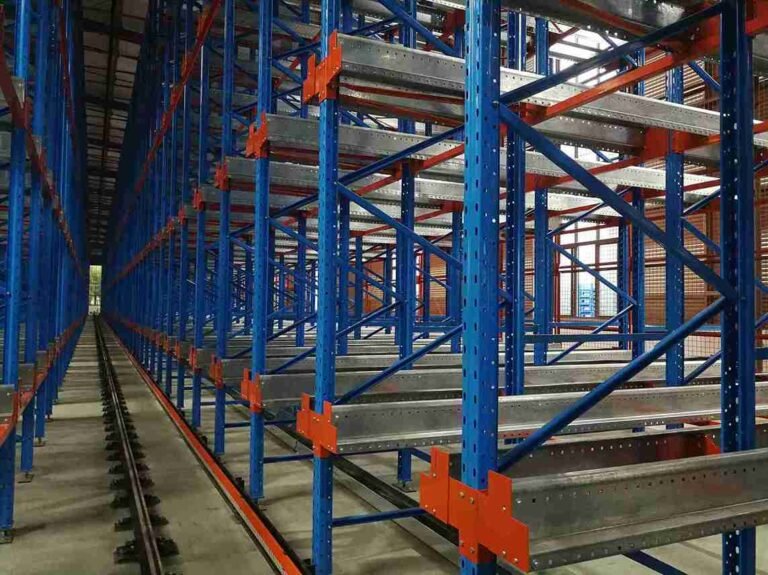
- Features removable electric shuttles that automate pallet movement within the rack.
- Reduces forklift dependency, improving safety and efficiency.
- Highly effective in high-throughput operations like retail distribution centers.
3.3 Mobile Racking (Motorized Adjustable Shelving)
- Motorized bases shift entire racking rows, maximizing floor space.
- Perfect voorlow-turnover inventory such as archival documentsofseasonal products.
3.4 Vertical Lift Modules (VLMs)
- Automated vertical carousels retrieve items with minimal human intervention.
- Excellent for small parts storage in pharmaceuticalsenelectronics manufacturing.
4. How to Select the Best Semi-Automated Racking Solutions
4.1 Evaluating Warehouse Requirements
- Inventory turnover rate (high vs. low).
- SKU diversity (uniform vs. mixed sizes).
- Available floor space (narrow vs. wide aisles).
4.2 Budget and ROI Considerations
- Upfront investment vs. long-term savings.
- Maintenance costs (automated parts vs. manual labor).
4.3 Integration with Warehouse Management Systems (WMS)
- Compatibility with ERP and inventory tracking software.
- Training requirementsvooroperational staff.
5. Real-World Success Stories with Semi-Automated Racking Solutions
5.1 E-Commerce Fulfillment Center Boosts Efficiency by 40%
Amid-sized online retailer implemented pallet shuttle systems, reducing order processing timeencutting labor costs by 35%.
5.2 Food & Beverage Warehouse Optimizes Cold Storage
Aleading beverage distributor increased storage density by 50% using push-back racking, allowing faster restocking during peak seasons.
6. The Future of Semi-Automated Racking Solutions
6.1 AI and Predictive Analytics for Smarter Warehousing
- Machine learning algorithms optimize stock placement based on demand forecasting.
- Automated restocking alerts prevent out-of-stock scenarios.
6.2 IoT-Enabled Smart Racking for Real-Time Monitoring
- RFID and sensor-based trackingbiedtlive inventory updates.
- Automated damage detection reduces product loss.
Conclusion: Are Semi-Automated Racking Solutions Right for Your Business?
Semi-automated racking solutions represent the ideal compromise between cost efficiencyenhigh-performance warehousing. By reducing labor dependency,opslagdichtheid maximaliserenenimproving accuracy, these systems are transforming modern logistics.
For businesses seeking a scalable,cost-effective storage solution that bridges the gap between manual and fully automated systems,semi-automated racking solutions offer unmatched flexibility and ROI.
Frequently Asked Questions (FAQ's)
1. How much do semi-automated racking solutions cost compared to fully automated systems?
Terwijlfully automated systems can cost 50,000–$200,000, making them far more accessible.
2. Can semi-automated racking solutions work with existing forklifts?
Yes, many semi-automated racking solutions, such as push-back racking, are designed to integrate seamlesslymetstandard forklifts.
3. What industries benefit most from semi-automated racking solutions?
E-commerce, pharmaceuticals, food & beverage, and automotive logistics see the highest efficiency gains from these systems.
4. How long does it take to install semi-automated racking solutions?
Installation typically takes 2–8 weeks, depending on warehouse sizeensystem complexity.
5. What maintenance is required for semi-automated racking solutions?
Regular lubrication of moving parts,software updatesenperiodic inspections ensure long-term reliability.