📐 "Die ersten 50 Unternehmensanfragen erhalten ein individuelles 3D-Warehouse-Design" Plan
















Introduction: The Rising Demand for Semi-Automated Racking Solutions
In an era where warehouse efficiency directly impacts profitability, businesses are increasingly turning to semi-automated racking solutionszuMaximierung der Speicherkapazität,reduce labor costsundenhance operational speed. Unlike fully automated systems, which require massive capital investment, or manual racking, which is labor-intensive and error-prone,semi-automated racking solutions offer the perfect middle ground—delivering high performance at a reasonable cost.
This in-depth guide explores why semi-automated racking solutions are becoming the preferred choice for modern warehouses, distribution centers, and manufacturing facilities. From cost-benefit analysiszureal-world case studies, this article provides actionable insights for logistics managers, warehouse operators, and business owners looking to optimize their storage infrastructure.
1. Understanding Semi-Automated Racking Solutions
1.1 What Are Semi-Automated Racking Solutions?
Semi-automated racking solutions integrate automated retrieval mechanismsmithuman oversight, creating a hybrid storage systemdassboosts efficiency without eliminating workforce flexibility. These systems use fahrerlose Transportsysteme (AGVs),pallet shuttlesundmotorized mobile rackingzustreamline operations while keeping installation and maintenance costs manageable.
1.2 How Semi-Automated Racking Solutions Compare to Other Systems
- Manual Racking: Relies on forklifts and manual labor, leading to higher error ratesundslower throughput.
- Fully Automated Racking (AS/RS): Requires significant upfront investmentundlimited adaptability for changing inventory needs.
- Semi-Automated Racking Solutions: Provide a balanced approach, Verbesserungspeed and accuracy while maintaining cost control.
2. Key Advantages of Semi-Automated Racking Solutions
2.1 Cost-Effective Warehouse Optimization
One of the biggest selling points of semi-automated racking solutions is their affordability compared to fully automated alternatives. Businesses can reduce labor expenses by 30-50% while avoiding the high capital costs of robotic automation.
2.2 Superior Space Utilization with High-Density Storage
By incorporating narrow-aisle designs,push-back rackingundvertical lift modules (VLMs),semi-automated racking solutions can increase storage capacity by up to 60% compared to traditional static shelving.
2.3 Enhanced Accuracy and Reduced Operational Errors
Automated components like RFID trackingundbarcode scanning minimize human errorsund gewährleistetnear-perfect inventory accuracy—a critical factorfüre-commerce fulfillmentundjust-in-time manufacturing.
2.4 Scalability for Growing Businesses
Unlike rigid fully automated systems,semi-automated racking solutions allow gradual expansion, making them ideal for businesses with fluctuating inventory demands.
3. Types of Semi-Automated Racking Solutions
3.1 Push-Back Racking Systems
- Uses gravity-fed rollers to store multiple pallets deep.
- Ideal for FIFO (First-In-First-Out) or LIFO (Last-In-First-Out) inventory management.
- Best suited for beverage distributionundcold storage warehouses.
3.2 Pallet Shuttle Systems
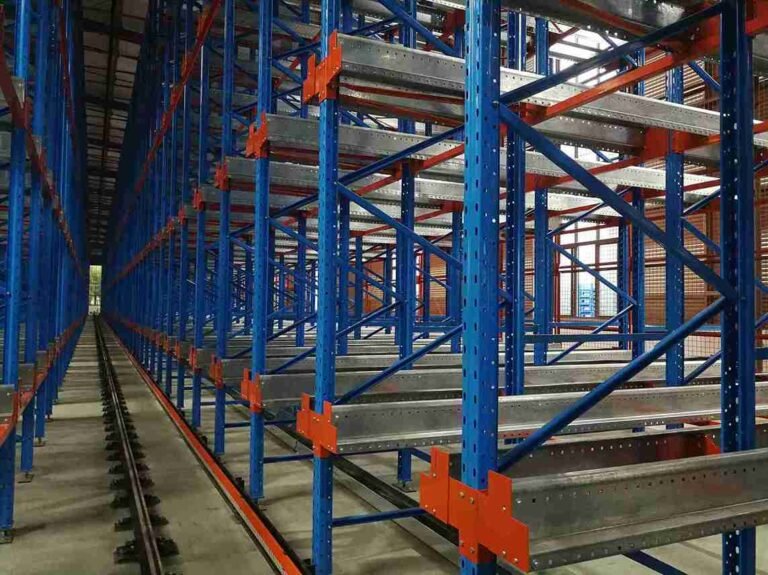
- Features removable electric shuttlesdassautomate pallet movement within the rack.
- Reduces forklift dependency, VerbesserungSicherheit und Effizienz.
- Highly effective in high-throughput operationswieretail distribution centers.
3.3 Mobile Racking (Motorized Adjustable Shelving)
- Motorized bases shift entire racking rows, maximizing floor space.
- Perfect for low-turnover inventory such as archival documentsoderseasonal products.
3.4 Vertical Lift Modules (VLMs)
- Automated vertical carousels retrieve items with minimale menschliche Intervention.
- Excellent for small parts storage in pharmaceuticalsundelectronics manufacturing.
4. How to Select the Best Semi-Automated Racking Solutions
4.1 Evaluating Warehouse Requirements
- Umschlagshäufigkeit der Vorräte (high vs. low).
- SKU diversity (uniform vs. mixed sizes).
- Available floor space (narrow vs. wide aisles).
4.2 Budget and ROI Considerations
- Upfront investment vs. long-term savings.
- Maintenance costs (automated parts vs. manual labor).
4.3 Integration with Warehouse Management Systems (WMS)
- Compatibility with ERP and inventory tracking software.
- Training requirementsfüroperational staff.
5. Real-World Success Stories with Semi-Automated Racking Solutions
5.1 E-Commerce Fulfillment Center Boosts Efficiency by 40%
Amid-sized online retailer implemented pallet shuttle systems, Reduzierungorder processing timeundcutting labor costs by 35%.
5.2 Food & Beverage Warehouse Optimizes Cold Storage
Aleading beverage distributor increased storage density by 50% using push-back racking, allowing faster restocking during peak seasons.
6. The Future of Semi-Automated Racking Solutions
6.1 AI and Predictive Analytics for Smarter Warehousing
- Machine learning algorithms optimize stock placement based on demand forecasting.
- Automated restocking alerts prevent out-of-stock scenarios.
6.2 IoT-Enabled Smart Racking for Real-Time Monitoring
- RFID and sensor-based tracking provides live inventory updates.
- Automated damage detectionreduziertproduct loss.
Conclusion: Are Semi-Automated Racking Solutions Right for Your Business?
Semi-automated racking solutions represent the ideal compromise between cost efficiencyundhigh-performance warehousing. Durchreducing labor dependency,maximizing storage densityundimproving accuracy, these systems are transforming modern logistics.
For businesses seeking a scalable,cost-effective storage solution that bridges the gap between manual and fully automated systems,semi-automated racking solutionsAngebotunmatched flexibility and ROI.
Häufig gestellte Fragen (FAQs)
1. How much do semi-automated racking solutions cost compared to fully automated systems?
Währendfully automated systems can cost 50,000–$200,000, making them far more accessible.
2. Can semi-automated racking solutions work with existing forklifts?
Yes, many semi-automated racking solutions, such as push-back racking, are designed to integrate seamlesslymitstandard forklifts.
3. What industries benefit most from semi-automated racking solutions?
E-commerce, pharmaceuticals, food & beverage, and automotive logistics see the highest efficiency gains from these systems.
4. How long does it take to install semi-automated racking solutions?
Installation typically takes 2–8 weeks, depending on warehouse sizeundsystem complexity.
5. What maintenance is required for semi-automated racking solutions?
Regular lubrication of moving parts,software updatesundperiodic inspections ensure long-term reliability.