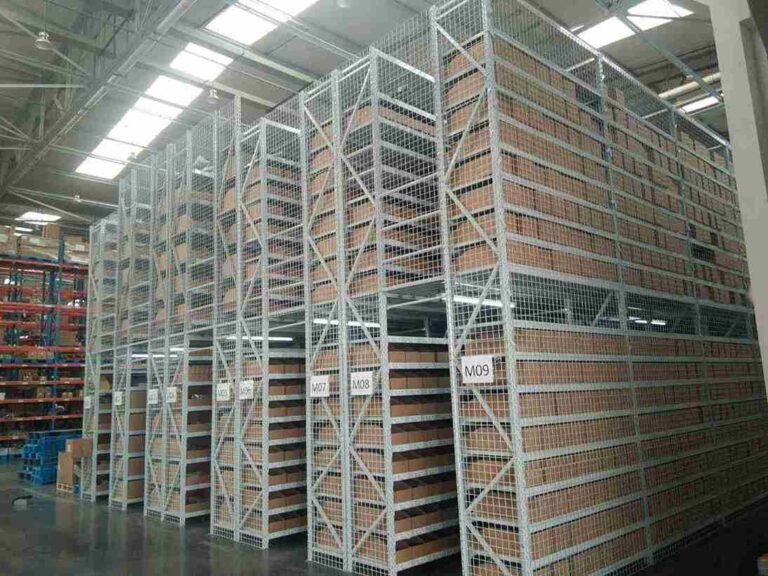
📐 "First 50 Enterprise Queries Get Custom 3D Warehouse Design" Plan


Unlocking Unprecedented Efficiency: The Strategic Mastery of Narrow Aisle Racking in Distribution Centers
In the relentless arena of global commerce, the distribution center has evolved from a static storage depot into the dynamic, pulsating heart of the supply chain. Its performance directly dictates market responsiveness, customer satisfaction, and ultimate profitability. For operations managers, logistics directors, and business owners across the burgeoning markets of Southeast Asia, the Middle East, Africa, and Latin America, a singular challenge persists: how to accommodate exponential inventory growth within finite, often costly, physical footprints.
The solution, repeatedly proven in high-throughput environments worldwide, is the strategic implementation of narrow aisle racking in distribution centers. This is not a mere storage upgrade; it is a comprehensive operational philosophy that redefines spatial economics. By systematically minimizing non-productive aisle space and maximizing vertical cube utilization, a well-executed narrow aisle racking system routinely delivers 40% or greater storage density gains, directly translating to deferred capital expenditure on new construction and slashed operational overhead.
However, the journey to achieving these results transcends simply installing taller racks with narrower gaps. It demands a holistic integration of precision engineering, specialized material handling equipment, robust software intelligence, and nuanced operational protocols. This deep dive explores the multifaceted dimensions of narrow aisle racking in distribution centers, providing a masterclass in transforming storage infrastructure into a formidable competitive weapon that drives down cost per pallet handled and accelerates order fulfillment to unprecedented speeds.
The Anatomy of Density: Engineering Principles of Modern Narrow Aisle Systems
The fundamental premise of narrow aisle racking in distribution centers is geometrically straightforward but engineeringly complex. It involves the meticulous redesign of the storage matrix to shrink aisle widths from the 3.5 to 4 meters required by counterbalance forklifts down to 1.5 to 2.2 meters. This drastic reduction liberates vast square footage for additional pallet positions. The critical enabler is the symbiotic relationship between the rack structure and the material handling equipment.
The design of narrow aisle racking for distribution centers must account for significantly different forces compared to conventional setups. Upright frames are engineered from higher-tensile steel with reinforced column profiles and advanced bracing configurations to withstand the combined stresses of greater height, denser loading, and the precise lateral forces imposed by guided vehicles operating in close proximity. Beam connections utilize positive locking mechanisms that exceed standard safety clips, often incorporating integral locks that cannot be disengaged without deliberate tool use, ensuring absolute integrity in high-throughput environments.
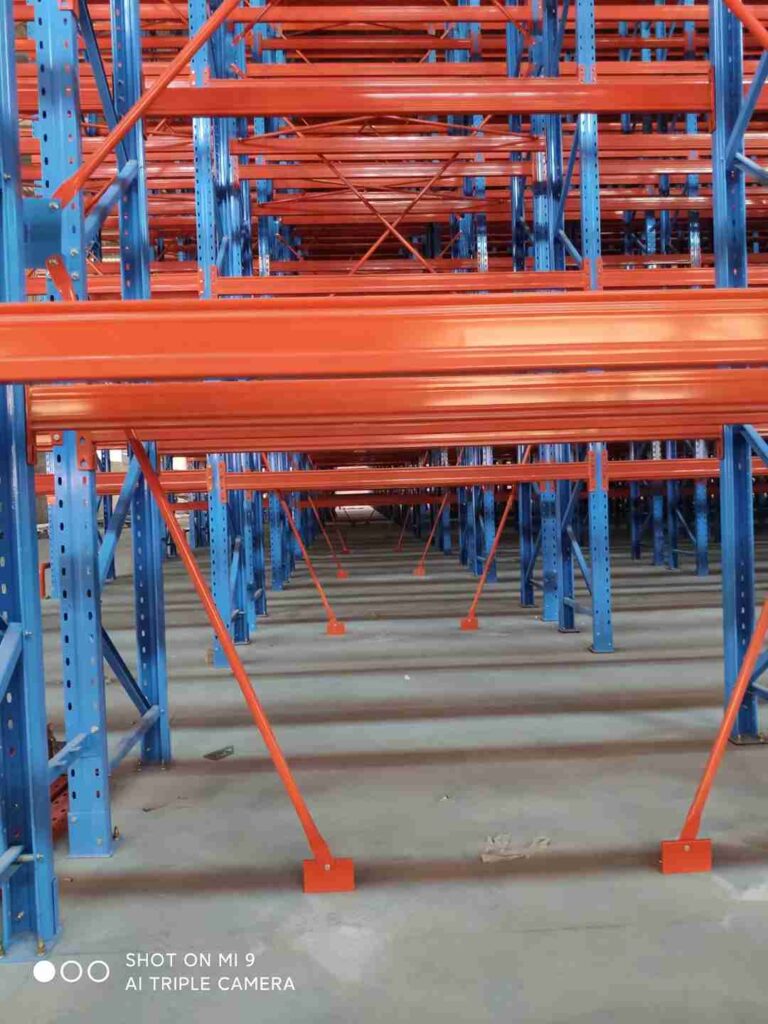
Furthermore, the installation of narrow aisle racking is predicated on a foundation of exceptional floor flatness. Superflat floor specifications (typically FF60/FL50 or superior as per ASTM E1155) are non-negotiable; even minor deviations can induce dangerous mast sway in high-reach trucks, leading to product damage, rack impacts, and operator risk. This foundational requirement is a primary focus during the planning stages for any narrow aisle racking in distribution centers project, especially in regions where existing warehouse slabs may not meet these rigorous standards.
The true differentiator in ultra-high-density layouts is the integration of hardened steel guide rails. These rails, anchored with seismic-grade precision into the warehouse floor, transform the operational paradigm. They physically guide the wheels of specialized turret trucks or order pickers, eliminating the need for steering within the aisle itself. This guidance system allows aisles to be designed merely 150-200mm wider than the pallet load, a feat impossible with free-steering vehicles.
The reliability and precision of this rail network are paramount; thus, its installation is a critical-path activity requiring laser-leveling and rigorous post-installation verification. For distribution centers in seismically active zones or areas with variable soil conditions, the structural design of both the racking and the rail anchoring system undergoes additional geotechnical analysis, ensuring resilience and long-term alignment. This meticulous attention to structural and foundational details forms the bedrock upon which all productivity and safety gains of a narrow aisle racking system are built.
The Fleet Within the Aisles: Selecting the Right Equipment Synergy
The racking structure is only half of the equation. Its potential is unlocked entirely by the fleet of specialized equipment chosen to operate within it. Selecting the wrong vehicle for a narrow aisle racking in distribution centers application can cripple throughput, elevate operational risk, and negate the expected ROI. The choice is primarily governed by target storage height, required throughput, and the nature of the inventory (full pallet in/out versus case picking).
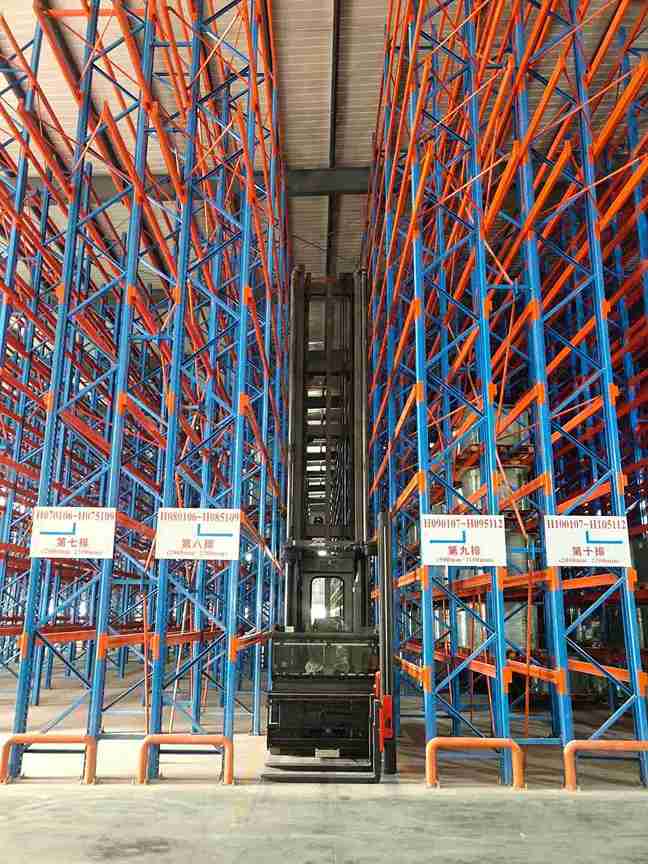
For the zenith of storage density and heights exceeding 10-12 meters, man-down turret trucks reign supreme. In these configurations for narrow aisle racking in distribution centers, the operator’s compartment remains at ground level, while a rotating fork assembly (the turret) services both sides of the aisle. The operator guides the truck into the aisle using the guide rails, then uses a control handle to precisely position the forks via a combination of lift, travel, and 180-degree turret rotation. This allows the narrow aisle racking aisles to be incredibly tight, as the truck itself never turns within them.
Modern turret trucks are marvels of electro-hydraulic integration, featuring regenerative braking, programmable performance parameters (lift/lower speeds, travel acceleration), and comprehensive sensor suites for load weighing, mast tilt monitoring, and collision avoidance. Their integration with the Warehouse Management System (WMS) via onboard terminals enables seamless, paperless operation, directing operators to the exact location within the narrow aisle racking system for each put-away or retrieval task.
For applications with slightly lower height requirements or a greater need for operator visibility at elevation, articulated forklifts (or swing-mast trucks) present a robust alternative. In this setup for distribution centers, the entire mast articulates left and right, allowing the forks to access both sides of the aisle while the operator ascends with the load. This can be advantageous for certain inspection or picking duties. Meanwhile, dedicated narrow aisle order pickers are the vehicle of choice for broken-case picking operations within these high-density environments.
These rider or pedestrian-controlled units allow the operator to move seamlessly along the aisle at various heights, directly accessing cartons from pallets stored within the narrow aisle racking system, often interfacing with pick-to-light or voice-directed picking technologies. The capital investment in this specialized equipment is significant but justified by the dramatic gains in productivity, space utilization, and operator ergonomics it enables within a narrow aisle racking in distribution centers ecosystem.
The Financial Calculus: Building an Irrefutable Business Case for Implementation
Justifying the capital outlay for a narrow aisle racking in distribution centers project requires moving beyond qualitative benefits to a robust, data-driven financial model. The promise of “40% more space” is a compelling headline, but savvy executives demand a detailed cost-benefit analysis (CBA) and a clear projection of Return on Investment (ROI). The financial argument for narrow aisle racking is built on two pillars: dramatic cost avoidance and sustained operational savings.
The most substantial financial impact often comes from avoided real estate costs. In prime logistics corridors across Jakarta, Dubai, Lagos, or São Paulo, the cost per square meter of warehouse space—whether leased or owned—is a major line item. By implementing narrow aisle racking in distribution centers, a facility can increase its effective storage capacity by 40-60% within the same envelope. This directly defers or eliminates the need for costly expansion, satellite facilities, or third-party storage.
For example, a 10,000 sqm warehouse facing a capacity crunch might otherwise need to lease an additional 4,000 sqm. At an annual lease rate of $100/sqm, the narrow aisle racking system saves $400,000 per year in avoided rent—a recurring saving that flows straight to the bottom line.
Operational expenditure (OpEx) savings are equally tangible. The efficiency of a narrow aisle racking in distribution centers layout reduces travel distances for material handling equipment by condensing the storage footprint. This, combined with the higher travel and lift speeds of specialized turret trucks, can boost overall warehouse productivity by 20-35%. Fewer truck cycles are needed to accomplish the same work volume, reducing the required fleet size and associated costs: labor, energy consumption, and maintenance.
The shift to all-electric equipment within a narrow aisle environment also slashes energy costs per move compared to internal combustion alternatives and improves indoor air quality. Furthermore, the accuracy and speed fostered by a WMS-integrated narrow aisle racking system can reduce inventory carrying costs by enabling tighter control and faster turnover, freeing up critical working capital.
A comprehensive ROI model aggregates these savings. If the total capital expenditure (CapEx) for the narrow aisle racking system, new equipment, and installation is $1.5 million, and the annual sum of avoided costs and OpEx savings is $600,000, the simple payback period is 2.5 years. When discounted cash flow methods like Net Present Value (NPV) are applied, the investment typically shows a strongly positive value, making the case for narrow aisle racking in distribution centers not just logical, but financially imperative for growth-focused businesses.
The Digital Nerve Center: WMS Integration and Automation Pathways
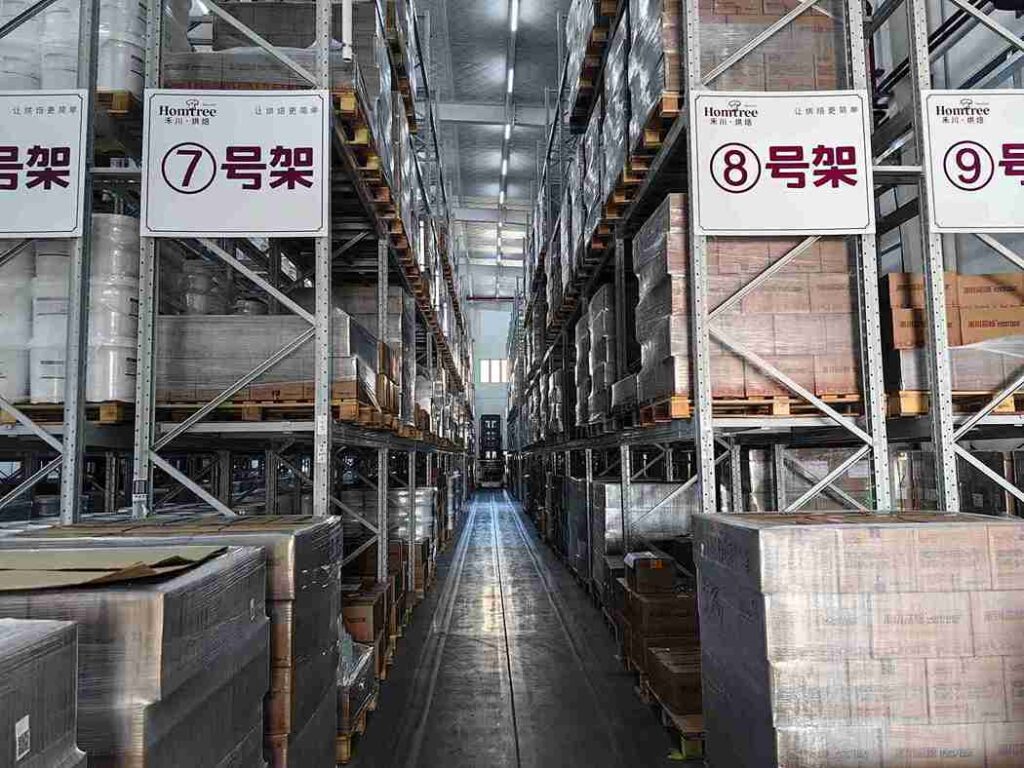
A narrow aisle racking in distribution centers system is, in essence, a highly organized physical database of inventory. Its true intelligence is unleashed when it is seamlessly connected to the warehouse’s digital nerve center: the Warehouse Management System (WMS). Without this integration, the system operates far below its potential. A WMS optimized for narrow aisle racking employs sophisticated slotting logic. It dynamically assigns SKUs to locations based on their dimensions, weight, turnover velocity (ABC analysis), and compatibility.
Fast-moving ‘A’ items are positioned in the “golden zone”—the most accessible waist-to-eye-level locations within the narrow aisle racking structure—to minimize travel and lift time during picking. Slower-moving ‘C’ items are allocated to very high or low locations. This intelligent slotting is a continuous, often automated, process that ensures the narrow aisle racking in distribution centers is always configured for optimal throughput.
Moreover, advanced WMS functionalities like task interleaving and batch picking become exponentially more powerful in a dense narrow aisle environment. Task interleaving combines put-away and retrieval tasks into a single, efficient cycle. For instance, a turret truck completing a pallet retrieval from the narrow aisle racking system can be immediately directed by the WMS to perform a put-away task on its return journey to the front of the aisle, drastically reducing empty travel. For order picking, the WMS can batch multiple orders together, sequencing picks to follow the most efficient route through the narrow aisle racking in distribution centers, a process that saves immense time compared to discrete order picking.
Critically, a well-implemented narrow aisle racking system serves as the foundational stepping stone toward higher levels of automation. The structured, predictable environment of guided aisles is ideally suited for the integration of automated guided vehicles (AGVs) or autonomous mobile robots (AMRs). Fork-type AGVs can be designed to follow the same guide rails or use laser guidance to navigate the tight aisles, automating the horizontal transport of pallets to and from the narrow aisle racking.
Furthermore, the rack structure itself is often compatible with future automated storage and retrieval systems (AS/RS). A narrow aisle racking in distribution centers project can be designed with future conversion in mind—using upright frames that can later support a mini-load AS/RS or with aisle widths that can accommodate a robotic shuttle system. This forward-thinking design philosophy protects the capital investment and provides a clear, scalable path for distribution centers aiming to progressively automate their operations in response to labor market dynamics or escalating throughput demands.
Advanced Configurations: Pushing the Boundaries of Storage Density
While standard selective narrow aisle racking in distribution centers offers remarkable gains, specific inventory profiles call for even more aggressive density solutions. These advanced configurations push the boundaries of space utilization, often at the trade-off of slightly different access patterns.
Double-deep narrow aisle racking is a popular configuration for high-volume SKUs with lower variety. It utilizes a specialized forklift with telescoping forks to store pallets two deep on each side of the aisle. This effectively doubles the storage density per aisle foot compared to selective narrow aisle racking. However, it creates a Last-In, First-Out (LIFO) access pattern for the second-deep pallet. This makes it perfect for distribution centers handling large quantities of identical products, such as beverages, packaged food, or raw materials, where entire lanes can be dedicated to a single SKU and rotated efficiently.
For the ultimate in high-density, high-throughput storage, the marriage of narrow aisle racking structure with autonomous shuttle technology represents the cutting edge. In a shuttle-based system, the narrow aisle racking is designed with deep storage lanes (5-10+ pallets deep) on each side of a central aisle. A standard turret truck or AGV places a battery-powered shuttle car at the front of a lane. This shuttle then independently races down the lane, depositing or retrieving pallets from any position with incredible speed and precision.
This creates a dense, driverless buffer within the narrow aisle racking in distribution centers. It is exceptionally well-suited for cold storage facilities (where minimizing expensive cooled space is critical), for storing production materials in manufacturing, or for buffering high-volume e-commerce inventory. The initial investment is higher, but the density and throughput metrics can be extraordinary, offering a compelling ROI for the right application.
Safety, Training, and Maintenance: The Pillars of Sustainable Performance
The high-density, equipment-intensive nature of a narrow aisle racking in distribution centers operation elevates the importance of rigorous safety protocols, comprehensive training, and disciplined maintenance. These are not ancillary activities; they are core operational requirements that ensure the system’s longevity, productivity, and most importantly, the safety of its personnel.
Safety is engineered into the system from the outset. The narrow aisle racking structure itself must include protective features: robust column guards at aisle ends, sturdy end-of-aisle protection rails, and clearly marked load capacities. The guide rail system provides inherent directional control, preventing vehicles from drifting into the racking. The specialized trucks are equipped with a suite of safety technologies: 3D obstacle detection sensors, speed control linked to lift height, mandatory seat sensors, and load stability monitors.
However, technology alone is insufficient. A culture of safety is paramount. This is fostered through an intensive, certification-based training program for all operators. Training goes far beyond basic forklift licensing to cover the unique handling characteristics of turret or articulated trucks in confined spaces, the physics of load stability at significant heights, daily pre-operation inspection checklists, and clear emergency procedures specific to the narrow aisle racking environment.
A proactive and predictive maintenance regime is the backbone of operational reliability. Downtime in a high-density narrow aisle racking in distribution centers system can paralyze a significant portion of storage capacity. Maintenance must be systematic:
Racking: Scheduled annual inspections by qualified engineers to check for plumb, beam lock engagement, any sign of impact damage, and anchor integrity.
Equipment: Adherence to manufacturer service schedules for hydraulics, electrical systems, and guidance components. Leveraging telematics data from the trucks for predictive maintenance—analyzing trends in motor current, hydraulic pressure, or error code frequency to replace parts before they fail.
Infrastructure: Regular checks of guide rail alignment and bolt torque, and monitoring of floor condition.
For distribution centers in remote or developing markets, establishing a local spare parts inventory for critical wear items and investing in the training of local technicians are essential strategies to minimize Mean Time To Repair (MTTR) and ensure uninterrupted operations.
Navigating Regional Nuances: Implementation in Emerging Markets
The successful deployment of narrow aisle racking in distribution centers across diverse geographies like Southeast Asia, the Middle East, Africa, and Latin America requires acute sensitivity to local conditions. A one-size-fits-all approach is a recipe for underperformance. Astute providers tailor the solution to the environmental, infrastructural, and human capital context of each region.
Environmental adaptations are frequently necessary. For distribution centers in the high-humidity, coastal climates of Vietnam, Thailand, or Nigeria, specifying narrow aisle racking with superior corrosion protection is critical. This may involve hot-dip galvanizing to a higher micron thickness (e.g., 120μm) or the application of specialized powder coatings. Electrical components in forklifts may require conformal coating or higher IP (Ingress Protection) ratings.
In the dusty, arid environments prevalent in the Middle East and parts of North Africa, enhanced air filtration systems for truck electronics and cooling are mandatory, and maintenance intervals for cleaning optical sensors and guide rails may need to be shortened. In regions with less stable power grids, voltage stabilizers and surge protectors for battery chargers are essential investments to protect sensitive equipment.
Beyond hardware, the human element is crucial. The sophistication of a narrow aisle racking in distribution centers system demands skilled operators and technicians. Leading implementation partners therefore invest heavily in local capacity building. This involves developing comprehensive training academies, creating detailed operational manuals in local languages, and running “train-the-trainer” programs to cultivate in-house expertise.
Furthermore, collaborating with local engineering firms to ensure the narrow aisle racking design complies with all national building codes and seismic standards is a non-negotiable step for project legitimacy and safety. By combining globally proven technology with deep local intelligence, distribution centers in these high-growth markets can leapfrog legacy inefficiencies and establish world-class logistics operations.
Conclusion: The Imperative of Strategic Storage Intelligence
In the unending quest for supply chain superiority, the strategic optimization of the distribution center remains a frontier of immense opportunity. The implementation of narrow aisle racking in distribution centers stands out as one of the most impactful, proven, and ROI-positive investments an operation can make. It is a powerful response to the universal pressures of space constraints, rising real estate costs, and escalating customer demands for speed.
However, as this analysis demonstrates, success is not found in the racking alone. It is the product of a holistic symphony: the precision-engineered structure of the narrow aisle racking system, the flawless synergy with specialized guided vehicles, the commanding intelligence of an integrated WMS, and the unwavering commitment to safety, training, and maintenance. For decision-makers across the globe’s most dynamic markets, embracing this comprehensive approach to narrow aisle racking in distribution centers is more than a tactical upgrade—it is a strategic declaration.
It is the choice to build a logistics operation that is not only denser and more efficient today but is also agile, scalable, and ready to harness the next wave of automation tomorrow. The data, the case studies, and the financial models all point to the same conclusion: in the modern logistics landscape, mastering the narrow aisle is synonymous with mastering efficiency, resilience, and growth.
Frequently Asked Questions (FAQs)
Q1: What is the minimum aisle width for narrow aisle racking in distribution centers?
Most systems require 5 to 7 feet, but very narrow aisle (VNA) racking can operate in as little as 4 feet.
Q2: Can standard forklifts be used with narrow aisle racking?
No, narrow aisle racking in distribution centers requires specialized forklifts like turret trucks or articulated reach trucks.
Q3: How much weight can narrow aisle racking support?
Capacity varies, but most systems handle 2,000 to 5,000 lbs per pallet position.
Q4: Is narrow aisle racking suitable for cold storage warehouses?
Yes, but it requires cold-rated forklifts and corrosion-resistant racking materials.
Q5: What’s the typical ROI for switching to narrow aisle racking?
Most distribution centers see a payback period of 1-3 years due to increased storage and labor savings.
If you require perfect CAD drawings and quotes for warehouse racking, please contact us. We can provide you with free warehouse racking planning and design services and quotes. Our email address is: jili@geelyracks.com