📐 "First 50 Enterprise Queries Get Custom 3D Warehouse Design" Plan


Revolutionizing Warehouse Storage with Narrow Aisle Pallet Racking Systems
In an era where every square foot of warehouse space translates directly into operational costs and efficiency, narrow aisle pallet racking systems have emerged as the gold standard for high-density storage. These innovative systems allow businesses to store up to 30% more inventory without expanding their facility footprint, making them indispensable for distribution centers, manufacturing plants, and third-party logistics providers.
Unlike traditional wide-aisle configurations that waste valuable floor space, narrow aisle pallet racking systems are engineered for precision, durability, and safety. They require specialized material handling equipment, such as narrow aisle reach trucks or turret trucks, which can maneuver through aisles as narrow as 5 to 6 feet wide.
This comprehensive guide explores every critical aspect of narrow aisle pallet racking systems, from design and installation to maintenance and safety best practices. Whether you’re upgrading an existing warehouse or planning a new facility, understanding these systems will help you maximize storage capacity, improve workflow efficiency, and reduce long-term operational costs.
1. What Is a Narrow Aisle Pallet Racking System? (And Why It Outperforms Traditional Storage Solutions)
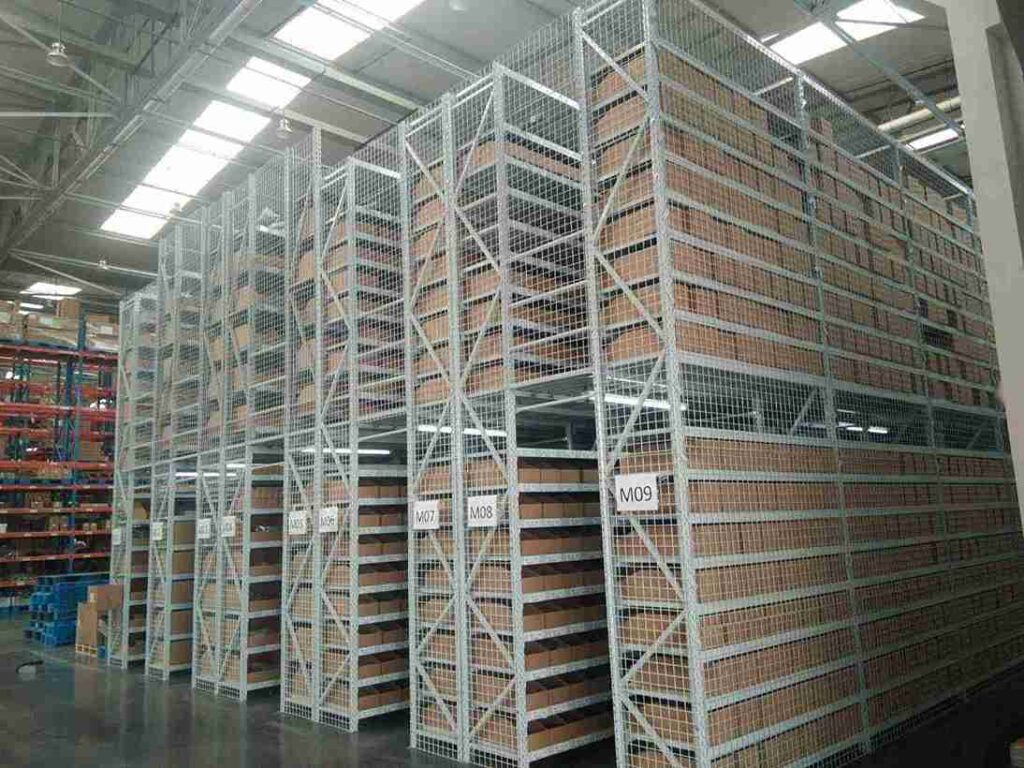
A narrow aisle pallet racking system is a high-density storage solution that minimizes aisle width while maximizing vertical storage space. Unlike conventional selective pallet racking, which typically requires 10 to 12-foot aisles, these systems operate in much tighter spaces, allowing warehouses to store more pallets in the same square footage.
Key Components of a Narrow Aisle Pallet Racking System:
Heavy-duty steel upright frames – Designed to support extreme loads while maintaining stability in tight spaces.
Adjustable beam levels – Allow for customizable storage configurations based on SKU sizes.
Reinforced bracing & safety guards – Prevent rack deflection and minimize damage from forklift impacts.
Compatible forklifts (narrow aisle reach trucks, turret trucks, order pickers) – Essential for navigating tight aisles safely.
Why Businesses Are Switching to Narrow Aisle Systems:
✔ Higher Storage Density – Store more inventory without expanding the warehouse.
✔ Faster Order Picking – Reduced travel time for forklifts improves throughput.
✔ Lower Operational Costs – Fewer forklifts needed due to optimized workflows.
2. The Top 5 Benefits of Narrow Aisle Pallet Racking Systems
2.1. Unmatched Space Optimization
The primary advantage of a narrow aisle pallet racking system is its ability to reduce wasted aisle space. Traditional wide-aisle setups consume up to 40% of a warehouse’s floor space, whereas narrow aisle configurations cut this down to just 20%. This allows businesses to increase storage capacity by 25-30% without costly facility expansions.
2.2. Enhanced Operational Efficiency
Faster load retrieval – Narrow aisle forklifts reduce travel distance between picking locations.
Better inventory organization – Clear visibility of stock minimizes search times.
Scalable configurations – Easily adapt to changing inventory needs.
2.3. Superior Safety & Durability
Unlike standard racking systems, narrow aisle pallet racking is built to withstand:
Heavy seismic & wind loads (critical for high-bay warehouses).
Frequent forklift traffic (reinforced column protectors prevent damage).
Long-term wear & tear (hot-dip galvanized steel resists corrosion).
2.4. Cost Savings Over Time
Lower real estate costs – More storage in the same space delays facility expansions.
Reduced equipment expenses – Fewer forklifts needed due to optimized workflows.
Minimized product damage – Precision racking reduces mishandling risks.
2.5. Future-Proof Warehouse Design
As e-commerce and just-in-time logistics grow, narrow aisle pallet racking systems provide the flexibility to scale storage without redesigning the entire warehouse.
3. Critical Design Considerations for Narrow Aisle Racking Systems
3.1. Warehouse Layout & Aisle Width Planning
Minimum Aisle Width: 5-6 feet for turret trucks, 6-8 feet for reach trucks.
Clear Ceiling Height: Must accommodate lift heights (often 30-40 feet in high-bay warehouses).
Floor Flatness Tolerance: ±1/4 inch over 10 feet to prevent rack instability.
3.2. Load Capacity & Beam Configuration
Uniform vs. Mixed Loads – Adjustable beam levels for varying pallet sizes.
Dynamic vs. Static Load Ratings – Ensures stability in high-traffic or seismic zones.
3.3. Forklift Compatibility & Maneuverability
Narrow Aisle Reach Trucks – Require at least 6-foot aisles.
Turret Trucks – Can operate in aisles as narrow as 5 feet.
Wire Guidance Systems – Improve precision in ultra-narrow aisles.
4. Installation Best Practices for Long-Term Performance
4.1. Professional Site Assessment
Before installation, engineers should evaluate:
Floor flatness & load-bearing capacity.
Overhead obstructions (sprinklers, lighting, HVAC).
Seismic & wind load requirements (for high-bay warehouses).
4.2. Precision Assembly Techniques
Laser-guided leveling ensures uprights are perfectly vertical.
Boltless connections speed up installation without sacrificing strength.
4.3. Post-Installation Safety Inspections
Rack deflection testing confirms structural integrity.
Employee training reduces accidents from improper forklift use.
5. Maintenance Tips to Extend Rack Lifespan
Monthly visual inspections for bent beams or loose anchors.
Annual professional audits to assess wear and tear.
Immediate replacement of damaged components to prevent collapses.
6. Why Choose [Your Company Name] for Your Narrow Aisle Racking Needs?
✔ 30+ Years of Industry Expertise – Custom solutions for diverse industries.
✔ CAD Modeling & 3D Warehouse Simulations – Optimize before installation.
✔ OSHA-Compliant Installation Teams – Safety-first approach.
✔ Ongoing Support & Preventative Maintenance Programs.
Conclusion: Optimize Your Warehouse with the Right Narrow Aisle Pallet Racking System
A well-designed narrow aisle pallet racking system is a game-changer for modern warehouses, delivering higher storage density, improved efficiency, and long-term cost savings. By partnering with an experienced provider like [Geelyracks], businesses can ensure their storage solutions are durable, safe, and tailored to their exact needs.
Ready to transform your warehouse? Contact us today for a free consultation and site assessment!
FAQs: Expert Answers to Common Narrow Aisle Racking Questions
1. How much space can I save with a narrow aisle pallet racking system?
By reducing aisle width from 10-12 feet to just 5-6 feet, businesses can increase storage capacity by 25-30% without expanding their facility.
2. What forklifts work best with narrow aisle racking?
Turret trucks, narrow aisle reach trucks, and order pickers are ideal, as they operate efficiently in 5-8 foot aisles.
3. Can narrow aisle racking be used in cold storage warehouses?
Yes! Our systems feature corrosion-resistant coatings to withstand extreme temperatures and humidity.
4. How often should racking systems be inspected?
Monthly visual checks and annual professional inspections are recommended to maintain safety and compliance.
5. Can I retrofit my existing warehouse with narrow aisle racking?
Absolutely! We conduct detailed site evaluations to ensure seamless integration with your current layout.
Welcome to contact us, if you need warehouse rack CAD drawings. We can provide you with warehouse rack planning and design for free. Our email address is: jili@geelyracks.com