📐 "First 50 Enterprise Queries Get Custom 3D Warehouse Design" Plan


Maximizing Warehouse Potential: The Definitive Guide to Implementing a High-Density Narrow Aisle Pallet Racking System
For logistics directors, warehouse managers, and operations executives across the vibrant, high-growth corridors of Southeast Asia, the Middle East, Africa, Latin America, and Central Asia, the equation is relentless: storage demands are skyrocketing, while available space and capital are constrained. The traditional model of expansive, low-bay warehouses is a luxury of the past, a direct drain on profitability in today’s competitive landscape. This comprehensive resource addresses that fundamental challenge by exploring in exhaustive detail the most effective operational response: the strategic deployment of a narrow aisle pallet racking system.
More than just equipment, a properly engineered narrow aisle pallet racking system represents a paradigm shift in storage philosophy—a move towards radical space optimization, operational intensification, and future-ready infrastructure. This guide delves into the technical, financial, and operational intricacies of these systems, demonstrating how they transform a warehouse from a passive cost center into a dynamic, high-density asset.
From core components and integration with cutting-edge automation like AGVs to region-specific adaptations for challenging environments, the following analysis provides the blueprint for achieving unparalleled storage density, slashing operational costs, and building a scalable logistics foundation. The journey towards a transformative narrow aisle pallet racking system begins with understanding its profound capability to redefine a facility’s volumetric efficiency.
narrow aisle pallet racking system warehouse layout with forklift
The Global Warehouse Space Crisis: Why Conventional Storage is Economically Obsolete
In industrial zones from Tangerang to Guadalajara, a silent crisis unfolds. Land values are appreciating at a staggering pace, driven by urbanization and industrial growth. Simultaneously, consumer and B2B expectations for rapid delivery have compressed logistics timelines to a degree never before seen. The classic wide-aisle warehouse, designed for the maneuverability of counterbalance forklifts, is now recognized as profoundly inefficient. These facilities often dedicate 40% to 50% of their precious floor area solely to aisle space—corridors of empty air that generate zero revenue but incur full costs for rent, utilities, and maintenance.
The economic argument for change is irrefutable. A narrow aisle pallet racking system directly attacks this spatial inefficiency at its core. By re-engineering the storage paradigm around specialized, space-optimized material handling equipment, these systems reduce typical aisle widths from a standard 3.5 meters to between 1.5 and 2.0 meters. This single architectural change unlocks a dramatic increase in a building’s usable storage volume. For a business in a market like Vietnam or Nigeria, where capital for new construction is scarce and bureaucratic hurdles are high, achieving a 40-50% increase in pallet positions within an existing shell is not merely an improvement; it is a strategic survival tactic.
The narrow aisle pallet racking system enables this by allowing operations to maximize the cubic capacity of the building, storing upwards rather than sprawling outwards. This approach defers or eliminates the need for costly greenfield expansion, delivering a compelling return on investment that is measured in months, not years, when factoring in avoided real estate and construction expenses.
Deconstructing Excellence: The Core Components of a Robust Narrow Aisle Pallet Racking System
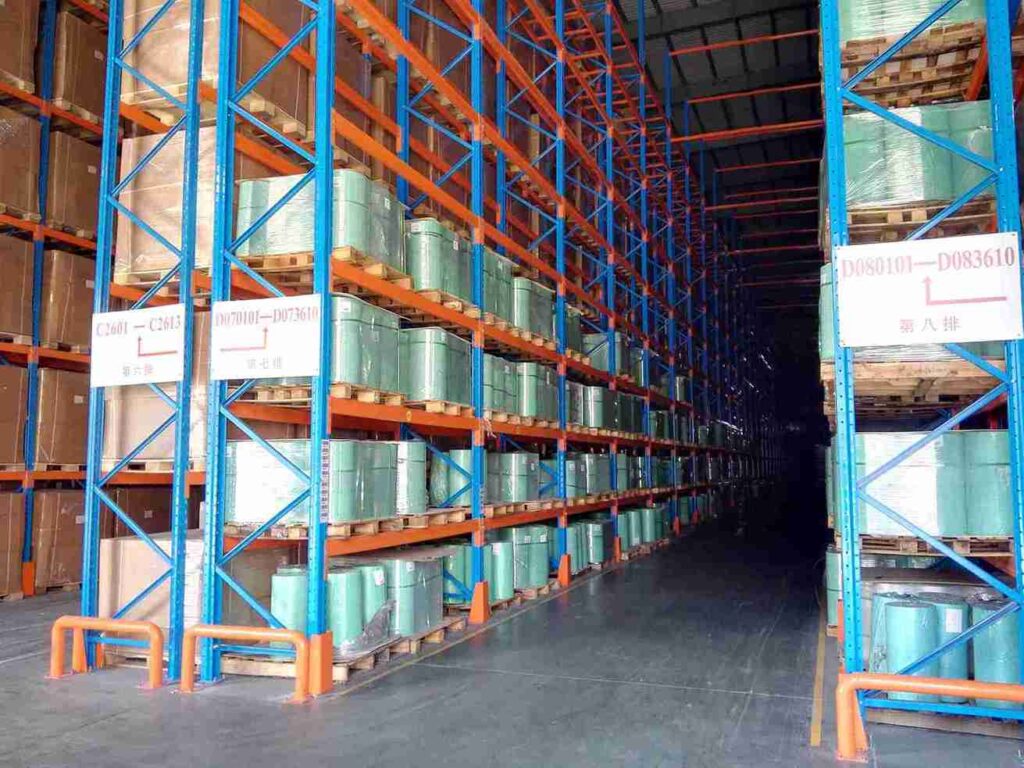
Understanding the superiority of a narrow aisle pallet racking system requires a deep dive into its engineered components. This is not a simple assemblage of beams and posts; it is a precision-integrated storage ecosystem designed for stability, safety, and high-throughput performance.
The Structural Backbone: Engineered for Height and Density
At the heart of any narrow aisle pallet racking system is its structural framework, which must be inherently more robust than that used in conventional selective racking. The upright frames are typically manufactured from high-tensile, hot-rolled steel with reinforced column profiles. This added strength is non-negotiable, as a narrow aisle pallet racking system is designed to exploit vertical space, often reaching clear heights of 12, 15, or even 18 meters. At these elevations, load capacity and stability are paramount. Beams feature advanced locking mechanisms—often boltless, safety-clip designs—that ensure a secure, vibration-resistant connection to the uprights.
Furthermore, a true narrow aisle pallet racking system incorporates critical stabilization elements often omitted in simpler setups. Row spacers and continuous tie bars run horizontally and vertically between adjacent rows, creating a rigid three-dimensional matrix. This “space frame” design is essential for managing the longitudinal forces exerted by moving forklifts in tight aisles and is a critical safety requirement in seismically active regions like parts of Indonesia, the Philippines, or Chile. The structural integrity of the entire narrow aisle pallet racking system hinges on this engineered interconnectivity.
The Enabling Technology: Specialized Handling and Guidance Systems
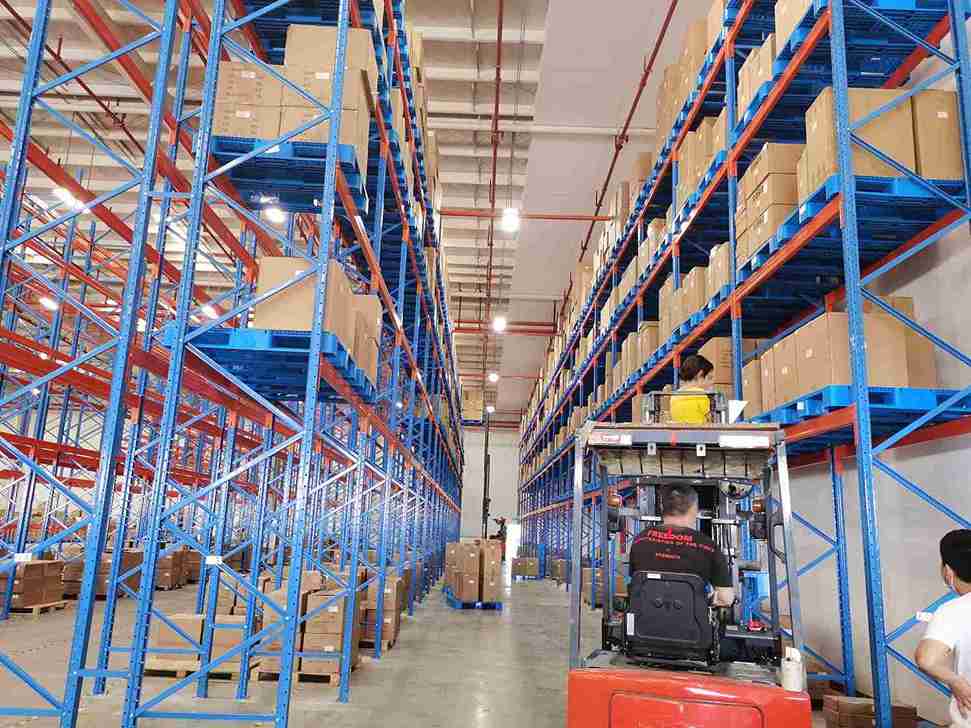
The rack structure is only half of the equation. The full potential of a narrow aisle pallet racking system is unlocked by the symbiotic relationship with specialized material handling equipment. The most common partner is the narrow aisle reach truck. Unlike a counterbalance forklift, a reach truck has forks that extend forward from the vehicle’s chassis, allowing it to deposit or retrieve a pallet while the truck body remains in the slim aisle. For even higher density applications, a turret truck or swing-mast truck is employed. These machines feature a fork assembly that rotates 180 degrees, allowing the operator to access pallets on both sides of the aisle without turning the truck, enabling aisles as narrow as 1.5 meters.
To operate safely and efficiently within such tight tolerances—often with just inches of clearance on either side—most advanced implementations of a narrow aisle pallet racking system incorporate guidance technology. This can take several forms:
Wire Guidance: A low-voltage wire embedded in the concrete floor creates a magnetic path the truck follows automatically, freeing the operator to focus solely on lifting and lowering.
Rail Guidance: Physical steel rails guide the truck’s wheels. This is the standard for Very Narrow Aisle (VNA) systems and offers exceptional precision and stability for heights above 15 meters.
Optical/Laser Guidance: The truck follows reflective tape or bar codes on the floor or uses laser scanners to triangulate its position relative to the rack, offering greater layout flexibility.
This guidance is not an optional extra; it is a fundamental pillar of a safe and productive narrow aisle pallet racking system. It minimizes rack damage, reduces operator cognitive load, maximizes travel speed, and ensures consistent alignment—directly impacting throughput and asset longevity.
The Multifaceted ROI: Strategic Advantages Beyond Square Footage
While the dramatic increase in storage density is the most cited benefit, a well-executed narrow aisle pallet racking system delivers a cascade of strategic advantages that reverberate throughout an organization’s logistics function.
Unlocking Capital and Operational Expenditure Savings
The financial argument is compelling. By increasing storage capacity within an existing footprint, a company can delay or cancel a capital-intensive expansion project. In markets like the UAE or Thailand, where industrial land and construction costs are significant, this avoided capital expenditure (CapEx) alone can justify the investment in a narrow aisle pallet racking system. Operationally, the condensed footprint leads to tangible savings. Forklift travel distances for order picking and put-away are drastically reduced, lowering energy consumption (for electric trucks) and increasing the number of cycles per shift. This translates directly into lower cost per pallet handled, a key metric for any third-party logistics (3PL) provider in competitive markets like Malaysia or Mexico.
Enhancing Throughput, Accuracy, and Systemic Safety
A warehouse powered by a narrow aisle pallet racking system is inherently more organized. The disciplined layout, combined with a modern Warehouse Management System (WMS), leads to superior inventory accuracy. Every pallet has a designated, logical location. Furthermore, the guided traffic flow eliminates the chaotic, cross-directional movement common in wide-aisle facilities. Vehicles move in predictable paths, greatly reducing the risk of collisions between equipment, with racking, or with personnel. This engineered safety, supported by features like column guards, end-of-aisle protectors, and high-visibility rack components, creates a safer work environment, potentially lowering insurance premiums and reducing costly product damage and downtime.
Building the Foundation for Scalable Automation
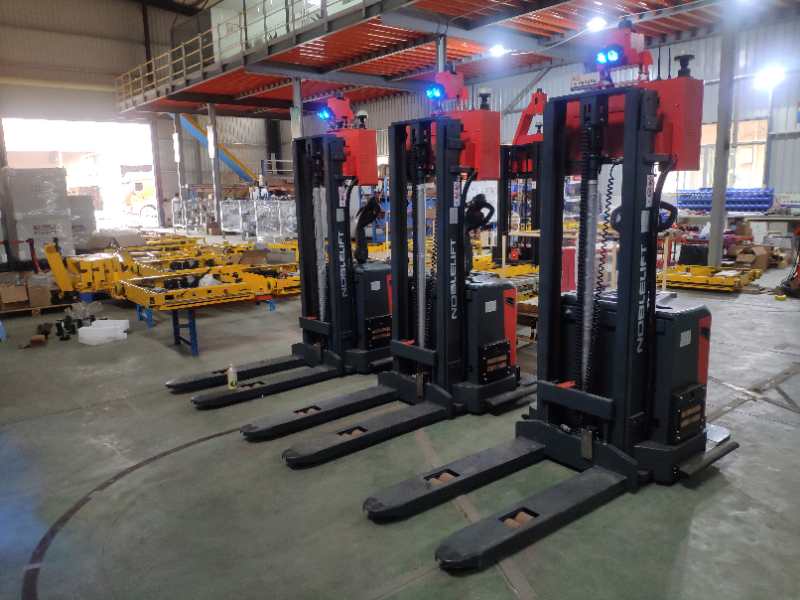
For businesses looking toward the future, a narrow aisle pallet racking system is the ideal physical infrastructure for automation. The structured, predictable environment of guided aisles is perfectly suited for Automated Guided Vehicles (AGVs) and autonomous mobile robots (AMRs). Companies can start with a manned narrow aisle pallet racking system and later integrate automated forklifts or pallet shuttles that operate on the same guidance paths, enabling a phased, scalable approach to automation. This makes the narrow aisle pallet racking system a future-proof investment, protecting the initial capital outlay by ensuring the racking infrastructure remains relevant and compatible with next-generation technology.
Implementation Mastery: A Phased Approach to Success
The successful deployment of a high-performance narrow aisle pallet racking system is a meticulous engineering project, not a simple procurement exercise. It follows a disciplined, phased methodology to mitigate risk and ensure optimal results.
Phase 1: Comprehensive Feasibility and Design Engineering
This critical first phase involves a forensic analysis of the existing facility and operational requirements. Key activities include:
Detailed Site Survey: Precise measurements of the building, including column locations, door placements, ceiling clearances, and sprinkler layouts.
Floor Flatness Analysis: The floor slab must meet stringent flatness tolerances (often FF/FL 50 or better) to ensure the stability of high-reach equipment. Laser profiling is used, and grinding or topping may be recommended.
Load Analysis and Seismic Design: Engineers calculate the dynamic and static loads, designing the narrow aisle pallet racking system to meet local building codes and seismic standards, which is crucial in regions like Central Asia or along the Pacific Rim.
3D Simulation and Digital Twin Creation: Using advanced software, designers create a virtual model of the proposed narrow aisle pallet racking system. This digital twin allows for workflow simulation, bottleneck identification, and optimization of pick paths before any physical work begins.
Phase 2: Precision Installation and Systems Integration
Installation of a narrow aisle pallet racking system requires specialized expertise. Certified crews undertake the process with surgical precision:
Floor Marking and Anchoring: The aisle network and rack footprints are laser-projected onto the floor. High-strength anchor bolts are set to exacting specifications.
Erection to Tight Tolerances: Racking is erected with a focus on absolute plumb and level alignment—deviations of even a few millimeters per meter can cause issues with guided equipment.
Integration of MHE and WMS: The new fleet of narrow aisle forklifts is commissioned, their guidance systems calibrated, and their onboard terminals integrated with the company’s WMS for seamless real-time instruction.
Phase 3: Operational Ramp-Up and Sustained Partnership
Go-live is not the end. Comprehensive training is provided for managers, supervisors, and operators, covering both the safe use of the equipment and the new operational procedures dictated by the narrow aisle pallet racking system. A robust preventive maintenance plan is established for both the racking and the MHE. This long-term partnership ensures the system continues to deliver peak performance and adapts to evolving business needs.
Navigating Regional Complexities: Tailoring the System for Local Success
A one-size-fits-all approach guarantees failure. Implementing a narrow aisle pallet racking system in the humid climate of Bangladesh presents different challenges than in the dusty environment of Saudi Arabia or the high-altitude locations of Bolivia.
Climate and Environmental Adaptations: In humid or coastal regions, specifications for the narrow aisle pallet racking system may include higher-grade galvanization or paint finishes to prevent corrosion. Forklifts may require enhanced filtration and cooling systems. For cold storage applications, as seen in food distribution across Latin America, all components—racking, forklifts, and guidance systems—must be rated for sub-zero temperatures.
Labor Market and Skill Development: In regions where experienced reach truck operators are scarce, the choice of equipment leans towards models with intuitive controls, enhanced visibility, and built-in safety features. The implementation partner must provide immersive, hands-on training programs to build local competency, ensuring the narrow aisle pallet racking system is operated safely and efficiently from day one.
Local Supply Chains and Regulatory Compliance: An experienced provider navigates local import regulations, tariffs, and logistics to ensure timely delivery. They ensure the design of the narrow aisle pallet racking system complies not only with international standards (like RMI or FEM) but also with all local safety and fire codes, which can vary significantly from country to country.
Calculating the Business Case: A Framework for Financial Justification
To move from concept to approval, decision-makers require a clear, quantified business case. The financial justification for a narrow aisle pallet racking system typically revolves around a comparative analysis:
The Cost of the Status Quo: Calculate the annual cost of the current wasted aisle space (square meters of aisles x cost per sqm/year). Project the future cost of expansion if growth continues.
The Investment Analysis: Sum the total project cost for the new narrow aisle pallet racking system, including racking, MHE, guidance, installation, and any building modifications (floor grinding, sprinkler upgrades).
The Value Creation Model: Quantify the new storage capacity (number of additional pallet positions). Assign a value to this capacity, either based on avoided lease costs for equivalent space or on the revenue potential of supporting additional business volume.
The Operational Efficiency Gain: Estimate savings from reduced travel time (lower energy use, higher productivity), decreased product damage, and improved inventory accuracy.
In virtually every scenario for medium to large-scale operations, the analysis reveals that the capital expenditure for a high-quality narrow aisle pallet racking system is substantially less than the cost of building equivalent new space. The operational savings then deliver a rapid, ongoing return, making the narrow aisle pallet racking system one of the highest-ROI investments a logistics operation can make.
Addressing Common Concerns and Misconceptions
Prospective adopters of a narrow aisle pallet racking system often have valid concerns that must be addressed with data and experience.
“It’s too restrictive and will slow us down.” The opposite is true. While individual travel speed in the aisle may be slightly lower, the drastic reduction in travel distance between picks results in a net significant increase in picks per hour. The discipline improves overall workflow.
“The specialized forklifts are too expensive and hard to maintain.” While the upfront cost is higher, the total cost of ownership (TCO) is competitive due to higher energy efficiency and productivity. Furthermore, a robust narrow aisle pallet racking system requires fewer total forklifts to achieve the same throughput. Maintenance requires specialized technicians, which is why partnering with a provider offering local service support is critical, especially in markets across Africa or Central Asia.
“Our warehouse layout is too irregular.” Expert designers specialize in hybrid solutions. A narrow aisle pallet racking system can be deployed in the bulk storage areas, while other zones use drive-in racking, pallet flow, or mezzanines, all cohesively planned within the same facility.
Conclusion: The Strategic Imperative for Modern Logistics
In the dynamic, cost-sensitive markets that define global growth today, operational agility and capital efficiency are the ultimate competitive advantages. The decision to implement a narrow aisle pallet racking system transcends a simple storage equipment purchase. It represents a strategic commitment to logistics excellence—a conscious move to maximize asset utilization, control costs, enhance safety, and build an infrastructure capable of scaling with future demand and integrating with automation.
For logistics leaders in Jakarta, Istanbul, Lagos, São Paulo, and Almaty, the path to resilient, high-performance warehousing is clear. It begins with a detailed, professional assessment and leads to the transformative power of a meticulously engineered narrow aisle pallet racking system. The data, the technology, and the global track record of success are unequivocal. The question is no longer if such a system is beneficial, but how soon an operation can begin its transformation to achieve the density, efficiency, and readiness that define industry leaders.
Frequently Asked Questions (FAQs)
1. How does the weight capacity of a narrow aisle pallet racking system compare to standard selective racking?
A professionally engineered narrow aisle pallet racking system is typically designed for equal or greater load capacities than standard selective racking. The upright frames and beams are often more robust to handle the dynamic stresses of high-lift operations and the greater cumulative load of a denser, taller storage profile. Each component within the narrow aisle pallet racking system is rated based on the specific application requirements, with beam capacities commonly ranging from 2,500 kg to 7,000 kg per pair. The key is the holistic system design, which ensures all components—frames, beams, connectors, and anchors—are matched to the specified unit load and height.
2. Can an existing warehouse with standard racking be partially converted to a narrow aisle pallet racking system?
Yes, a phased or hybrid approach is common and can be very effective. Often, companies will designate a specific zone or product category (e.g., fast-moving goods) for the new high-density narrow aisle pallet racking system, while maintaining standard racking in other areas for very slow-moving items or oversized products. This requires careful planning to ensure efficient traffic flow between the different storage zones and to correctly size the receiving and dispatch areas to handle the different types of material handling equipment in use.
3. What are the key differences between a reach truck-based system and a turret truck-based VNA system within the narrow aisle category?
This is a crucial distinction. A reach truck-based narrow aisle pallet racking system typically operates in aisles from 2.0 to 2.5 meters wide and up to around 12 meters high. The operator faces the direction of travel. A turret truck-based Very Narrow Aisle (VNA) system operates in aisles from 1.5 to 1.8 meters wide and can service heights exceeding 15 meters.
The operator remains in a fixed position within the truck cab, which does not rotate, while the forks and mast rotate to either side. VNA systems almost always use rail guidance for utmost precision at great height. The choice depends on desired density, building height, and budget, as a VNA system represents a higher level of investment in both racking and equipment.
4. How does the lighting and sprinkler design need to change for a narrow aisle installation?
Lighting must be repositioned to run directly above the aisles to illuminate the picking faces, as the dense racking blocks light from standard ceiling-mounted fixtures. Sprinkler design is more complex. Due to the high density and potential for vertical flue spaces within the racking, an in-rack sprinkler system is almost always mandatory. These are sprinkler heads installed at multiple vertical levels within the rack structure itself, following strict codes (like NFPA 13), to ensure water can penetrate a potential fire within the dense storage array. This is a non-negotiable safety requirement in any professional narrow aisle pallet racking system design.
5. What is the typical process for relocating or reconfiguring a narrow aisle pallet racking system if our needs change?
While more complex than relocating boltless selective racking, a narrow aisle pallet racking system can be reconfigured. Due to its tight tolerances and guidance system integration, it is not a DIY task. It requires a systematic process: decommissioning the guidance system, carefully dismantling sections, resurveying the new floor plan (including flatness and anchor points), and then reinstalling and realigning the racking and guidance with professional precision. Engaging the original provider or a certified specialist is strongly recommended to maintain the system’s structural integrity and performance specifications.
If you require perfect CAD drawings and quotes for warehouse racking, please contact us. We can provide you with free warehouse racking planning and design services and quotes. Our email address is: jili@geelyracks.com