📐 "First 50 Enterprise Queries Get Custom 3D Warehouse Design" Plan















The Strategic Investment: Unlocking the Long-Term Cost Benefits of Industrial Racking
In the high-stakes world of logistics and supply chain management, where every square foot and every minute counts, the choice of storage infrastructure is far from a mere operational detail. For a CEO, it is a pivotal strategic decision with profound financial implications that ripple across the balance sheet for years, even decades. While the allure of the lowest upfront cost is strong, truly visionary leadership recognizes that the real value lies in understanding the complete picture of the long-term cost benefits of industrial racking.
This concept moves beyond basic storage to frame industrial racking as a dynamic capital asset. A thorough analysis reveals that the long-term cost benefits of industrial racking are not found in its purchase price, but in its total cost of ownership and its capacity to generate continuous operational returns. This guide provides a comprehensive exploration of the long-term cost benefits of industrial racking, offering a clear-eyed ROI analysis that positions a strategic investment in robust racking systems not as an expense, but as a cornerstone for enduring profitability, resilience, and competitive advantage.
This is not just about storing goods; it’s about architecting a financially optimized operational ecosystem where the long-term cost benefits of industrial racking become a measurable driver of bottom-line performance.
Beyond the Price Tag: Redefining “Cost” in Storage Solutions
When procurement teams evaluate storage solutions, the initial capital outlay often dominates the conversation. This is a critical, but ultimately myopic, view. A cheap, under-engineered racking system is one of the most expensive assets a company can ever own, fundamentally undermining any potential for achieving the long-term cost benefits of industrial racking. The true cost must be evaluated through a wider lens that encompasses the entire lifecycle of the equipment and its impact on all facets of the operation. Failing to do so means a business will never realize the full spectrum of long-term cost benefits of industrial racking.
The Deceptive Allure of Low Initial Investment
Countless businesses fall into the trap of selecting a racking system based solely on the lowest bid. What seems like a win for the budget today inevitably transforms into a recurring cost center tomorrow, completely negating the potential for positive long-term cost benefits of industrial racking. These systems often utilize inferior-grade steel, less robust manufacturing processes, and lack sophisticated engineering.
The consequences are predictable: premature wear and tear, higher susceptibility to damage from routine operations, and limited weight capacity that restricts inventory flexibility. The initial “savings” are quickly erased, often within the first 18-24 months, by mounting ancillary costs, making the promised long-term cost benefits of industrial racking impossible to achieve.
The Total Cost of Ownership (TCO) Framework: The True Path to Quantifying Value
To make a sound investment and truly grasp the long-term cost benefits of industrial racking, executives must adopt a Total Cost of Ownership (TCO) analysis. This comprehensive financial model accounts for all direct and indirect costs associated with the racking system over its entire useful life, providing the only accurate picture of the long-term cost benefits of industrial racking. Key components of the TCO for industrial racking include:
Acquisition Cost: The initial purchase and installation.
Operational Costs: The impact on labor efficiency (picking, put-away, replenishment), energy consumption (especially in automated systems), and ongoing maintenance.
Cost of Downtime: The devastating financial impact of system failures, repairs, or required reconfiguration that halts warehouse activity.
Cost of Space: How efficiently the system utilizes your facility’s cubic air space, effectively reducing your cost per pallet stored.
Replacement & Disposal Cost: The expense of prematurely replacing a failed system and disposing of the old one.
By shifting the evaluation from price to TCO, the superior financial logic of investing in high-quality, professionally engineered industrial racking becomes undeniable. This framework is essential for uncovering the genuine long-term cost benefits of industrial racking.

The Pillars of Long-Term Savings: Where Your Racking Investment Pays Off
A superior industrial racking system, whether it’s a simple selective pallet rack or a fully automated unit load ASRS, generates returns across multiple dimensions. These are the core pillars that build your long-term profitability and constitute the primary drivers of the long-term cost benefits of industrial racking.
Maximizing Cubic Space and Slashing Real Estate Costs
The most expensive asset in any warehouse is the building itself. Rent, mortgages, taxes, and utilities are fixed costs. Every cubic foot of air that goes unused is a waste of capital, directly working against the goal of achieving long-term cost benefits of industrial racking. High-density storage solutions like pallet racking configured for narrow aisles, drive-in racking, or push back racking are engineered to dramatically increase storage density, a fundamental aspect of the long-term cost benefits of industrial racking.
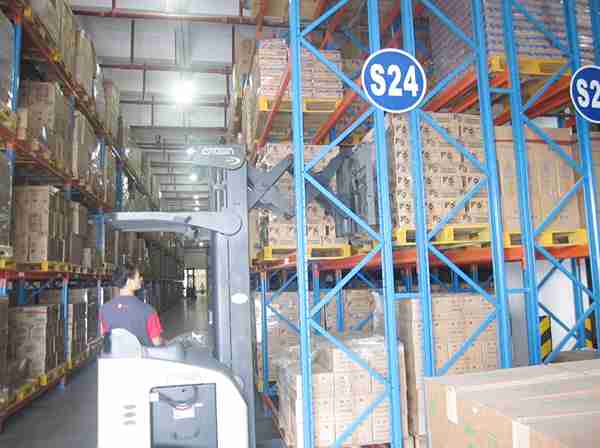
Case in Point: By implementing narrow aisle racking with compatible wire-guided stackers or forklifts, a company can reduce aisle widths from 12 feet to as little as 6 feet. This single change can increase storage capacity by 20-30% without adding a single square foot to the building footprint. For a company considering expansion, this can defer a multi-million dollar investment in a new facility for years, representing an astronomical return on the racking investment and a clear demonstration of the long-term cost benefits of industrial racking. The long-term cost benefits of industrial racking are thus directly tied to maximizing the value of existing real estate assets.
Turbocharging Labor Efficiency and Productivity
Labor is the single largest ongoing operational cost in most warehouses. An inefficient storage layout directly translates into excessive labor hours, eroding the potential for realizing the long-term cost benefits of industrial racking. A well-designed racking system is a blueprint for efficient workflow and is critical for securing the long-term cost benefits of industrial racking related to human capital.
Speed and Accessibility: Selective pallet racking with logical slotting (e.g., fast-moving items in the “golden zone”) minimizes travel and search time for order pickers, contributing directly to the long-term cost benefits of industrial racking.
Accuracy Enhancement: Integrated solutions like pick module racking with pick-to-light or voice-picking technology can double or even triple picking rates while drastically reducing errors. The cost of a mis-picked order—in terms of reshipping, customer dissatisfaction, and inventory reconciliation—is a direct hit to the bottom line that proper racking can help prevent, thereby protecting the long-term cost benefits of industrial racking.
Safety as a Cost Saver: A poorly designed or installed racking system is a safety hazard. Collapses, falling goods, and forklift collisions lead to injuries, insurance claims, and potential regulatory fines. A robust, professionally installed system, complete with column guards and upright frame protections, creates a safer environment, reduces accidents, and lowers insurance premiums, all of which are crucial, though often overlooked, components of the long-term cost benefits of industrial racking.
Minimizing Product Damage and Inventory Shrink
Damage to stored goods is pure profit loss. Flimsy racking with thin beams or poorly designed decking can lead to beam deflection, sagging, and ultimately, product collapse. Secure, robust beam locks and high-quality decking ensure inventory integrity, which is a non-negotiable element for achieving the long-term cost benefits of industrial racking. Furthermore, systems like carton live storage or flow racking ensure First-In-First-Out (FIFO) inventory rotation, critical for perishable goods, preventing spoilage and obsolescence. This preservation of inventory value is a direct contributor to the long-term cost benefits of industrial racking.
The Scalability Dividend: Future-Proofing Your Investment
Businesses evolve. A rigid storage system that cannot adapt to changing inventory profiles, SKU proliferation, or business growth becomes a strategic liability and nullifies the long-term cost benefits of industrial racking. Modern racking systems are inherently modular and scalable, which is key to sustaining the long-term cost benefits of industrial racking.
Adaptable Design: A quality selective pallet racking system can be easily reconfigured—beams can be relocated, racks can be extended in height (where building clearance allows), and sections can be added or relocated. This flexibility prevents the massive capital outlay of a complete system overhaul every time a business needs change, ensuring the long-term cost benefits of industrial racking are protected over time. This scalability is the foundation for a phased approach to automation, where a company can start with basic racking and later integrate AGV forklifts or an ASRS system without starting from scratch, thereby extending and enhancing the long-term cost benefits of industrial racking.
The ROI Blueprint: Quantifying the Return on Your Racking Investment
For a CEO, the ultimate question is: “What is the financial return?” Let’s translate these benefits into a tangible ROI analysis. The formula is straightforward, but the inputs are powerful and directly linked to the long-term cost benefits of industrial racking.
ROI = (Net Financial Benefits from Investment / Total Cost of Investment) x 100
The “Net Financial Benefits” are the annualized savings generated by the new racking system, which are the quantitative expression of the long-term cost benefits of industrial racking. Let’s construct a hypothetical, yet realistic, scenario for a mid-sized distribution center to illustrate how the long-term cost benefits of industrial racking translate into hard numbers.
Building the Business Case: A Hypothetical Model
Company Profile: ABC Distributors, operating a 50,000 sq. ft. warehouse.
Current Situation: Using outdated, low-density shelving and wide-aisle racking.
Proposed Investment: $250,000 for a high-density narrow aisle pallet racking system, including minor site preparation.
Calculating Annual Savings (Net Financial Benefits)
Real Estate Savings: The new system increases storage capacity by 25%. This defers the need to lease an additional 12,500 sq. ft. of space. At a local rate of $6/sq. ft./year, this saves $75,000 annually, a direct result of the long-term cost benefits of industrial racking.
Labor Productivity Savings: Picking and put-away efficiency improves by 15%. With an annual labor cost of $400,000 in the warehouse, this saves $60,000 annually, another clear component of the long-term cost benefits of industrial racking.
Damage Reduction Savings: A 50% reduction in inventory damage, from a previous annual loss of $20,000 to $10,000, saves $10,000 annually, contributing to the overall long-term cost benefits of industrial racking.
Maintenance & Energy: Reduced forklift travel distance and more reliable equipment lead to savings of $5,000 annually, further adding to the long-term cost benefits of industrial racking.
Total Annual Savings (Net Benefits): $150,000
The Powerful ROI Calculation
Using our formula:
ROI = ($150,000 / $250,000) x 100 = 60%
This demonstrates a payback period of just under 20 months. After that, the $150,000 in annual savings flows directly to the bottom line as increased profit, year after year. This is a conservative estimate, as it does not assign a monetary value to improved safety, customer satisfaction from higher accuracy, or the strategic flexibility gained—all of which are part of the comprehensive long-term cost benefits of industrial racking.
The Automation Multiplier: When Racking Becomes a Robotic Asset
For companies looking to maximize the long-term cost benefits of industrial racking, the conversation naturally progresses to automation. The racking system is the skeleton upon which automated flesh is built. Investing in the right racking today is the first and most critical step toward future automation and is essential for unlocking the next tier of long-term cost benefits of industrial racking.
The Symbiosis of Racking and Robotics
A company cannot simply drop an Automated Guided Vehicle (AGV) or a stacker crane into any warehouse. The racking structure must be precision-engineered to interact with these machines, a requirement for achieving the advanced long-term cost benefits of industrial racking through automation.
Tolerances and Precision: An ASRS requires extremely tight tolerances in racking alignment and flatness. The racking must be designed to handle the dynamic loads imposed by the rapid movement of the cranes, a foundational requirement for securing the long-term cost benefits of industrial racking in a high-throughput automated environment.
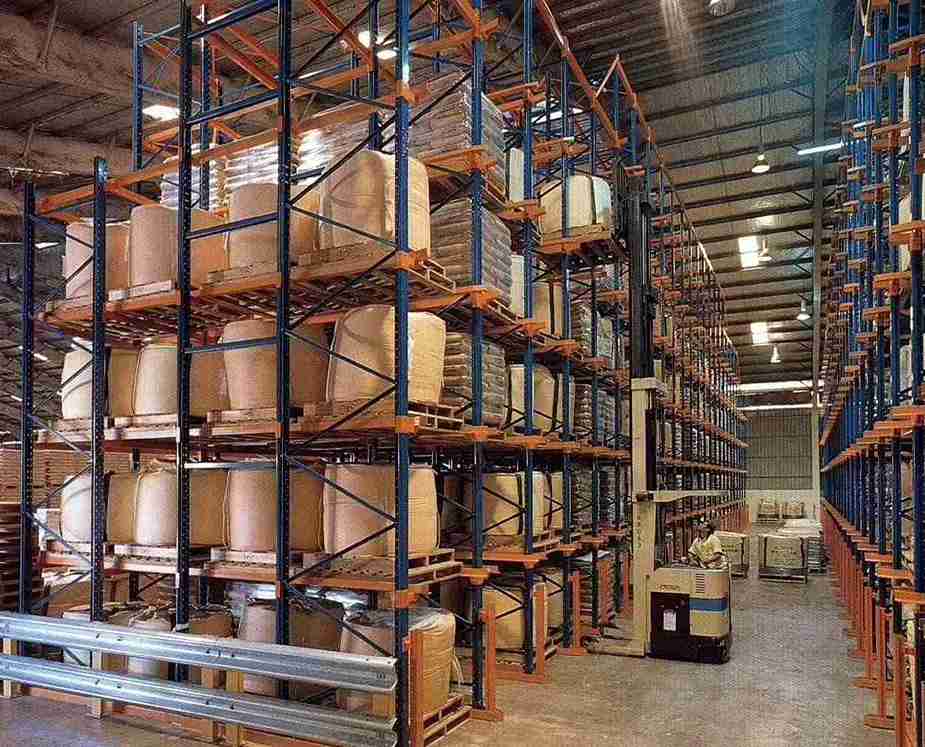
Structural Integrity: The racking for a VNA (Very Narrow Aisle) system, which uses wire-guided or rail-guided turret trucks, must be robust enough to occasionally withstand contact from the vehicle, a concept known as “impact design.” This durability is paramount for ensuring the long-term cost benefits of industrial racking are not compromised by operational wear and tear.
Interface Ready: Investing in racking that is pre-designed to integrate with automated conveyor systems, sortation systems, and AGV forklifts prevents a costly “rip-and-replace” scenario down the line. Designing racking systems with this future-state in mind is a strategic move that protects and enhances the long-term cost benefits of industrial racking.

The Compounding ROI of an Automated Storage and Retrieval System (ASRS)
The ROI model for an ASRS or an Autonomous Mobile Robot (AMR) system is even more compelling, though the initial investment is higher. The labor savings are transformative, moving from a model of “cost per picker” to “cost per system.” These systems can operate 24/7, in dark environments (saving lighting costs), with near-perfect accuracy. The racking, in this context, transitions from a passive storage structure to an active, high-throughput component of a production-level system, thereby multiplying the long-term cost benefits of industrial racking. The long-term cost benefits of industrial racking in an automated context are measured in radical labor reduction, unparalleled accuracy, and ultimate space utilization.
Choosing the Right Partner: The Critical Role of Design and Engineering
The profound long-term cost benefits of industrial racking are not automatic. They are the direct result of superior design, engineering, and installation. The partner a company chooses is as important as the technology itself in realizing the promised long-term cost benefits of industrial racking.
The Non-Negotiable: Professional Site Survey and Load Analysis
A reputable provider will never sell racking from a catalog without a comprehensive site survey. This includes precise measurements of the facility, understanding soil composition for slab concerns, and a detailed analysis of the inventory—including weight, dimensions, turnover rates, and future growth projections. This data is the foundation for a safe and optimized design, and without it, the long-term cost benefits of industrial racking remain a theoretical concept rather than a tangible reality.
Compliance and Certification: Your Shield Against Liability
In regions like Southeast Asia, the Middle East, Africa, and Latin America, adherence to international standards like OSHA, FEM, or RMI is a mark of quality and safety. Ensuring designs and products comply with these rigorous standards provides peace of mind and protects a business from the catastrophic costs of a structural failure, which would instantly wipe out any long-term cost benefits of industrial racking. This due diligence is a critical risk mitigation strategy that safeguards the investment and the long-term cost benefits of industrial racking.
Conclusion: Industrial Racking as a Strategic, Profit-Generating Asset
The evidence is clear and compelling. Viewing industrial racking through the narrow lens of initial purchase price is a strategic error that costs companies millions in hidden operational expenses and missed opportunities. By adopting a Total Cost of Ownership framework and recognizing the multi-faceted long-term cost benefits of industrial racking—from radical space optimization and labor productivity gains to enhanced safety and future-proof scalability—CEOs and financial leaders can make an investment decision that pays dividends for the life of the facility.
The high-quality racking system is not a cost; it is a profit center, a competitive weapon, and the essential physical platform upon which a modern, efficient, and resilient supply chain is built. The question is no longer if a company can afford to invest in a superior system, but how it can afford not to, given the overwhelming evidence supporting the long-term cost benefits of industrial racking. A strategic commitment to understanding and leveraging the long-term cost benefits of industrial racking is a hallmark of market-leading, forward-thinking organizations.

Frequently Asked Questions (FAQs)
1. How does the quality of steel used in racking directly impact the long-term cost benefits of industrial racking?
The grade and quality of steel are fundamental. Inferior steel has lower yield strength, making it more susceptible to bending, buckling, and fatigue over time. This leads to a lower safe working load (SWL), a shorter lifespan, and a higher risk of catastrophic failure. High-quality, high-yield strength steel ensures structural integrity for decades, protects inventory, and is a core reason why professionally engineered racking systems deliver on the promise of the long-term cost benefits of industrial racking. Compromising on steel quality is the fastest way to undermine the long-term cost benefits of industrial racking.
2. Can existing racking be reinforced or modified to achieve some of the long-term cost benefits of industrial racking?
In many cases, yes. Professional firms often conduct racking audits for clients where they can reinforce upright frames, add cross-bracing, or upgrade beam locks to increase capacity and safety. However, there are limits. The foundation and the overall system design impose constraints. A professional assessment is crucial to determine whether modification is a cost-effective solution for achieving some long-term cost benefits of industrial racking or if a new system is the wiser long-term investment to fully capture all potential long-term cost benefits of industrial racking.
3. What is the typical lifespan of a well-maintained, high-quality industrial racking system, and how does this relate to its long-term cost benefits?
With proper use and minimal damage, a high-quality racking system manufactured from prime-grade steel can have a functional lifespan of 25 years or more. This makes the long-term cost analysis even more favorable, as the initial investment is amortized over a very long period, while the operational savings compound annually. This extended lifespan is a critical factor in maximizing the long-term cost benefits of industrial racking, as the ROI continues to grow for decades.
4. How do you calculate the ROI for a racking system in a warehouse that isn’t planning to expand?
Even without physical expansion, the ROI is powerful and central to the long-term cost benefits of industrial racking. The increased storage density from a high-density system like push back racking or pallet flow racking can allow a company to consolidate operations from multiple warehouses into one, slashing rental, utility, and management costs. Furthermore, the labor and efficiency savings are universal and apply to any facility seeking to do more with less. These operational efficiencies are the heart of the long-term cost benefits of industrial racking, regardless of expansion plans.
5. What are the hidden costs of a “cheap” racking system that directly destroy the long-term cost benefits of industrial racking?
Beyond the obvious safety risks, hidden costs that eradicate any chance of achieving long-term cost benefits of industrial racking include: constantly declining productivity as the system becomes harder to work with; higher energy costs for forklifts navigating inefficient layouts; more frequent and costly repairs; higher insurance premiums due to a perceived greater risk; and the massive “hidden” cost of lost business opportunity because the storage system cannot adapt to new product lines or sales volumes. These cumulative costs ensure that the long-term cost benefits of industrial racking remain entirely out of reach.
Welcome to contact us, if you need warehouse rack CAD drawings. We can provide you with warehouse rack planning and design for free. Our email address is: jili@geelyracks.com