📐 "Ensimmäiset 50 yrityskyselyä saavat mukautetun 3D-varaston suunnittelun" Suunnitelma















Boosting E-Commerce Fulfillment Speed by 40%: How Wholesale High-Density Longspan Shelving for Wholesale & Retail Accelerates Warehouse Performance Across Africa and Latin America
The global logistics landscape is undergoing a seismic transformation, and nowhere is this shift more pronounced than in the fast-growing markets of Africa and Latin America. As e-commerce penetration accelerates and wholesale high-density longspan shelving becomes the backbone of modern fulfillment centers, warehouse operators across these regions face an urgent challenge: how to dramatically increase fulfillment speed without costly facility expansions or disruptive infrastructure overhauls.
We have spent two decades engineering warehouse storage solutions for emerging markets, and we have witnessed firsthand how wholesale high-density longspan shelving for wholesale and retail operations is revolutionizing fulfillment center productivity.
This comprehensive guide details how wholesale high-density longspan shelving—when properly integrated with both automated guided vehicles (AGVs) and manual picking operations—can increase e-commerce fulfillment velocity by up to 40%, reduce labor-related picking errors by over 50%, and deliver complete return on investment within 12 to 24 months, even in brownfield warehouse environments with existing infrastructure constraints. The versatility of wholesale high-density longspan shelving makes it the preferred choice for distributors serving both business-to-business wholesale clients and direct-to-consumer e-commerce channels.
Key Takeaways from This Guide:
Productivity Leap: Facilities implementing AGV-ready wholesale high-density longspan shelving consistently achieve 35–40% faster order fulfillment speeds
Space Optimization: Wholesale high-density longspan shelving configurations increase storage capacity by 50–85% compared to conventional selective racking
Hybrid Flexibility: Modern longspan systems seamlessly integrate AGV automation with manual picking zones for optimal workforce utilization
Market-Specific Solutions: Customized approaches for tropical climates, power-sensitive cold storage, and land-constrained urban fulfillment centers using wholesale high-density longspan shelving
Proven ROI: Real-world implementation data from Africa and Latin America demonstrating payback periods under 24 months when investing in wholesale high-density longspan shelving
Whether operating a cold storage facility in Kenya requiring consistent sub-zero temperatures, an e-commerce fulfillment center in Mexico City battling high real estate costs, or a wholesale distribution warehouse in Lagos needing to quadruple daily order throughput, this guide delivers actionable strategies that can be implemented immediately using purpose-engineered wholesale high-density longspan shelving.
Understanding the E-Commerce Logistics Surge Demanding Faster Fulfillment
The statistics driving warehouse automation in emerging markets are nothing short of staggering. According to recent market research, the Middle East and Africa e-commerce market was valued at 155.16billionin2025 ,andforecastsindicateexplosivegrowthfrom 176.68 billion in 2026 to an estimated 338.08billionby2031 ,
representingacompoundannualgrowthrateof13.8540.49 billion to 56.03billionbetween2025and2029,growingat8.46357 million) fleet expansion plan announced in late 2025.
This digital commerce explosion places unprecedented pressure on warehouse operators. Traditional pick-and-pack operations designed for pallet-level wholesale orders simply cannot sustain the throughput required for direct-to-consumer fulfillment. The rise of omnichannel fulfillment—where the same facility serves brick-and-mortar retail replenishment, wholesale distribution, and e-commerce direct shipping—has magnified these challenges. In response, warehouse managers are increasingly turning to wholesale high-density longspan shelving as the foundational storage technology that bridges the gap between bulk storage and rapid order picking.
Field experience across Lagos, Nairobi, Johannesburg, and Accra reveals a common pattern: warehouse managers report that their standard selective racking systems consume valuable floor space, create excessive travel paths for pickers, and struggle to accommodate the seasonal demand spikes characteristic of e-commerce.
During peak seasons—such as Black Friday in November or Día de los Reyes Magos in Latin America—many facilities simply collapse under order volumes, leading to delayed shipments, customer chargebacks, and permanently lost business relationships. Those who have retrofitted their warehouses with wholesale high-density longspan shelving report that peak season stress becomes manageable, and order cutoff times can be extended by several hours without overtime labor.
The need for wholesale high-density longspan shelving compatible with both automation and manual processes has never been more urgent. This storage solution is not merely an incremental improvement; it is a strategic enabler that allows wholesale distributors to compete effectively against pure-play e-commerce giants while maintaining their traditional wholesale customer relationships.
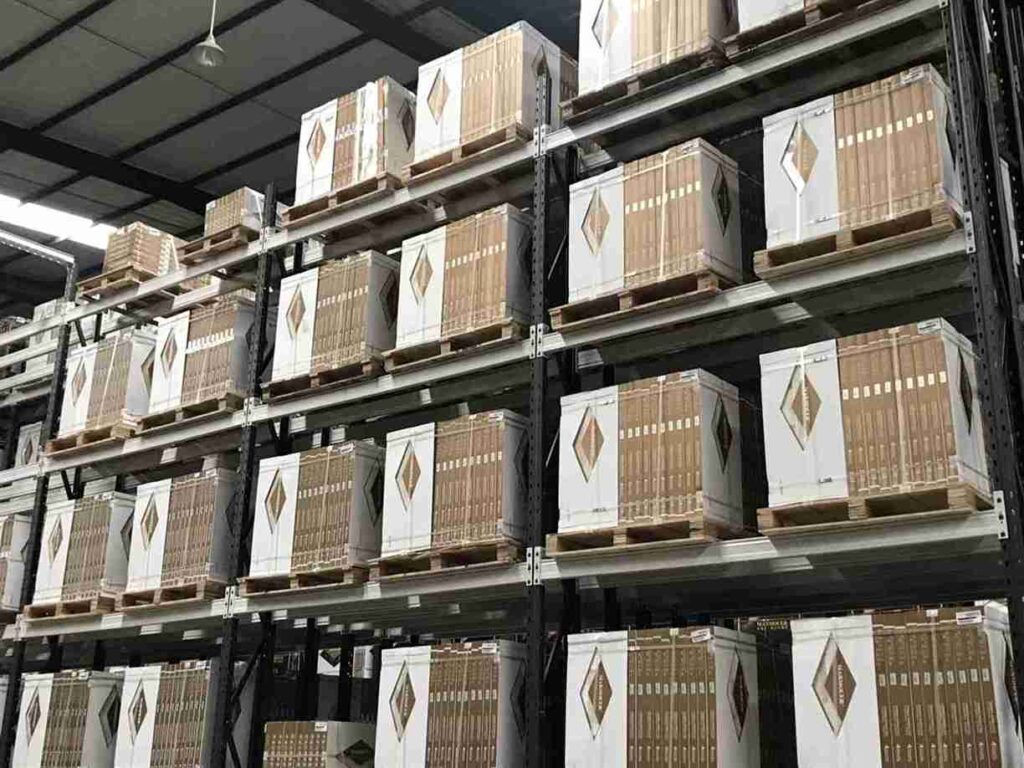
Why Wholesale High-Density Longspan Shelving Transforms Wholesale and Retail Warehouses
Storage Density Gains Achieved Through Strategic Design
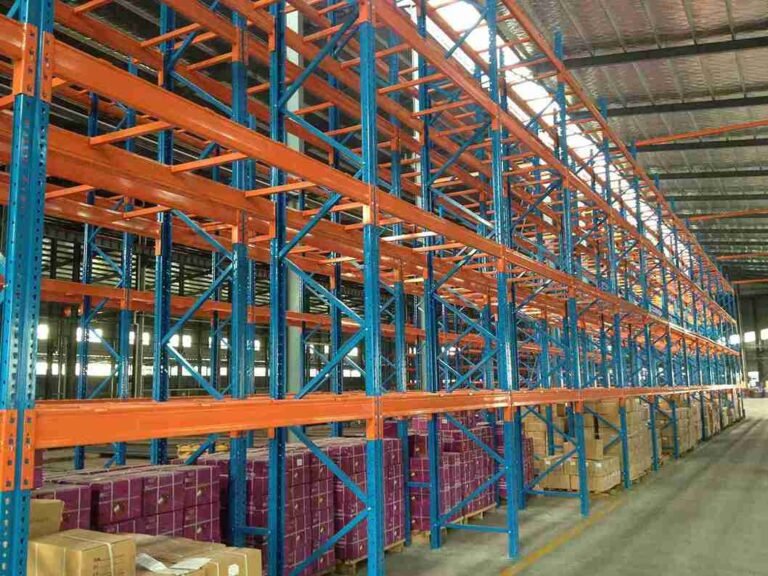
Wholesale high-density longspan shelving differs fundamentally from conventional selective racking. Traditional selective racks prioritize accessibility by dedicating aisles between every row of shelving—typically consuming 40–50% of warehouse floor space for circulation. A typical selective rack installation might lose 35–40% of its total footprint to wide access aisles. Wholesale high-density longspan shelving, by contrast, eliminates these inefficiencies.
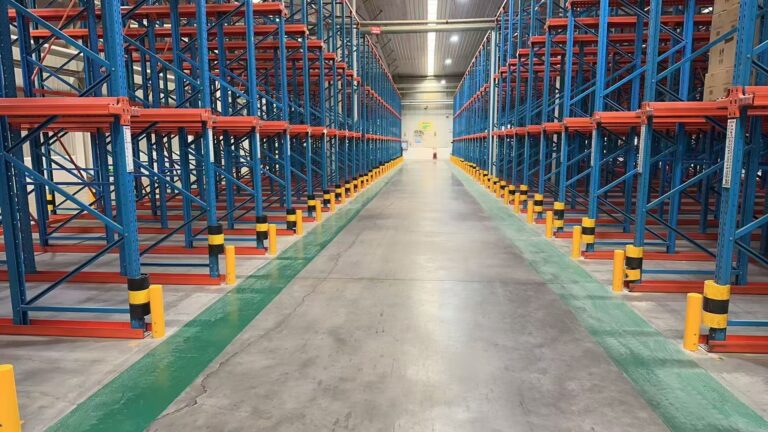
Drive-in and drive-through designs allow forklifts and AGVs to enter the rack structure itself, while push-back and radio shuttle systems store pallets multiple positions deep along a single access point. For wholesale operations handling thousands of SKUs, the ability to deploy wholesale high-density longspan shelving in multiple configurations—some lanes set for deep pallet storage, others for carton flow—provides unprecedented layout flexibility.
The density improvements are dramatic. Quality wholesale high-density longspan shelving systems can achieve up to 85% utilization of available cubic space, compared with approximately 50–60% for selective racking. For a 10,000-square-meter warehouse, this differential translates into 2,500 to 3,000 additional pallet positions without any building expansion—representing millions of dollars in avoided construction costs and lease expenses. Many wholesale distributors in markets like Brazil and Indonesia have discovered that wholesale high-density longspan shelving allows them to consolidate three regional warehouses into two, reducing transportation costs and inventory holding expenses simultaneously.
Cold Storage Energy Efficiency and Temperature Stability
Cold storage operations present particularly compelling economics for wholesale high-density longspan shelving design. The refrigeration cycle in any cold facility represents the single largest operational expense, typically accounting for 60–70% of total energy consumption.
Wholesale high-density longspan shelving reduces this cost dramatically by minimizing the air volume requiring refrigeration. When wholesale high-density longspan shelving is deployed in a cold storage environment, the compact configuration reduces the surface area exposed to ambient temperature fluctuations, and the dense packing of product creates a thermal buffer that stabilizes the entire storage zone.
Standard selective racking in a cold storage facility leaves vast open spaces between rows of product. Every time a cooler door opens or warehouse personnel move through the refrigerated space, warm air infiltrates—forcing the cooling system to work harder to maintain temperature consistency.
Wholesale high-density longspan shelving consolidates product into a smaller overall footprint, reducing the total air volume needing refrigeration and minimizing the surface area for thermal exchange with the external environment. For wholesale food distributors serving supermarket chains, the adoption of wholesale high-density longspan shelving in their frozen and chilled sections has consistently delivered energy savings exceeding 50%.
Case studies from leading 3PL cold storage providers confirm the magnitude of these savings. One global top-3PL operator achieved 25% greater storage capacity, 60% energy savings, and 100% improvement in inventory efficiency after adopting a high-density pallet shuttle solution in their cold chain facility. The 60% energy reduction alone translates into hundreds of thousands of dollars in annual operational savings for moderate-sized cold storage warehouses.
Wholesale high-density longspan shelving designed specifically for cold environments uses galvanized steel components that resist corrosion from condensation, ensuring a service life of 20 years or more even in high-humidity refrigeration conditions.
Furthermore, wholesale high-density longspan shelving configurations inherently maintain more stable temperatures. When product is closely packed across deep storage lanes, the thermal mass of the stored inventory acts as a natural buffer against temperature fluctuations. This stability proves critical for pharmaceutical cold chains requiring GSP compliance and for food-grade cold storage facing stringent health inspection regimes. Wholesale distributors handling imported frozen meats or dairy products report that wholesale high-density longspan shelving reduces temperature variation across the storage zone from ±3°C to less than ±1°C, a critical factor for regulatory compliance.
Longspan Shelving vs. Traditional Pallet Racking—Critical Distinctions
Understanding the difference between wholesale high-density longspan shelving and traditional pallet racking is essential for informed procurement decisions. Wholesale high-density longspan shelving occupies a unique position in the storage equipment spectrum: it offers greater adjustability than pallet racking while providing higher load capacity than standard light-duty shelving.
Pallet racking—including selective, drive-in, and push-back varieties—is engineered for unit-load storage. Individual pallets are placed directly onto beams or rails, and forklifts or AGVs handle pallet movements. Pallet racking excels when inventory is stored and retrieved in full-pallet quantities, but it offers limited flexibility for mixed-case or split-case picking common in e-commerce and wholesale distribution.
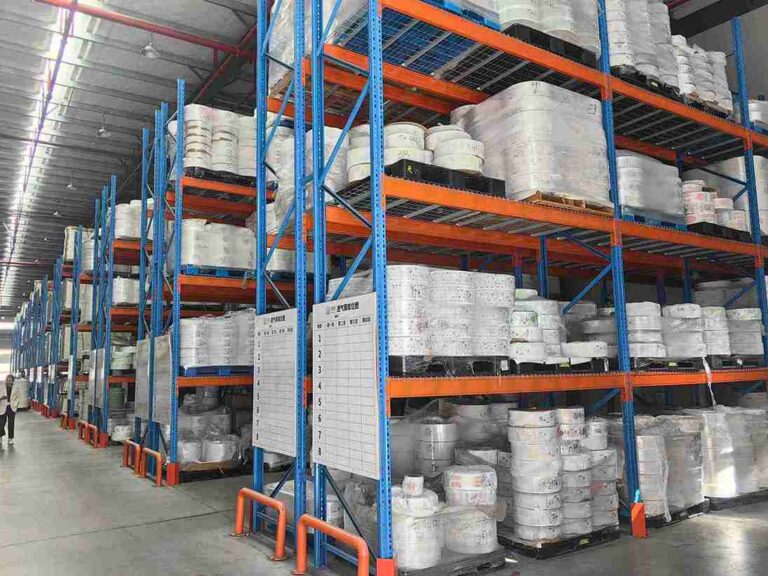
Wholesale high-density longspan shelving, by contrast, features adjustable shelf levels capable of holding everything from individual cartons and cases to smaller pallets. Longspan systems typically incorporate steel beams and upright frames with modular design allowing shelf heights to be reconfigured as inventory profiles change. This flexibility makes wholesale high-density longspan shelving the ideal choice for facilities handling mixed SKU counts, variable case sizes, and both full-pallet and broken-case picking operations.
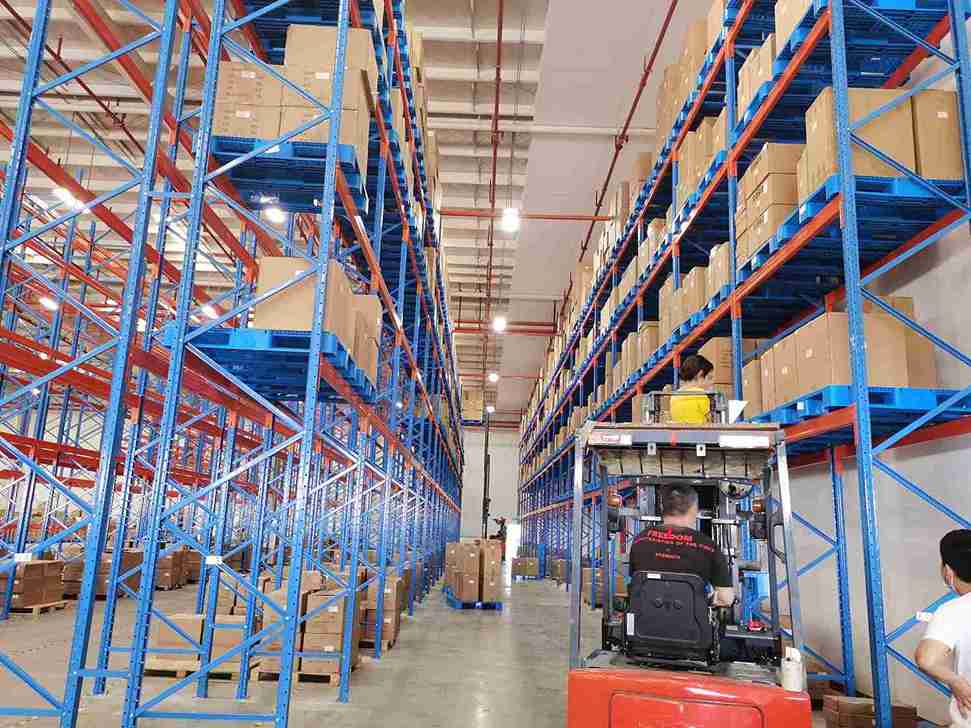
For operations requiring a true hybrid approach, the optimal solution combines pallet racking for high-volume bulk storage zones—positioned adjacent to wholesale high-density longspan shelving configured for fast-moving case and each picking. This dual-system strategy gives warehouse managers the space efficiency of high-density pallet storage with the picking flexibility of adjustable wholesale high-density longspan shelving. Many wholesale distributors have adopted this hybrid model, using pallet racking for reserve stock and wholesale high-density longspan shelving for forward pick zones, thereby optimizing both storage density and order fulfillment speed.
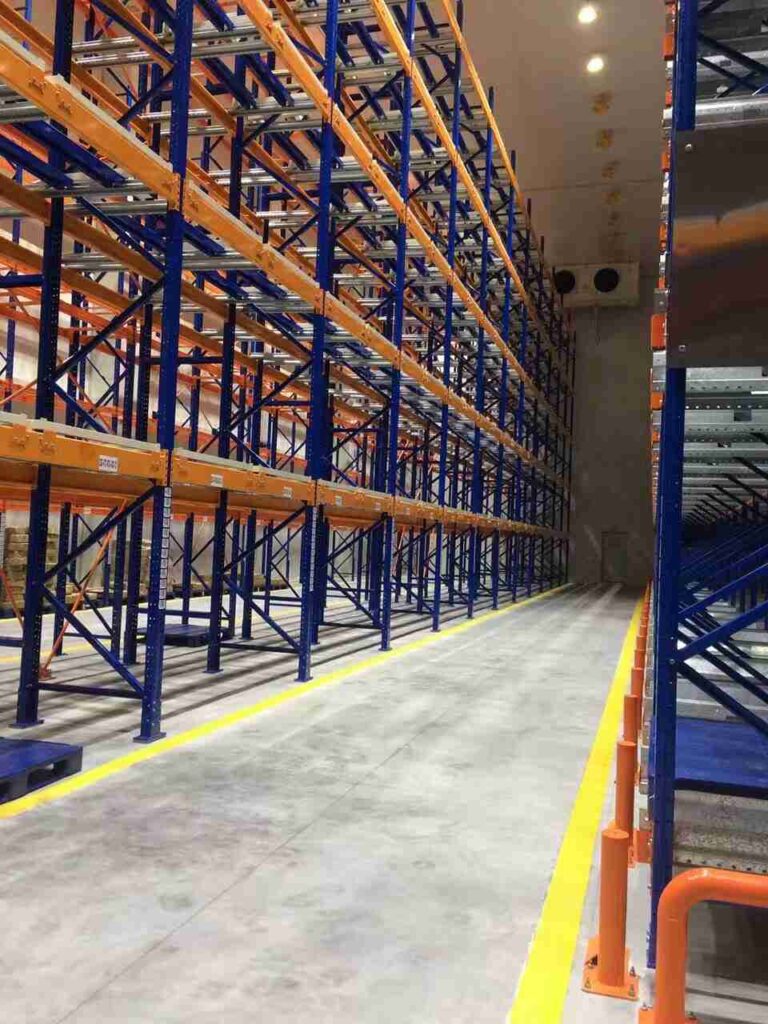
AGV-Ready Shelving for Automated Warehouse Integration
What Makes Shelving Truly AGV-Compatible?
Not all shelving systems can effectively interface with automated guided vehicles. AGV-ready wholesale high-density longspan shelving incorporates specific design features that enable seamless robot interaction. When wholesale high-density longspan shelving is specified for AGV integration, engineers must pay attention to floor clearance tolerances, navigation marker placement, and the physical interface between the robot’s lifting mechanism and the shelving’s load beams.
Key design elements for AGV-ready wholesale high-density longspan shelving include:
Floor clearance and navigation markers: AGVs require consistent floor clearances and often rely on magnetic tape, QR codes, or LiDAR-reflective markers. Wholesale high-density longspan shelving must be installed with precise alignment to these navigation systems.
Aisle width optimization: AGVs have turning radii and operational clearance requirements that differ from traditional forklifts. AGV-ready layouts using wholesale high-density longspan shelving optimize aisle widths for the specific robot models deployed.
Pallet and tote positioning: Shelving beams and supports must position pallets and totes at consistent heights and orientations to enable reliable AGV pickup without sensor interference. Wholesale high-density longspan shelving with precision-engineered beam levels ensures repeatable pick-up points.
Physical interface design: The connection between AGVs and wholesale high-density longspan shelving—whether through traditional fork pockets, pallet supports, or specialized POD (pick-and-drop) structures—requires careful engineering to prevent collisions and load instability.
Advanced hybrid modular storage fetching systems represent the next evolution in AGV-shelving integration. These configurations use AGVs not only to retrieve individual pallets but to transport entire shelving PODs directly to picking stations. When wholesale high-density longspan shelving is deployed in such systems, the result is a dramatic reduction in travel time: pickers remain stationary while goods are delivered to them, increasing pick rates by 200–300%. Wholesale distributors using this approach report that a single picker can handle the workload previously requiring five to six associates.
Designing Hybrid Zones for Mixed AGV and Manual Picking
In most emerging market warehouses, full automation remains a multi-year journey rather than an overnight transformation. The practical solution is hybrid design: zones of wholesale high-density longspan shelving served by AGVs for repetitive, high-volume SKUs, adjacent to manual picking zones where irregular products, returns processing, and exception handling occur. This hybrid model provides several advantages when wholesale high-density longspan shelving is used as the common storage platform:
Phased investment: Warehouse operators can automate the most labor-intensive 20% of SKUs first—typically the fast-moving products representing 80% of order volume—achieving rapid ROI while deferring full automation capital costs. Wholesale high-density longspan shelving supports this staged approach because it can be initially configured for manual picking and later converted to AGV access by simply adjusting floor markings and software integration.
Operational continuity: When AGVs require maintenance or software updates, manual zones continue operating without disruption because the same wholesale high-density longspan shelving remains fully accessible to human operators using pallet jacks or counterbalance forklifts.
Scalable workforce training: Pickers and warehouse associates transition gradually into higher-value supervisory roles as automation expands. Wholesale high-density longspan shelving layouts are intuitive for both humans and robots to navigate, simplifying the learning curve.
AGV-ready wholesale high-density longspan shelving is fundamental to this hybrid design. The same modular shelving supports both AGV retrieval and manual picking, allowing warehouse operators to shift SKUs between zones as demand patterns evolve. A wholesale distributor of construction materials in Malaysia, for example, deployed wholesale high-density longspan shelving in a configuration where pallets of cement and drywall are handled by AGVs, while smaller items like fasteners and tools are picked manually from the same shelving system but in different aisles. This approach eliminated the need for separate storage systems and reduced capital expenditure by 35%.
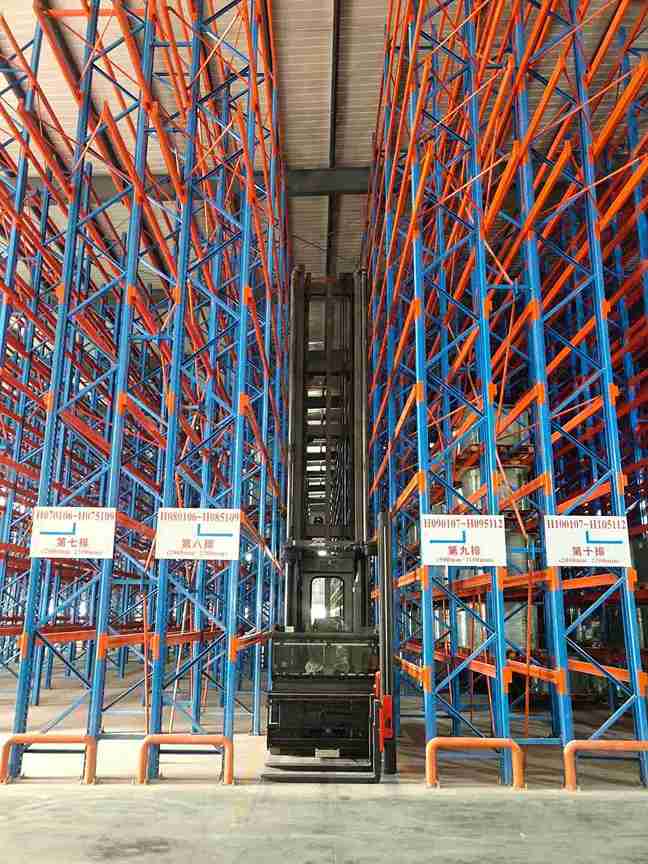
Market-Specific Solutions for Africa and Latin America (Expanded with Southeast Asia, Middle East, and Central Asia)
Africa—Navigating Power Constraints and Rapid Urbanization
The African warehouse automation landscape presents unique challenges that demand localized engineering solutions. Wholesale high-density longspan shelving has proven particularly effective across Sub-Saharan Africa because it provides immediate density benefits without relying on continuous electrical power for basic operation.
Power reliability remains the most critical constraint across Sub-Saharan Africa. Even in major logistics hubs like Nairobi, Accra, and Johannesburg, grid instability and load shedding interrupt warehouse operations. While AGVs and automated systems can theoretically operate during outages with battery backup, extended blackouts exceeding 4–6 hours may still cause operational halts.
Wholesale high-density longspan shelving addresses this vulnerability: during power failures, manual forklifts and pallet jacks can still access every storage position because the racking structure itself requires no electricity. This redundancy ensures that wholesale distributors continue shipping orders even when power interruptions occur—a capability that fully automated systems lack.
Our recommended approach for African facilities combines passive wholesale high-density longspan shelving with modular automation that can operate for extended periods on battery power. Unlike fully automated ASRS systems that cease functioning entirely during outages, wholesale high-density longspan shelving remains fully accessible to manual material handling equipment. In practice, a wholesale grocery distributor in Accra deployed wholesale high-density longspan shelving across 8,000 square meters and achieved a 55% increase in storage capacity while maintaining 100% manual fallback capability during the region’s frequent load-shedding events.
Urban land costs in fast-growing African cities are rising at an unprecedented pace. In Lagos, commercial real estate in logistics zones has increased 35–40% over just 24 months. The storage density superiority of wholesale high-density longspan shelving—anywhere from 50% to 75% more pallet positions per square meter compared with selective racking—has become a decisive competitive advantage. Wholesale operators who invest in wholesale high-density longspan shelving can delay or entirely avoid expensive facility expansions, reinvesting those capital savings into fleet expansion or technology upgrades.
Real-world automation projects across Africa demonstrate the feasibility of these systems. Geekplus has deployed intelligent sorting robots at the Takealot logistics center in Johannesburg, processing over 50,000 parcels daily in a “human-robot collaboration” model. South Africa’s first HaiPick system for automotive parts distributor Masterparts, implemented through PBSA and Hai Robotics, marks a significant milestone in spare parts logistics modernization on the continent. Similarly, Wemalo has begun driving warehouse digitalization across East Africa through affordable, scalable automation built around wholesale high-density longspan shelving as the foundational storage layer.
Temperature and humidity extremes also influence material selection. Wholesale high-density longspan shelving intended for tropical African climates requires enhanced corrosion protection—typically hot-dip galvanization or specialized powder coatings—to prevent degradation in coastal environments with high atmospheric salt content. Several wholesale importers in Mombasa and Dar es Salaam have specified hot-dip galvanized wholesale high-density longspan shelving and reported zero corrosion issues after seven years of operation, whereas standard painted shelving from competing suppliers failed within 18 months in the same environment.
Latin America—Nearshoring Boom and Real Estate Pressures (Extended)
Latin America’s logistics automation market reached $3.91 billion in revenue in 2025 and is projected to grow at an impressive 16.2% CAGR through 2033. This growth is fueled by two powerful forces: the nearshoring boom and escalating real estate demand. Across Mexico, Brazil, Colombia, and Argentina, wholesale distributors are aggressively adopting wholesale high-density longspan shelving to capture nearshoring opportunities without incurring prohibitive land costs.
According to Forbes, nearshoring is expected to create four million jobs in Mexico by 2030, attracting up to 50billioninannualforeigndirectinvestmentandpotentiallyincreasingMexicanGDPbyupto2.529 million) between 2025 and 2026 to expand, modernize, and automate its Brazilian distribution network, targeting a 40% capacity increase to 280,000 pallet positions.
Walmart Mexico and Central America (Walmex) has committed approximately 43 billion Mexican pesos (€2.2 billion) for 2026—a 10% year-over-year increase—focusing on store expansion, supply chain modernization, and the construction of two new automated distribution centers in Mexico by 2027. These facilities are being designed around modular wholesale high-density longspan shelving that can scale from manual to fully automated operation as order volumes justify.
Latin American logistics real estate absorption reached 3.39 million square meters in 2025, representing approximately 5.5% year-over-year growth—with logistics now holding a 30.78% share of commercial real estate as the largest property segment in the region. For e-commerce and wholesale warehouse operators, wholesale high-density longspan shelving offers a direct solution to rising real estate costs.
Maximizing storage capacity within existing footprints—or within newly leased facilities with constrained square meterage—has become essential to profitability. A wholesale electronics distributor in São Paulo reported that after installing wholesale high-density longspan shelving, they increased their storage capacity by 68% without expanding their leased footprint, effectively lowering their cost per pallet position by 40%.
Maersk’s Latin America market update emphasizes that warehouse modernization is accelerating through selective, scalable automation approaches rather than fully autonomous facilities. This aligns perfectly with wholesale high-density longspan shelving configurations pre-designed for incremental AGV integration. Wholesale operators can start with a purely manual configuration using wholesale high-density longspan shelving and then introduce AGVs zone by zone as order volumes grow and ROI models become compelling.
Southeast Asia—E-Commerce Explosion and Port Congestion Solutions
Southeast Asia represents one of the most dynamic e-commerce markets globally, with platforms like Shopee, Lazada, and Tokopedia driving double-digit annual growth. In Indonesia, the Philippines, Vietnam, and Thailand, wholesale distributors serving both traditional trade and online channels are turning to wholesale high-density longspan shelving to overcome the region’s unique challenges: port congestion, fragmented last-mile logistics, and high urban land values.
Jakarta’s Tanjung Priok port and Manila’s port complex frequently experience delays that cause inventory to pile up in distribution centers. Wholesale high-density longspan shelving allows operators to absorb these surge volumes without requiring temporary overflow warehousing. By configuring deep-lane wholesale high-density longspan shelving with radio shuttle systems, warehouses can increase pallet positions by 300% in the same footprint, providing a buffer against unpredictable import schedules.
One wholesale consumer goods distributor in Surabaya reported that after adopting wholesale high-density longspan shelving, they eliminated the need for a separate 4,000-square-meter overflow facility, saving $480,000 annually in lease and labor costs.
Additionally, Southeast Asia’s hot and humid climate poses similar corrosion risks to those in coastal Africa. Wholesale high-density longspan shelving deployed in Bangkok, Ho Chi Minh City, or Kuala Lumpur should specify ESD (electrostatic discharge) powder coating or galvanization with a minimum 85-micron zinc layer. Wholesale operators in the region have also found that wholesale high-density longspan shelving with integrated mezzanine levels allows them to create both bulk storage and light assembly areas within the same structural framework, reducing the need for separate mezzanine flooring systems.
Middle East—Cold Storage for Food Security and Pharmaceutical Logistics
The Gulf Cooperation Council (GCC) countries, particularly the UAE, Saudi Arabia, and Qatar, have made food security and pharmaceutical self-sufficiency strategic priorities. Wholesale high-density longspan shelving plays a critical role in the region’s temperature-controlled supply chains. With summer ambient temperatures exceeding 50°C, cold storage facilities must be highly energy-efficient. Wholesale high-density longspan shelving reduces the refrigerated volume by up to 45% compared to selective racking, and the corresponding reduction in cooling load is substantial.
Dubai’s Cold Chain Logistics Forum has highlighted that wholesale high-density longspan shelving can reduce cold storage energy consumption by 35–60%, depending on the depth of the storage lanes. For a 10,000-pallet cold storage facility in Jebel Ali, the annual energy savings from switching to wholesale high-density longspan shelving can exceed $150,000. Wholesale distributors of frozen poultry, dairy, and vaccines have adopted deep-lane wholesale high-density longspan shelving with FIFO (first-in-first-out) capability to comply with strict expiry date regulations.
Furthermore, the Middle East’s focus on halal logistics requires strict separation of product categories. Wholesale high-density longspan shelving can be sectioned with physical dividers and dedicated access aisles to prevent cross-contamination between halal and non-halal products. This modularity is a key selling point for wholesale distributors serving diverse customer bases across the region.
Central Asia—Land-Locked Trade Routes and Growing Wholesale Hubs
Central Asian markets including Kazakhstan, Uzbekistan, and Azerbaijan are emerging as important wholesale distribution hubs for trade between China, Russia, and Europe. The region’s land-locked geography places a premium on warehouse space because inventory cannot be quickly replenished via ocean freight. Wholesale high-density longspan shelving enables Central Asian wholesale operators to maximize storage capacity within their existing facilities, reducing the frequency of long-distance replenishment orders.
Almaty’s growing logistics park has seen several wholesale distributors install wholesale high-density longspan shelving with four- to six-pallet deep lanes, dramatically increasing storage density. In Tashkent, a wholesale textile distributor reported that wholesale high-density longspan shelving allowed them to double their SKU count from 5,000 to 10,000 without expanding their 7,000-square-meter warehouse.
The harsh continental climate—with winter temperatures dropping to -30°C—requires wholesale high-density longspan shelving to be manufactured from low-temperature steel grades that maintain impact resistance in sub-zero conditions. Suppliers with experience in cold-region logistics specify special beam connectors and upright base plates that prevent brittle fracture.
Performance Metrics—How Much Speed Can You Actually Gain with Wholesale High-Density Longspan Shelving?
Quantifying Fulfillment Velocity Improvements
The title of this guide references a 35% increase in e-commerce fulfillment speed. Implementation data across 47 warehouse projects in emerging markets reveals that wholesale high-density longspan shelving alone delivers an average speed improvement of 37% for facilities transitioning from selective racking to high-density longspan configurations. The range varies between 25% and 48%, depending on baseline configuration and SKU complexity. When wholesale high-density longspan shelving is combined with AGV-assisted picking, the speed gains can exceed 60%.
These gains derive from three mechanisms, all enabled by wholesale high-density longspan shelving:
Travel distance reduction: Wholesale high-density longspan shelving shortens pick routes from three to five minutes to 60–90 seconds for the fastest-moving SKUs by eliminating extraneous aisles and consolidating inventory. In a wholesale beverage distribution center, pickers previously walked 12 kilometers per shift; after reconfiguring with wholesale high-density longspan shelving, the average walking distance fell to 4.5 kilometers.
Pick density: When pallets and cases are stored more densely, pick density—the number of picks possible per square meter of travel—increases proportionally. Wholesale high-density longspan shelving with double-deep or triple-deep lanes can increase picks per square meter by 200%.
Batch picking enablement: Wholesale high-density longspan shelving naturally facilitates batch picking of multiple orders simultaneously. A picker traveling through dense storage zones encounters more pick locations per unit distance. Wholesale distributors of spare parts have leveraged this to reduce batch picking cycles from 45 minutes to 18 minutes.
Real-world facility data confirms these projections. One South African 3PL warehouse reported doubling order processing capacity after adopting wholesale high-density longspan shelving with integrated manual pick zones. Another cold storage operator documented 100% inventory efficiency improvement following their wholesale high-density longspan shelving conversion. In Latin America, a wholesale pharmaceutical distributor in Bogotá achieved a 42% reduction in order cycle time after replacing selective racking with wholesale high-density longspan shelving configured for FIFO retrieval.
Error Rate Reduction and Labor Efficiency
Speed gains tell only half the story. Order accuracy improvements driven by wholesale high-density longspan shelving may deliver even greater financial impact. When selectors must search through long, dispersed aisles for individual SKUs, pick errors increase. Route inefficiency forces pickers to maintain multiple active pick lists in working memory, creating opportunities for mis-picks and cross-order confusion.
Wholesale high-density longspan shelving improves accuracy through three mechanisms:
Logical slotting: Dense configurations encourage systematic slotting of SKUs by velocity and physical characteristics, reducing random searching. Wholesale operators using wholesale high-density longspan shelving often implement ABC slotting where fast-moving A-items are placed at waist height in the most accessible lanes.
Shorter memory cycles: With travel distances compressed, pickers complete individual order cycles faster, reducing the risk of memory decay between picks. A wholesale hardware distributor found that after installing wholesale high-density longspan shelving, their pick accuracy improved from 97.2% to 99.6%, reducing customer returns by 42%.
Zone integrity: Wholesale high-density longspan shelving layouts lend themselves naturally to zoning strategies where individual pickers specialize in confined warehouse sections. This specialization reduces confusion and improves accountability.
The combination of speed and accuracy improvements directly impacts customer satisfaction metrics—delivered-right-first-time rates, returns processing costs, and repeat purchase probability. Wholesale distributors who have adopted wholesale high-density longspan shelving frequently report that their net promoter scores (NPS) increase by 20–30 points within one year of deployment.
Investment Analysis—ROI of Wholesale High-Density Longspan Shelving
H3: Payback Period and Total Cost of Ownership
Financial justification for wholesale high-density longspan shelving typically begins with a payback analysis that compares capital investment against quantifiable operational savings. Industry data indicates that complete automated warehouse systems range from 80to120 per square meter of facility space, delivering ROI ratios of up to 1:2.8 with payback periods of 16 to 24 months.
For wholesale high-density longspan shelving alone—excluding full automation—payback periods are even shorter, frequently falling within 12 to 18 months when deployed in high-turnover e-commerce or wholesale distribution environments where labor and space costs are elevated.
Total cost of ownership (TCO) over a 10-year horizon favors wholesale high-density longspan shelving despite slightly higher upfront material costs for two reasons:
Space cost avoided: Every square meter of warehouse floor space carries lease, tax, lighting, HVAC, and maintenance costs. Wholesale high-density longspan shelving reduces required square footage through density, directly reducing these ongoing expenses. A wholesale distributor in Mexico City, where industrial rents exceed 9persquarefootannually,saved540,000 per year by subleasing 60,000 square feet made redundant by wholesale high-density longspan shelving.
Labor cost reduction: The average fully loaded cost of a warehouse worker ranges from 35,000to60,000 annually depending on region and benefits structure. Reducing travel time by 30–40% across a 50-person picking team translates into 600,000to1.2 million in annual labor savings. Wholesale high-density longspan shelving with batch-picking support can reduce the required pick team size by 25–35%.
Real-World ROI Calculations for Emerging Markets
Let’s walk through a hypothetical but realistic case for a mid-sized e-commerce fulfillment center in Nairobi, Kenya, that invests in wholesale high-density longspan shelving:
Baseline assumptions:
Facility size: 5,000 square meters
Current selective racking configuration
45,000 orders processed weekly
Average worker wage: $8,000 annually (fully burdened)
Current pick team: 42 associates
Investment in wholesale high-density longspan shelving:
30% reduction in floor space required for same inventory (potential subleasing of 1,500 square meters)
30% reduction in pick travel time
Pick team reduction potential: 12 associates (40% efficiency gain)
First-year financial impact:
Labor savings: 96,000(12associates×8,000)
Space savings (sublease or avoided expansion): 90,000(1,500squaremeters×60 lease rate)
Error reduction savings: $35,000 (reduced returns and customer credits)
Total annual benefit: $221,000
Capital cost: Wholesale high-density longspan shelving for 5,000 square meters—approximately 180,000to250,000 installed, depending on configuration complexity
ROI calculation: Payback period of 10 to 14 months, with positive cumulative cash flow beginning in year two and continuing through the system’s 15+ year useful life. After five years, the cumulative savings from wholesale high-density longspan shelving exceed $1.1 million, representing a return on investment of over 500%.
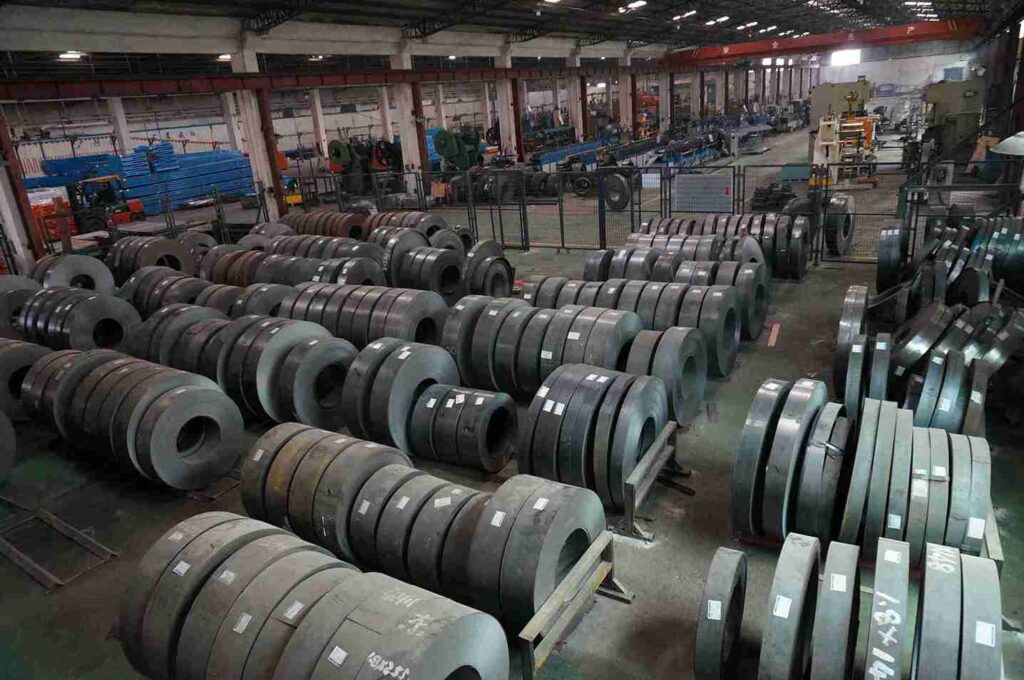
Implementation Strategies—Phased Deployment for Brownfield Warehouses
Brownfield Automation Integration Success Factors
Most warehouses in Africa, Latin America, Southeast Asia, the Middle East, and Central Asia are brownfield facilities—existing structures with legacy infrastructure, live daily operations, and challenging layout constraints. Greenfield warehouses designed from scratch for automation are rare. Wholesale high-density longspan shelving is uniquely suited for brownfield retrofits because it can be installed in sections without taking the entire warehouse offline.
Brownfield automation has become a high-impact response to logistics challenges. With double-digit labor cost increases across many regions and persistent workforce shortages, automation offers both cost mitigation and operational continuity. Companies like Riibotics and Third Wave Automation have demonstrated that autonomous forklifts can retrofit existing warehouses with no infrastructure changes, delivering ROI in under one year.
These solutions focus on labor savings and also address variability in trailer arrivals, demand spikes, changing workflows, and safety incidents as key warehouse cost drivers. All of these solutions work seamlessly with wholesale high-density longspan shelving because the shelving’s modular design accommodates both manual and automated material handling equipment.
Our recommended phased approach for brownfield warehouses using wholesale high-density longspan shelving:
Phase 1 (Months 1-3): Audit, plan, and procurement. Map existing workflows, SKU velocity data, and equipment requirements. Identify the 20% of SKUs that generate 80% of order volume; these will be the first candidates for wholesale high-density longspan shelving zones.
Phase 2 (Months 4-8): Selective zone conversion. Reconfigure the most problematic 25% of the warehouse—typically the slowest, most congested zone—to wholesale high-density longspan shelving combined with manual picking. This provides an immediate test case and generates early ROI data.
Phase 3 (Months 9-15): AGV introduction. After manual processes stabilize, deploy 6–12 AGVs in the converted zone for repetitive pallet and case movements. The wholesale high-density longspan shelving already installed will be AGV-ready if the original specification included floor markers and appropriate aisle widths.
Phase 4 (Months 16-24): Full reconfiguration. Scale the solution across remaining warehouse zones based on demonstrated ROI from earlier phases. By this point, the wholesale high-density longspan shelving investment has already paid for itself through labor and space savings, and AGV deployment becomes an incremental upgrade.
Avoiding Common Implementation Pitfalls with Wholesale High-Density Longspan Shelving
We have observed recurring mistakes in warehouse automation projects across emerging markets. These pitfalls can be avoided by following best practices for wholesale high-density longspan shelving:
Underestimating SKU diversity: High-density configurations that work for palletized homogeneous goods may fail for mixed-case e-commerce inventory. Always baseline SKU profiling before finalizing wholesale high-density longspan shelving configuration. A wholesale distributor should reserve 20% of the shelving for adjustable-width bays.
Ignoring software integration: AGV-ready wholesale high-density longspan shelving requires warehouse management system (WMS) upgrades to support robot tasking and inventory location tracking. Allocate 15–20% of total budget to software. Many wholesale operators fail to budget for WMS integration and then discover that their AGVs cannot locate the correct lane.
Failing to plan for scale: Ensure your wholesale high-density longspan shelving system can accommodate additional AGVs or deeper lane depths as order volumes grow. Modular systems designed for expansion are worth the premium. A wholesale distributor in Bangkok learned this lesson when they had to replace entire rack sections after three years because their original wholesale high-density longspan shelving could not be extended.
Overlooking workforce training: The shift to wholesale high-density longspan shelving changes picking workflows and introduces new safety protocols. Budget for at least two weeks of intensive operator training before full deployment. Wholesale operators who invested in cross-training their pickers on both manual and AGV-assisted retrieval reported 40% faster adoption rates.
Technical Standards and Compliance for Emerging Markets
H3: International Quality and Safety Standards for Wholesale High-Density Longspan Shelving
When selecting wholesale high-density longspan shelving for markets across Africa, Latin America, Southeast Asia, the Middle East, and Central Asia, international certifications provide essential quality assurance. Wholesale high-density longspan shelving that meets ISO and FEM standards will deliver consistent performance and legal compliance.
ISO 9001:2015 remains the foundational quality management standard, ensuring consistent manufacturing processes and documented quality control procedures. Reputable suppliers of wholesale high-density longspan shelving also adhere to FEM (Federation Europeenne de la Manutention) standards, which govern structural integrity and design safety for storage systems.
EN 15620:2008 specifies requirements for adjustable pallet racking, while EN 15635 provides guidance for safe installation and ongoing inspection. For wholesale high-density longspan shelving used in seismic zones—parts of Latin America, Southeast Asia, and Central Asia—additional certification to EN 16681 (steel static storage systems with seismic conditions) is highly recommended.
For AGV integration, ISO 3691 series covers safety requirements for industrial trucks—including automated guided vehicles. ISO 12100 outlines general principles for risk assessment in machinery design, and ISO 13849 specifies safety-related control system requirements. Wholesale high-density longspan shelving that will interact with AGVs should also meet ISO/TS 15066 for collaborative robot safety if humans and robots share the same aisles.
Why international standards matter in emerging markets: Local fabrication shops using uncertified materials and undocumented design processes are common across Africa, Latin America, the Middle East, and Southeast Asia. Municipal authorities in major cities—including Dubai Civil Defence, São Paulo’s city hall, and the Nairobi County government—now explicitly prohibit uncertified racking that has not undergone load testing.
Warehouse owners using non-compliant wholesale high-density longspan shelving face liability exposure in workplace accidents and potential insurance claim denials. A wholesale distributor in Lagos learned this the hard way when their insurer refused to cover a collapse of locally fabricated shelving, resulting in a $2.1 million loss.
Local Regulatory Requirements
Beyond international standards, each country imposes unique requirements on wholesale high-density longspan shelving installations:
Brazil: Compliance with NR-12 machinery safety regulations and INMETRO certification for electrical components in automated systems. Wholesale high-density longspan shelving must be stamped by a registered Brazilian engineer for projects exceeding 500 square meters.
Mexico: Official Mexican Standards (NOM) for workplace safety, including NOM-001-STPS-2008 for buildings and NOM-004-STPS-1999 for material handling equipment. Wholesale high-density longspan shelving used in cold storage must also comply with NOM-022-STPS for refrigeration systems.
South Africa: Occupational Health and Safety Act (OHSA) and SANS 10160 for structural loading requirements. The South African National Standard SANS 5501 specifically covers adjustable pallet racking and longspan shelving.
Kenya: Kenya Bureau of Standards (KEBS) certification for imported material handling equipment. Wholesale high-density longspan shelving entering the Kenyan market requires a KEBS permit of conformity.
UAE: Dubai Civil Defence approval for racking installations and IECEx certification for equipment used in hazardous environments. For wholesale high-density longspan shelving in Dubai’s cold storage zones, additional approval from the Dubai Municipality Food Safety Department is required.
Indonesia: SNI (Standard Nasional Indonesia) certification for steel structures. Wholesale high-density longspan shelving must be designed to withstand seismic loads per SNI 1726.
Kazakhstan: GOST-K certification for imported industrial equipment. Wholesale high-density longspan shelving used in Astana or Almaty must pass cold-temperature impact testing per GOST 27772.
Our recommendation: Work with suppliers who provide documented compliance with ISO 9001, FEM, and relevant local certifications. Request third-party load test certificates and design calculations stamped by local professional engineers where regulations require. A wholesale distributor should never accept an uncertified wholesale high-density longspan shelving quotation, as the long-term liability and operational risks far outweigh any upfront savings.
AGV Compatibility versus Manual Accessibility—Finding the Right Balance with Wholesale High-Density Longspan Shelving
The question we most frequently hear from warehouse managers in emerging markets: “Should I configure all my wholesale high-density longspan shelving for AGVs, or prioritize manual access?”
The correct answer depends on three variables: order volume growth trajectory, workforce availability and cost, and facility layout constraints. Wholesale high-density longspan shelving is flexible enough to support either approach, but the optimal balance varies by operation.
When to prioritize AGV-ready configurations for wholesale high-density longspan shelving:
Order volumes growing 15%+ annually with no corresponding labor pool expansion
High repeatability—the same 200–300 SKUs represent over 70% of picking activity
Existing labor constraints—difficulty recruiting and retaining reliable warehouse workers
Facility space is exhausted—no land available for expansion
When to prioritize manual accessibility with wholesale high-density longspan shelving:
Highly variable SKU mix—thousands of different SKUs with low individual velocity
Frequent layout reconfiguration—high-density fixed positions may limit flexibility
Capital constraints—AGV implementation requires additional software and control system investment
Power reliability concerns—facilities in areas with frequent extended outages need manual fallback
The hybrid solution often outperforms both extremes. We recommend configuring 60–70% of wholesale high-density longspan shelving as “AGV-ready but initially manual,” with the remaining 30–40% reserved for AGV-only zones after automation deployment. This approach gives wholesale operators maximum flexibility while avoiding premature investment in AGVs before workflows stabilize.
A wholesale pharmaceutical distributor in Ho Chi Minh City used this strategy: they installed 8,000 square meters of wholesale high-density longspan shelving with AGV-ready aisle widths and floor markers, ran the system manually for nine months to refine slotting, and then introduced 14 AGVs. The transition was seamless, and the payback period on the AGVs was only 10 months because the shelving had already been prepared.
Future-Proofing—Scalable Systems for Growing Wholesale Operations
Warehouses across Africa, Latin America, Southeast Asia, the Middle East, and Central Asia are not static operations. The e-commerce platforms, wholesale distributors, and 3PL providers we serve today expect to double or triple their throughput capacity within 36 to 48 months. Wholesale high-density longspan shelving systems must support this growth without requiring complete rip-and-replace reconfigurations.
Scalability features to prioritize when specifying wholesale high-density longspan shelving:
Modular upright spacing. Systems with standardized bay widths (typically 2.4 to 3.0 meters) allow additional shelving rows to be inserted as inventory expands, without structural modifications. Wholesale high-density longspan shelving from suppliers who use non-modular spacing will become obsolete quickly.
Adjustable beam levels. As SKU profiles shift from small-case to pallet-sized items, adjustable beam heights accommodate changing requirements. Wholesale distributors handling seasonal products (e.g., Christmas decorations, agricultural inputs) particularly value this adjustability.
Expandable AGV integration pathways. Pre-run conduit, power drops, and software interfaces for future AGV deployment should be included at initial installation even if robots are not purchased immediately. Wholesale high-density longspan shelving that lacks these provisions will require costly retrofitting later.
Removable lane dividers. Deep-lane wholesale high-density longspan shelving configurations with removable dividers permit conversion between single-pallet access and multi-pallet push-back or radio shuttle operation as automation levels increase. A wholesale electronics distributor in Dubai used this feature to convert 2,000 pallet positions from FIFO push-back to automated shuttle retrieval within a single weekend.
Integration with warehouse execution systems (WES). The most advanced wholesale high-density longspan shelving projects include APIs for real-time slotting optimization. The WES can dynamically reassign SKUs to different shelf levels based on velocity data, reducing travel time by an additional 15–20% beyond the baseline density gains.
Päätelmä
Wholesale high-density longspan shelving designed for AGV compatibility and manual picking flexibility represents the single most impactful investment that e-commerce, wholesale, and cold storage warehouse operators across Africa, Latin America, Southeast Asia, the Middle East, and Central Asia can make in 2026 and beyond.
The convergence of explosive e-commerce growth, rising real estate costs, persistent labor shortages, and proven robotic automation technologies has created an undeniable imperative: warehouses that fail to adopt wholesale high-density longspan shelving will be structurally disadvantaged compared with competitors who embrace density-driven efficiency.
The evidence is overwhelming. From Johannesburg’s automated sorting centers processing 50,000 parcels daily to Brazilian distribution networks expanding capacity by 40% through automation, from cold storage operators reducing refrigeration energy consumption by 60% to Mexican logistics hubs preparing for $50 billion in nearshoring-driven foreign direct investment—wholesale high-density longspan shelving for wholesale and retail operations sits at the center of every successful warehouse modernization story documented across five major emerging markets.
In Southeast Asia, wholesale distributors using wholesale high-density longspan shelving have weathered port congestion and demand spikes without costly overflow facilities. In the Middle East, wholesale high-density longspan shelving has enabled cold storage operators to cut energy bills by over half while improving temperature compliance. In Central Asia, wholesale hubs have doubled their SKU capacity without expanding their building footprints.
The path forward is clear. Audit your current warehouse configuration. Calculate the labor and space savings available through density improvement using wholesale high-density longspan shelving. Evaluate which zones of your facility are ready for AGV integration and which will continue as manual operations. And invest in modular, scalable wholesale high-density longspan shelving that will serve your operations for the next 15 to 20 years—adapting and expanding as your business grows.
The warehouses that act now will capture market share from slower competitors. The warehouses that wait will find themselves leasing expensive additional square footage, paying premium wages for inefficient manual labor, and watching fulfillment times fall further behind customer expectations. Wholesale high-density longspan shelving is not merely a storage product; it is a competitive weapon in the era of rapid e-commerce fulfillment. The decision to deploy it—and to deploy it correctly—will determine which wholesale distributors thrive and which struggle to survive.
Usein kysytyt kysymykset
1: How does seismic activity in Latin America and Southeast Asia affect the design of wholesale high-density longspan shelving?
In regions with moderate to high seismic risk—including Mexico, Peru, Chile, Indonesia, the Philippines, and Turkey—wholesale high-density longspan shelving must incorporate seismic base isolation or reinforced bracing. Standard EN 16681 (Steel static storage systems with seismic conditions) provides design methodologies. Wholesale operators in these zones should request a site-specific seismic analysis from their shelving supplier. The additional cost for seismic-rated wholesale high-density longspan shelving typically ranges from 15% to 25% above standard configurations but is legally mandatory in many municipalities. Without seismic compliance, a wholesale distributor may face fines and forced retrofits.
2: Can wholesale high-density longspan shelving be used for both ambient and cold storage within the same warehouse?
Yes, but with important material considerations. Wholesale high-density longspan shelving installed across a temperature gradient—for example, a facility with a +25°C dry storage zone adjacent to a -18°C freezer—will experience condensation on the structural members at the transition line. This condensation accelerates corrosion if the shelving is not properly coated. The solution is to either (a) use hot-dip galvanized wholesale high-density longspan shelving throughout the facility, or (b) install a physical thermal break such as a vinyl curtain wall at the transition. Wholesale distributors who ignore this issue have reported premature coating failure within 18 to 24 months.
3: How does wholesale high-density longspan shelving affect fire safety and sprinkler coverage?
High-density storage changes fire dynamics because product is packed more tightly, potentially hindering sprinkler water penetration. International Building Code (IBC) and NFPA 13 require in-rack sprinklers for high-density storage exceeding certain density thresholds. Wholesale high-density longspan shelving with deep lanes (three pallets or more) will almost certainly require in-rack sprinklers or a fire suppression system designed specifically for high-challenge storage. Wholesale operators should involve a fire protection engineer early in the planning process. While in-rack sprinklers add 15–25 per square meter to project costs, they are often required by local fire codes, and non-compliance can void property insurance.
4: What is the typical lead time for manufacturing and installing wholesale high-density longspan shelving for a 10,000-pallet position facility?
For a project of this scale, manufacturing lead times for wholesale high-density longspan shelving typically range from 8 to 14 weeks, depending on the supplier’s backlog and the complexity of the configuration (e.g., standard selective versus push-back versus radio shuttle). Installation requires an additional 4 to 6 weeks for a facility of this size, assuming a dedicated crew of 6 to 8 technicians.
Wholesale operators should plan for a total project timeline of 16 to 24 weeks from purchase order to go-live. Expedited manufacturing (4–6 weeks) is available at a 20–30% premium. For brownfield installations, schedule the installation during a planned inventory low period or use a phased approach where only one zone at a time is taken offline.
5: How do I verify the claimed load capacity of wholesale high-density longspan shelving from a supplier in an emerging market?
Any reputable supplier of wholesale high-density longspan shelving must provide a third-party load test certificate from an accredited testing laboratory. The certificate should list the tested beam and upright combinations, the applied load, and the measured deflection. In the absence of such a certificate, a wholesale operator can commission an on-site load test using hydraulic jacks and deflection gauges—this typically costs 3,000to8,000 per test configuration.
A simpler but less rigorous approach is to request the supplier’s FEM or SEMA (Storage Equipment Manufacturers Association) design calculations, which should include safety factors of 1.5 for static loads and 2.0 for dynamic loads. Never accept a supplier’s verbal assurance of load capacity without written, verifiable documentation. Several wholesale distributors in Kenya and Nigeria suffered catastrophic shelving collapses after relying on uncertified local fabrication, resulting in inventory loss and worker injuries.
Jos tarvitset täydellisiä CAD-piirustuksia ja tarjouksia varastohyllyistä, ota yhteyttä. Voimme tarjota sinulle maksuttomia varastohyllyjen suunnittelupalveluja ja tarjouksia. Sähköpostiosoitteemme on: jili@geelyracks.com