📐 "La unuaj 50 entreprenaj demandoj ricevas personigitan dezajnon de 3D-stokejo" Plano















Introduction: Understanding High-Density Storage Solutions
In today’s competitive warehousing landscape, maximizing storage density while maintaining operational efficiency is critical. When evaluating double deep racking vs push back racking, warehouse managers must consider multiple factors including storage capacity, accessibility, inventory rotation methods, and equipment requirements. This comprehensive guide provides an in-depth analysis of both systems, helping businesses make informed decisions about their storage infrastructure.
The debate between double deep racking vs push back racking isn’t about which system is superior, but rather which solution best aligns with specific operational needs. Both systems offer distinct advantages for different warehouse scenarios, and understanding their fundamental differences is essential for optimizing storage space and workflow efficiency.
1. Core Principles of Double Deep Racking vs Push Back Racking
1.1 The Mechanics of Double Deep Racking
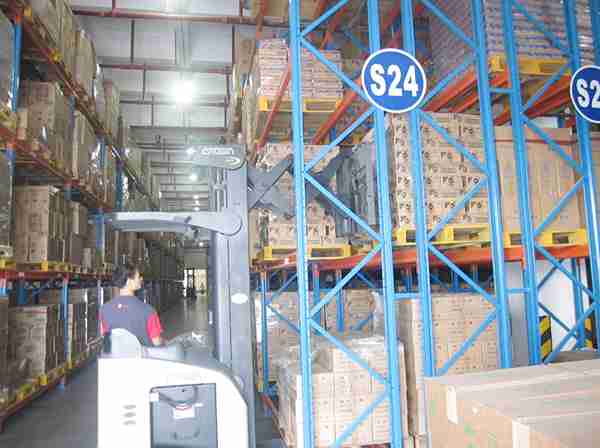
Duoble profunda bretsistemo represents an evolutionary step from traditional selective pallet racking, extending storage depth to two pallet positions while maintaining relatively easy access. This system:
- Utilizes standard upright frames with extended beams
- Requires specialized reach trucks with telescoping forks
- Typically operates on either FIFO or LIFO inventory rotation
- Increases storage density by approximately 40% compared to selective racking
1.2 How Push Back Racking Operates
Push back racking introduces a dynamic storage approach that differs significantly from duoble profunda bretsistemo:
- Features inclined rails with wheeled carts for pallet movement
- Operates exclusively on LIFO (Last-In, First-Out) principle
- Allows storage depths from 2 to 6 pallets per lane
- Eliminates the need for specialized forklift equipment
The fundamental difference in double deep racking vs push back racking lies in their access methods and density capabilities. While both systems increase storage capacity beyond selective racking, they achieve this through completely different mechanical implementations.
2. Storage Capacity: Double Deep Racking vs Push Back Racking
2.1 Pallet Position Density Comparison
When evaluating double deep racking vs push back racking for storage capacity:
| Sistemo | Typical Depth | Density Increase | Alirebleco |
|---|---|---|---|
| Double Deep | du paledoj | ~40% over selective | Meza |
| Push Back | 2-6 pallets | 50-85% over selective | Restricted |
Double deep racking provides a balanced approach, doubling storage capacity while maintaining reasonable access times. Push back racking, however, offers superior density at the cost of immediate access to all pallet positions.
2.2 Warehouse Layout Implications
The choice between double deep racking vs push back racking significantly impacts overall warehouse design:
- Double deep systems require slightly wider aisles (9-11 feet) for reach truck operation
- Push back systems can utilize standard forklift aisles (8-9 feet)
- Duoble profunda configurations work well in rectangular warehouse footprints
- Push back systems excel in square or irregularly shaped facilities
3. Operational Efficiency: Access and Throughput
3.1 Retrieval Speed and Labor Requirements
In the double deep racking vs push back racking productivity comparison:
- Duoble profunda systems average 25-35 pallet moves per hour
- Push back systems typically handle 20-30 pallet moves per hour
- Duoble profunda requires skilled reach truck operators
- Push back can be operated by standard forklift drivers
3.2 Inventory Rotation Considerations
The double deep racking vs push back racking decision heavily depends on inventory management needs:
- Duoble profunda offers FIFO flexibility when configured properly
- Push back is strictly LIFO by design
- Duoble profunda better suits perishable goods or time-sensitive materials
- Push back works best for non-perishable, uniform SKUs
4. Cost Analysis: Double Deep Racking vs Push Back Racking
4.1 Initial Investment Comparison
Breaking down costs in the double deep racking vs push back racking debate:
| Cost Factor | Double Deep | Push Back |
|---|---|---|
| Rack Structure | $$ | $$$ |
| Forklift Equipment | $$$ (reach truck) | $ (standard) |
| Installation | $$ | $$$ |
| Total per Pallet Position | $ | $$ |
4.2 Long-Term Operational Costs
The double deep racking vs push back racking cost analysis extends beyond initial investment:
- Duoble profunda systems have lower maintenance requirements
- Push back systems need regular wheel and rail inspections
- Duoble profunda offers better resale value
- Push back may require more frequent component replacement
5. Industry-Specific Applications
5.1 Ideal Uses for Double Deep Racking
Double deep racking excels in these environments:
- Food and beverage distribution centers
- Pharmaceutical warehouses
- Retail distribution hubs
- Manufacturing raw material storage
5.2 Optimal Push Back Racking Applications
Push back racking proves most effective for:
- Building materials suppliers
- Automotive parts distribution
- Electronics component warehouses
- Seasonal product storage facilities
6. Making the Final Decision: Double Deep Racking vs Push Back Racking
6.1 Key Decision Factors
When choosing between double deep racking vs push back racking, consider:
- Inventory characteristics (SKU variety, turnover rate)
- Throughput requirements (daily pallet movements)
- Available equipment (forklift types on site)
- Future growth projections (scalability needs)
- Budget constraints (capital and operational)
6.2 Hybrid Solutions
Some facilities benefit from combining double deep racking vs push back racking in different zones:
- Use double deep for fast-moving SKUs
- Implement push back for bulk storage items
- Create transitional areas where systems interface
Conclusion: Optimizing Warehouse Storage Strategy
The double deep racking vs push back racking decision represents a critical juncture in warehouse design. Double deep racking offers a balanced approach for facilities needing moderate density with good accessibility, while push back racking provides maximum storage for operations handling large quantities of similar products.
By thoroughly evaluating the double deep racking vs push back racking alternatives against specific operational parameters, businesses can implement the ideal storage solution that maximizes space utilization while maintaining efficient material flow. The optimal choice varies for each facility, but understanding these systems’ capabilities ensures informed decision-making for long-term warehouse efficiency.
Frequently Asked Questions
1. Can existing selective racking be converted to double deep?
Yes, many duoble profunda bretsistemo installations can be created by modifying existing selective rack systems with extended beams and proper reinforcement.
2. What’s the maximum height for push back racking systems?
Plej multajpush back racking configurations support heights up to 40 feet, though structural analysis is recommended for installations above 30 feet.
3. How does seismic safety compare between these systems?
In earthquake-prone regions, duoble profunda bretsistemo generally offers better seismic performance due to its more rigid structure compared to push back racking’s dynamic components.
4. What lead time should we expect for new installations?
Typical lead times for double deep racking vs push back racking systems range from 6-12 weeks, depending on system complexity and manufacturer capacity.
5. Can these systems accommodate non-standard pallet sizes?
Both duoble profunda bretsistemokaj kajpush back racking can be customized for unusual pallet dimensions, though this may affect storage density and require engineering review.