📐 "First 50 Enterprise Queries Get Custom 3D Warehouse Design" Plan


Double Deep vs Narrow Aisle Racking: The Ultimate Guide to Maximizing Warehouse Storage Efficiency
In the relentless pursuit of warehouse optimization, the choice between double deep racking and narrow aisle racking stands as one of the most critical—and often misunderstood—decisions for logistics managers and business owners across emerging markets. This comprehensive guide cuts through the industry jargon to deliver a clear, actionable comparison grounded in decades of field experience.
The analysis doesn’t merely list features; it provides a strategic framework tailored for the unique challenges and explosive growth trajectories seen in Southeast Asia, the Middle East, Africa, and Latin America. Whether the operation is an e-commerce giant in Jakarta, a manufacturing hub in Turkey, a cold storage facility in Nigeria, or a distributor in Mexico, the wrong storage decision can cost millions in lost space, productivity, and scalability.
While both systems are engineered to increase storage density beyond traditional selective pallet racking, their operational philosophies, infrastructure demands, and long-term financial implications differ dramatically. Double deep racking effectively doubles storage lanes by placing pallets two-deep, thereby slashing the total number of aisles. Conversely, narrow aisle racking retains single-deep accessibility but employs specialized equipment to function within drastically compressed aisle widths. The superior choice is never universal; it is a calculated function of SKU profile, inventory turnover (FIFO vs. LIFO), material handling equipment (MHE) strategy, local labor dynamics, and the broader automation roadmap.
This definitive guide dissects every component, from structural engineering and forklift dynamics to region-specific ROI calculations. It integrates real-world case studies from markets like Vietnam, Saudi Arabia, Colombia, and Kenya, demonstrating system performance under local conditions. Furthermore, it explores how both double deep racking and narrow aisle racking configurations integrate with modern warehouse automation—AGVs, unmanned forklifts, and WMS-driven workflows—to create a future-proof logistics asset. The objective is to equip decision-makers with the insights not just to select a racking system, but to engineer a storage solution that delivers a tangible competitive advantage.

Part 1: The Foundational Principles of High-Density Storage
1.1 The Core Challenge: Cubing Out Before Running Out
Warehouse managers perpetually grapple with a fundamental constraint: maximizing the usable cube of their existing facility. The cost per square meter in industrial zones from Manila to Dubai is escalating rapidly. Physical expansion is often logistically impossible or prohibitively expensive. Consequently, the strategic goal evolves from merely storing goods to storing a maximum volume within the same footprint. This imperative is the driving force behind high-density storage solutions. Traditional wide-aisle racking, while flexible, can dedicate 40-50% of valuable floor space solely to aisles for forklift maneuvering—a significant portion of real estate generating no direct storage revenue.
The evolution toward double deep racking and narrow aisle racking systems represents a direct, engineered response to this spatial inefficiency. Both systems target the reduction of non-productive aisle space, but they employ fundamentally different methodologies. Understanding this core principle of “aisle space recovery” is paramount. The discussion extends beyond the racking structure itself to encompass the entire ecosystem—the rack design, the specialized equipment that services it, the product profile it must accommodate, and the management systems that orchestrate its operation.
1.2 The Critical Role of Emerging Market Dynamics
Geographical and economic context is not a minor detail; it is a decisive variable in storage strategy formulation. In Southeast Asia, breakneck e-commerce growth demands blistering pick rates and flawless operation in mixed-SKU environments, placing a premium on speed and flexibility. In the GCC countries, large-scale import/export operations and high-value goods necessitate secure, high-throughput systems with excellent visibility and control. Across Africa, common challenges include inconsistent power grids and a pressing need for robust, low-maintenance solutions that minimize downtime. Latin American operations often contend with highly seasonal inventory swings, requiring systems that can handle variable throughput pressures.
These regional nuances profoundly influence every aspect of the decision between double deep racking and narrow aisle racking. They affect the type of forklift that can be reliably sourced, maintained, and repaired locally; the available skill level and training requirements for operators; and even the structural specifications for seismic or wind loads. A solution perfectly optimized for a climate-controlled, unionized warehouse in Northern Europe may falter in the demanding environment of a port-side warehouse in Bangladesh. Therefore, any comparative analysis of double deep racking vs narrow aisle racking must be firmly grounded in these operational realities.
Part 2: A Comprehensive Deep Dive into Double Deep Racking
2.1 Operational Mechanics: The System of Depth
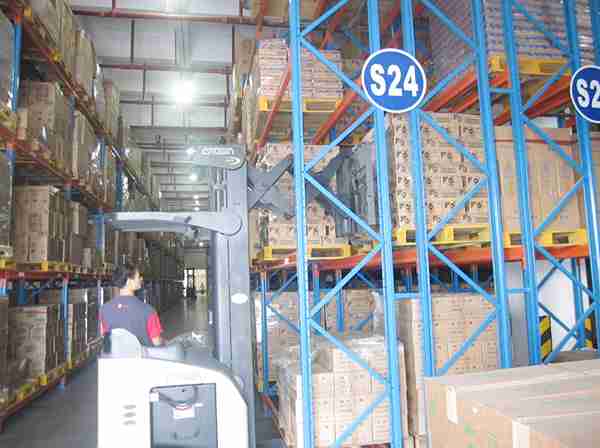
Double deep racking is a concept of elegant simplicity that demands mechanical precision in execution. The system utilizes a specially reinforced rack structure that allows for two standard pallets to be stored consecutively, back-to-back, in a single storage lane. This configuration necessitates the use of a dedicated double reach truck or a forklift equipped with a telescopic attachment capable of extending to safely retrieve the second pallet. While the aisles themselves are typically wider than those in a pure narrow aisle racking setup to accommodate the truck’s extended forks, the total number of aisles is dramatically reduced.
Consider a standard selective racking layout with ten aisles. By transitioning to a double deep racking configuration, that number might be reduced to five or six aisles, instantly reclaiming linear floor space for additional storage rows. The typical aisle width required ranges from 11 to 13 feet (approximately 3.3 to 4 meters), compared to the 12-14 feet needed for a standard reach truck.
Key Structural Components and Considerations:
Upright Frames: Require significant reinforcement to handle the increased load and moment forces generated by the double-deep lanes. The frame’s resistance to lateral torsion is critical.
Load Beams: Often employ a step-beam design or extra-deep channels to provide the necessary load-bearing capacity for two pallet weights and to facilitate smoother entry for extended forks.
Pallet Support Bars or Wire Decking: Essential for providing stable support to the inner pallet, which lacks direct contact with the front load beam.
Guide Rails & Protections: Frequently installed at the base to guide forklifts accurately into the lane and prevent costly impacts to the uprights, a vital consideration for long-term integrity.
2.2 The Strategic Advantages: When Density Reigns Supreme
Superior Pallet-Density-to-Footprint Ratio: In direct comparisons within the same warehouse footprint, double deep racking frequently delivers the highest possible storage density for uniform, palletized goods, outperforming many other systems short of more complex drive-in designs. It is a master of volumetric cube utilization.
Favorable Initial Capital Outlay for Racking: While the required material handling equipment (MHE) is specialized, the racking structure itself often presents a lower cost per pallet position compared to the high-specification structures needed for some very narrow aisle (VNA) applications. This can make double deep racking an attractive option when capital allocation for physical infrastructure is a primary constraint.
Inherent Compatibility with certain Automation Pathways: The predictable, repetitive nature of the deep storage lane makes it a candidate for emerging automation technologies. Solutions include AGV-powered transfer carts that service lane fronts or the development of automated double reach trucks that can operate with high precision.
Ideal for Medium-Turnover, LIFO-Compatible Inventory: The system shines in environments with multiple pallets of identical SKUs. It is perfectly suited for beverage distributors, packaged food warehouses, or chemical storage facilities where goods are shipped in full-pallet quantities and production or procurement is batched.
2.3 The Inherent Constraints and Operational Realities
The Fundamental LIFO Limitation (Last-In, First-Out): This is the most significant and often decisive constraint. Accessing the rear pallet invariably requires the removal of the front pallet. This makes classic double deep racking unsuitable for FIFO (First-In, First-Out) goods with strict expiry dates or lot-tracking requirements, such as pharmaceuticals, perishable foods, or regulated electronics.
Dependence on Specialized, Higher-Cost MHE: Operations cannot utilize standard counterbalance or reach trucks. Double reach trucks are more mechanically complex, command a higher purchase price, incur greater maintenance costs, and require operators with specific, advanced skills.
Risk of Reduced Accessibility and “Honeycombing”: In operations with a high mix of SKUs per lane, depletion of one SKU can leave a single, inaccessible pallet blocking a lane position—a phenomenon known as “honeycombing.” This leads to lost storage capacity and can severely hamper overall warehouse throughput if not meticulously managed by a sophisticated WMS.
Elevated Risk of Load and Rack Damage: The operation of extended forks in a confined depth requires exceptional operator skill and concentration. Minor errors in alignment or depth perception can lead to impacts with the rear rack structure or the pallet behind, potentially damaging both product and equipment.
Part 3: Unpacking the Narrow Aisle Racking (NA & VNA) Ecosystem
3.1 System Anatomy: Precision Engineering for Access
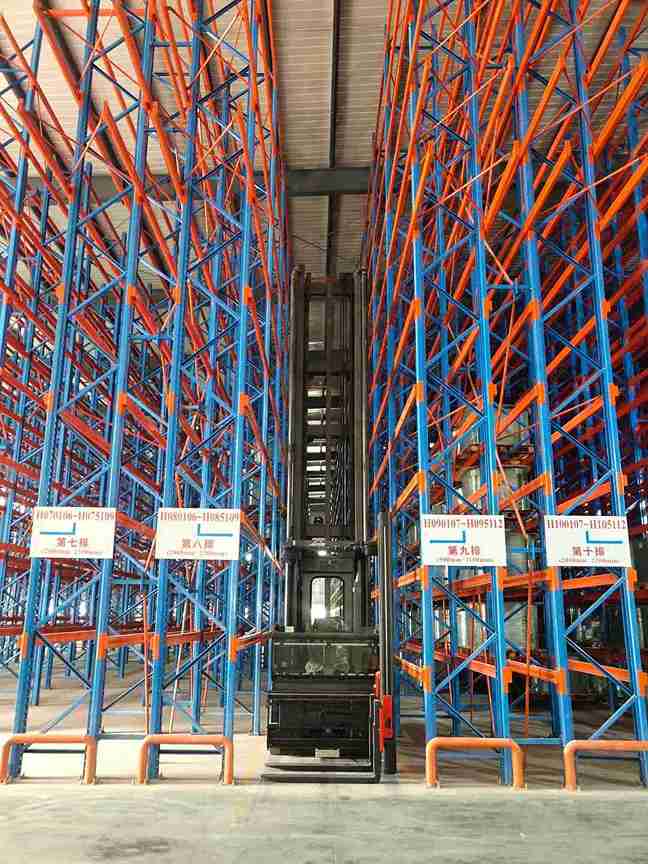
Narrow aisle racking takes the fundamental concept of selective racking and optimizes it through a symbiotic relationship between structure and machine. The aisle width is compressed, typically to between 5.5 and 8 feet (1.7 to 2.4 meters), by eliminating the need for the forklift to turn within the aisle. Specialized narrow aisle reach trucks or turret trucks operate within these confines, using rotating forks or mast assemblies to place and retrieve loads from either side without turning the vehicle’s chassis.
The system’s integrity rests on three interdependent pillars:
The Racking Structure: Must be erected with exceptional precision—plumb, level, and unwavering—to allow for operation within centimeters of clearance. Tolerances are far tighter than for standard or double deep racking.
The Material Handling Equipment: Narrow aisle forklifts are equipped with guidance systems. These range from proven physical systems like wire or rail guidance to advanced optical or LiDAR-based technologies, ensuring straight travel and preventing catastrophic collisions with the racking.
The Building Infrastructure: Requires a warehouse floor with a high degree of flatness (often specified by a detailed Fₗ flatness number) to ensure the stability and safety of the tall, narrow equipment, especially when handling loads at significant heights.
3.2 The Compelling Benefits: Selectivity Meets Density
Maintains 100% Direct Selectivity (FIFO Compatibility): Every pallet position is immediately and directly accessible. This is the paramount advantage for operations mandating strict lot control, first-expiry-first-out (FEFO) policies, or rapid turnover of a vast number of unique SKUs.
Excellent Storage Density with Unmatched Accessibility: While the ultimate pallet count may sometimes be slightly less than an optimized double deep racking layout, narrow aisle racking typically delivers a 40-50% density improvement over traditional wide-aisle designs. It is the preferred choice for high-SKU-count distribution centers and e-commerce fulfillment hubs where access speed is paramount.
Higher Potential Order Picking Throughput: Direct access to every pallet facilitates faster order picking, particularly for less-than-pallet (LTL) or case-picking operations. Travel paths can be optimized more efficiently, making narrow aisle racking a productivity powerhouse in fast-moving environments.
The Definitive Pathway to High-Bay Automation: Narrow aisle racking forms the static infrastructure for Very Narrow Aisle (VNA) operations, which are serviced by man-up turret trucks or fully automated swing-mast trucks. This creates a natural, scalable evolution from a manned to a semi- or fully-automated storage and retrieval system (AS/RS), protecting long-term capital investment.
3.3 The Challenges and Strategic Investment Considerations
Higher Integrated Initial Investment: The total project cost encompasses the high-precision racking, the significantly more expensive specialized forklifts, and often substantial floor preparation work. The capital outlay is generally higher than for a double deep racking system when factoring in all components.
Critical Single Point of Failure Risk: The efficiency of a narrow aisle racking system is heavily dependent on the uptime of its specialized trucks. A single equipment failure can render an entire aisle—and a large block of inventory—inaccessible. Strategic planning must include redundancy (backup trucks) or rapid-response maintenance agreements.
Elevated Operator Skill and Training Demands: Operating in such tight confines at significant heights requires highly trained, certified, and consistently vigilant operators. In emerging markets where skilled labor may be scarce or turnover high, this can pose a significant operational challenge, making the case for operator-agnostic automation more compelling.
System Inflexibility Post-Installation: The racking layout is essentially permanent due to the fixed guidance systems embedded in the floor or rack base. Future reconfiguration to accommodate different pallet sizes or a radically altered workflow is a major, disruptive undertaking.
Part 4: A Granular Head-to-Head Comparative Analysis
4.1 The Storage Density Showdown: A Numerical Model
A practical model illustrates the decision. Consider a warehouse in Bangkok with 30,000 sq ft of clear storage area and a 10-meter clear height.
Traditional Selective Racking (Baseline): Aisle width: 12 ft. Estimated net capacity: 3,000 pallet positions.
Double Deep Racking Configuration: Aisle width: 12 ft for the double reach truck, but a 50% reduction in aisle count. Result: Typically achieves a 40-55% increase over baseline. Modeled Capacity: ~4,200 to 4,650 pallets. The double deep racking strategy wins on pure horizontal density.
Narrow Aisle Racking Configuration: Aisle width: 6.5 ft. Result: Typically achieves a 30-45% increase in pallet positions over the same footprint. Modeled Capacity: ~3,900 to 4,350 pallets. However, if the building height allows, the narrow aisle racking system can be built taller more safely (using the guided equipment), potentially winning on total cubic volume utilization.
Verdict: In a low-ceiling scenario, double deep racking often claims the density crown. In a modern, high-clear-height building, narrow aisle racking can leverage vertical space more effectively. The building itself is a key determinant in the double deep racking vs narrow aisle racking density debate.
4.2 Operational Workflow & Throughput Impact Analysis
Picking Efficiency: For case picking or each-picking, narrow aisle racking with its direct access is unrivaled. For full-pallet picking of homogeneous SKUs from a dedicated lane, a well-organized double deep racking system can achieve comparable, if not superior, speed.
Putaway and Replenishment Efficiency: Double deep racking putaway can become inefficient if lanes require constant reorganization to group SKUs. Narrow aisle racking putaway is generally more straightforward and faster, as any open location for the correct SKU is accessible.
Inventory Control and Cycle Counting: Narrow aisle racking supports flawless FIFO and allows for easy, visual cycle counts of all inventory. Double deep racking imposes a heavier burden on the Warehouse Management System (WMS) to track lane residency, prevent mis-shipments, and manage inventory freshness, adding a layer of software dependency.
4.3 Total Cost of Ownership (TCO) Over a 10-Year Horizon
For financial controllers in growth markets, a TCO analysis is indispensable. The comparison between double deep racking and narrow aisle racking reveals distinct financial profiles:
| Cost Component | Double Deep Racking | Narrow Aisle Racking |
|---|---|---|
| Initial Racking Cost | Moderate | Moderate to High (Precision Engineering) |
| Initial MHE Cost | High (Specialized Double Reach Trucks) | Very High (NA Trucks + Guidance System) |
| Floor Preparation Cost | Standard | High (Precision Flatness Often Required) |
| Operational Labor Cost | Moderate (Requires Skilled Operators) | Moderate to High (Requires Highly Skilled Operators) |
| Maintenance Cost | Higher (Complex Telescopic Mechanisms) | Higher (Complex Guidance & Turret Systems) |
| Space Cost Savings | Highest (Pallet/Floor Area) | Very High (Cube Utilization Potential) |
| Flexibility for Future Change | Low (Fixed Lane Depth) | Very Low (Fixed Aisle & Guidance) |
| Optimal Business Case | Capital focused on max space recovery for LIFO goods. | Operations focused on throughput, selectivity, and FIFO compliance. |
The breakeven calculus often hinges on local real estate costs versus local equipment and labor costs. In a premium logistics park in Jebel Ali where land is exorbitant, the high density of either a double deep racking or narrow aisle racking system pays for itself quickly. In a peri-urban area of Kenya with lower land costs but high equipment import duties, the upfront capital intensity of a full narrow aisle racking system might lengthen the ROI period considerably.
Part 5: The Automation & Technology Integration Imperative
5.1 AGVs and Unmanned Forklifts: Redefining the Value Proposition
The conversation around double deep racking vs narrow aisle racking evolves dramatically when viewed through the lens of automation. Both systems are compatible with smart technology, but the integration paths differ.
Automating Double Deep Racking: The primary challenge is the deep retrieval. Current and emerging solutions include:
AGV-Powered Transfer Shuttles: An autonomous mobile robot (AMR) or AGV delivers a pallet to the lane entrance. A dedicated, rail-based transfer shuttle within the lane then takes the pallet and stores it in the first or second position, creating a dense, automated block storage system.
Automated Double Reach Trucks: These are now entering the market, utilizing integrated LiDAR, vision systems, and sophisticated control software to precisely position their extended forks. This allows a double deep racking system to operate in a fully lights-out environment.
Automating Narrow Aisle Racking: This is the most mature and common path to high-density automation.
Automated Guided Turret Trucks (AGVs): These are driverless VNA trucks that follow predefined or dynamic paths, accessing heights over 15 meters (50 feet). They integrate seamlessly with a WMS or Warehouse Execution System (WES) for fully automated storage and retrieval.
Forklift AGVs for NA Layouts: Standard narrow aisle racking layouts can be serviced by forklift-type AGVs designed to operate in narrow aisles, offering a more flexible, scalable, and often more affordable entry point into automation compared to fixed-path systems.
A project for an automated cold storage facility in Durban exemplifies this synergy. The design utilized narrow aisle racking paired with cold-rated forklift AGVs, completely removing human operators from the -25°C environment. This solved a critical operational hardship while maximizing density, a perfect alignment of system capability with business need.
5.2 The Indispensable Role of a Smart WMS: The System’s Brain
No high-density storage system, whether double deep racking or narrow aisle racking, reaches its potential without intelligent software control. A robust, modern WMS is non-negotiable. It functions as the central nervous system, determining:
Intelligent Slotting: For double deep racking, it dynamically pairs compatible SKUs in the same lane and dictates putaway locations to minimize future honeycombing.
Task Interleaving and Travel Optimization: For narrow aisle racking, it optimizes the forklift or AGV’s travel path by combining putaway, picking, and replenishment tasks into a single trip, dramatically reducing non-productive travel.
Real-Time Inventory Integrity: It maintains the definitive digital twin of the warehouse. This is especially critical for double deep racking, where the WMS must faithfully track the “hidden” rear pallet, ensuring picking accuracy and inventory visibility.
Part 6: Case Studies from the Front Lines of Emerging Markets
6.1 Case Study 1: E-Commerce Fulfillment Center, Manila, Philippines
Challenge: A rapidly scaling online retailer needed to triple storage capacity within their existing building to handle massive 11.11 and 12.12 sales surges. SKU count exceeded 20,000, with a strict FIFO requirement for cosmetics and perishable goods. Throughput and picking accuracy were paramount.
Analysis & Solution: Double deep racking was eliminated early due to the FIFO constraint. A narrow aisle racking system was designed with 1.8-meter aisles, serviced by man-up turret trucks for high-level picking. The racking was built to 11 meters, fully utilizing the building’s clear height. The entire system was integrated with a tier-1 WMS for optimized wave picking and slotting.
Result: Storage capacity increased by 135% within the original walls. Picking productivity soared by 60% due to drastically reduced travel time between picks. The narrow aisle racking infrastructure created a platform that later allowed for seamless integration of pick-to-light zones at the aisle ends, further boosting efficiency. This case demonstrates why narrow aisle racking is often the default choice for complex, high-SKU e-commerce operations.
6.2 Case Study 2: Bottling Plant, Cairo, Egypt
Challenge: A major beverage manufacturer required extreme-density storage for full pallets of finished goods (water, soft drinks). Turnover was high but followed a batch production model—storing hundreds of pallets of identical SKU for regional distribution. Strict FIFO was secondary to maximizing output per square meter in a costly industrial zone.
Analysis & Solution: Double deep racking was identified as the ideal fit. The plant deployed a fleet of double reach trucks for the main high-bay storage area, with standard forklifts handling the loading bays. The double deep racking design included heavy-duty impact protection throughout, considering the high-traffic, multi-shift environment.
Result: The facility achieved a 50% increase in on-site buffer storage capacity, eliminating costly off-site leasing and smoothing logistics to distributors. The return on investment (ROI) for the double deep racking system was achieved in under 22 months purely through avoided real estate costs. This showcases the raw space-saving power of double deep racking in a LIFO-friendly, high-volume environment.
6.3 Case Study 3: Third-Party Logistics (3PL) Provider, Monterrey, Mexico
Challenge: This 3PL serviced a diverse portfolio—from automotive parts (FIFO, high-value) to paper goods (LIFO, high-volume). They needed a flexible but dense solution to attract and retain clients in a fiercely competitive market, without segregating services into separate buildings.
Analysis & Solution: A purpose-built hybrid solution was engineered. One zone of the warehouse featured narrow aisle racking serviced by guided turret trucks for FIFO, high-SKU clients. An adjacent zone utilized double deep racking serviced by double reach trucks for high-volume, LIFO clients like the paper company. Different MHE fleets serviced each zone, but both were managed under a single, unified WMS capable of orchestrating both storage methodologies.
Result: The 3PL could strategically market “right-fit” storage technology, winning premium contracts from both automotive and consumer goods clients. Overall site storage density increased by over 45% without new construction. This hybrid approach to double deep racking vs narrow aisle racking demonstrates that the choice is not always binary; strategic segmentation can yield optimal results.
Part 7: The Strategic Decision-Making Framework: Your Actionable Checklist
Selecting between double deep racking and narrow aisle racking is a strategic business investment, not a tactical procurement. Decision-makers should methodically work through this framework:
Inventory Profile Analysis: Is the operation fundamentally FIFO or LIFO? What is the average and range of pallets-per-SKU? High pallet-per-SKU ratios favor double deep racking; high SKU-per-pallet ratios favor narrow aisle racking.
Throughput and Activity Profile: What are the peak daily pallet in/out movements? What percentage of activity is full-pallet versus case/each picking? High-speed, mixed-SKU picking strongly leans toward narrow aisle racking.
Physical and Infrastructural Audit: What is the net clear height? What is the current floor condition and flatness tolerance? A low ceiling or poor floor may disqualify a narrow aisle racking system or make it prohibitively expensive to prepare.
Financial and ROI Modeling: What is the total budget for racking, equipment, and infrastructure? More critically, what is the cost of unused space in your specific market? Quantifying the cost of inaction is often the most compelling driver for investing in either double deep racking or narrow aisle racking.
Labor and Skillset Assessment: What is the availability, cost, and turnover rate of trained forklift operators? Is the operational goal to reduce dependency on scarce labor? A push toward automation may favor the more established automation pathways of narrow aisle racking.
Long-Term Strategic Vision: Is the business model, product mix, or throughput likely to change radically in 5-7 years? How scalable and adaptable is each system? Double deep racking offers less post-installation flexibility than narrow aisle racking, which itself is fairly fixed.
There is no universal answer in the double deep racking vs narrow aisle racking debate. The optimal system is the one that aligns perfectly with the unique operational DNA, financial constraints, and growth trajectory of the business.
Conclusion
The journey to maximize warehouse storage is a strategic undertaking, not a pursuit of the latest industry trend. It is a deliberate, calculated investment in the very backbone of the supply chain. Both double deep racking and narrow aisle racking are formidable, proven tools in the modern logistics arsenal. One offers profound, horizontal density for homogeneous, deep-lane inventory. The other provides unparalleled selectivity, speed, and vertical potential for diverse, fast-moving SKUs.
As demonstrated through granular analysis and practical applications from Southeast Asia to Latin America, the correct choice in the double deep racking vs narrow aisle racking decision directly amplifies competitiveness—reducing operational costs, accelerating order fulfillment, and providing a scalable platform for future automation. It is a decision with palpable impact on the balance sheet and ultimate customer satisfaction.
The path forward is to translate this foundational knowledge into a custom-engineered plan, tailored to the specific facility, inventory profile, and commercial ambitions of the operation. The dialogue between double deep racking and narrow aisle racking is a technical one, but its outcome is profoundly commercial.
Frequently Asked Questions (FAQs)
1. Can a double deep racking system ever be engineered for partial FIFO access?
True 100% FIFO access is mechanically impossible in a standard double deep racking system. However, a workaround known as “lane-depth FIFO” can be implemented with a highly sophisticated WMS. By strictly mandating that only identical SKUs (with the older lot always placed in front) occupy a given lane, a form of controlled FIFO is achieved. This adds significant operational complexity and WMS dependency and is not suitable for environments with strict regulatory lot-tracking requirements.
2. How do seismic or high-wind conditions in regions like the Philippines or Chile affect the choice between double deep racking and narrow aisle racking?
Both double deep racking and narrow aisle racking systems require rigorous, locale-specific engineering for dynamic loads. Narrow aisle racking, especially in very tall (VNA) applications, is more susceptible to lateral sway and requires enhanced cross-bracing, potentially thicker-gauge uprights, and specialized anchor bolt designs. Double deep racking must be carefully analyzed for the increased torsional and moment forces on the long-span beams supporting two pallet loads. In high-risk zones, a full seismic analysis by a qualified structural engineer adhering to local building codes is non-negotiable for either system.
3. What are the critical fire safety and sprinkler considerations for these high-density systems?
This is a paramount safety and compliance issue often underestimated. High-density storage, whether double deep racking or narrow aisle racking, directly impacts fire protection design. Both systems typically require in-rack sprinkler heads installed at multiple vertical levels to ensure water can penetrate the dense storage array and reach the seat of a fire. Local fire codes dictate specific requirements. Double deep racking presents a particular challenge, as the inner pallet is shielded by the front pallet; sprinkler heads must be strategically positioned within the rack structure itself. Consultation with a fire protection engineer during the initial design phase is essential.
4. We handle a wide variety of pallet types and sizes (wooden, plastic, slip-sheets, non-standard). Which system between double deep racking and narrow aisle racking is more forgiving?
Narrow aisle racking generally offers more forgiveness for pallet variability. The operator has a direct, visual line to the target load beam during placement, allowing for minor adjustments. Double deep racking is less tolerant. Non-standard, damaged, or flimsy pallets can become unstable when placed in the rear position, and misalignment can cause the extended forks to damage the pallet or product behind. For operations with inconsistent load dimensions, narrow aisle racking presents a lower operational risk, or alternatively, mandates strict pallet quality control for double deep racking.
5. How can we future-proof our decision for potential automation within a 3-5 year horizon?
Future-proofing requires installing the necessary infrastructure today. For narrow aisle racking, this means installing physical guidance rails (even if starting with manned, guided trucks) and ensuring the racking is erected with laser precision. For double deep racking, ensure the rack design (lane depth, beam heights) is compatible with the specifications of emerging automated double reach trucks or shuttle systems. For both double deep racking and narrow aisle racking, the single most important future-proofing investment is a modern, API-friendly WMS capable of integrating with robotics and automation control systems. This software layer is the true key to unlocking future flexibility.
If you require perfect CAD drawings and quotes for warehouse racking, please contact us. We can provide you with free warehouse racking planning and design services and quotes. Our email address is: jili@geelyracks.com