📐 "First 50 Enterprise Queries Get Custom 3D Warehouse Design" Plan


Understanding Double Deep Racking vs Single Deep Racking
When evaluating warehouse storage solutions, the comparison between double deep racking vs single deep racking represents one of the most critical decisions for logistics managers. These two systems offer fundamentally different approaches to pallet storage, each with distinct advantages that impact everything from daily operations to long-term profitability.
The double deep racking vs single deep racking debate centers on a core trade-off: immediate accessibility versus storage density. While single deep configurations allow direct access to every pallet, double deep systems nearly double storage capacity by sacrificing some accessibility. This comprehensive guide will explore every aspect of the double deep racking vs single deep racking decision to help you optimize your warehouse operations.
competitive advantages.
1. Understanding Single Deep Racking Systems
1.1 The Fundamentals of Single Deep Storage
Single deep racking, also known as selective pallet racking, remains the most widely used storage system in warehouses worldwide. This configuration features:
Single-row pallet storage with direct aisle access
Typical aisle widths of 10-12 feet for conventional forklifts
100% selectivity – every pallet is immediately accessible
Compatibility with all standard forklift types
“Single deep racking offers unparalleled accessibility, which is why it dominates industries requiring rapid inventory turnover,” explains Michael Chen, a warehouse design specialist with 25 years of experience.
1.2 Operational Advantages in Detail
The benefits of single deep racking become particularly apparent when examining specific operational metrics:
Accessibility & Productivity:
Immediate access to every pallet position
No need to move other pallets for retrieval
Ideal for first-in, first-out (FIFO) inventory management
Enables faster order picking cycles
Flexibility & Adaptability:
Accommodates varying pallet sizes and SKUs
Easy to reconfigure as inventory profiles change
Simplifies cycle counting and inventory control
Works with all material handling equipment
1.3 Ideal Applications and Industry Examples
Single deep racking proves most effective in these operational environments:
E-commerce Fulfillment:
Amazon fulfillment centers utilize single deep configurations for fast-moving consumer goods
Enables rapid picking of individual items
Supports high-velocity order processing
Cold Storage Facilities:
Preferred for perishable goods requiring FIFO rotation
Reduces product handling time in temperature-controlled environments
Minimizes energy loss from frequent door openings
Retail Distribution:
Major retailers like Walmart use single deep for store replenishment
Accommodates mixed-SKU pallets efficiently
Supports just-in-time delivery models
2. Exploring Double Deep Racking Solutions
2.1 The Engineering Behind Double Deep Systems
Double deep racking represents a significant evolution in storage density, achieved through:
Two-deep pallet storage in each bay
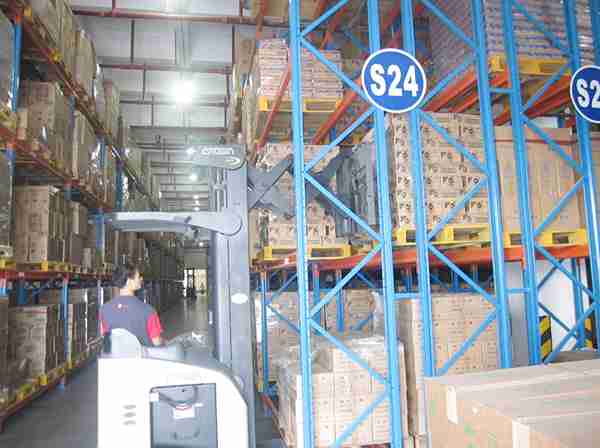
Specialized extended-reach forklifts (12-14 ft aisles)
Reinforced upright frames to handle additional loads
Strategic placement of fast- and slow-moving SKUs
“Double deep configurations can transform a warehouse’s storage capacity without expanding the building footprint,” notes Sarah Williamson, a logistics engineer specializing in high-density storage systems.
2.2 The Space Optimization Advantage
The storage density benefits of double deep racking merit close examination:
Capacity Comparisons:
Stores approximately 1.8 pallets in the space of 1 single deep position
Reduces required aisle space by 30-40%
Increases overall storage capacity by 50-70%
Cost Efficiency:
Lower cost per pallet position over system lifespan
Reduced real estate requirements per stored unit
Better utilization of vertical cube space
2.3 Operational Scenarios Where Double Deep Excels
Double deep racking delivers exceptional results in these applications:
Beverage Distribution:
Anheuser-Busch facilities use double deep for consistent palletized products
Ideal for uniform SKUs with stable demand
Maximizes storage for heavy products
Manufacturing Warehousing:
Automotive parts suppliers benefit from high-density storage
Excellent for slow-moving components
Reduces warehouse footprint requirements
Import/Export Logistics:
Port-adjacent facilities optimize limited space
Handles long-term storage needs efficiently
Accommodates seasonal inventory fluctuations
3. Comparative Analysis: Performance Metrics and Operational Impacts
3.1 Storage Capacity and Space Utilization
A detailed examination of storage metrics reveals critical differences:
| Performance Indicator | Single Deep | Double Deep | Differential |
|---|---|---|---|
| Pallets per 10,000 sq ft | 3,200 | 5,400 | +68% |
| Aisle space allocation | 45% | 32% | -13% |
| Cubic space utilization | 22% | 37% | +15% |
| Forklift productivity | 28 picks/hr | 21 picks/hr | -25% |
3.2 Labor Efficiency and Productivity Considerations
The labor implications of each system significantly impact operational costs:
Single Deep Advantages:
Faster picking cycles (25-30 picks/hour)
Reduced training requirements
Lower error rates in retrieval
Flexible workforce allocation
Double Deep Considerations:
Requires specialized forklift operators
Slightly slower retrieval times
Higher skill requirements pay off in density gains
Excellent for bulk order fulfillment
3.3 Equipment and Infrastructure Requirements
The material handling equipment needs differ substantially:
Forklift Specifications:
Single deep: Standard reach trucks (12-15 ft lifts)
Double deep: Extended-reach trucks (18-22 ft lifts)
Building Considerations:
Floor load capacity requirements
Clear height utilization
Column spacing limitations
Fire protection system adaptations
4. Financial Analysis and ROI Considerations
4.1 Cost Structure Comparison
A detailed breakdown of financial considerations:
Initial Investment:
Single deep: $45-55 per pallet position
Double deep: $50-65 per pallet position
Ongoing Costs:
Equipment maintenance differentials
Labor productivity impacts
Energy consumption variations
Storage density efficiencies
4.2 Calculating Return on Investment
A proven methodology for evaluating the financial impact:
Current State Analysis:
Existing storage costs per pallet
Throughput bottlenecks
Labor inefficiencies
Projected Improvements:
Density gains calculations
Labor savings projections
Opportunity costs of unused space
Implementation Costs:
Racking system investment
Equipment upgrades
Training requirements
Payback Period Analysis:
Typical ROI horizons (18-36 months)
Lifecycle cost comparisons
Scalability considerations
4.3 Real-World Financial Outcomes
Documented results from actual implementations:
Case Study 1:
Consumer goods distributor
Converted 30% of space to double deep
Achieved 22% storage capacity increase
ROI in 22 months
Case Study 2:
Pharmaceutical wholesaler
Implemented hybrid single/double deep system
Reduced picking costs by 18%
Increased storage density by 40%
5. Implementation Strategies and Best Practices
5.1 System Selection Criteria
A structured approach to decision-making:
Inventory Profile Analysis:
SKU velocity distribution
Pallet dimension consistency
Turnover rate patterns
Operational Requirements:
Order fulfillment profiles
Peak season demands
Growth projections
Physical Constraints:
Building dimensions
Floor load capacities
Clear height availability
5.2 Hybrid System Optimization
Innovative approaches combining both systems:
Velocity-Based Slotting:
Fast movers in single deep configurations
Slow movers in double deep positions
Dynamic re-slotting algorithms
Seasonal Adjustments:
Holiday inventory planning
Promotional product positioning
Annual inventory fluctuations
5.3 Technology Integration
Modern enhancements to traditional systems:
Warehouse Management Systems:
Intelligent location assignment
Dynamic pick path optimization
Real-time inventory visibility
Automation Compatibility:
AGV integration considerations
AS/RS interface requirements
Robotics retrieval adaptations
Conclusion: Strategic Implementation for Optimal Results
The double deep racking vs single deep racking decision requires careful analysis of multiple operational and financial factors. Key takeaways from our comprehensive examination include:
Single deep racking remains the gold standard for operations requiring maximum accessibility and flexibility, particularly in e-commerce and retail distribution environments.
Double deep racking offers transformative storage density advantages for operations handling uniform, slower-moving inventory, especially in space-constrained facilities.
Hybrid solutions incorporating both systems frequently deliver superior overall results when properly designed and implemented.
Technology integration continues to evolve both systems’ capabilities, with automation particularly enhancing double deep configurations’ efficiency.
Financial analysis should consider both immediate costs and long-term operational savings, with most quality implementations achieving ROI within 2-3 years.
Ultimately, the optimal solution depends on your specific operational requirements, inventory characteristics, and growth projections. By applying the frameworks and analysis methods presented in this guide, warehouse operators can make informed decisions that balance storage density with operational efficiency.
FAQs: Expert Answers to Common Questions
Q1: How does the choice between double deep racking vs single deep racking impact fire safety systems?
Double deep configurations require particular attention to fire protection design. The increased storage density necessitates:
Higher sprinkler density requirements
Potential need for in-rack sprinkler systems
Modified aisle width calculations for egress
Enhanced smoke detection systems
Q2: What are the maintenance implications when comparing these systems?
Maintenance considerations differ significantly:
Double deep reach trucks require more frequent maintenance
Single deep systems have simpler component replacement
Both systems need regular rack inspections
Load capacity monitoring is critical for double deep
Q3: How do these systems compare in terms of damage rates and product loss?
Industry data shows:
Single deep: 2-3% damage rate (direct access reduces errors)
Double deep: 3-5% damage rate (more complex retrievals)
Proper training can minimize these differences
Damage prevention systems are more critical for double deep
Q4: What technological advancements are changing the double deep vs single deep equation?
Emerging technologies impacting the decision:
Vision-guided forklifts reducing double deep retrieval times
RFID tracking improving deep storage visibility
AI-powered slotting optimization
Automated pallet position verification systems
Q5: How should seasonal operations evaluate these systems?
Seasonal considerations include:
Temporary reconfiguration possibilities
Hybrid approaches for peak seasons
Throughput vs storage emphasis shifts
Labor availability impacts on system choice
This comprehensive guide provides warehouse operators with the detailed information needed to make informed decisions about their storage systems. By carefully considering all operational factors and implementing best practices, businesses can optimize their warehouse operations for both efficiency and cost-effectiveness.
Welcome to contact us, if you need warehouse rack CAD drawings. We can provide you with warehouse rack planning and design for free. Our email address is: jili@geelyracks.com