📐 "First 50 Enterprise Queries Get Custom 3D Warehouse Design" Plan


(H1) Double Deep Racking vs. Shuttle Racking: The Definitive Guide to Long-Term Warehouse Optimization
In the high-stakes world of logistics and supply chain management, the battle for warehouse space is relentless. Two titans have emerged as leading solutions for high-density storage: double deep racking and shuttle racking. This comprehensive analysis delves beyond superficial comparisons to provide warehouse operators, logistics managers, and corporate decision-makers with the critical intelligence needed to make a multi-million dollar decision.
The choice between double deep racking vs shuttle racking is not merely about which system holds more pallets; it’s a strategic calculation of Total Cost of Ownership (TCO), operational resilience, and future-proofing a business against market volatility. This guide dissects every facet of the double deep racking vs shuttle racking debate, providing a granular, data-driven framework to determine which system will deliver superior space utilization and cost efficiency for the next decade.
(H2) The Fundamental Operational Dichotomy: Mechanized vs. Automated Logic
The core of the double deep racking vs shuttle racking comparison lies in their fundamentally different operational philosophies. One is a mechanized enhancement of a familiar system, while the other is a leap into semi-automated, robotic logistics.

(H3) Double Deep Racking: The High-Density Workhorse
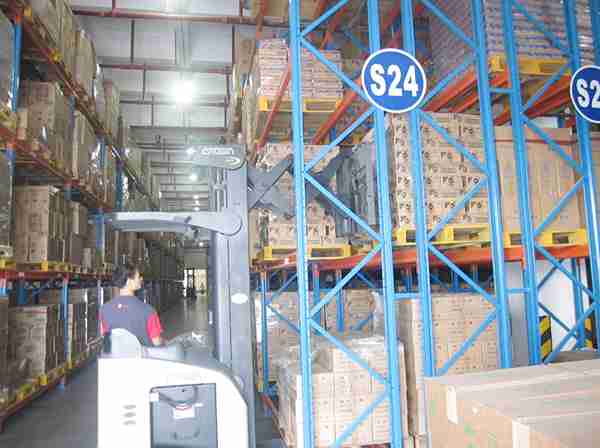
Double deep racking is an elegant evolution of selective pallet racking. By placing two rows of racking back-to-back, it effectively doubles storage depth within a single aisle. The operational logic of double deep racking relies on specialized, very narrow aisle (VNA) forklifts, known as double deep reach trucks.
These trucks feature a telescoping mechanism that allows the forks to extend into the second storage position. The operational paradigm for double deep racking is strictly LIFO (Last-In, First-Out) for each two-pallet lane. To access the rear pallet in a double deep racking system, the front pallet must be retrieved first. This makes double deep racking a system predicated on disciplined load management and predictable SKU velocity.
(H3) Shuttle Racking: The Robotic Storage Matrix
In the double deep racking vs shuttle racking debate, shuttle racking represents a paradigm shift towards automation. A shuttle racking system replaces the traditional forklift-in-aisle model with a battery-powered, remote-controlled shuttle car that operates on rails within the racking structure itself. The operational flow of a shuttle racking system is fundamentally different. A standard forklift or conveyor simply presents a pallet at the end of a lane.
The shuttle racking vehicle then takes over, autonomously transporting the pallet to its designated location deep within the storage lane. This core difference—a machine moving within the racking versus a machine serving the racking from an aisle—is the central point of divergence in any double deep racking vs shuttle racking analysis. Furthermore, shuttle racking can be configured for both FIFO (First-In, First-Out) and LIFO, providing superior inventory rotation flexibility compared to double deep racking.
(H2) A Granular Deep Dive into Storage Density and Space Economics
When evaluating double deep racking vs shuttle racking, the most immediate and quantifiable metric is storage density. The battle between double deep racking vs shuttle racking is won or lost in the inches of aisle width.
(H3) The Aisle Width Factor: A Battle of Inches
Double Deep Racking Aisle Requirements: The double deep racking system necessitates an aisle wide enough to maneuver the double deep reach truck. These aisles typically range from 2,700mm to 3,200mm (approximately 9 to 10.5 feet). This is a significant improvement over the 3,500mm+ required for selective racking, but it is not the final frontier in space compression.
Shuttle Racking Aisle Requirements: The shuttle racking system requires an aisle width that is, in essence, a function of pallet size. With no forklift needing to turn or maneuver inside, the aisle in a shuttle racking setup needs to be only 100-150mm wider than the pallet itself, often resulting in aisles of 1,400mm to 1,600mm (approximately 4.5 to 5.2 feet). This dramatic reduction is the single most powerful argument for shuttle racking in the double deep racking vs shuttle racking density debate.
(H3) Calculating Real-World Cube Utilization
A theoretical comparison of double deep racking vs shuttle racking is insufficient. Consider a warehouse footprint of 60 meters by 40 meters (2,400 sqm) with a clear stacking height of 12 meters.
A standard selective pallet racking system might achieve a capacity of 6,000 pallet positions.
A double deep racking system, by reducing aisle count, could increase this capacity to approximately 10,200 pallet positions—a 70% density gain.
A shuttle racking system, leveraging its ultra-narrow aisles, could push this capacity to over 12,500 pallet positions—more than double the selective system and a 22% improvement over the double deep racking layout.
This clear density advantage for shuttle racking in the double deep racking vs shuttle racking comparison must be weighed against other factors. However, for operations where real estate cost is exorbitant or the building footprint is physically constrained, the density offered by shuttle racking can be the deciding factor.
(H2) The Total Cost of Ownership (TCO): A 10-Year Financial Forecast
The purchase price is a mere down payment. The true cost of any storage system is revealed over its entire operational lifespan. The financial analysis of double deep racking vs shuttle racking is a tale of CAPEX versus OPEX.
(H3) Capital Expenditure (CAPEX): The Initial Outlay
Double Deep Racking CAPEX: The investment for a double deep racking system is more transparent. It comprises the cost of the racking structure (which is more substantial than selective racking to handle the double-deep loads) and the fleet of double deep reach trucks. These trucks are a known quantity in the market, but their specialized nature commands a premium over standard reach trucks.
Shuttle Racking CAPEX: The initial investment for a shuttle racking system is almost invariably higher. This is not just a racking purchase; it is an integrated technology solution. The cost includes the reinforced racking with integrated rails, multiple shuttle cars (to service different levels and avoid bottlenecks), a lift system for vertical transfer, and the essential Warehouse Control System (WCS) software. When analyzing double deep racking vs shuttle racking on pure CAPEX, double deep racking holds a distinct advantage.
(H3) Operational Expenditure (OPEX): The Long-Term Financial Engine
This is where the double deep racking vs shuttle racking debate becomes complex and highly specific to the operation.
Labor Cost Dynamics: The double deep racking system requires a skilled VNA forklift operator for each active aisle. Productivity is tied to the operator’s skill and endurance. In contrast, a shuttle racking system decouples labor from the storage/retrieval process. One operator can manage multiple shuttle operations concurrently from a single point. The forklift’s role is simplified to presenting and removing pallets at the end of the aisle. In a multi-shift, high-labor-cost environment, the shuttle racking system can generate staggering annual savings, rapidly amortizing its higher CAPEX.
Energy and Maintenance Regimes: The double deep reach trucks used in double deep racking are large, powerful electric vehicles that consume significant energy for lifting, traveling, and the reach mechanism. Maintenance follows a standard industrial vehicle schedule. The shuttle cars in a shuttle racking system are smaller, lighter, and optimized for horizontal movement, leading to lower energy consumption per pallet transaction.
However, the maintenance of a shuttle racking system is more specialized. A breakdown of a single shuttle car can block an entire lane, creating a critical single point of failure. A robust maintenance contract and potentially spare shuttles are a necessary OPEX consideration for shuttle racking that does not apply to the same degree in a double deep racking system.
Product Damage and Hidden Costs: Product damage is a direct hit to the bottom line. The double deep racking system, reliant on human operators carefully maneuvering in tight spaces, carries an inherent risk of impacting uprights or adjacent pallets. The shuttle racking system virtually eliminates this type of damage. The robotic shuttle places and retrieves pallets with millimeter precision. This reduction in damage claims and inventory write-offs is a significant, though often overlooked, financial benefit in the shuttle racking column when conducting a double deep racking vs shuttle racking TCO analysis.
(H2) Throughput, Accessibility, and System Intelligence
The speed of inventory movement is the pulse of a modern distribution center. The performance characteristics of double deep racking vs shuttle racking differ markedly.
(H3) Peak Throughput Capabilities
Double Deep Racking Throughput: The throughput of a double deep racking system is linear and directly proportional to the number of double deep reach trucks and operators. Each transaction requires the full cycle time of the truck. While efficient, it lacks the ability for parallel processing within a single aisle.
Shuttle Racking Throughput: The shuttle racking system excels at parallel processing. With multiple shuttles operating across different levels and lanes, and a lift system working independently, the system can handle a flood of orders simultaneously. For operations with extreme peak-time demands, such as e-commerce fulfillment, the throughput potential of a well-configured shuttle racking system can far surpass that of a double deep racking system.
(H3) Inventory Management and Stock Rotation
This is a critical differentiator in the double deep racking vs shuttle racking evaluation. The LIFO nature of double deep racking makes it a poor fit for goods with strict expiration dates, like food and pharmaceuticals, unless complex and time-consuming pallet shuffling is implemented. The shuttle racking system, with its ability to be configured for true FIFO operation, is inherently suited for such applications. The choice between double deep racking vs shuttle racking can be decided solely on this inventory characteristic.
(H2) Scalability, Flexibility, and Future-Proofing
A storage system is a long-term asset. Its ability to adapt to business growth and change is paramount.
The Scalability of Double Deep Racking: The double deep racking system is highly modular and scalable. Adding more bays or entire new aisles is a straightforward process of installing more standard racking and potentially acquiring another reach truck. The system can easily accommodate changes in SKU dimensions and profile.
The Scalability of Shuttle Racking: Expanding a shuttle racking system is a more engineered process. Adding new lanes requires purchasing additional shuttle cars and ensuring they are integrated into the existing WCS. The system is less flexible to significant changes in pallet size or weight, as this may require physical modifications to the shuttles and rails. When future business agility is a top priority, the flexibility of double deep racking often holds an advantage over the more rigid, albeit highly efficient, shuttle racking system.
(H2) The Critical Role of Software and Integration
In a modern warehouse, the physical hardware is only as good as the software that controls it. This is a stark point of contrast in the double deep racking vs shuttle racking discussion. A double deep racking system relies on the warehouse’s WMS and the operator’s skill. A shuttle racking system is dependent on its proprietary Warehouse Control System (WCS).
This WCS is the brain of the operation, optimizing shuttle movements, managing battery levels, and providing real-time inventory location data. The seamless integration of this WCS with the host WMS (e.g., SAP, Oracle) is a non-negotiable for success with shuttle racking and represents an implementation complexity that does not exist with double deep racking.
(H2) The Verdict: A Strategic Decision Matrix for Double Deep Racking vs Shuttle Racking
The final decision in the double deep racking vs shuttle racking deliberation is not a matter of which is universally better, but which is optimally suited for a specific operational profile.
(H3) Choose Double Deep Racking If Your Operation Aligns With These Criteria:
High SKU Pallet Count: You have a high number of pallets per SKU (4+), making LIFO management practical.
CAPEX Sensitivity: You have a firm budget and require a significant density boost without the premium price tag of automation.
Operational Simplicity: You value ease of maintenance, widespread technician availability, and operational familiarity.
Future Flexibility: Your business anticipates changes in SKU profile or requires a system that can be easily expanded or reconfigured.
Moderate Throughput: Your peak throughput demands can be met with a scalable fleet of double deep reach trucks.
In this scenario, double deep racking provides the most sensible and financially prudent long-term value.
(H3) Choose Shuttle Racking If Your Operation Demands These Capabilities:
Maximum Density is Non-Negotiable: Your facility footprint is fixed and expensive, and you must maximize every cubic meter of space.
FIFO is Mandatory: You handle time-sensitive goods requiring strict stock rotation.
High-Throughput and Multi-Shift Operation: You operate 24/7 or multiple shifts where the labor savings from automation will provide a rapid and substantial ROI.
Zero-Tolerance for Damage: Product integrity is paramount, and the reduction of human-handling damage is a key performance indicator.
Stable SKU Profile: Your pallet dimensions and weights are standardized and not subject to frequent change.
In this context, the higher initial investment in shuttle racking is justified by its superior operational savings, density, and performance.
(H2) Beyond the Binary: The Power of Hybrid Warehouse Design
Sophisticated warehouse design often moves beyond a pure double deep racking vs shuttle racking choice. A hybrid approach can harness the strengths of both. A common configuration uses shuttle racking for the dense, high-bay reserve storage of slow and medium-moving SKUs, while employing double deep racking in a lower-level picking module or for fast-moving goods. This strategy optimizes both the cube and the throughput, demonstrating that the ultimate solution in the double deep racking vs shuttle racking conversation might be a strategic combination of both.
(H2) Conclusion: An Investment in Operational Philosophy
The double deep racking vs shuttle racking analysis is a microcosm of a larger strategic choice: to enhance existing mechanized processes or to embrace a automated future. Double deep racking is the pinnacle of refined, high-density mechanized storage—a powerful, reliable, and adaptable workhorse. Shuttle racking is the gateway to the smart warehouse—a high-performance, data-driven system that prioritizes peak efficiency and labor optimization.
The path to the right decision in the double deep racking vs shuttle racking debate is through meticulous, data-driven modeling. By simulating your specific inventory, throughput, and growth projections against the TCO of both systems, the optimal path forward becomes clear. This strategic investment will define your warehouse’s efficiency, scalability, and profitability for the next decade, making the thorough examination of double deep racking vs shuttle racking one of the most valuable exercises a logistics leader can undertake.
(H2) Frequently Asked Questions (FAQs)
1. What is the typical lifespan of a double deep racking system versus a shuttle racking system?
The structural racking in both double deep racking and shuttle racking systems can last 20-30 years with proper maintenance. The critical difference lies in the equipment. The double deep reach trucks in a double deep racking system have a typical lifespan of 7-10 years before major refurbishment or replacement is needed. The shuttle cars in a shuttle racking system, being robotic devices, may have a shorter technology lifecycle (5-7 years) before they risk becoming obsolete or require significant software/hardware upgrades.
2. How do both systems perform in cold storage environments, which are notoriously hard on equipment?
Both double deep racking and shuttle racking are used in cold storage, but with specific challenges. The double deep reach trucks require special cold-store specifications for hydraulics, seals, and batteries, and operator comfort is a significant issue. For shuttle racking, the environmental challenge is transferred to the shuttle cars. They must be engineered for reliable operation at sub-zero temperatures. The reduced labor time inside the freezer offered by shuttle racking is a massive advantage, often making it the preferred choice despite the higher initial cost in these demanding environments.
3. Can a shuttle racking system be retrofitted into an existing warehouse with a different racking system?
While it is technically possible, it is often not economically viable. A shuttle racking system requires a perfectly leveled floor and a racking structure designed to handle the dynamic loads and precise alignment of the rails. Retrofitting an existing selective or double deep racking structure to become a shuttle racking system is usually more expensive and less effective than installing a new, purpose-built shuttle racking system from the ground up.
4. What are the insurance and liability implications for each system?
A double deep racking system carries standard liabilities associated with industrial forklift operations, including worker safety and potential damage to the racking. Insurance premiums are relatively predictable. A shuttle racking system, as a automated system, may have different policy requirements. The high value of the shuttle fleet and the critical dependency on the WCS software might necessitate specialized insurance coverage for business interruption due to system failure or cyber-related issues affecting the control software.
5. How does the performance of each system degrade during a power outage?
A double deep racking system has a distinct advantage during a power failure. The double deep reach trucks have backup batteries that can allow for limited operation to move critical loads or secure the area. In a shuttle racking system, a total power outage will immediately halt all shuttle movements. If a shuttle car is stuck in the middle of a lane without power, it can completely block access to that lane until power is restored, presenting a more severe operational risk.
Welcome to contact us, if you need warehouse rack CAD drawings. We can provide you with warehouse rack planning and design for free. Our email address is: jili@geelyracks.com