📐 "De første 50 virksomhedsforespørgsler får tilpasset 3D-lager-design" Planlæg


Introduction: Why Racking Aisle Width Requirements Matter
In warehouse design, racking aisle width requirements are among the most critical factors influencing storage density, operational efficiency, and workplace safety. Choosing the wrong aisle width can lead to bottlenecks, increased product damage, higher labor costs, and even OSHA violations.
This guide dives deep into racking aisle width requirements, covering:
- OSHA & ANSI compliance standards for safe warehouse operations
- Hvordannarrow aisle (NA), very narrow aisle (VNA), and wide aisle racking systems impact workflow
- The best forklift types for different racking aisle width requirements
- Optimizing warehouse layouts for maximum storage without sacrificing accessibility
- Future-proofing warehouse designs for automation and scalability
By the end, warehouse managers, logistics planners, and operations teams will have a data-driven approach to selecting the best racking aisle width requirements for their specific needs.

1. The Science Behind Racking Aisle Width Requirements
1.1 How Aisle Width Affects Warehouse Performance
Every warehouse must balance storage capacityogoperational speed. The reoler aisle width requirements directly influence:
- Storage density – Narrower aisles allow for more pallet positions per square foot
- Forklift maneuverability – Wider aisles enable faster material handling
- Safety compliance – OSHA mandates minimum clearances to prevent accidents
1.2 The Cost of Ignoring Racking Aisle Width Requirements
Companies that overlook racking aisle width requirements often face:
- Reduced productivity due to forklift congestion
- Higher equipment wear and tear from tight turns
- Increased risk of OSHA fines for non-compliant layouts
Key Insight: The right racking aisle width requirements can increase storage capacity by 30-50% while maintaining fast, safe operations.
2. OSHA & ANSI Standards for Racking Aisle Width Requirements
2.1 OSHA Regulations: What Warehouse Managers Must Know
While OSHA does not specify exact racking aisle width requirements, it enforces:
- 1910.176(a): Aisles must be ”wide enough for safe equipment operation”
- 1910.178(n): Forklifts must have adequate clearance when turning
- Emergency exit accessibility: Aisles must not block fire exits
2.2 ANSI MH16.1-2012: The Gold Standard for Racking Aisle Width Requirements
The American National Standards Institute (ANSI) provides precise racking aisle width requirements:
- Minimum aisle width = forklift width + 12 inches (30 cm) per side
- Pedestrian walkways must be at least 36 inches (91 cm) wide
- High-traffic aisles should be 48 inches (122 cm) or wider
Best Practice: Always consult local fire marshals to ensure compliance with regional racking aisle width requirements.
3. Types of Racking Aisle Width Requirements & Their Applications
3.1 Wide Aisle Racking (8-12 ft / 2.4-3.6 m)
- Best for: Traditional counterbalance forklifts
- Typical use: General warehousing, low-to-medium density storage
- Advantages:
- Lower equipment costs (standard forklifts work)
- Easier operator training
- Disadvantages:
- Lower storage density compared to narrow aisles
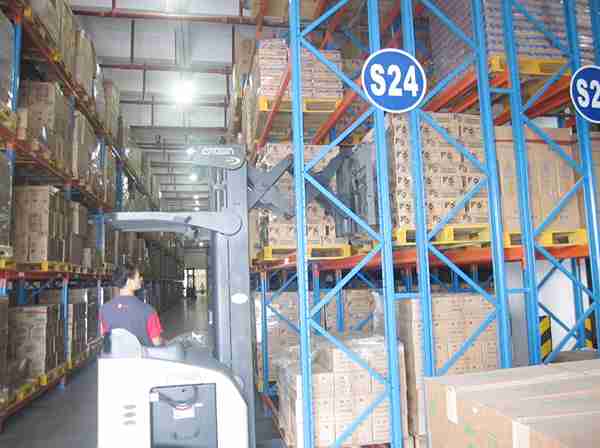
3.2 Narrow Aisle Racking (6-8 ft / 1.8-2.4 m)
- Best for: Articulated forklifts or reach trucks
- Typical use: High-density storage with moderate accessibility
- Advantages:
- 20-30% more pallet positions than wide aisles
- Faster order picking with specialized equipment
- Disadvantages:
- Higher forklift costs
3.3 Very Narrow Aisle (VNA) Racking (5-6 ft / 1.5-1.8 m)
- Best for: Turret trucks or guided VNA forklifts
- Typical use: High-density warehouses with automated storage systems
- Advantages:
- Up to 50% more storage than wide aisles
- Compatible with AS/RS (Automated Storage & Retrieval Systems)
- Disadvantages:
- Requires wire or rail guidance
- Higher initial investment
3.4 Ultra-Narrow Aisle (UNA) Racking (<5 ft / <1.5 m)
- Best for: Fully automated warehouses with robotic shuttles
- Typical use: E-commerce fulfillment centers, cold storage
- Advantages:
- Maximum storage density
- No human operators needed
- Disadvantages:
- Highest capital costs
4. Calculating the Perfect Racking Aisle Width Requirements
4.1 Step 1: Measure Forklift Dimensions
- Forklift width (including load)
- Turning radius (critical for racking aisle width requirements)
- Mast height (impacts stability in narrow aisles)
4.2 Step 2: Add Safety Clearance
- Standard operations: 6 inches (15 cm) per side
- High-speed operations: 12 inches (30 cm) per side
4.3 Step 3: Simulate Before Finalizing
- Use 3D warehouse design software (e.g., AutoCAD, SketchUp)
- Conduct test runs with actual forklifts
Pro Tip: Always future-proof your racking aisle width requirements by planning for potential automation upgrades.
5. Forklift Compatibility with Racking Aisle Width Requirements
| Aisle Type | Recommended Forklift | Minimum Aisle Width |
|---|---|---|
| Wide Aisle | Counterbalance Forklift | 8-12 ft (2.4-3.6 m) |
| Narrow Aisle | Reach Truck | 6-8 ft (1.8-2.4 m) |
| Very Narrow Aisle (VNA) | Turret Truck | 5-6 ft (1.5-1.8 m) |
| Ultra-Narrow Aisle (UNA) | Robotic Shuttle | <5 ft (<1.5 m) |
6. Safety Best Practices for Narrow Aisle Warehousing
- Install protective column guards to prevent rack damage
- Use high-visibility floor tape for pedestrian zones
- Train operators on narrow aisle best practices
- Conduct regular aisle inspections
7. Optimizing Warehouse Layouts Based on Racking Aisle Width Requirements
- Fishbone layout – Maximizes storage in narrow aisles
- Cross-aisle placement – Reduces forklift travel time
- Vertical storage solutions – High-bay racking for tall warehouses
8. Common Mistakes in Racking Aisle Width Requirements Planning
- Underestimating forklift turning radius
- Ignoring pedestrian safety zones
- Choosing aisles too narrow for future expansion
9. The Future of Racking Aisle Width Requirements
- AI-driven warehouse optimization
- Modular racking for flexible aisle adjustments
- Autonomous forklifts for ultra-narrow aisles
10. Conclusion: Mastering Racking Aisle Width Requirements for Peak Efficiency
Selecting the right racking aisle width requirements is a strategic decision that impacts storage capacity, operational speed, and workplace safety. By following OSHA and ANSI guidelines, choosing the right forklift typeogfuture-proofing warehouse layouts, businesses can maximize efficiency while minimizing risks.
For high-density storage,narrow and very narrow aisle (VNA) racking is ideal, while wide aisles offer greater accessibility. Companies should consult warehouse design experts to ensure compliance and efficiency.
FAQs on Racking Aisle Width Requirements
1. What is the minimum aisle width for a reach truck?
De flestereach trucks require racking aisle width requirements of 6-8 feet (1.8-2.4 m).
2. Can I retrofit an existing warehouse for narrow aisles?
Yes, but racking modifications may be needed. Consult a warehouse racking specialist for an assessment.
3. How do I know if my aisles are too narrow?
Signs include frequent forklift collisions, slow operations, and damaged racking.
4. What’s the difference between VNA and NA racking?
- NA (Narrow Aisle) racking uses reach trucks (6-8 ft aisles).
- VNA (Very Narrow Aisle) racking requires turret trucks (5-6 ft aisles).
5. How does aisle width affect fire safety?
Aisles must allow unobstructed emergency exits per local fire codes.