📐 "First 50 Enterprise Queries Get Custom 3D Warehouse Design" Plan


Beyond Security: Leveraging Blockchain in Warehousing to Build Unbeatable Efficiency & Trust
In the dynamic landscape of global logistics, the paradigm of Blockchain in Warehousing is rapidly evolving from a speculative concept into an operational imperative. For forward-thinking businesses across emerging markets in Southeast Asia, the Middle East, Africa, and Latin America, the initial investment in automation—deploying AGVs, automated shelving, and sophisticated sortation systems—was the first leap forward. However, these advanced physical systems often generate isolated data streams, creating a new set of challenges centered on data integrity, transactional transparency, and systemic interoperability.
This is where the strategic implementation of Blockchain in Warehousing transitions from a competitive advantage to a foundational necessity. It is not merely an added layer of security; it is the core technology that orchestrates a new paradigm for intelligent warehouse management. By seamlessly integrating blockchain protocols directly into the physical infrastructure—from the highest levels of an Automated Storage and Retrieval System (AS/RS) to the intricate navigation patterns of a fleet of unmanned forklifts—this approach enables a degree of traceability, operational efficiency, and verifiable trust that remains unattainable through traditional or siloed automated systems.
This powerful synergy fosters the creation of a resilient, self-auditing warehouse ecosystem that proactively minimizes disputes, maximizes the return on automation assets, and builds unshakeable confidence with every stakeholder in the supply chain. The future of logistics is verifiable, and it is being built on the robust foundation of Blockchain in Warehousing.
The Invisible Backbone: Deconstructing the Role of Blockchain in Warehousing
A common misconception among warehouse operators is to view blockchain technology solely through the lens of cryptocurrency, a digital ledger for financial transactions that seems distant from the physical realities of moving pallets and cartons. This perspective fundamentally underestimates its transformative potential for physical logistics. A more accurate analogy is to envision a modern automated warehouse as a highly tuned organism: the AGVs and conveyor systems are the muscles and limbs, the Warehouse Management System (WMS) acts as the brain, and the constant flow of data between them constitutes the nervous system. Without a synchronized and infallible nervous system, the entire organism moves with inefficiency and is prone to errors.
Traditional data management systems in logistics are notoriously vulnerable to what can be termed “nerve” damage—data silos, latency, human input error, and even intentional manipulation. The application of Blockchain in Warehousing introduces an immutable, distributed ledger that functions as a perfected central and peripheral nervous system combined. It records every single operational event—from the receipt of a single carton to the maintenance cycle of an unmanned forklift—as a cryptographically verified, timestamped, and permanently unchangeable “block” of data.
The Elimination of Data Silos: In a typical multi-vendor automation environment, an AS/RS from one manufacturer and a fleet of AGVs from another might operate on proprietary, non-communicative protocols. The strategic use of Blockchain in Warehousing creates a universal, neutral language—a single, shared source of truth that all systems can write to and read from, ensuring perfect synchronization and data consistency across the entire operation.
Proactive and Fact-Based Dispute Resolution: Consider a scenario where a client claims a high-value product arrived damaged. Instead of initiating a days-long, costly investigation that involves cross-referencing WMS logs, scouring hours of CCTV footage, and reconciling maintenance reports, the warehouse manager can instantly pull a complete, immutable history from the blockchain.
The record would show precisely which location in the automated pallet racking stored the item, which specific unmanned forklift performed the retrieval, and which chute in the automated sorting system handled it last. This capability, powered by Blockchain in Warehousing, transforms potentially acrimonious disputes into straightforward, fact-based conversations, preserving business relationships and saving significant resources.
The Tangible Cost of Untrustworthy Data in Logistics
Operating without the verifiable truth provided by Blockchain in Warehousing incurs significant, often hidden, costs that directly impact the bottom line. These include inventory shrinkage from unverifiable causes, financial chargebacks from clients over disputed shipments, and thousands of labor hours wasted manually reconciling conflicting data from disparate software platforms.
For businesses in high-growth markets, where establishing international credibility is paramount for attracting global partners, these operational inefficiencies can actively stifle expansion and limit access to premium supply chains. Therefore, integrating Blockchain in Warehousing should not be viewed as a mere IT expense; it is a strategic investment in operational credibility and long-term financial resilience.
Synergy in Action: How Blockchain in Warehousing Supercharges AGV and Automated Shelving Fleets
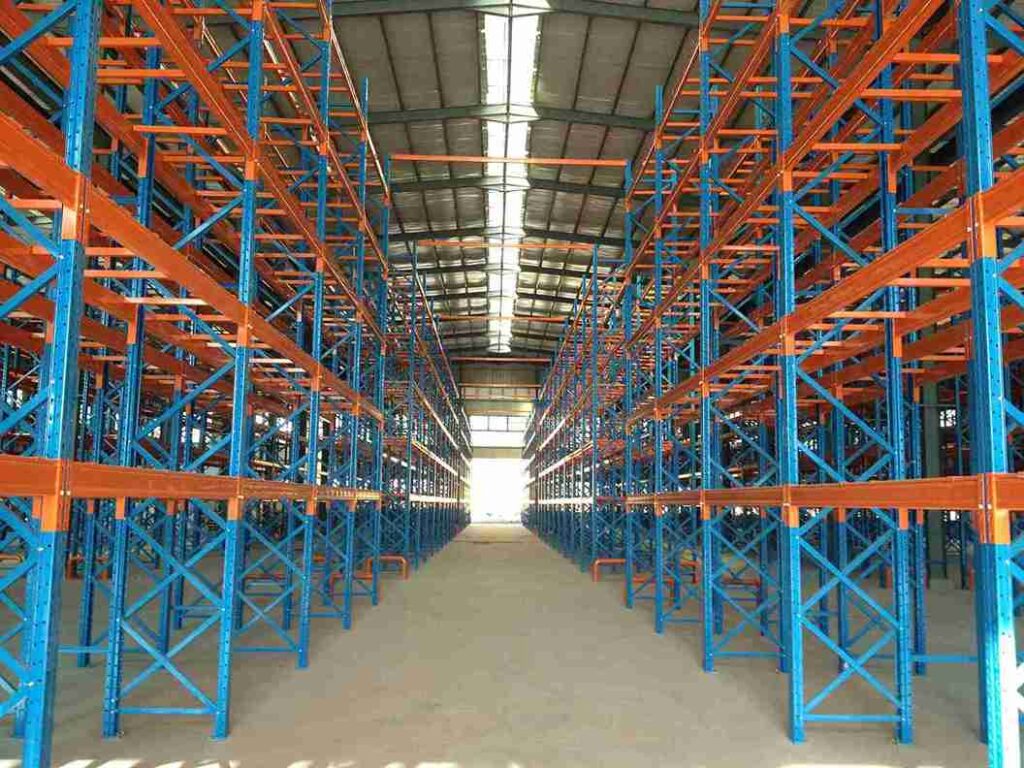
The profound power of Blockchain in Warehousing becomes fully apparent when it is intricately woven into the fabric of a facility’s physical automation systems. The following sections dissect how this technology fundamentally transforms core components of modern smart warehouse solutions, creating a cohesive and intelligent operational unit.
Creating an Immutable History for Every Pallet, Carton, and Item
In a warehouse powered by Blockchain in Warehousing, every unit that enters the facility—from a full pallet to a single e-commerce item—is assigned a dynamic digital twin on the blockchain. This digital identity is far more sophisticated than a simple barcode or RFID tag; it is a rich, historical ledger of the item’s entire journey through the supply chain. As the item moves, every single interaction is autonomously logged onto the chain:
Receiving & Induction: Upon arrival, the item is scanned, and its condition, quantity, and arrival timestamp are permanently recorded as the first block in its chain.
Put-away & Storage: The AS/RS or an unmanned forklift confirms the precise storage location within the high-density racking system, logging this action. The integration of Blockchain in Warehousing here ensures the physical location is perfectly mirrored in the digital realm.
Picking & Retrieval: An AGV or automated retrieval system is dispatched, and its successful retrieval of the specific item is recorded, creating an unforgeable link between the task order and its physical execution.
Sortation & Dispatch: The automated sorting system scans the item and directs it to the appropriate outbound lane, with this final internal handoff adding another immutable link to the chain before shipment.
This granular, item-level traceability, a hallmark of advanced Blockchain in Warehousing, is nothing short of a revolution for industries dealing with high-value goods, pharmaceuticals, perishable items, or products with strict regulatory requirements—all common challenges in the diverse and rapidly evolving markets of Southeast Asia, the Middle East, Africa, and Latin America.
Optimizing AGV Swarm Intelligence with a Decentralized Ledger
A fleet of AGVs operates on principles of swarm intelligence. Traditional management systems control them from a central server, which can become a bottleneck and a single point of failure. With a blockchain-backed system, a core component of modern Blockchain in Warehousing strategies, AGVs can communicate and transact with each other in a secure, peer-to-peer, and autonomous manner.
Decentralized and Efficient Task Allocation: When an AGV completes a task, it can broadcast its “available” status directly to the peer-to-peer network. The first AGV to cryptographically confirm availability can claim the next task in the queue, with the entire transaction—from offer to acceptance—being recorded on the blockchain. This decentralized approach reduces communication latency with a central server, minimizes idle time, and significantly improves the overall throughput of the fleet.
Predictive Maintenance with an Unforgeable Record: The performance metrics of every AGV—including battery charge cycles, motor load statistics, and even minor collision near-misses—are continuously logged on the blockchain. This creates a comprehensive and tamper-proof maintenance history. This application of Blockchain in Warehousing enables support teams to move from reactive to truly predictive maintenance, scheduling service for components before they fail, thereby maximizing uptime and protecting the investment in automation within a 24/7 operational environment.
Transforming Automated Shelving into an Active, Participatory System
Within a framework defined by Blockchain in Warehousing, your automated pallet racking and AS/RS are elevated from being passive storage structures to becoming active, intelligent participants in the inventory management process.
Dynamic Slotting and Instantaneous Verification: The system can be programmed to automatically verify that a pallet placed in a specific location by an unmanned forklift matches the digital assignment in the WMS. Any discrepancy, such as a mis-scan or a placement error, triggers an immediate, automated alert. This proactive error-prevention, facilitated by Blockchain in Warehousing, stops put-away mistakes at the source, preventing the hours of frustrating and costly search time that typically occur later during picking cycles.
Structural Integrity and Safety Compliance Monitoring: For critical infrastructure like mezzanine floors and heavy-duty racking systems, data from IoT sensors monitoring load weight, structural stress, and even seismic activity can be recorded on the blockchain. This provides an auditable, unchangeable trail of compliance with safety standards and operational limits, which is invaluable for risk management, insurance assessments, and regulatory audits, further solidifying the role of Blockchain in Warehousing in comprehensive facility management.
Forging Trust and Unlocking New Business Models in Emerging Markets
For businesses in Southeast Asia, Africa, and Latin America that are aggressively integrating into sophisticated global supply chains, demonstrable trust is the most valuable and sought-after currency. The implementation of Blockchain in Warehousing provides the technological bedrock upon which this trust is built, opening doors to new financial and commercial opportunities.
Transparent and Efficient Supply Chain Finance
A critical hurdle for many exporters and small-to-medium enterprises in growth markets is accessing affordable working capital. Financial institutions are often hesitant to provide loans using warehouse inventory as collateral due to the pervasive risks of fraud, misrepresentation, or double-financing. A warehouse secured and managed through Blockchain in Warehousing fundamentally alters this risk calculus.
A bank or financier can be granted permissioned, view-only access to observe the real-time, immutable status of the inventory serving as collateral. Seeing that goods are securely stored in a verified location within the blockchain-secured facility and have a clear, auditable chain of custody drastically reduces the perceived risk for the lender. This strategic use of Blockchain in Warehousing unlocks previously inaccessible capital, empowering businesses to scale their operations and fulfill larger orders.
Case in Point: The Agricultural Exporter’s Advantage
Consider a premium coffee exporter in Vietnam or a specialty fruit producer in Kenya. By storing their goods in an automated facility that leverages Blockchain in Warehousing, they can provide international buyers with irrefutable, cryptographically verified proof of harvest date, consistent storage conditions (via IoT sensor data logged directly on the chain), and a complete processing history. This transparent provenance not only justifies and secures a premium price in the market but also dramatically streamlines the customs clearance process, as all necessary regulatory and phytosanitary data is pre-verified and readily accessible to authorities. This is a direct commercial benefit derived from Blockchain in Warehousing.
Building a Consortium for Unbreakable End-to-End Supply Chains
The most powerful expression of Blockchain in Warehousing is its ability to facilitate the creation of a supply chain consortium. Leading providers can assist their clients in establishing a private, permissioned blockchain network that includes all key partners: manufacturers, raw material suppliers, logistics providers, the warehouse itself, and final retailers.
On this network, every critical transfer of custody—from the factory gate, to the automated distribution center, to the final delivery truck—is recorded not in separate systems, but as a single, shared, and immutable version of the truth. This ecosystem-wide application of Blockchain in Warehousing effectively eliminates bill-of-lading disputes, drastically reduces opportunities for cargo theft and fraud, and creates a supply chain that is not only hyper-efficient but also inherently and demonstrably trustworthy.
A Phased Implementation Framework for Blockchain in Warehousing
Understanding that the adoption of such a transformative technology requires a meticulous and strategic approach, a professional implementation of Blockchain in Warehousing is always conducted through a phased methodology. This framework is designed to deliver measurable value at every step, effectively minimizing risk while maximizing the return on investment.
Phase 1: Comprehensive Audit and Strategic Blueprinting
The journey begins with a deep-dive operational audit conducted by experts in both physical logistics and digital systems. This analysis scrutinizes the current warehouse layout, the configuration of storage racking systems, the capabilities of all automation assets (AGVs, AS/RS), and the existing software ecosystem. The goal is to identify the most critical pain points—whether in the receiving process, inventory accuracy, or shipment verification—and to design a tailored Blockchain in Warehousing integration blueprint that precisely targets the highest-value opportunities for improvement and ROI.
Phase 2: Controlled Pilot Integration and MVP Development
The philosophy is to demonstrate tangible value quickly and concretely. A controlled area of the operation, such as a designated zone for high-value goods within the selective pallet racking, is selected for a pilot project. This zone is integrated with a lightweight blockchain module, connecting it to the relevant automated handling equipment. Within a matter of weeks, the client has a functioning Minimum Viable Product (MVP) that provides a live demonstration of the benefits in traceability, error reduction, and operational clarity, all made possible by the initial application of Blockchain in Warehousing.
Phase 3: Full-Scale Deployment and Systemic Scaling
Following the validation and success of the pilot, the solution is systematically scaled across the entire facility. This phase involves deep, enterprise-level integration with the core WMS and ERP systems, and the full deployment of blockchain protocols across the entire AGV fleet, the automated sorting system, and all unmanned forklifts. A professional project management team oversees the entire rollout, ensuring a seamless transition with minimal disruption and providing comprehensive training for operational staff to manage the new, enhanced system.
Phase 4: Continuous Optimization and Ecosystem Expansion
The partnership does not conclude at the go-live stage. A continuous monitoring and optimization service is provided to ensure the system is performing at its peak. Furthermore, dedicated support is offered to assist the client in onboarding their key supply chain partners onto the platform. This gradual expansion of the trusted network amplifies the benefits for all participants, strategically positioning the warehouse that pioneered Blockchain in Warehousing as the most reliable and advanced link in the entire regional supply chain.
The Definitive Competitive Edge: The Integrated Solution Advantage
While many providers can sell standalone warehouse racks or a fleet of AGVs, the true value is delivered by a cohesive, intelligent system where the whole is vastly greater than the sum of its parts. The deep, dual expertise in both physical warehouse infrastructure—ranging from specialized cantilever racks for long goods to high-bay modular shelving for small parts—and cutting-edge digital platforms like blockchain is what sets a true industry leader apart. This is not about simply installing equipment; it is about engineering resilience, transparency, and intelligence into the very DNA of a client’s logistics operations.
For a massive distribution center in the UAE, a temperature-controlled cold storage facility in Thailand, or an e-commerce fulfillment hub in Brazil, this deeply integrated approach to Blockchain in Warehousing is the definitive key to achieving not just local dominance, but sustained global competitiveness.
Conclusion: The Verifiable and Connected Future is Now
The strategic journey toward full warehouse automation has always been about more than just replacing manual labor with machines. It is about architecting a connected, intelligent, and truly trustworthy ecosystem where data and physical movement are in perfect, verifiable harmony. The technology of Blockchain in Warehousing is the critical enabler that ensures the data governing complex physical operations is as reliable and robust as the heavy-duty steel racks supporting the inventory.
It systematically transforms a warehouse from a cost center into a powerful strategic asset—an asset that generates continuous value through unparalleled operational efficiency, irrefutable integrity, and access to new financial instruments and business models. For forward-thinking businesses operating in the world’s most dynamic growth markets, the critical question is no longer if they should adopt this integrated approach to Blockchain in Warehousing, but how swiftly they can begin the journey to build the future of logistics, one verified block at a time.
Frequently Asked Questions (FAQs)
1. How does blockchain integration impact the real-time performance of our automated equipment like AGVs and AS/RS?
This is a critical technical question that addresses a common concern. In a well-architected system, the blockchain layer operates in parallel to, not in place of, the real-time control systems. The high-frequency operational commands (e.g., “AGV, move to location X now”) are handled by the dedicated, low-latency automation controllers for instantaneous physical response. The blockchain is utilized for recording the verification and outcome of these actions (e.g., “AGV 123 cryptographically confirmed arrival at location X at 14:35:02”). This decoupled architecture ensures that the implementation of Blockchain in Warehousing introduces no operational latency to the physical movements of the equipment while providing an immutable audit trail.
2. We have automation from multiple vendors. Can your blockchain solution integrate with all of them?
Yes, overcoming interoperability challenges is a core design principle of a sophisticated Blockchain in Warehousing platform. The platform itself acts as a universal adapter and neutral data repository. It utilizes standard APIs (Application Programming Interfaces) and industrial communication protocols (like MQTT, OPC-UA) that are common in modern automation. Where necessary, custom connectors are developed, allowing different systems—a German AS/RS, a Chinese AGV fleet, and a local automated conveyor system—to all write to and read from the same immutable ledger. This effectively breaks down the vendor-specific data silos that plague many automated facilities.
3. What is the specific ROI of implementing blockchain in a warehouse?
The Return on Investment for Blockchain in Warehousing is multi-faceted and significant. Tangible benefits consistently include a substantial reduction in inventory shrinkage (often in the range of 15-25% due to verifiable tracking), the near-elimination of financial chargebacks from clients due to fact-based dispute resolution, a dramatic decrease in managerial time spent on audit and reconciliation tasks, and new revenue streams unlocked through supply chain finance. A professional provider will develop a detailed, data-driven ROI model during the initial audit phase, projecting these savings and new opportunities based on the client’s specific operational metrics and pain points.
4. Is the data on the blockchain entirely visible to everyone?
Absolutely not. Professional implementations of Blockchain in Warehousing utilize private, permissioned blockchains, not public ones like Bitcoin. The client retains complete and granular control over data visibility. All sensitive data can be fully encrypted on the chain. The client can grant granular, view-only permissions to specific partners. For example, a transportation carrier might only see the data related to the specific shipments they are handling, a financier might only see the high-level status and value of collateralized inventory, and a supplier might be permitted to see only the status of their own inbound shipments and stock levels.
5. How does this help with compliance for industries like pharmaceuticals or food & beverage?
It is a transformative tool for regulatory compliance. Strict regulations like GDP (Good Distribution Practice) for pharmaceuticals or HACCP for food safety require rigorous, unbroken logs of environmental conditions and handling procedures. A system leveraging Blockchain in Warehousing automatically records time-stamped temperature and humidity data from IoT sensors located in cold storage rack shelving directly onto the immutable ledger, creating an unforgeable and easily accessible audit trail. This same principle applies to any handled good, providing irrefutable proof to regulators and auditors that every required step of the storage and handling process has been followed, thereby simplifying compliance and dramatically reducing associated risks.
If you require perfect CAD drawings and quotes for warehouse racking, please contact us. We can provide you with free warehouse racking planning and design services and quotes. Our email address is: jili@geelyracks.com