📐 "First 50 Enterprise Queries Get Custom 3D Warehouse Design" Plan


7 Critical Beam Racking Safety Mistakes and How to Avoid Costly Collapses: The Ultimate Guide
In the high-stakes, fast-paced world of industrial logistics, the silent sentinels of productivity are the beam racking systems that rise to the ceiling. These structures are more than just steel; they are a complex, engineered ecosystem critical to operational flow and, most importantly, to human safety. A failure within this ecosystem is not a simple maintenance issue.
It is a catastrophic event with a domino effect of consequences: devastating inventory loss, operational paralysis, severe injury, and profound financial and legal repercussions. Through decades of forensic analysis and proactive safety audits in warehouses across Southeast Asia, the Middle East, and the Americas, a consistent pattern emerges. The same seven, often-overlooked errors in beam racking safety training and protocols are the root cause of nearly all preventable incidents. This definitive guide goes beyond merely listing these mistakes.
It provides a masterclass in risk mitigation, offering a detailed, actionable blueprint for cultivating a world-class safety culture that protects personnel, safeguards assets, and ensures uninterrupted business continuity.

The True Cost of Complacency: A Calculus of Risk Beyond Bent Steel
To fully appreciate the necessity of rigorous beam racking safety training, one must first move beyond a simplistic view of racking damage. Many facility managers see a dented upright or a scuffed beam as a cosmetic issue or a minor repair line item. This perspective is dangerously myopic. The true cost of a beam racking failure is a multi-headed hydra:
The Human Cost: This is the paramount, non-negotiable concern. A collapsing bay can release several tons of product in a terrifying cascade, creating a lethal hazard for any personnel in the vicinity. The human toll of a serious incident is immeasurable and represents an absolute organizational failure.
The Financial Reckoning: The immediate cost of replacing twisted beams and uprights is just the beginning. The real financial blow comes from total inventory loss, regulatory shutdowns and fines, exponential increases in insurance premiums, and potentially ruinous civil litigation from affected parties.
The Operational Heart Attack: A significant collapse can halt operations in a critical section of the warehouse, or worse, the entire facility. This downtime, which can extend for weeks during an investigation and rebuild, severs supply chains, destroys delivery schedules, and erodes hard-won customer trust, causing long-term reputational damage.
The following seven mistakes are the primary catalysts for these catastrophic scenarios. A deep understanding of each, rooted in comprehensive beam racking safety training, is the first and most critical line of defense.
Mistake #1: The Silent Integrity Killer: Misunderstanding the “1/6/42 Rule” of Pallet Support
This fundamental principle of load management is arguably the most common and dangerously misunderstood aspect of daily warehouse operations. The “1/6/42 rule” is not a suggestion; it is an iron-clad engineering guideline for ensuring pallets properly transfer their load to the racking beams.
The Core Error: Operators and even seasoned floor supervisors often operate under the assumption that if a pallet fits on the beams, it is safe to load. This leads to pallets with excessive overhang or pallets that are simply too narrow, concentrating the entire load on the thin flanges of the beams rather than distributing it across the full strength of the load beam. This creates an extreme point load stress, a primary failure mode that can cause a beam to snap without warning.
The Engineering Rationale: A pallet must be uniformly supported by at least two parallel beams. The industry-standard rule is explicit:
The pallet must overhang the front and rear beams by no more than one-sixth (1/6th) of the pallet’s depth.
The pallet must have a minimum of 3 inches of solid support on each beam along its entire width.
For standard 48-inch beams, the pallet itself must be at least 42 inches wide to guarantee adequate support and stability.
The Strategic Mitigation through Enhanced Beam Racking Safety Training:
Conduct a Pallet DNA Audit: The foundation of any effective beam racking safety training program is data. Identify, measure, and catalog every pallet type and size that enters the facility. Create a visual, easy-to-understand guide that dictates which pallets are approved for which racking configurations.
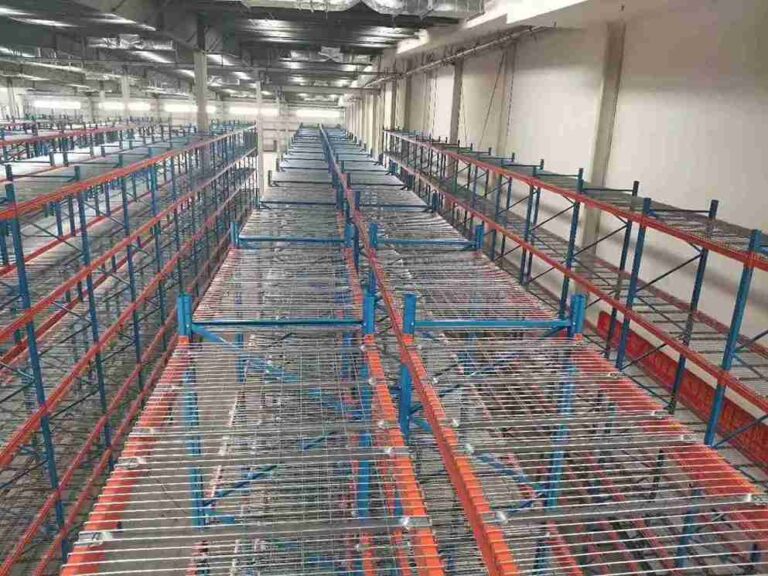
Mandate Pallet Support Systems: For non-standard, damaged, or smaller pallets, the use of wire decking, pallet support bars, or after-market support systems is not optional. These devices are critical safety components that bridge the gap between beams, creating a stable, full-support surface and preventing a pallet from falling through or creating a dangerous point load. This is a key topic for hands-on beam racking safety training demonstrations.
Ingrain the Rule through Repetition: This knowledge cannot be delivered once. It must be the bedrock of continuous beam racking safety training. Incorporate real-life photos of failed beams from within the own facility (if available) or from industry case studies into daily pre-shift meetings to make the consequences visceral and unforgettable.
Mistake #2: The Domino Effect: Complacency with Beam Connector Locking Mechanisms
The monumental structural integrity of a multi-ton selective racking system depends entirely on a component often smaller than a human thumb: the beam connector lock. A failure here is often the trigger for a progressive, catastrophic collapse.
The Prevalent Oversight: During the dynamic process of racking reconfiguration or even initial installation, crews can fail to ensure the gravity-activated locking tab is fully and audibly “clicked” into the punch hole on the upright. In other cases, a tab is sheared off by a forklift impact and the beam is simply re-engaged without the lock, creating a ticking time bomb. An unsecured beam can dislodge with a surprisingly small amount of lateral force.
The Mechanical Science: These connectors are ingeniously designed with a small, spring-loaded or gravity-fed tab. When the beam is seated correctly, this tab snaps into a pre-punched hole in the upright column. This mechanism is what positively locks the beam in place, preventing it from lifting or walking out due to the vibrations and dynamic forces inherent in loading and unloading cycles. A core module in any quality beam racking safety training program must be a physical demonstration of this mechanism.
The Proactive Avoidance Strategy, Reinforced by Training:
Institute the “Two-Tap” Audit Protocol: A cornerstone of practical beam racking safety training is empowering staff with simple, effective tools. Implement a weekly audit where supervisors use a rubber mallet to gently tap the end of each beam connector. A properly secured connection will feel and sound solid. A loose or unsecured connection will produce a distinct, hollow “click” or show visible movement. This simple test can identify a critical failure point in seconds.
Deploy a Color-Coded Verification System: To streamline visual checks, use a color-coded marking system. Each time a beam is inspected and verified as secure, a small dot of a specific color paint is applied to the connector and the adjacent upright. This allows for rapid visual confirmation during walk-throughs and reinforces the importance of this check within the beam racking safety training curriculum.
Zero-Tolerance Policy on Damaged Connectors: Any beam connector found with a missing, bent, cracked, or otherwise non-functional locking tab must be replaced immediately. Operations in that bay must cease until the repair is made. A central tenet of all beam racking safety training must be that a damaged connector is not a minor issue; it is a critical, red-line fault.
Deep Dive: The Anatomy of a Secure Connection – A Pillar of Racking Safety Training
A comprehensive beam racking safety training program uses visual aids to cement understanding. (In a full publication, a detailed, annotated technical diagram would be inserted here, contrasting a perfectly seated beam connector lock with common failure modes like sheared tabs, partially engaged locks, and damaged weld points.)
Mistake #3: The Weight of Assumption: Exceeding UDL and Point Load Capacities
Every component in a racking system is certified by a professional engineer to specific, non-negotiable maximum load capacities. The two most critical, and most commonly confused, ratings are the Uniformly Distributed Load (UDL) and the Point Load.
The All-Too-Common Error: Warehouse staff, under pressure to maximize space, see an empty slot on a beam and fill it, operating on the dangerous logic of “if it fits, it sits.” They place a 2,800 lb. load on a beam rated for a 2,000 lb. UDL. Even more insidiously, they place a heavy, compact item (like a drum of oil or a machine part) on a single point of a beam, vastly exceeding its much lower point load capacity and causing a localised structural failure.
The Critical Distinction:
UDL (Uniformly Distributed Load): The maximum safe load, evenly distributed across the entire span of the beam. This is the number most commonly found on load placards.
Point Load: The maximum safe load that can be applied to any single, concentrated point along the beam’s length. This rating is often 50-70% lower than the UDL and is a common point of failure that is rarely addressed in basic beam racking safety training.
The Strategic Avoidance through Systems and Education:
Unambiguous, Multi-Lingual Load Placards: Every single bay of racking must have a permanently affixed, highly visible, and durable load placard. This placard must clearly state, in both text and intuitive icons, the maximum UDL and point load for each level. This is a fundamental output of any site-specific beam racking safety training.
Deep Integration with Warehouse Management Systems (WMS): The most effective beam racking safety training extends into digital systems. A sophisticated WMS should be configured with the precise load capacities (both UDL and point load) of every single storage location. The system should then automatically assign put-away locations based on the product’s dimensions, weight, and weight distribution, preventing an overloading scenario at the point of instruction.
Rigorous Equipment Calibration Schedules: Ensure all forklift scales and any other weighing equipment are calibrated on a strict, documented schedule. An operator relying on a faulty scale, thinking they are loading 1,700 lbs. when the load is actually 2,200 lbs., is a direct path to a structural compromise.
Mistake #4: The Slow-Motion Collapse: Neglecting Systematic Column and Upright Inspections
Upright columns are the primary, vertical load-bearing spines of the entire racking system. Damage to an upright is the single greatest predictor of a catastrophic, progressive collapse that can take down multiple bays.
The Dangerous Misprioritization: Supervisors often focus on visible beam damage but overlook the more critical upright frames. A dent from a forklift mast might be dismissed as “cosmetic,” but its effect is structural. Depending on its location (especially in the critical “middle-third” of the column’s height) and depth, a seemingly small dent can reduce the column’s load-bearing capacity by 20%, 40%, or more. The famous “1/2 Inch Rule” (a maximum out-of-plumb of 1/2 inch over 10 feet of height) exists to ensure vertical loads are carried correctly and without inducing bending moments.
The Structural Science: Upright columns are cold-rolled or fabricated from high-strength steel to bear immense vertical compressive loads. A dent, twist, or bow compromises their geometric integrity, creating a weak point that can buckle under designed loads. This is not a gradual failure; it is a sudden, violent event.
The Multi-Layered Avoidance Strategy:
Conduct a Rack Protection Audit: The first principle of safety is prevention. A thorough audit of existing rack protection is essential. Are the upright guards substantial, steel-reinforced units, or merely flimsy plastic sleeves that offer a false sense of security? Are they installed at the correct height? This audit is a key action item following advanced beam racking safety training.
Implement a Semi-Annual Plumb and Level Protocol: Quarterly or semi-annually, use a laser level or a precision plumb bob to check the vertical alignment of upright frames. Any frame exceeding the 1/2 inch out-of-plumb tolerance over 10 feet must be immediately taken out of service and evaluated by a Qualified Rack Inspector. This procedure should be a formal part of the supervisor’s beam racking safety training certification.
Empower Staff with a Rack Inspection Gauge: This simple, inexpensive, yet profoundly effective tool is designed specifically to measure the depth and location of dents on upright columns. It provides an unambiguous go/no-go assessment, removing subjectivity and empowering floor staff to make definitive, confident safety calls. Training on the use of this gauge is a hallmark of a mature beam racking safety training program.
Mistake #5: The Unsecured Foundation: Overlooking Floor and Anchor Integrity
The most perfectly engineered and meticulously maintained racking system is only as strong as the foundation upon which it stands. Ignoring the interface between the rack and the floor is a critical error.
The Foundational Mistake: Assuming the concrete slab is uniformly strong, level, and stable indefinitely. Over time, concrete slabs can settle, crack, or heave due to ground movement, hydraulic pressure, or dynamic loading. Anchor bolts can work themselves loose through constant vibration. This leads to racking systems that are out of level, inducing complex torsional and bending stresses they were never designed to handle.
The Geotechnical and Structural Science: Racking design calculations are based on a stable, level, and specified minimum compressive strength concrete floor (e.g., 3,500 psi or 4,000 psi). If an upright frame is sitting on a low spot, a crack, or an area of compromised sub-base, it ceases to be a uniformly supported column and becomes a pivot point. As loads are applied from above, the frame can twist, transferring unpredictable and highly dangerous forces throughout the interconnected system.
The Proactive Avoidance Strategy:
Invest in a Professional Floor Survey: For new installations or in facilities experiencing persistent racking alignment issues, a professional floor flatness and levelness (Ff/Fl) survey conducted by a structural engineer is a wise investment. This will definitively identify areas that require grouting, remediation, or special consideration in the racking layout.
Annual Anchor Bolt Torque-Check Protocol: As part of a comprehensive annual inspection that goes beyond basic beam racking safety training, a qualified technician should torque-check a statistically significant sample of anchor bolts to ensure they haven’t loosened and are maintaining the required clamping force.
Incorporate Slab Integrity into Visual Inspections: Train inspection teams to specifically look for new or widening cracks, spalling (surface chipping), or crumbling around the base of uprights during their weekly rounds. Early detection of slab issues can prevent a major structural failure.
Mistake #6: The Patchwork Hazard: The Peril of Non-Compliant Replacement Parts
In the urgency to resume operations after a damaging impact, the temptation to take a shortcut is high. Welding a repair plate onto a bent beam or sourcing a cheaper, “will-fit” component from a non-OEM supplier is a gamble with the highest possible stakes.
The Critical Error: Using uncertified, non-original replacement beams, connectors, or foot plates. Even more dangerously, attempting field-welding repairs on damaged structural components.
The Metallurgical and Engineering Science: Racking components are manufactured, tested, and certified as a complete, integrated system. A beam from a different manufacturer may have identical physical dimensions but be made from a lower-grade steel, have a different yield strength, or a subtly different cross-sectional profile, any of which completely invalidates its load capacity and the certification of the entire system. Field welding, unless performed under a strict, certified procedure, can anneal (soften) or embrittle the high-strength steel around the weld, creating a new, critical point of failure and voiding all original engineering certifications.
The Uncompromising Avoidance Strategy:
Source Strictly from the Original Manufacturer or Certified Distributors: This is a non-negotiable corporate policy. Maintain a strategic inventory of critical spare parts—beams, connectors, and foot plates—directly from the original racking manufacturer.
Demand Certification Documentation: Any replacement part, without exception, must come with its own, traceable load certification documentation from a professional engineer. This paperwork is as important as the part itself.
Institute an Absolute Policy on Modifications: A core message in all beam racking safety training must be a strict, company-wide, zero-tolerance policy: No welding, grinding, cutting, or unapproved modifications to any racking component are permitted under any circumstances. Damaged components are to be replaced, not repaired, unless the repair is overseen by the original equipment manufacturer.
Mistake #7: The Human Factor: The Illusion of “One-and-Done” Operator Training
An organization can have the finest equipment, the most robust policies, and the most advanced software, but without a deep-seated, continuously reinforced culture of safety, failure remains a matter of “when,” not “if.” Inadequate and infrequent beam racking safety training is the thread that unravels the entire safety fabric.
The Fundamental Flaw: Treating forklift operator certification as a single, static event focused predominantly on vehicle maneuvering skills, while critically neglecting the ongoing education about the racking ecosystem they interact with every minute of their shift. This creates a dangerous knowledge gap between driving a forklift and understanding the storage structure.
The Human Performance Reality: Human error is the root cause of the vast majority of racking impacts. However, this error is rarely born of malice or sheer negligence. It is typically the result of a lack of continuous awareness, ingrained unsafe habits developed over time, and a failure to connect individual actions with systemic consequences. This is precisely what a dynamic beam racking safety training program is designed to combat.
The Cultural Transformation Strategy through Continuous Beam Racking Safety Training:
Implement a Multi-Modal Training Regimen: Move decisively beyond the initial certification. Develop a continuous, multi-faceted beam racking safety training program that includes:
Classroom Theory and Case Studies: Explain the “why” behind the rules using physics, engineering principles, and powerful visuals from real-world collapses, both from external sources and, more impactfully, from within the own facility (anonymized if necessary).
Practical, Hands-On Drills and Simulations: Set up a dedicated test bay with intentionally damaged and safe components. Have operators conduct inspections, identify hazards, and practice reporting protocols. The use of forklift simulators can provide a risk-free environment to practice maneuvering in ultra-narrow aisles and high-level stacking, honing skills without endangering actual assets.
Regular Knowledge Assessments: Use short, practical quizzes and spot-checks to reinforce key concepts from the beam racking safety training curriculum and keep safety top-of-mind.
Foster a Culture of Universal Accountability and Empowerment: The most powerful outcome of effective beam racking safety training is a culture where every employee, from the newest hire to the most veteran operator, feels personally responsible for safety and is empowered—and expected—to report any racking damage or unsafe practice they observe, without any fear of reprisal. The first person to see a new dent is rarely the one who caused it; they are the first responder preventing a disaster.

Building an Impregnable Culture of Safety: A Proactive, Three-Pillar Action Plan
Understanding these seven critical mistakes is the diagnostic phase. Building a resilient, proactive system to prevent them is the prescriptive cure that defines world-class warehouse operations. A robust strategy, continuously reinforced by beam racking safety training, rests on three interdependent pillars:
Prevention (The First Line of Defense): This involves investing in superior physical protection, including high-impact, steel-reinforced upright guards, end-of-aisle protectors, and highly visible aisle markers. It also entails maintaining a well-serviced and modern fleet of material handling equipment to minimize the risk of impact. This pillar is the physical manifestation of the principles taught in beam racking safety training.
Inspection (The Continuous Monitoring Layer): A multi-tiered, documented inspection protocol is non-negotiable. This includes:
Operator Level (Daily): A brief visual check of the immediate work area before starting operations.
Supervisor Level (Weekly): A formal, checklist-driven walk-through of assigned areas, incorporating the “two-tap” test, visual checks for damage, and verification of load placards.
Professional Level (Annually): A comprehensive audit conducted by a certified Qualified Rack Inspector (QRI), resulting in a formal engineering report and action plan. The frequency and rigor of the first two levels are direct outcomes of the quality of the site’s beam racking safety training.
Correction (The Swift Response Engine): A fast, efficient, and meticulously documented process for addressing any and all damage found. This ranges from the immediate replacement of a single damaged component to the controlled decommissioning of an entire bay until certified repairs can be made. Speed and certainty in this phase are critical and are driven by the protocols established in beam racking safety training.

Conclusion: Safety as the Cornerstone of Sustainable Logistics
A beam racking system is far more than a passive storage structure; it is a dynamic, critical component of a live operational environment. Treating its safety with anything less than rigorous, expert-level diligence, rooted in comprehensive and continuous beam racking safety training, is a fundamental strategic miscalculation. The seven critical mistakes detailed in this guide are not academic concepts; they are the direct, root causes of the failures that forensic investigators are called to analyze.
By consciously moving from a reactive “fix-it-when-it-breaks” mentality to a proactive, knowledge-driven, and empowered safety culture, an organization does more than just protect its physical assets. It safeguards its most valuable resource—its people—and secures its operational integrity, profitability, and long-term viability. The journey toward ultimate warehouse safety begins with a single, decisive step: conducting a thorough, unflinching audit of current practices against this definitive list and committing to a program of relentless, ongoing beam racking safety training.

Frequently Asked Questions on Beam Racking Safety
1. What is the ideal frequency for formal, classroom-style beam racking safety training sessions for our warehouse team?
While informal “toolbox talks” should be weekly, a formal, structured beam racking safety training session should be conducted for all relevant personnel during their initial onboarding and then repeated at least annually. For high-turnover environments or facilities with a history of incidents, semi-annual formal training is highly recommended. The content should be refreshed each time with new data and case studies to maintain engagement and relevance.
2. Beyond upright guards, what is the next most impactful piece of rack protection we should budget for?
Following robust upright column guards, the next highest priority is investing in high-visibility, high-durability end-of-aisle protectors and impactable guard posts at key traffic intersections. These are designed to absorb the energy of a direct impact from a forklift mast, preventing that force from being transferred to the critical upright frames. Selecting the right protection is a key topic in advanced beam racking safety training.
3. We found a beam that is slightly bent. Our maintenance team suggests they can carefully straighten it in a press. Is this acceptable?
Under no circumstances is this acceptable. Any beam that has undergone visible plastic deformation (bending) has had its crystalline steel structure permanently altered. Its load-bearing capacity is now unknown and un-certifiable. Attempting to straighten it may introduce micro-fractures and further weaken the steel. The only safe action, as dictated by all major safety standards and quality **beam racking safety training** programs, is immediate tagging and replacement with a certified OEM part.
4. What specific qualifications should we look for when hiring an external firm to conduct our annual professional racking inspection?
The individual performing the inspection must be recognized as a “Qualified Rack Inspector” (QRI) or hold an equivalent, verifiable certification from a recognized international body (such as the Storage Equipment Manufacturers’ Association – SEMA in the UK or the Rack Manufacturers Institute – RMI in the US). They should carry professional liability insurance and provide a detailed report that includes not just a list of damages, but a structural assessment and a prioritized action plan. Verifying these credentials is a critical part of managing your beam racking safety training ecosystem.
5. Our operations run 24/7. How can we possibly conduct repairs or the annual inspection without shutting down critical aisles?
For weekly supervisor-level inspections, operations can continue with heightened awareness. However, for any physical repair work—including beam replacement, upright straightening (of minor, approved types), or anchor re-torquing—and for the annual professional inspection, the affected bay and the entire adjacent aisle must be completely evacuated and cordoned off with a formal “Lockout-Tagout” (LOTO) procedure. This is a non-negotiable requirement for life-critical work. Planning these activities during lower-production shifts or with ample advance notice is a key operational challenge that must be addressed, a process that is greatly smoothed by a workforce that understands the “why” behind the rule, thanks to effective beam racking safety training.
If you require perfect CAD drawings and quotes for warehouse racking, please contact us. We can provide you with free warehouse racking planning and design services and quotes. Our email address is: jili@geelyracks.com