📐 "First 50 Enterprise Queries Get Custom 3D Warehouse Design" Plan


Beam Racking Safety Warning: 5 Common Overlooked Accessories Causing Costly Accidents
In the bustling ecosystem of a modern warehouse, beam racking systems form the silent, skeletal framework upon which profitability and efficiency rest. However, this framework possesses a critical vulnerability often invisible to the untrained eye. The integrity of the entire structure frequently hinges not on the primary beams and uprights, but on the small, seemingly insignificant components known as beam racking safety accessories. A profound understanding of these components separates a safe, resilient operation from one teetering on the brink of a catastrophic failure.
This analysis delves into the five most perilously overlooked beam racking safety accessories, providing a forensic examination of their function, the consequences of their neglect, and the strategic imperative of their integration into a holistic safety protocol. For any logistics or warehouse manager, this knowledge is not merely operational—it is foundational to risk management and asset protection.

The High Stakes of Overlooking Racking Safety
The financial and operational repercussions of beam racking failure are rarely confined to a single pallet location. The immense loads involved transform a localized component failure into a kinetic, cascading event. The true cost is a complex web of direct damage, operational paralysis, and long-term liability.
The Domino Effect of a Single Accessory Failure
A failure in one set of beam racking safety accessories can initiate a disastrous sequence of events. It begins with a single point of compromise, such as a disengaged safety lock. This allows a beam end connector to slip from its socket in the upright frame. The subsequent beam displacement causes the palletized load to drop, impacting the level below with tremendous force. This impact often overloads the lower beams, triggering a progressive collapse that can consume multiple racking bays.
The consequential damage extends beyond the beam racking safety accessories and structural components to include destroyed inventory, crippled material handling equipment (MHE) like forklifts or AGVs, and, most devastatingly, severe injury or loss of life. The initial failure of a few dollars worth of beam racking safety accessories can thereby precipitate losses running into hundreds of thousands of dollars.
The Compliance Illusion: Meeting Code vs. Ensuring Safety
Many facility operators labor under the dangerous misconception that regulatory compliance equates to comprehensive safety. Codes and standards represent the minimum acceptable threshold, not the gold standard for operational excellence. The performance and integrity of beam racking safety accessories degrade over time due to vibration, minor impacts, and cyclic loading. A system that was compliant upon installation may be critically deficient months later. A proactive, predictive approach that prioritizes the condition of beam racking safety accessories is the only methodology that genuinely mitigates risk. This involves moving beyond periodic inspections to foster a daily culture of awareness where every operator understands the critical role these components play.
The 5 Most Overlooked Beam Racking Safety Accessories
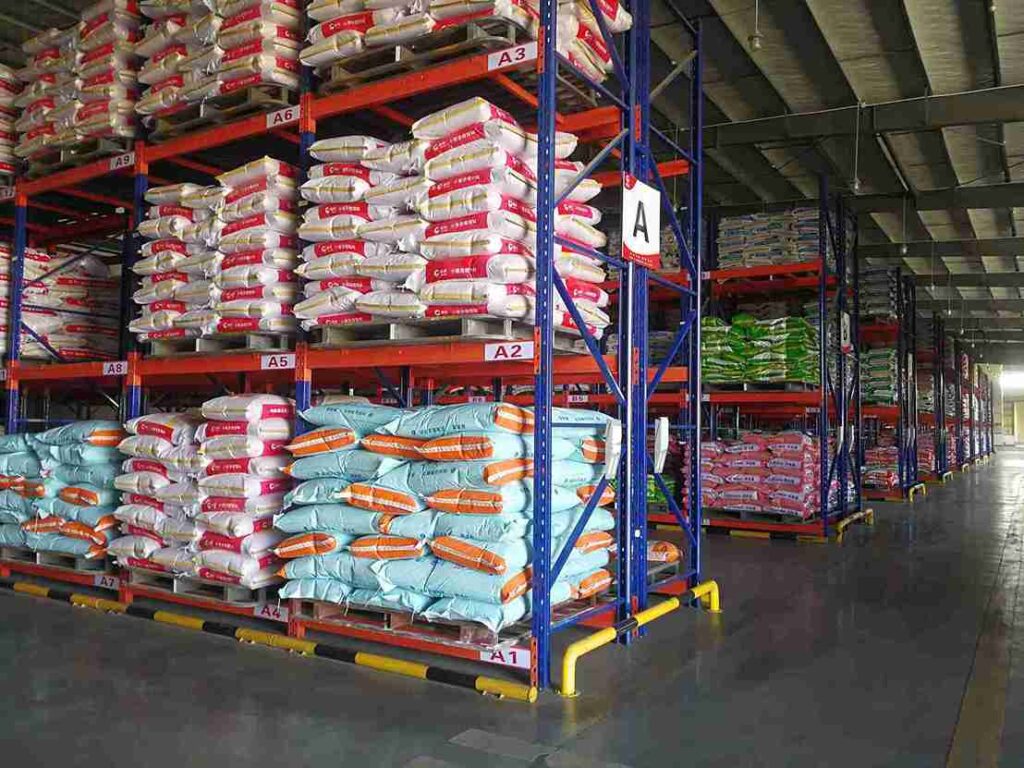
The following five categories of beam racking safety accessories represent the most common points of failure observed in post-accident forensic analyses. Their oversight is typically not born of negligence, but of a fundamental underestimation of their systemic importance.
1. Beam End Connector Safety Locks and Locking Pins
These are arguably the most critical of all beam racking safety accessories. While the beam end connector itself is a primary component, the safety locks and pins are the dedicated secondary retention mechanisms that are far too often missing, damaged, or bypassed.
The Critical Function and The Hidden Risk
The fundamental purpose of these specific beam racking safety accessories is to provide a positive mechanical lock that prevents the beam end from accidentally disengaging from the upright frame. This disengagement can be caused by a glancing impact from a forklift mast, pallet, or even significant vibration from nearby machinery. Without these beam racking safety accessories in place, the beam is secured solely by gravity and friction—a terrifyingly precarious situation in a dynamic industrial environment. The risk is a sudden, unannounced beam drop that immediately compromises the entire level’s integrity.
Real-World Consequences of Missing Locks
A case study from a high-volume distribution center in Southeast Asia illustrates the point with stark clarity. A reach truck operator made minor contact with an upright frame. The impact was not severe enough to trigger any alarm, but it was sufficient to jiggle a beam that was missing its safety locks—a common issue among the beam racking safety accessories in that section. The beam end slipped from its socket, and the entire level, loaded with consumer electronics, collapsed.
The subsequent investigation revealed that over 30% of the beam racking safety accessories designed to prevent this exact scenario were either broken or had never been installed after a reconfiguration. The total loss, including inventory, racking replacement, and over a week of operational downtime, exceeded $350,000. The root cause was the neglect of a few dollars worth of beam racking safety accessories.
2. Column and Upright Frame Guards / Protectors
While often considered for perimeter columns, these vital beam racking safety accessories are frequently under-specified for the interior of the storage system, leaving critical structural elements exposed.
More Than Just a Bumper: The Engineering Purpose
A properly engineered upright guard is one of the most robust beam racking safety accessories. Its function is not merely to act as a visual cue or a minor bumper. It is engineered to absorb and dissipate the kinetic energy from an impact, preventing that energy from being transferred directly to the thin-walled upright column. A direct impact can cause a local dent or crack that catastrophically reduces the column’s load-bearing capacity, often without any visible sign of the danger from a distance. These beam racking safety accessories are a primary defense for the most expensive and difficult-to-replace parts of the racking system.
The Financial Math of Proactive Protection
The economic argument for the comprehensive deployment of these beam racking safety accessories is compelling. The cost of replacing a single compromised upright frame involves not only the component itself but also the complex, costly process of offloading the racking, disassembling the structure, and reinstalling it—a process that can run into thousands of dollars per upright. In contrast, high-quality beam racking safety accessories like column guards represent a minor one-time capital expenditure. Protecting every exposed upright, not just those at the end of aisles, is one of the most straightforward and high-return investments in warehouse infrastructure, directly safeguarding the structural asset.
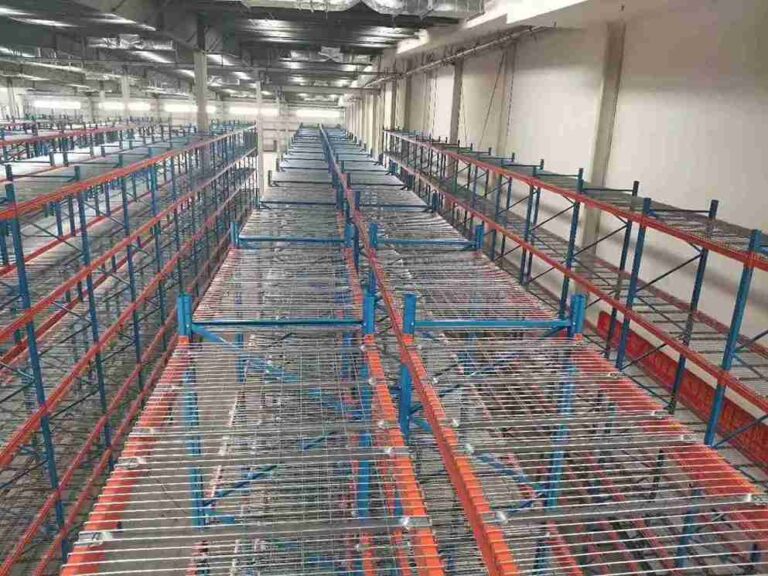
3. Pallet Supports and Wire Mesh Decking
Often mistakenly viewed as a simple shelf, decking is a fundamental category of beam racking safety accessories that provides critical load support, fall-through protection, and structural stability.
Preventing Fall-Through and Ensuring Load Stability
The primary safety function of these beam racking safety accessories is to create a continuous support surface that prevents pallets, products, or debris from falling to lower levels. A falling item from a significant height poses a severe struck-by hazard to personnel and can damage inventory and equipment below. Furthermore, when securely installed, these beam racking safety accessories contribute significantly to the overall lateral stability of the racking structure, acting as a diaphragm that ties adjacent bays together and resists sway, much like the shear walls in a building.
The Specification Mistake: Gauge and Integration
A common and dangerous error is the underspecification of these essential beam racking safety accessories. Selecting a wire mesh decking based on initial cost rather than engineering requirements—for instance, choosing a 1.2mm gauge where a 2.0mm or heavier is needed—invites failure. Under dynamic or uniform loads, underspecified decking can permanently deform, sag, or rupture. Crucially, the specification of these beam racking safety accessories must be integrated into the overall structural calculation of the racking system. They are not passive shelves but active structural elements that influence the system’s overall performance and safety.
4. Seismic Restraints and Row Spacers
In regions with low-to-moderate seismic activity or in facilities with significant vibration, these specialized beam racking safety accessories are often value-engineered out of projects, creating a latent vulnerability.
Not Just for Earthquakes: The Stability Role
Seismic restraints, including tie-backs to the building structure and row-spacing braces, are highly engineered beam racking safety accessories designed to resist lateral forces. These forces are not exclusive to earthquakes. They are generated daily by the deceleration of heavy forklifts, the constant operation of conveyor systems, and the harmonic vibration from industrial machinery. These beam racking safety accessories prevent the racking from “walking” or tipping, maintaining plumb and alignment over its operational lifespan.
The Vibration Problem You Can’t Always See
An example from an automated facility in Latin America demonstrates this insidious risk. A racking system was consistently failing plumb checks, despite no visible impacts. The culprit was traced to the defined paths of automated guided vehicles (AGVs). The persistent, low-frequency vibration was gradually shifting the entire structure. The retrofit of beam racking safety accessories—specifically, row spacers and additional seismic bracing—resolved the chronic misalignment, adding a layer of resilience that protected the system’s long-term integrity. This case highlights how these beam racking safety accessories are vital for stability in any dynamic environment.
5. Load Capacity and Configuration Labels
This administrative-seeming category is, in fact, one of the most crucial beam racking safety accessories. It serves as the primary communication link between the engineered system and the human operators interacting with it daily.
The Critical Communication Link
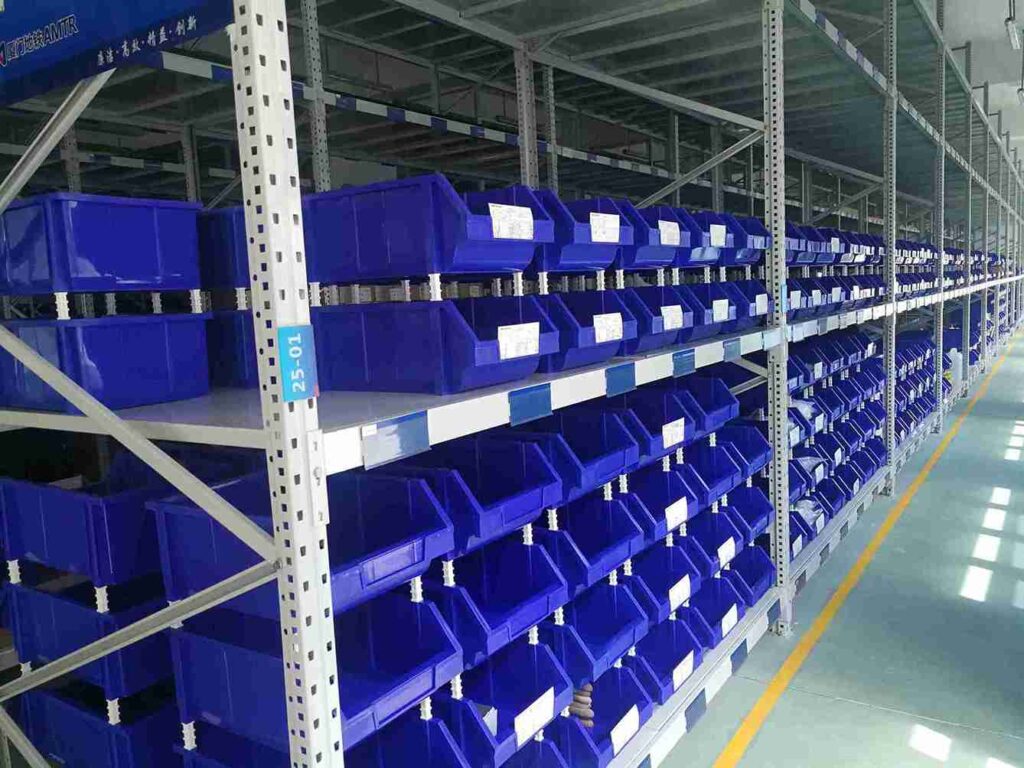
A permanently affixed, legible load capacity label is a non-negotiable beam racking safety accessory. It provides the unambiguous, on-the-spot data required for safe operation, detailing the maximum uniform and point loads for that specific bay in its current configuration. The absence of these beam racking safety accessories forces operators and planners to rely on memory or assumption, a practice that inevitably leads to dangerous overloading. An overloaded beam will deflect beyond its design limits, placing immense stress on the beam ends and connectors, and can lead to a sudden, catastrophic failure.
The Human Factor in Racking Safety
Human error is a constant in complex operations. These simple beam racking safety accessories—the load labels—are a powerful tool for error-proofing. Modern best practices involve using durable, UV-resistant labels that may include QR codes. When scanned, these codes can provide instant access to the bay’s load application drawings and configuration history, transforming a static label into a dynamic portal for safety information. This empowers the workforce, making them active participants in a culture of safety centered around the proper use of all beam racking safety accessories.
Proactive Measures: Building a Culture of Racking Safety
Knowledge of the risks associated with neglected beam racking safety accessories must be translated into actionable, systematic protocols. A reactive approach is a gamble with unacceptable odds.
Implementing a Daily Visual Inspection Protocol
The first line of defense is the warehouse floor staff. A simple, effective daily visual inspection checklist should be implemented, requiring operators to check for:
The presence and intact condition of all beam racking safety accessories, particularly safety locks.
Newly appeared impacts on upright guards or the uprights themselves.
Visible sagging, deformation, or damage to decking and other supportive beam racking safety accessories.
The presence and legibility of all load capacity labels.
This process takes seconds per bay but creates a powerful, distributed network of vigilance.
Scheduling Professional Racking Inspections
Daily checks are vital but cannot replace expert analysis. The industry-standard three-tiered inspection regime is essential:
Frequent (Daily/Weekly): Operator-led visual checks focused on obvious damage and the presence of key beam racking safety accessories.
Regular (e.g., Quarterly): A more detailed inspection by a trained, designated person within the organization.
Expert (Annually): A comprehensive inspection and structural assessment conducted by a certified external specialist. These experts use precision tools to measure deflection and plumb, identifying issues invisible to the untrained eye and providing a certified report on the state of the entire system, including every category of beam racking safety accessories.
Conclusion: Safety is in the Details
A beam racking system is a precision-engineered structure whose reliability is inextricably linked to the integrity of its beam racking safety accessories. The five categories examined—safety locks, upright protectors, properly specified decking, seismic restraints, and load labels—are not optional extras; they are fundamental to the system’s safe operation. Neglecting these beam racking safety accessories is an untenable risk, a gamble where the potential losses dwarf the minimal cost of prevention.
A proactive strategy, rooted in quality components, daily vigilance, and expert oversight, transforms the warehouse from a venue of potential hazard to a model of operational resilience and safety. The time to audit and reinforce these critical beam racking safety accessories is now, before an oversight manifests as a costly accident.
Frequently Asked Questions (FAQs)
1. Can safety locks be retrofitted onto existing beam racking systems?
Yes, in the vast majority of cases, beam end connector safety locks are designed to be retrofittable. They are among the most cost-effective and impactful beam racking safety accessories to add to an existing system. It is crucial to source the correct lock model that is compatible with the specific brand and type of beam end connector in use.
2. How is the correct thickness/gauge for wire mesh decking determined?
The specification is a structural engineering calculation based on the decking’s span (the distance between supporting beams), the intended Uniformly Distributed Load (UDL), and the required safety factor. It is not a decision based on cost alone. An underspecified decking, one of the most critical supportive beam racking safety accessories, will fail under load. Engineering guidance is mandatory for correct selection.
3. What are the different types of upright protectors, and how is the best one chosen?
The two primary types are steel post guards (often hollow structural sections filled with concrete or high-density foam for energy absorption) and high-visibility polymer guards. The choice depends on the anticipated impact energy. Steel/concrete guards are for high-energy impacts from heavy MHE, while polymer guards are excellent for lower-energy, frequent contact and offer superior visibility. A risk assessment of the warehouse traffic will guide the selection of these essential beam racking safety accessories.
4. What is the industry standard for the maximum allowable deflection of a loaded beam?
The widely accepted standard, per organizations like the Rack Manufacturers Institute (RMI), is a maximum deflection of L/180, where ‘L’ is the clear span of the beam. For a 3-meter beam, this equates to a maximum deflection of 16.7mm under its rated load. Deflection beyond this limit indicates overloading or a compromised beam and must be investigated immediately, as it stresses all connected beam racking safety accessories.
5. Are seismic restraints necessary in geographically stable regions?
While their primary design purpose is for seismic events, the stability benefits of these beam racking safety accessories are universal in any active warehouse. They provide critical resistance to the lateral forces generated by forklift traffic, conveyor systems, and other machinery, preventing racking sway and maintaining long-term alignment. Their installation is a mark of a robust, well-engineered storage system, irrespective of seismic activity.
If you require perfect CAD drawings and quotes for warehouse racking, please contact us. We can provide you with free warehouse racking planning and design services and quotes. Our email address is: jili@geelyracks.com