📐 "أول 50 استفسار مؤسسي يحصل على تصميم مستودع ثلاثي الأبعاد مخصص" الخطة















Comprehensive Technical Specifications for Welded Steel Structure Racks in Automated Warehouses: The Ultimate Guide to JB/T 5323 Compliance
Article Summary
إن JB/T 5323 standard serves as the foundational technical specification governing the manufacturing, installation, and acceptance of welded steel structure racks used in automated warehouses و أنظمة التخزين والاسترجاع الآلي (AS/RS) . Originally established in 1991 and significantly revised in 2017, this standard defines everything from material selection و welding procedures to installation tolerances و inspection protocols لـ welded rack systems with unit load capacities up to 3,000 kg.
This comprehensive guide explores every facet of JB/T 5323 compliance, providing warehouse engineers, facility managers, and procurement professionals with the technical depth needed to specify, install, and maintain high-performance welded steel structure racks that ensure operational safety, structural integrity, and long-term durability in demanding automated storage environments .
H1: Understanding JB/T 5323: The Backbone of Automated Warehouse Rack Safety
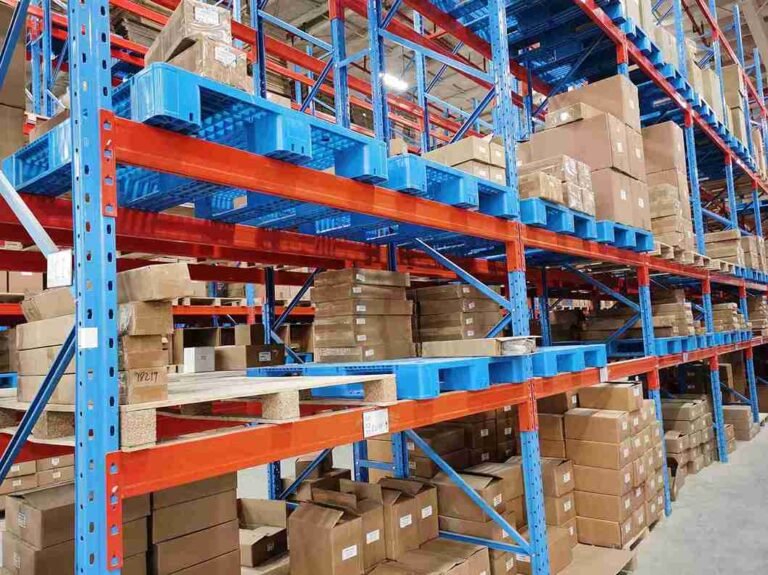
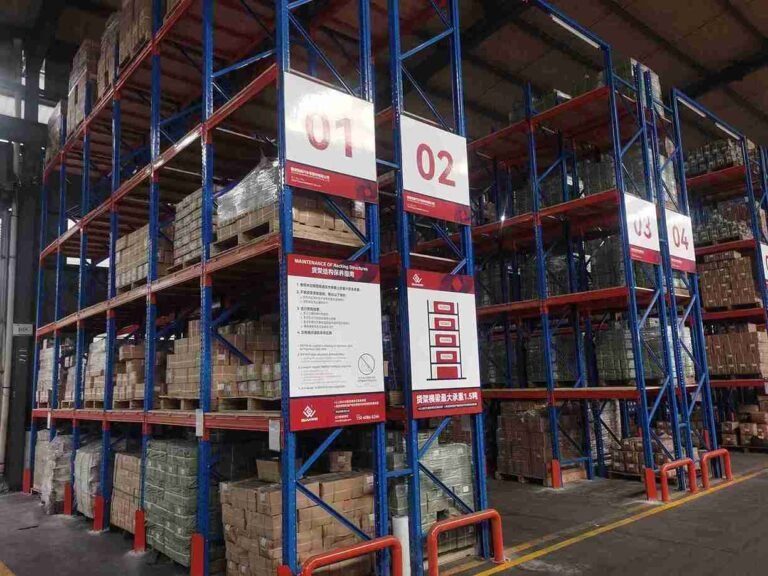
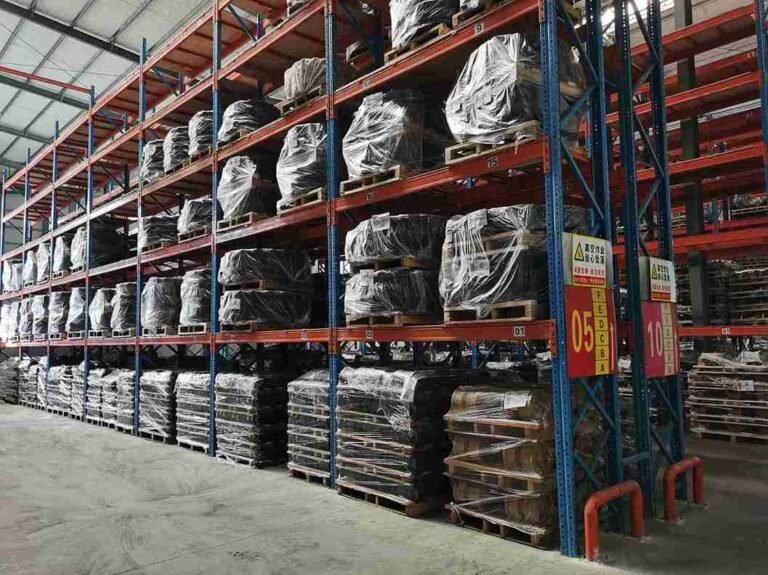
When professionals in the material handling industry talk about automated warehouses و high-bay storage systems , few things matter more than the structural integrity of the racks themselves. These towering steel frameworks support thousands of pallets, guide sophisticated stacker cranes , and must withstand years of continuous operation without failure. That is precisely why the JB/T 5323 standard exists. For any AS/RS installation , the rack structure is not merely a passive storage medium—it is an active, integral component of the entire automated warehouse النظام.
What makes this standard so critical for automated warehouses ? AS/RS installations operate with minimal human intervention. Stacker cranes move at high speeds, positioning loads with millimeter precision. If a rack column is even slightly out of plumb, or if a beam is not perfectly level, the consequences can be catastrophic—ranging from product damage و equipment wear to structural collapse و worker injury . JB/T 5323 provides the technical guardrails that prevent these outcomes.
إن global automated warehouse market is experiencing significant growth. The global automated high-bay warehouse market was valued at approximately USD 3,385 million in 2025 and is projected to reach USD 4,951 million by 2031, representing a compound annual growth rate of 6.5%. Meanwhile, the warehouse racking market is projected to hit USD 13.7 billion by 2032 at a CAGR of 4.9% from USD 10.3 billion in 2026.
إن automated racking system market was valued at USD 1.08 billion in 2025 and is projected to reach USD 2.64 billion by 2034, expanding at a strong CAGR of 10.4%. The Asia Pacific region accounts for approximately 35% to 40% of the global industrial racking system market, with a growth rate of 6% to 7%. As more facilities transition to automated warehouse operations, understanding and implementing JB/T 5323 becomes ever more essential.
إن warehouse racking market is undergoing a structural transformation driven by automation, e-commerce growth, and the rapid emergence of dark warehouses that operate with minimal human intervention. Traditional static pallet racking systems are increasingly insufficient for modern fulfillment requirements, which prioritize speed, density, and seamless integration with robotics and warehouse management software.
As a result, racking systems are now being engineered as active components of automated storage and retrieval systems (AS/RS). Major global manufacturers such as Daifuku, SSI Schaefer, Dematic, Jungheinrich, Mecalux, Kardex, and Murata Machinery dominate the high-end market, while regional players are innovating aggressively in carton flow, shuttle racking, and modular systems.
H2: Scope and Application of JB/T 5323 for Automated Warehouses Racks
H3: What Types of Automated Warehouses Racks Does This Standard Cover?
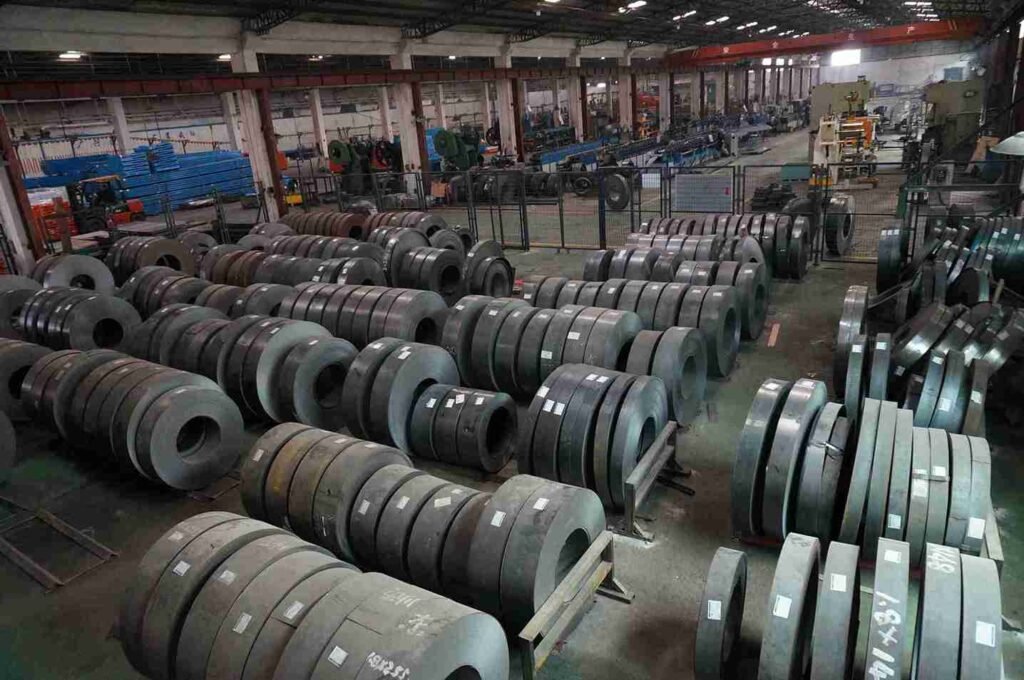
The standard specifically applies to welded steel structure racks used in rail-guided laneway-type high-bay warehouse facilities . Under the original 1991 version, the scope was limited to automated warehouses racks with unit load capacities not exceeding 2 tons , where the rack frames are of welded construction.
ومع ذلك، فإن 2017 revision significantly expanded this scope. The updated standard now applies to welded steel structure racks in automated warehouses where unit load capacities do not exceed 3,000 kg. This increase from 2 tons to 3,000 kg reflects the evolution of the warehousing industry, where heavier loads have become commonplace in modern AS/RS installations . The standard applies to automated warehouses that utilize laneway (aisle stacker cranes) for (goods storage and retrieval).
The standard is applicable to welded steel structure shelves in three-dimensional warehouses , covering everything from terminology and definitions to technical requirements, test methods, inspection rules, signage, packaging, transportation, and storage. For any AS/RS project , understanding these comprehensive requirements is essential for successful implementation. The standard covers material selection, structural design, welding processes, surface treatment, anti-corrosion measures, and safety performance aspects of automated warehouses racks.
H3: Why Welded Construction Matters for AS/RS
The standard focuses specifically on welded steel structures, as opposed to bolted أو assembled systems. Why does this distinction matter so much in automated warehouses ?
Welded rack structures offer several distinct advantages that are particularly valuable in AS/RS environments :
Superior rigidity : Welded connections create continuous load paths with no play or movement at joints. In an automated warehouse where stacker cranes operate at high speeds, this rigidity translates directly into positioning accuracy and system reliability.
Elimination of bolt loosening : Unlike bolted systems that can work loose over time under vibration—a common condition in busy automated warehouses —welded connections remain permanently secure.
Higher precision : Welded frames can be manufactured to tighter tolerances in controlled shop environments. For AS/RS installations , where tolerances must be exact for the computer-controlled storage and retrieval system to work properly, this precision is non-negotiable.
Better dynamic load resistance : The continuous nature of welded joints provides superior resistance to the shocks and vibrations generated by automated equipment in high-throughput automated warehouses .
That said, the industry has seen a growing trend toward modular assembled racks , which offer advantages in scalability, shipping efficiency, and on-site installation speed . While JB/T 5323 focuses on welded structures, the related JB/T 11270-2024 standard addresses combined steel structure racks لـ automated warehouses. This newer standard, published on March 29, 2024, and effective from October 1, 2024, specifies technical requirements for beam-type and corbel-type combined steel structure racks. For many AS/RS applications , however, welded construction remains the preferred choice due to its superior structural performance.
H2: Material Requirements Under JB/T 5323 for Automated Warehouses Racks
H3: Primary Structural Steels
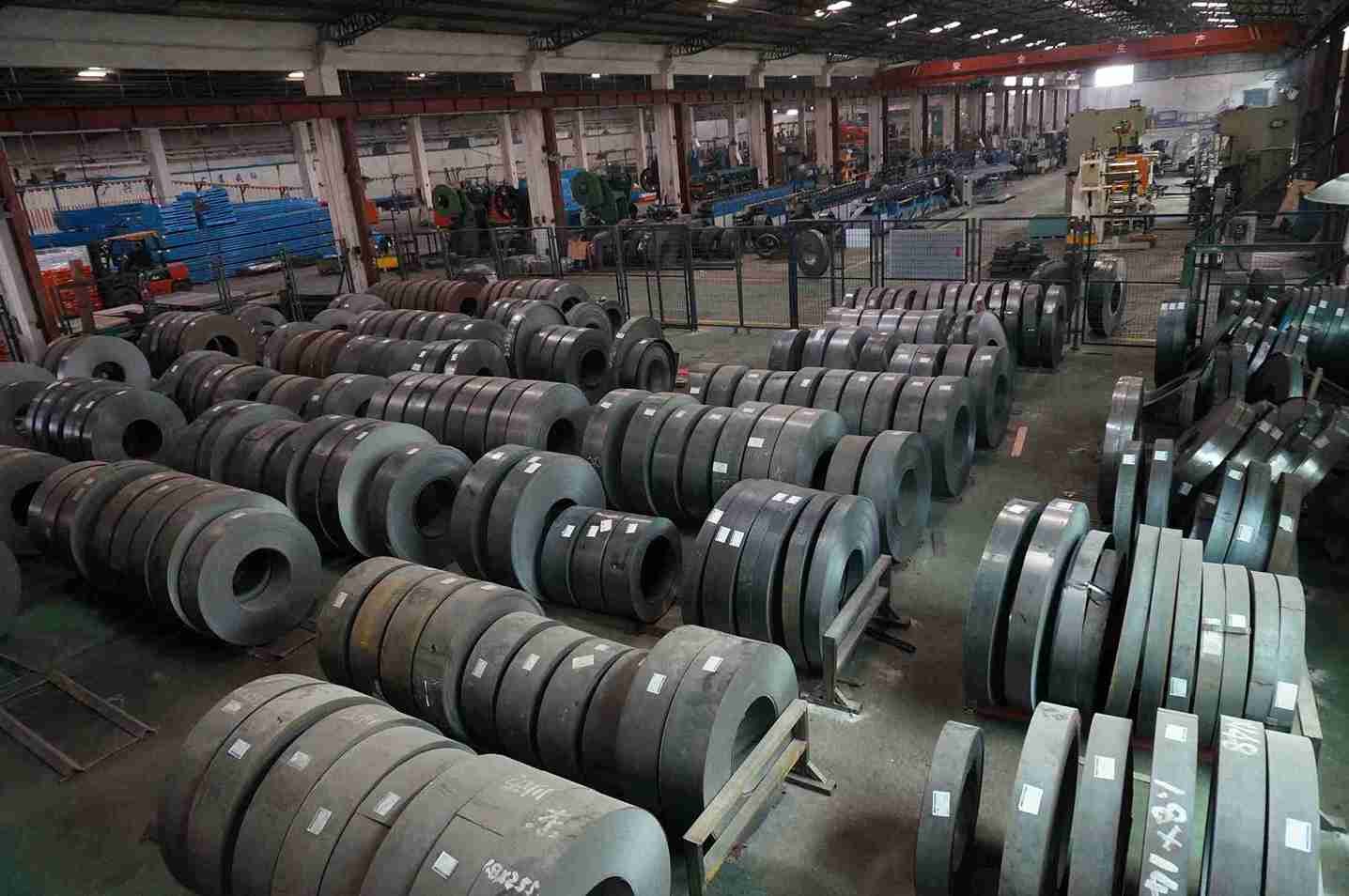
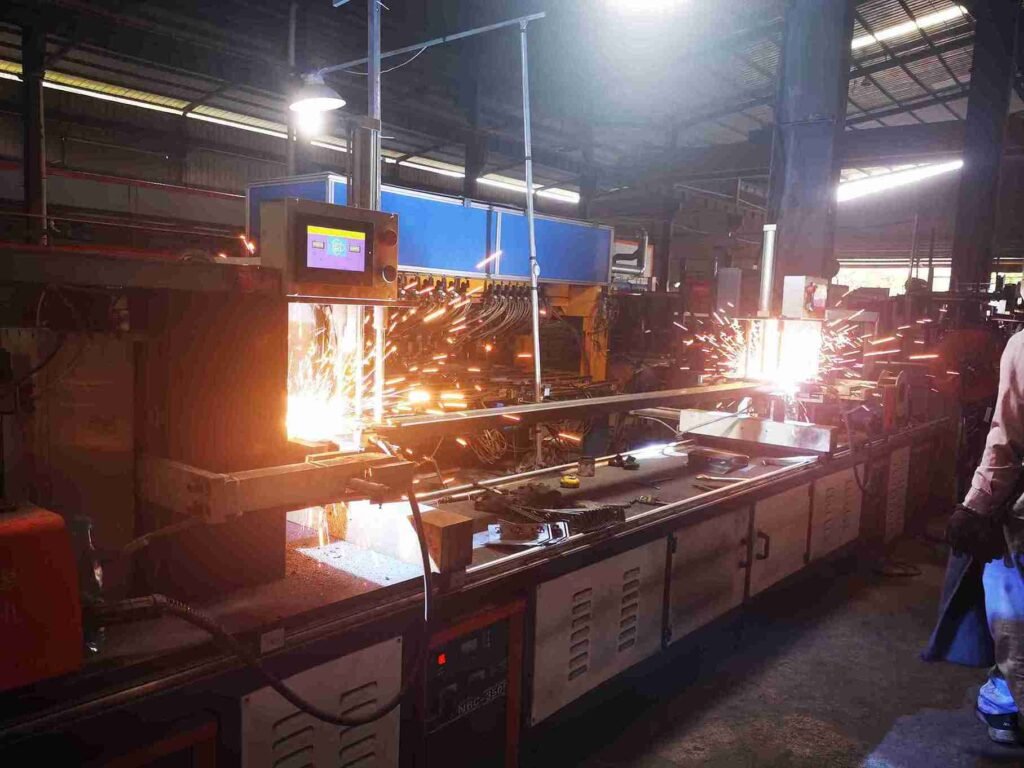
The standard specifies that primary load-bearing structural members must be manufactured from either Q235 steel (per GB700) or 16Mn steel (per GB1591). These are the workhorses of Chinese structural steel:
Q235 steel is a general-purpose carbon structural steel with good weldability and formability, making it ideal for the demanding conditions of automated warehouses .
16Mn steel is a low-alloy high-strength steel offering superior strength-to-weight ratio, which becomes increasingly important as AS/RS installations reach greater heights.
The selection of appropriate materials is fundamental to the long-term performance of any AS/RS rack structure . In automated warehouses , where racks may support thousands of loads over decades of operation, material quality directly impacts safety and service life.
H3: Low-Temperature Performance Requirements
One of the most critical material provisions in the standard addresses cold-weather performance —a consideration that becomes particularly important for automated warehouses located in northern climates. For racks operating in environments where temperatures reach -20°C or lower , the standard mandates:
Use of Q235-D grade steel
16Mn steel must provide certified Charpy impact test assurance at -40°C
This requirement is not merely academic. Steel undergoes a ductile-to-brittle transition at low temperatures, meaning it can suddenly become brittle and prone to catastrophic fracture under load. Automated warehouses in northern China, Siberia, or other cold climates must take this requirement seriously. Industry experts further recommend that when the working environment temperature equals or drops below -20°C, load-bearing structural members must use killed steel with impact toughness not less than 0.30 N·mm²/mm² at the relevant service temperature. For AS/RS installations in cold regions, this is a critical specification that cannot be overlooked.
The standard also specifies that automated warehouses racks should operate within an ambient temperature range of -5°C to 40°C. For welded steel structure racks used in automated warehouses , for structural members requiring cold bending, the steel should also provide qualified assurance for cold bending tests.
H3: Surface Condition and Defect Limitations
The standard imposes strict limitations on surface defects in raw steel:
The depth of rust, pitting, or scratches must not exceed half the negative tolerance of the steel thickness
Fracture surfaces must be free of lamination defects
These requirements ensure that surface imperfections do not compromise the structural integrity of the finished rack components. In automated warehouses , where racks are subjected to continuous dynamic loading, even minor surface defects can become stress concentration points that lead to premature failure.
H2: Welding Consumables and Procedures for Automated Warehouses Racks
H3: Electrode and Wire Specifications
The standard provides detailed specifications for welding consumables , recognizing that the quality of the weld is only as good as the materials used:
Manual welding electrodes must comply with GB5117 (carbon steel electrodes) or GB5118 (low-alloy steel electrodes), with electrode types matched to the base metal strength
Automatic and semi-automatic welding wires must comply with GB1300 , with wire and flux matched to the base metal
CO₂ gas-shielded welding wires must comply with GB8110
The quality of welding directly affects the structural integrity of automated warehouses racks . Poor welds can lead to premature failure, creating safety hazards and costly downtime. For AS/RS installations , where racks support expensive automated equipment and valuable inventory, weld quality is paramount.
H3: Weld Quality Requirements
The standard establishes rigorous weld quality criteria that every welded rack must meet:
Weld bead surfaces must be uniform with no cracks, slag inclusions, weld tumors, burn-through, craters, or pinhole porosity
إن welding zone must be free of spatter
Surface porosity is completely prohibited
Undercut depth must not exceed 0.5 mm , with total undercut length not exceeding 10% of the total weld length
Butt welds and fillet welds must comply with the dimensional tolerance limits specified in GBJ205
Industry practice further reinforces that weld joints must be continuous and uniform , entirely free from cracks, slag, weld tumors, burn-through, craters, and pinhole porosity. Each welded joint should be manually cleaned of slag and spatter . In automated warehouses , where racks may be subjected to millions of load cycles over their service life, these weld quality requirements are essential for long-term reliability.
بالنسبة لـ automated warehouses racks , the welding must also satisfy the requirements of the Building Seismic Design Code (GB 50011) when seismic design is applicable. The seismic design specifications for steel frame storage racks in automated warehouses include JB/T 5323-2017 و JB/T 11270-2011. Furthermore, GB/T 39830-2021 , published on March 9, 2021, and effective from October 1, 2021, specifies the seismic design code for steel static storage systems in automated warehouses , covering general provisions, seismic design process, seismic action and structural seismic calculation, analysis methods, and structural requirements. This standard fills the gap in seismic design standards for rack products in China.
H2: Manufacturing Precision Requirements for Automated Warehouses Racks Frames
H3: Pre-Fabrication Preparation
Before any cutting or welding begins, the standard requires that all steel members be individually straightened . After straightening, the steel surface must show no obvious indentations or damage. While heat straightening is permitted, the heating temperature must never exceed the normalizing temperature of 900°C.
This preparation phase is critical for AS/RS installations because any warping or distortion in individual members will be magnified when the frame is assembled. In automated warehouses , where millimeter precision is required for proper stacker crane operation, starting with straight members is essential.
H3: Cutting and Straightness Tolerances
After cutting, each component must be inspected for straightness , which must not exceed 1/1000 of the cut length (L) . This ensures that even before welding, the individual members are straight enough to produce a finished frame that meets all dimensional requirements. For tall racks in automated warehouses —some reaching heights of 35 meters or more—this straightness requirement becomes increasingly critical.
H3: Frame Assembly and Jig Requirements
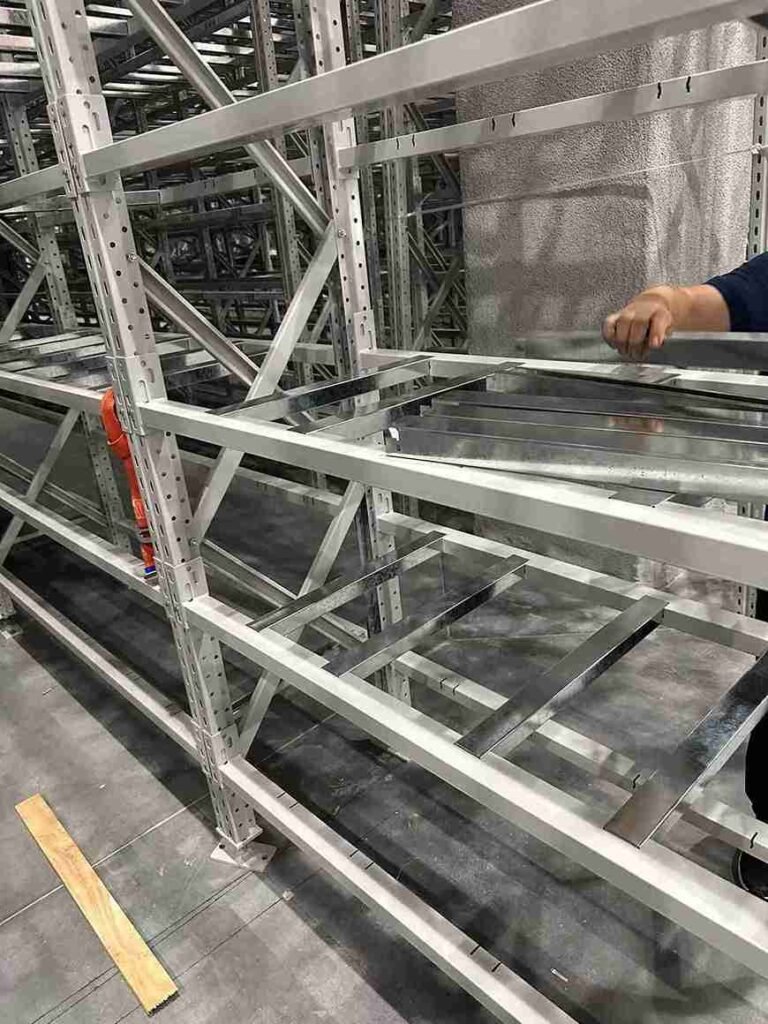
One of the most important manufacturing requirements is that rack frames and support members must be manufactured using jigs and fixtures (胎模). All bolt holes must be drilled in the jig —field drilling or hole enlargement during installation is not permitted. Additionally, each end of a support member must have no fewer than two connecting bolts.
This jig requirement ensures repeatable precision across all frames produced. When holes are drilled in a controlled jig setting, every frame will have bolt holes in exactly the same positions, enabling interchangeability و trouble-free field assembly . For large AS/RS installations that may contain thousands of rack frames, this interchangeability is essential for efficient manufacturing and installation.
H3: Column Splicing Allowances
The standard permits column splicing (joining two pieces to create a longer column), provided that:
The splice strength is not less than the original member strength
The splice location does not interfere with the placement of diagonal members, load-bearing corbels, or connection plates
Post-weld straightness meets the 1/1000 requirement
Column splicing is a practical necessity for very tall automated warehouses racks , where single-piece columns may be impractical to manufacture, transport, or handle. However, the standard ensures that splices do not compromise structural performance.
H3: Frame Dimensional Tolerances
After welding, each rack frame must meet the following dimensional tolerances:
| Parameter | Tolerance |
|---|---|
| Frame full height (L) | ±2 mm |
| Frame width (D) | ±2 mm |
| Each corbel/beam support height | ±2 mm |
| Frame base plate height differential (a) | ±0.5 mm |
| Each connection plate height | ±2 mm |
| Frame side and column bending (f₁, f₂, f₃) | ≤ L/1000 (max 6 mm) |
| Column-to-base plate perpendicularity (f₀) | ≤0.5 mm over 500 mm height |
These tolerances are extremely tight —a full-height frame 20 meters tall must be straight to within 6 mm over its entire height. This level of precision is essential for the proper operation of automated stacker cranes that travel within the rack structure. In automated warehouses , where loads are deposited and retrieved with computer-controlled precision, even small deviations can cause misalignment issues that lead to equipment damage or operational failures.
Industry practice further specifies that for automated warehouses racks , upright straightness must be within ±3 mm over 12 m height to permit smooth crane travel. Rail misalignment exceeding 2 mm over 10 m causes crane jerking and premature wheel wear. The column verticality deviation for the entire height is typically controlled at ≤ H/1000 (for a 20 m high rack, the full-height deviation should be ≤20 mm, and for strict projects ≤10 mm). Stacker crane floor rail levelness should be ≤2 mm/10 m, with fork positioning accuracy at the ±1 mm level.
H2: Surface Preparation and Coating Requirements for Automated Warehouses Racks
H3: When Coating Is Applied
The standard specifies that descaling and priming can only begin after the quality inspection department has approved the fabrication quality. This sequencing ensures that coating does not hide any fabrication defects that would otherwise be visible. In automated warehouses , where racks may be inspected less frequently than in manually operated facilities, ensuring that coating does not conceal defects is particularly important.
H3: Surface Preparation Standards
Before coating, steel surfaces must be prepared per GB8923 to achieve a minimum of St 2 (hand or power tool cleaning). The time between surface preparation and primer application must not exceed 6 hours , and the surface must be free of rust or contamination at the time of coating.
Proper surface preparation is essential for coating adhesion, which directly affects the corrosion resistance of automated warehouses racks . Poor adhesion leads to premature coating failure and subsequent corrosion, compromising structural integrity.
H3: Environmental Conditions for Coating
Coating operations are subject to strict environmental controls :
Ambient temperature: 5°C to 38°C
Relative humidity: ≤85%
No coating during rain or when the surface has condensation
4-hour rain-free period after coating
These environmental controls ensure that coatings cure properly and achieve their designed protective properties. For AS/RS installations , where racks may be exposed to a wide range of environmental conditions, proper coating is essential for long-term durability.
H3: Coating Quality Requirements
في حين أن final decorative coating is ideally applied after installation and commissioning, the standard requires that:
Coating surfaces be uniform, glossy, and consistent in color
No blistering, peeling, cracking, runs, wrinkling, foreign matter, or other defects that reduce protection or appearance
Paint film adhesion must meet at least Grade 2 per GB9286
For the 2017 revision, powder coating requirements were added, including specifications for phosphating pretreatment and powder electrostatic spraying. This reflects the industry’s shift toward more durable and environmentally friendly coating systems for automated warehouse racks.
H2: Installation Requirements for Complete AS/RS Rack Systems in Automated Warehouses
H3: Pre-Installation Inspection
Before any installation work begins, the standard requires factory pre-assembly of some units. Additionally, the foundation condition, embedded parts, and pre-drilled holes must be inspected and approved before full installation proceeds.
بالنسبة لـ AS/RS installations , this pre-installation phase is particularly critical. Unlike conventional pallet rack, where shims and adjustments post-installation can correct minor variations, it is critical to get AS/RS installation right the first time. The precision required for automated warehouses means that foundation issues discovered after installation can be extremely difficult and expensive to correct.
إن installation and acceptance procedures لـ automated warehouses racks are further detailed in standards such as WBT1066-2017 (Technological conditions of rack installation and acceptance), which specifies installation conditions, installation and adjustment, testing, commissioning, and acceptance. Additionally, GB/T 39060-2020 provides technical requirements for manufacturing and installation supervision of automated warehouse equipment, covering steel structure racks, laneway stacker cranes, conveying and sorting equipment, and AGVs.
H3: Floor and Foundation Requirements for Automated Warehouses Racks
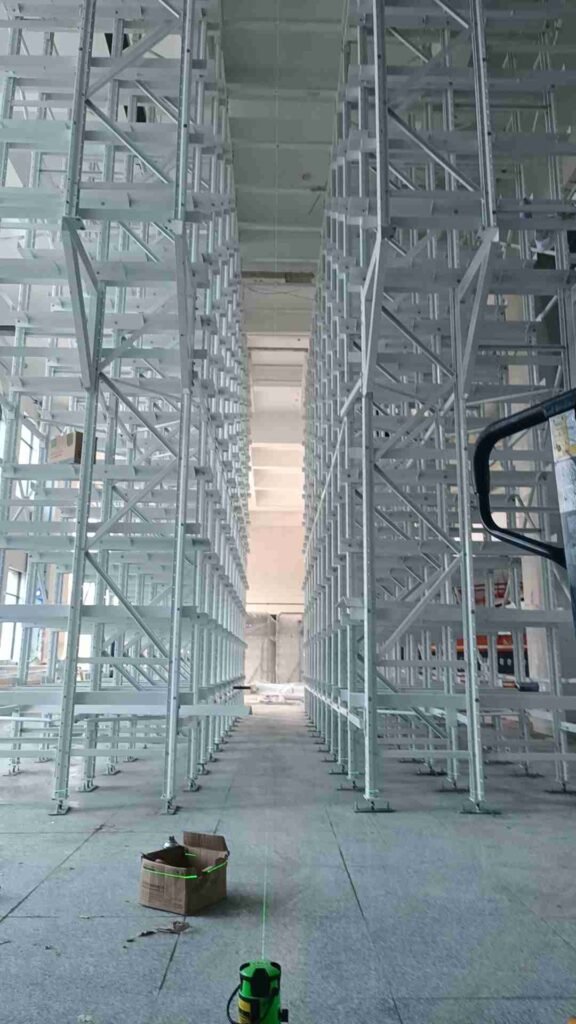
إن floor flatness must comply with ZBJ83015, Section 7.1. For racks installed using expansion anchor bolts :
Hole locations must be accurately positioned on the designated axes
Hole spacing errors must not exceed ±2 mm
For racks installed using adjustable steel base plates :
Each base plate’s elevation must be inspected
All base plate top surfaces must lie on the same reference plane
Height deviation must not exceed ±1 mm
Industry practice further emphasizes that for floor-mounted automated warehouses racks , the foundation must have sufficient bearing capacity (including for concentrated loads), and the foundation’s levelness deviation must not exceed the standard’s requirements. Floor flatness and rack installation tolerance are critical factors; if the rack is not installed level to within the tolerance specified by the equipment manufacturer, shuttle guide wheels experience uneven loading, leading to premature wear and potential failure.
بالنسبة لـ automated warehouses , ASRS and robot-guided systems typically require FF 75+ / FL 50+ for optimal performance in areas where equipment transitions between guided and unguided zones. أن FF rating of 50 is recommended for warehouses as a baseline. The industry standard for automation-ready warehouses is FF 35/FL 30 to FF 45/FL 35 depending on the type of automation and precision requirements. For high-rack storage and narrow-aisle operations, FF50/FL35 or higher is required. Robotics and automation environments require FF80+ in defined areas.
إن concrete floor slab in rack-supported buildings that integrate AS/RS must be thick enough to support the high roof heights that often accompany AS/RS. The engineer designing a rack-supported building must verify that the soil and concrete slab-on-grade can withstand the forces applied.
H3: Running Rail Installation Tolerances
إن running rails that guide stacker cranes must meet stringent tolerance requirements:
Vertical Bending (Table 1) :
| Measurement Length | Tolerance |
|---|---|
| Full length | ±3.0 mm |
| Stacker crane wheelbase length | ±1.5 mm |
| Rail joint (0.1 m each side) | ≤0.5 mm |
Horizontal Bending (Table 2) :
| Measurement Length | Tolerance |
|---|---|
| ≤100 m | ±2.0 mm |
| >100 m | ±3.0 mm |
| Stacker crane horizontal guide wheel wheelbase | ±0.5 mm |
| Rail joint (0.05 m each side) | ≤0.1 mm |
These rail tolerances are essential for smooth stacker crane operation in automated warehouses . Rail misalignment exceeding 2 mm over 10 m causes crane jerking and premature wheel wear. In high-throughput AS/RS installations , where stacker cranes operate 24/7, even minor rail misalignment can lead to significant maintenance costs and operational downtime.
H3: Guide Rail Tolerances
إن guide rails that keep stacker cranes aligned horizontally must meet these requirements:
| Measurement Length | Tolerance |
|---|---|
| ≤100 m | ±3.0 mm |
| >100 m | ±4.0 mm |
| Guide rail fixed distance ≥2 m | ±2.0 mm |
| Rail joint (0.1 m each side) | ≤0.5 mm |
إن distance between running rail and guide rail (l) must be within ±10 mm , and the horizontal misalignment (f) must not exceed 5 mm.
H3: Rack Frame Verticality for Automated Warehouses Racks
The verticality of rack frames along both the lane length و lane width directions (a and b) must meet the following:
| Control Method | Rack Frame Full Height | a and b Tolerance |
|---|---|---|
| Manual | ≤10 m | ≤12 mm |
| Manual | >10 m | ≤15 mm |
| Automatic | Full height | ≤10 mm |
Industry standards generally target verticality of 1/1000 of column height , meaning a 12-meter tall rack should have deviation not exceeding 12 mm, and a 15-meter rack not exceeding 15 mm. This precision is essential for proper stacker crane operation. For AS/RS installations , some specifications demand even tighter tolerances, with column verticality not exceeding H/1500.
بالنسبة لـ automated warehouses , فإن single column verticality deviation is typically controlled within 1 mm, and the rail straightness deviation is controlled within 0.5 mm/m. According to GB/T 39060-2020, فإن rack frame verticality deviation should be ≤ H/1000 and ≤10 mm (where H is the rack height), and the running rail horizontal misalignment should be controlled within ±1 mm.
H3: Beam Height Consistency
The height deviation of same-level load beams or crossbeams (e) must meet:
| Control Method | Tolerance |
|---|---|
| Manual | ±10 mm ( ±5 mm within same storage bay) |
| Automatic | ±5 mm |
The beam on the stacker crane side must be at equal or higher elevation than the opposite side, with the height difference ≤4 mm. This requirement ensures that loads are properly supported and that stacker crane forks can engage and disengage without interference.
H3: Additional Installation Tolerances
Additional installation requirements include:
Center-to-center distance of adjacent frame base columns (A): ±2 mm
B₁ and B₂ dimensions relative to track centerline: ±2 mm
Misalignment of same-lane, same-row frames : ≤5 mm
These tolerances ensure that the entire rack structure forms a consistent, predictable grid that stacker cranes can navigate reliably. In automated warehouses , where computer-controlled systems depend on consistent geometries, these tolerances are non-negotiable.
H2: The 20 Inspection Items Under JB/T 5323-2017 for Automated Warehouses Racks
The 2017 revision established 20 specific inspection items covering:
Structural Dimensions and Tolerances :
Each corbel/beam support height — ≤±1.5 mm same level, ≤3 mm/10 m cumulative. The purpose is to ensure corbel (beam support point) height consistency. Detection method: laser level or total station measuring corbel beam top surface elevation.
Each connection plate height — ≤±2 mm same column
Frame side and column bending — ≤L/1000, ≤5 mm
Frame base plate height differential — ≤2 mm/m² flatness
Column-to-base plate perpendicularity — ≤H/1000, ≤5 mm
Frame full height — ≤±5 mm
Frame width — ≤±3 mm
Rail System Installation :
Running rail top elevation — ≤±1.5 mm, joint step ≤0.5 mm
Running rail horizontal bending — ≤1 mm/m, ≤5 mm total
Guide rail horizontal bending — ≤0.5 mm/m, ≤3 mm total
Rail-to-guide rail vertical distance — ≤±1 mm
Rail-to-guide rail horizontal misalignment — ≤±1 mm
Installation Position and Fit :
Same-level beam height — ≤±2 mm
14-20. Additional fit and alignment checks
These 20 inspection items provide comprehensive coverage of all critical parameters for AS/RS rack installations . According to JB/T 5323-2017, the rack frame vertical deviation should not exceed 10 mm, same-level beam height deviation should be ±2 mm, adjacent rack frame column bottom center distance deviation should be ±2 mm, و same-lane same-row rack frame misalignment deviation should not exceed 5 mm.
H2: Marking, Packaging, Transport, and Storage of Automated Warehouses Racks
H3: Product Marking
Every rack must have a permanent metal nameplate affixed in a visible location, conforming to JB8 and including:
Rack height (m)
Number of storage positions
Storage bay dimensions (mm)
Unit load rated capacity (t)
Manufacturer name
Date of manufacture
This marking provides essential information for operators and maintenance personnel in automated warehouses , ensuring that racks are used within their design limits.
H3: Packaging and Transport
Rack frames must be shipped with dedicated fixing brackets and packaging. Frames must be stored vertically on their side in rack slots, securely tied down. Lifting points must be clearly marked. During lifting and transport, frames must not be impacted or deformed.
Proper packaging and transport are essential for ensuring that frames arrive at the AS/RS installation site in the same condition they left the factory. Damage during transport can compromise dimensional tolerances and structural integrity.
H3: Storage Conditions
Automated warehouses racks must be stored in environments free from rain, direct sunlight, and corrosive gases. The storage floor must be dry, level, and firm. Frames must be stored one-by-one vertically on their side — stacking is not permitted.
These storage requirements prevent damage and corrosion during the period between manufacturing and installation. For large AS/RS installations , where frames may be manufactured and stored before site preparation is complete, proper storage is essential.
H2: International Context and Comparisons for Automated Warehouses Racks Standards
H3: JB/T 5323 vs. European Standards
The European standard EN 15620 (Steel static storage systems — Adjustable pallet racking — Tolerances, deformations and clearances) addresses similar concerns. However, there are notable differences:
EN 15620 covers a broader range of rack types including adjustable pallet racking, narrow aisle racking, cantilever racking, and drive-in racking
JB/T 5323 is specifically focused on welded structures for automated warehouses
Tolerance values differ somewhat between the two standards, reflecting different design philosophies and operating conditions
Other relevant European standards include EN 15512 , which specifies structural design requirements for adjustable beam pallet rack systems, and FEM 10.2.06 و 10.2.07 , which provide European guidelines for shelving safety. FEM 9.831 standards are also applied for calculating the required number of cranes based on required picks per hour in automated racking systems.
H3: JB/T 5323 vs. North American Standards
In North America, MH16.1 from MHI specifies minimum requirements for the structural design, testing, and utilization of industrial steel storage racks, including those associated with automated storage and retrieval systems (ASRSs) . RMI’s ANSI MH16.1 standard notes that the rack’s design must accommodate not only the normal storage rack loads but also must withstand environmental loads including wind, snow, rain, roof live loads, and seismic loads.
إن CSA S345-2023 standard in Canada applies to free-standing, selective-type storage racks and AS/RS racks.
These international standards share many common principles with JB/T 5323 but differ in specific requirements and tolerances. For global AS/RS installations , understanding these differences is essential for ensuring compliance with local regulations.
H3: JB/T 5323 vs. Other Chinese Standards
JB/T 5323 is part of a family of Chinese warehousing standards :
JB/T 9018-2011 : Automated warehouse design specifications
JB/T 11270-2024 : Technical specifications for combined steel structure racks
GB/T 39060-2020 : Manufacturing and installation supervision technical requirements for automated warehouse equipment
GB/T 39681-2020 : Rack system design specifications for three-dimensional warehouses
JB/T 7016-1993 : Technical conditions for rail-guided stacker cranes
JB/T 10822-2008 : General rules for automated warehouse design
GB/T 39830-2021 : Seismic design code for steel static storage systems in automated warehouses
The national standard GB/T 39681-2020 has standardized the design of rack systems for three-dimensional warehouses and played a positive role in the development of China’s logistics storage equipment industry. JB/T 9018-2011 provides automated warehouse design specifications. GB/T 39060-2020 applies to steel structure racks, laneway stacker cranes, conveying and sorting equipment, and AGV equipment used in automated warehouses.
إن seismic design specifications for steel frame storage racks in automated warehouses include JB/T 5323-2017 و JB/T 11270-2011. GB/T 39830-2021 specifies the seismic design code for steel static storage systems under seismic action, covering general provisions, seismic design process, seismic action and structural seismic calculation, analysis methods, and structural requirements. This standard applies to steel structure racks and does not apply to racks made of other materials.
H2: The Future of Welded Rack Standards for Automated Warehouses
As automated warehouses continue to evolve, we can expect further refinements to JB/T 5323. Key trends shaping the future include:
Higher load capacities : Unit loads continue to increase, pushing the 3,000 kg limit
Taller racks : Automated warehouse heights are reaching 40+ meters, demanding ever-tighter tolerances
Automated guided vehicles (AGVs) : The integration of AGVs with rack structures introduces new alignment requirements
Sustainability : Greater emphasis on material efficiency and recyclability
Digital inspection : Laser tracking, drones, and 3D scanning are replacing manual measurement methods
Modular AS/RS : As AS/RS installations become increasingly modular and don’t require as much structural investment, the return on investment gap between AS/RS and other automation technologies is growing
Rack-supported buildings : Integrated rack-building structures are becoming more common, requiring new design and inspection approaches
Rack-supported buildings that integrate automated storage and retrieval (AS/RS) systems offer a range of benefits to distribution operations. Although a rack supported building’s design does not enable future reconfiguration should the operation’s intended use change, for a fully automated operation it can deliver several advantages. Integrating structural racks directly into the building’s framework allows facility operators to maximize storage density while reducing construction costs. With a rack supported building, the rack designer is required to incorporate wall girts, roof purlins, and ancillary framing within the racking structure.
Automated rack-supported buildings incorporating AS/RS such as stacker cranes for pallets leverage up to 45 meters of vertical space to store goods. According to automation industry surveys, AS/RS performance efficiency improves by 10–15% when installed in rack supported structures compared to traditional buildings. These systems are perfect for high-bay AS/RS installations reaching heights of 35 meters or more.
إن industrial racking system market continues to grow, with the Asia Pacific region expected to grow at a significant rate. The Asia Pacific Automated Storage and Retrieval System Market was valued at USD 3,666.4 million in 2025 and is projected to reach USD 5,891.1 million by 2030, representing a compound annual growth rate of 9.9%. The automated racking system market is projected to reach USD 2.64 billion by 2034 from USD 1.08 billion in 2025, expanding at a strong CAGR of 10.4%. The fixed automated racking system market is expected to grow from USD 4,710 million in 2025 to USD 10 billion by 2035, with a CAGR of approximately 7.8%.
Private equity activity in the material handling sector intensified in 2025, with investors targeting companies specializing in automation-ready racking and AS/RS-compatible infrastructure. This consolidation reflects confidence in long-term demand for high-throughput warehouses capable of supporting same-day and next-day delivery models. PE-backed firms are using capital infusions to expand engineering capabilities, standardize modular designs, and scale manufacturing capacity. For end users, this consolidation is resulting in more integrated solutions where racking, shuttles, conveyors, and software are delivered as a unified system rather than discrete components.
Fast-paced innovation is making high-tech warehouse solutions available to a wider audience, changing the face of automated storage and retrieval systems . Technology is advancing rapidly, and these self-contained automated systems are becoming more flexible and affordable, making them accessible to a wider array of end-users.
H2: Conclusion
إن JB/T 5323 standard represents the culmination of decades of engineering experience in the design, fabrication, and installation of welded steel structure racks لـ automated three-dimensional warehouses . From the selection of Q235 and 16Mn steels to the precise control of welding parameters , from the tight dimensional tolerances of rack frames to the meticulous installation of running rails and guide rails, this standard provides the comprehensive technical framework necessary to ensure that automated storage systems operate safely, reliably, and efficiently.
بالنسبة لـ warehouse owners , compliance with JB/T 5323 is not merely a regulatory checkbox—it is a fundamental investment in operational safety, equipment longevity, and business continuity . A rack system that meets these exacting standards will deliver decades of dependable service, while a system that cuts corners on these requirements invites catastrophic failure. In automated warehouses , where downtime can cost thousands of dollars per hour, the value of proper rack specification and installation cannot be overstated.
بالنسبة لـ engineers and specifiers , JB/T 5323 provides the technical language and performance criteria needed to communicate requirements clearly and unambiguously to suppliers and contractors. The standard’s detailed tolerance tables, inspection protocols, and material specifications leave no room for ambiguity. For AS/RS installations , where every millimeter counts, this clarity is essential.
بالنسبة لـ installers and inspectors , the standard provides clear, measurable criteria against which work can be evaluated. The two-stage sampling plan, the specified measurement methods, and the calibration requirements ensure that quality is not left to subjective judgment. In automated warehouses , where racks must perform flawlessly for decades, objective quality criteria are indispensable.
As the warehousing industry continues its relentless march toward greater automation, taller structures, and heavier loads , the importance of standards like JB/T 5323 will only grow. These standards are the silent guardians of automated warehouse safety—unseen but essential, technical but vital. Whether specifying a new AS/RS installation , evaluating an existing system, or simply seeking to understand the technical foundation of modern automated warehousing , a thorough grasp of JB/T 5323 is indispensable.
الأسئلة الشائعة
Q1: Is JB/T 5323-1991 still valid, or must I use JB/T 5323-2017 for automated warehouses racks?
JB/T 5323-2017 officially superseded the 1991 version on July 1, 2017. While the 1991 version contains valuable technical information, all new specifications, procurements, and inspections should reference the 2017 version . The 1991 standard is considered obsolete for regulatory and compliance purposes. For AS/RS installations , using the current standard is essential for ensuring compliance with modern safety and performance requirements.
Q2: Can JB/T 5323 be applied to combination (bolted) rack systems in automated warehouses?
إن JB/T 5323 standard specifically addresses welded steel structure racks. For combined/assembled (bolted) rack systems, the related standard JB/T 11270-2024 (立体仓库组合式钢结构货架技术规范) should be referenced. This newer standard, published on March 29, 2024, and effective from October 1, 2024, specifies technical requirements for beam-type and corbel-type combined steel structure racks. However, many principles from JB/T 5323—particularly regarding installation tolerances and inspection methods—are also applicable to assembled systems in automated warehouses . For modular AS/RS installations , both standards may be relevant.
Q3: What happens if my rack frames exceed the dimensional tolerances specified in JB/T 5323 for an AS/RS installation?
Exceeding the specified tolerances can have serious consequences for automated warehouses . Frame verticality exceeding L/1000 can cause stacker cranes to bind or misalign, leading to accelerated wear , product damage , or even derailment. Beam height deviations can cause uneven load distribution و pallet instability . If tolerances are exceeded during factory inspection, the frames must be rejected or reworked . If exceeded during installation, corrective action must be taken before the AS/RS installation is commissioned. As experts note, if rack tolerances are significantly off, loads could be deposited into a beam, upright, or the wrong storage location.
Q4: How often should installed racks in automated warehouses be re-inspected for compliance with JB/T 5323?
While the standard does not specify a recurring inspection interval, industry best practice recommends:
Annual visual inspections of all structural members, welds, and coatings
Periodic verticality checks (every 2–3 years or after any significant impact event)
Rail alignment inspections as part of regular stacker crane maintenance
Full load testing after any modification, seismic event, or major impact
Many facilities also perform post-seismic inspections following any earthquake that could have affected structural integrity. For high-throughput automated warehouses , more frequent inspections may be warranted.
Q5: What are the most common causes of JB/T 5323 non-compliance in the field for AS/RS installations?
Based on industry experience, the most frequent compliance issues in automated warehouses include:
Foundation settlement causing frame verticality to drift out of specification
Rail joint misalignment due to thermal expansion or inadequate anchoring
Bolt loosening in assembled sections of otherwise welded systems
Coating degradation leading to corrosion at weld joints
Improper measurement technique using uncalibrated or inconsistent instruments
Beam height drift due to overload or improper load distribution
Preventing these issues requires proper installation , regular maintenance , و use of calibrated measuring instruments as mandated by the standard. For AS/RS installations , where precision is paramount, attention to these details is essential for long-term reliability.
Geelyracks specializes in the production of warehouse racks and is a global rack customization expert: https://geelyracks.com/
إذا كنت تحتاج إلى رسومات CAD مثالية وعروض أسعار لأرفف المستودعات, يرجى الاتصال بنا. يمكننا أن نوفر لك خدمات تخطيط وتصميم أرفف المستودعات مجاناً وخدمات التصميم وعروض الأسعار. عنوان بريدنا الإلكتروني هو: jili@geelyracks.com