📐 "First 50 Enterprise Queries Get Custom 3D Warehouse Design" Plan
















The Warehouse Efficiency Revolution
In an era where supply chain speed and cost efficiency make or break businesses, shuttle racking systems have emerged as the gold standard for modern warehousing. These intelligent storage solutions aren’t just another rack configuration—they’re complete operational overhauls that systematically eliminate inefficiencies. For distribution centers battling labor shortages, 3PLs squeezed by razor-thin margins, or manufacturers needing faster throughput, shuttle racking delivers measurable, bankable results.
What separates industry leaders from competitors isn’t just adopting automation, but choosing the right type. Semi-automatic shuttle racking provides the perfect balance of human oversight and mechanized precision for mid-sized operations, while fully automatic shuttle systems integrate seamlessly with robotic fleets in high-volume environments. Both share one undeniable advantage: they typically reduce direct labor requirements by 50% or more within the first operational year.
1. The Labor Cost Crisis in Modern Warehousing
1.1 Why Traditional Storage Systems Bleed Money
Conventional selective racking forces forklifts to:
Navigate narrow aisles at slow speeds
Require highly skilled (and highly paid) operators
Create bottlenecks during peak shifts
A 2023 MHI report shows labor consumes 60-70% of total warehouse operating costs—with turnover rates exceeding 40% in material handling roles. This creates a double penalty: constant retraining expenses compounded by productivity drops.
1.2 How Shuttle Racking Changes the Equation
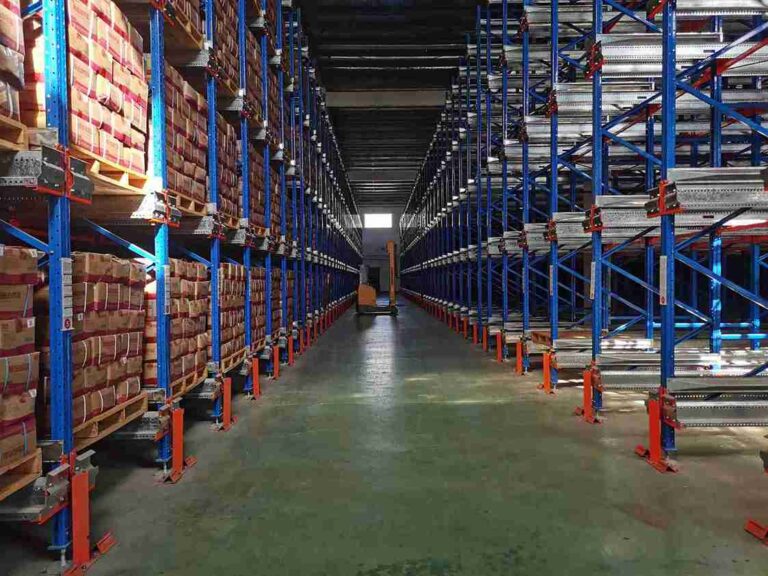
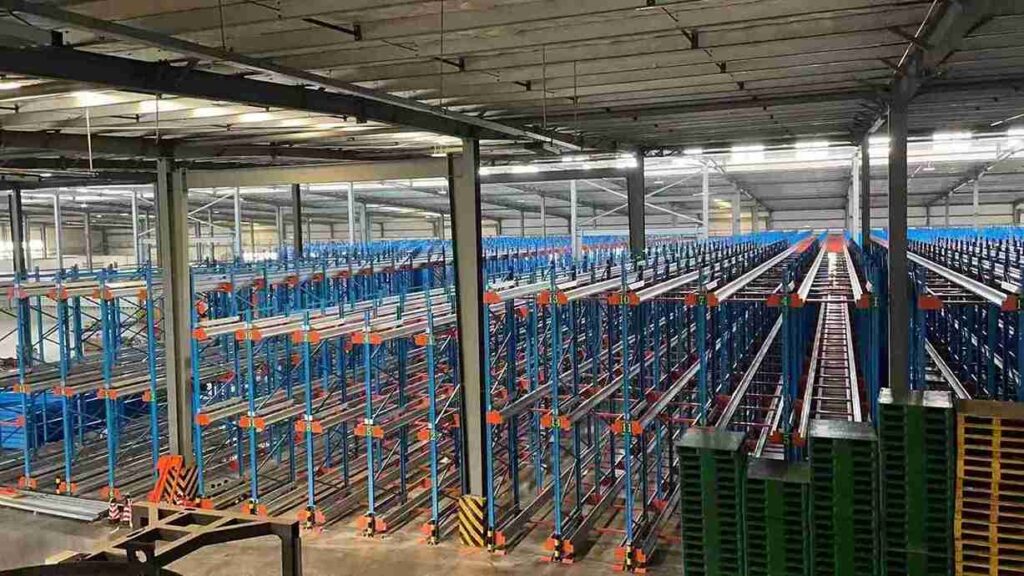
By deploying automated pallet shuttles that operate within the rack structure itself, facilities:
Reduce forklift aisle entries by 80-90%
Cut required operator headcount by half
Achieve consistent throughput regardless of staff experience levels
Real-world example: A Midwest automotive parts distributor replaced 14 manual reach trucks with 5 forklifts working alongside a semi-automatic shuttle racking system, slashing annual labor costs from $1.2M to $580,000 while improving daily throughput by 35%.
2. Engineering Breakdown: How Shuttle Racking Systems Work
2.1 Core Mechanical Components
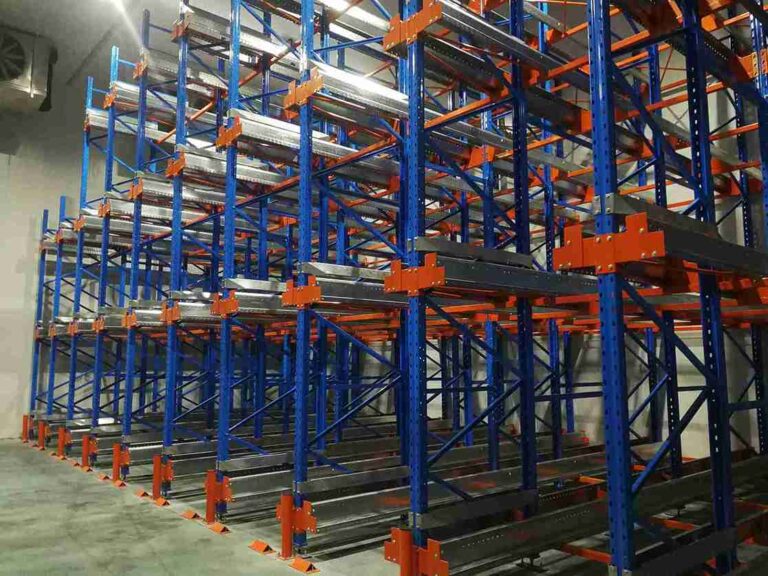
Unlike static racking, shuttle racking systems incorporate:
Motorized shuttles (capacity from 1,500kg to 3,000kg)
Rail guidance systems with millimeter precision
RFID/optical sensors for position control
Interchangeable battery packs (4-8 hour runtime)
2.2 The Loading/Unloading Sequence
Forklift places pallet at lane entry point
Shuttle automatically positions itself under load
Motorized rollers transfer pallet onto shuttle platform
Shuttle travels at 1.0-1.5m/s to designated depth
Reverse process occurs for retrieval
This eliminates the most labor-intensive aspects of LIFO (Last-In-First-Out) inventory management.
3. Cost Analysis: Calculating Your 50% Savings
3.1 Direct Labor Reductions
A typical shuttle racking installation affects three cost centers:
| Position | Before Shuttle | After Shuttle | Reduction |
|---|---|---|---|
| Forklift Operators | 10 @ $45,000/yr | 4 @ $45,000/yr | $270,000 |
| Order Pickers | 8 @ $38,000/yr | 3 @ $38,000/yr | $190,000 |
| Supervisors | 2 @ $65,000/yr | 1 @ $65,000/yr | $65,000 |
| Total Annual Savings | $525,000 |
3.2 Indirect Cost Benefits
Energy savings: Fewer forklifts = lower electricity/gas costs
Maintenance: Shuttles require less upkeep than lift trucks
Damage reduction: Automated handling cuts product losses by 3-5%
4. Choosing Between Semi-Auto vs. Full Automation
4.1 Semi-Automatic Shuttle Racking Advantages
Lower capital expenditure (30-40% less than full automation)
Gradual implementation possible
Better for mixed SKU environments
Best for: Warehouses with < 50 pallet moves/hour
4.2 Fully Automatic System Capabilities
Direct integration with WMS/ERP
Autonomous charging stations
Predictive maintenance alerts
Best for: Facilities with > 100 pallet moves/hour
5. Integration With Existing Operations
5.1 Retrofitting Current Racking
Many assume shuttle racking requires complete warehouse redesigns. In reality:
60% of installations modify existing structures
Typical retrofit takes 3-6 weeks
ROI often achieved in 18-24 months
5.2 Software Requirements
Modern shuttle racking controllers interface with:
SAP EWM
Oracle WMS
Manhattan Associates
Custom systems via API
6. Industry-Specific Applications
6.1 Cold Storage Facilities
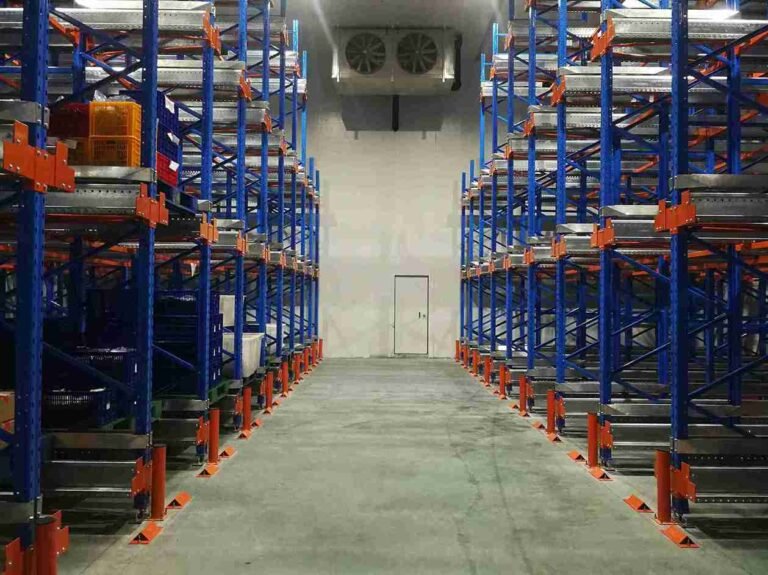
Shuttle racking maintains -25°C to -30°C operation
Eliminates need for personnel in freezer aisles
Specialized lubricants prevent mechanical freezing
6.2 Automotive Manufacturing
Handles oversized pallets (up to 3,000kg)
Withstands vibration from nearby presses
Custom shuttle speeds for JIT delivery
7. Maintenance & Longevity Considerations
Properly maintained shuttle racking systems deliver:
15-20 year operational lifespan
<1% annual downtime
Modular component replacement
Critical maintenance intervals:
Weekly: Rail alignment checks
Monthly: Battery performance tests
Annually: Full system diagnostics
8. Getting Started With Your Shuttle Racking Project
8.1 Facility Assessment Checklist
Current pallet dimensions/weights
Peak vs. average throughput needs
Future expansion plans
Power infrastructure capacity
8.2 Implementation Timeline
Design phase: 2-4 weeks
Shuttle racking fabrication: 6-8 weeks
Installation: 3-6 weeks
Testing/training: 2 weeks
9. Why Leading Warehouses Choose Our Shuttle Racking Solutions
Patented anti-jam technology (3x more reliable than competitors)
Custom shuttle configurations for odd-sized loads
24/7 remote monitoring included
500+ successful installations worldwide
10. Take the First Step Toward 50% Labor Savings
Request your customized shuttle racking proposal today:
📧 Email: [jili@geelyracks.com]
🌐 Online Assessment: https://geelyracks.com
FAQs
Q: How does shuttle racking handle different pallet sizes?
A: Adjustable shuttle platforms accommodate Euro, standard, and custom pallets (400-1600mm widths).
Q: What happens during power outages?
A: Systems include manual override modes and backup power options.
Q: Can shuttles operate on inclined racking?
A: Specialized models handle up to 5° inclines for multi-level facilities.
Q: What safety features are included?
A: Laser obstacle detection, emergency stops, and load sensors prevent accidents.
Q: How quickly can we expand the system?
A: Additional shuttles integrate within days; rack extensions take 2-4 weeks.
Conclusion: The Future-Proof Warehouse Starts Here
The arithmetic of modern warehousing leaves no room for debate—shuttle racking systems represent the most impactful ROI opportunity for labor-intensive facilities. Beyond the dramatic cost savings, these systems provide scalability that traditional racking simply cannot match. Operations implementing semi-automatic shuttle racking today position themselves to transition seamlessly to full automation as volumes grow.
For operations managers tired of staffing shortages eroding profitability, the solution isn’t higher wages or longer hours—it’s reengineering storage operations around intelligent shuttle technology. The only question remaining is how soon your facility will join the thousands already benefiting from 50% labor reductions and unprecedented operational consistency.
Welcome to contact us, if you need warehouse rack CAD drawings. We can provide you with warehouse rack planning and design for free. Our email address is: jili@geelyracks.com