📐 "First 50 Enterprise Queries Get Custom 3D Warehouse Design" Plan
















A. The Foundational Imperative: Why Cold Chain Logistics Demands Specialized Engineering
The global cold chain logistics market is propelled by an insatiable demand for perishable goods, pharmaceuticals, and premium consumables. In regions like Southeast Asia and the Middle East, this growth is exponential, driven by rising incomes, urbanization, and expanding export economies. However, the infrastructure supporting this growth—the cold storage warehouse—faces a unique and brutal set of environmental adversaries. Standard industrial storage solutions, designed for benign, temperate environments, are catastrophically inadequate here.
The marriage of intense heat, profound humidity, saline or polluted atmospheres, and the inherent physical stresses of sub-zero operations creates a perfect storm of degradation. This is not merely a question of corrosion on paint; it is a fundamental challenge to structural integrity, operational safety, and long-term profitability. Investing in a narrow aisle racking for cold chain application is not an upgrade; it is a non-negotiable prerequisite for any serious operator.
The correct narrow aisle racking for cold chain systems serve as the engineered backbone of the entire facility, dictating its storage density, its compatibility with modern automation, and ultimately, its resilience against the climatic onslaught. A failure in this critical component risks not just product loss, but operational collapse, brand reputation damage, and severe financial liability. Therefore, selecting a narrow aisle racking for cold chain solution is the single most important capital expenditure decision a cold chain operator will make, setting the trajectory for decades of operation.
B. Deconstructing the Environmental Adversary: A Climatological Threat Assessment
To understand the engineering required, one must first comprehend the enemy. The challenges differ subtly between the humid tropics of Southeast Asia and the arid, dusty climates of the Middle East, but their destructive synergy with cold storage is equally potent.
1. The Humidity and Condensation Onslaught (Southeast Asia Focus):
In cities like Jakarta, Bangkok, or Manila, ambient relative humidity consistently exceeds 80%, with temperatures hovering around 30-35°C year-round. When this moisture-laden air infiltrates a -25°C freezer, the physics are unforgiving. Water vapor instantly condenses, forming ice on every exposed surface. This process is continuous, driven by door openings, personnel movement, and imperfect seals. For a storage system, this means a perpetual cycle of wetting and freezing at connection points, upright bases, and beam ends.
Ordinary powder coatings, micron-thin and often applied over inadequately prepared steel, develop micro-cracks. Moisture seeps beneath, initiating rust that remains hidden until it blossoms into a structural concern. This environment makes the specification for any narrow aisle racking for cold chain in the region exceptionally stringent; it must be hermetically sealed against moisture ingress at a metallurgical level.
2. The Thermal Cycling and Physical Stress Dynamic:
Steel, the core material of racking, expands and contracts with temperature changes. A narrow aisle racking for cold chain system exists in a state of permanent contraction within the freezer. However, adjacent areas like loading docks or transfer zones may be at +5°C. Sections of racking near doors experience gradients and cyclical stress. Over thousands of cycles, this can lead to metal fatigue at stress points if the system is not designed for such dynamics.
Furthermore, the act of placing a -25°C pallet onto a beam causes a localized thermal shock. The connection systems—bolts, locks, and wedges—must maintain their clamping force and integrity despite these constant, subtle movements. A generic racking system lacks the engineering tolerances for this, leading to loosening, rack sway, and potential instability in the tight confines of a narrow aisle racking for cold chain setup, where clearances are measured in millimeters.
3. The Corrosive Atmospheric Assault (Middle East Focus):
The challenge in the Gulf Cooperation Council (GCC) states and similar arid regions is multifaceted. First, the extreme temperature differential—from +50°C outdoors to -25°C indoors—is among the most severe on earth, exacerbating thermal stress. Second, the atmosphere is laden with fine, abrasive sand and dust. During seasonal Shamal winds, this dust infiltrates every opening. When combined with minimal condensation, it forms a corrosive, abrasive paste. Third, coastal facilities face salt aerosol corrosion.
A standard painted rack will see its coating sandblasted away and its base steel attacked by chlorides. For a narrow aisle racking for cold chain facility in Jeddah, Dubai, or Doha, the protective system must be as much about abrasion resistance and chemical inertness as it is about moisture barrier.
4. The Economic Driver: Cube Utilization is King:
Beyond the environmental battle lies the commercial imperative. Refrigerated space is astronomically expensive to construct and, more critically, to operate. Energy costs for refrigeration can constitute 60-70% of a facility’s operating expenditure. Therefore, maximizing storage density—the number of pallet positions per cubic meter—is directly tied to profitability. This is the core promise of a narrow aisle racking for cold chain configuration. By drastically reducing the aisle width required for material handling equipment, it transforms the warehouse cube from an air-filled volume into a revenue-generating asset.
In a new build, optimal narrow aisle racking for cold chain design can reduce the required building volume by over 30%, slashing construction costs and creating a smaller, more efficient thermal envelope to cool. In a retrofit, it can increase capacity within the same walls by 50% or more, deferring the need for costly expansion.

C. The Anatomy of Resilience: Component-Level Engineering for Survival
A racking system is only as strong as its most vulnerable component. Engineering a narrow aisle racking for cold chain system for tropical and arid climates requires a defense-in-depth strategy, where every element is specified to exceed the environmental demands.
1. Metallurgical and Coating Science: The Primary Barrier:
Substrate Superiority: The journey begins with the steel. High-strength, low-alloy (HSLA) steel is preferred for its superior structural properties and inherent corrosion resistance compared to standard carbon steel. Its chemical composition provides a better starting point for the protective systems to follow.
Surface Preparation – The Make-or-Break Step: The most advanced coating is useless without perfect adhesion. The steel must be abrasive-blasted to a “near-white metal” finish (Sa 2.5 standard), removing all mill scale, rust, and contaminants. This creates an angular profile that mechanically locks the coating in place.
The Unbeatable Duo: Hot-Dip Galvanization + Hybrid Powder Coat: This is the industry gold standard for severe environments and is considered non-negotiable for a reliable narrow aisle racking for cold chain. The process:
Hot-Dip Galvanization: The entire structural component is immersed in a bath of molten zinc at ~450°C. This creates a metallurgical bond, forming a series of zinc-iron alloy layers topped by pure zinc. This coating provides sacrificial protection; if scratched, the zinc corrodes preferentially to the steel, halting rust progression. It also offers complete, uniform coverage, including edges and hard-to-reach internal surfaces of hollow sections.
Epoxy-Polyester Powder Coating: After galvanizing, a thick (typically 80-120 microns) layer of powder coat is applied electrostatically and cured. Epoxy-polyester hybrids offer excellent adhesion, flexibility (to accommodate thermal movement), and resistance to chemicals and moisture. The color (often white for light reflection) is also a functional choice. This dual-layer system provides a predictable service life of 25+ years, whereas a single coating in a tropical cold store may fail in under a decade.
2. Frost-Proof and Vibration-Resistant Structural Design:
Cold-Temperature Certification: The steel’s mechanical properties (yield strength, tensile strength) must be certified for performance at the facility’s lowest operating temperature (e.g., -30°C or lower). This ensures the material does not become brittle.
Connection Philosophy – Eliminating Weak Links: The points where beams connect to uprights are critical. Systems favored for narrow aisle racking for cold chain applications often use:
Wedge-Bolt or Locking Pin Systems: These create connections that become tighter under vertical load, are inherently resistant to vibration loosening, and have fewer small parts that can be dropped or lost in a cold environment.
Precision Torque Procedures: For traditional bolted systems, specific torque values are mandated and must be applied after the racking has acclimatized to the operating temperature, using calibrated tools. Locking nuts are standard.
Reinforced Upright Design: Upright columns are the spine of the system. For a narrow aisle racking for cold chain, they are often of a box-section or reinforced open-back design. The gauge is increased at the critical base section (the first 500-1000mm), where impact risk from equipment and moisture accumulation are highest. Perforations for beam connections are laser-cut to prevent stress concentrators and are positioned to maintain structural integrity.
High-Capacity, Sealed Beam Design: Load beams are not simple roll-formed C-channels. They are complex, box-style beams or beams with integrated locking mechanisms. Their design prevents the internal collection of moisture or dust, which could freeze and expand or cause internal corrosion. Their torsional stiffness is critical for stability in high-bay narrow aisle racking for cold chain applications.
3. The Density Equation: Configuring the Aisle for Maximum ROI:
The term “narrow aisle” encompasses a spectrum, each with specific equipment partnerships:
Narrow Aisle (NA) – 1.6m to 2.0m aisles: Served by man-down reach trucks. This configuration offers a significant density improvement over traditional wide aisles while retaining some flexibility. However, it requires human operators in the cold environment, posing challenges for welfare and efficiency.
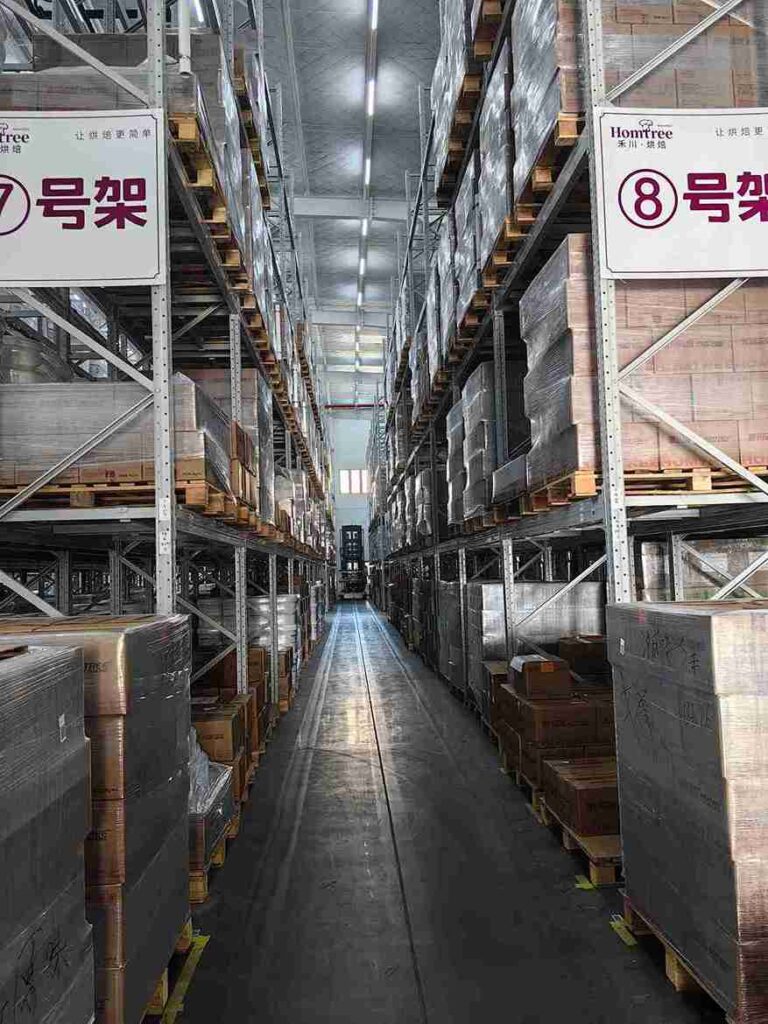
Very Narrow Aisle (VNA) – 1.2m to 1.6m aisles: The domain of man-up turret trucks or automated storage and retrieval systems (AS/RS). This maximizes density. The operator’s cab can be heated and insulated. Guidance is via wire, rail, or laser, ensuring pinpoint accuracy essential for the tight clearances of a narrow aisle racking for cold chain.
The Automation-Driven Aisle – 1.2m and below: This is the frontier, served by fully automated stacker cranes or Automated Guided Vehicles (AGVs). Here, the narrow aisle racking for cold chain system is part of a fully integrated mechatronic system. The racking must be installed with laser-level precision to serve as the physical “rail” for the automation. This configuration delivers the highest density, eliminates human exposure to cold, and offers 24/7 operational capability.
4. Integration with Cold-Optimized Material Handling Equipment (MHE):
The racking and the MHE are a symbiotic pair. Specifying a narrow aisle racking for cold chain dictates the type of equipment needed.
Cold-Store Forklift Specifications: Equipment must be “cold-store specified,” with special hydraulic oils, lubricants, and electronic components rated for low-temperature operation. Batteries require thermal management systems. Tires are made of non-marking, cold-pliable compounds.
The AGV/AMR Advantage: For a narrow aisle racking for cold chain, AGVs and Autonomous Mobile Robots (AMRs) present a compelling solution. They remove the human factor from the harsh environment, can operate in pitch darkness (saving lighting energy), and their movements are precisely programmed and repeatable, drastically reducing the risk of impact damage to the racking. A well-designed narrow aisle racking for cold chain system for automation will include integrated guidance targets, reinforced uprights at aisle ends, and often a dedicated “service aisle” for maintenance access without disrupting the automated storage aisles.
Pallet Shuttle Systems for Ultra-Dense Storage: Within the narrow aisle racking for cold chain framework, individual lanes can be fitted with autonomous pallet shuttles. These battery-powered carts run on rails inside the racking, allowing for deep-lane storage (10+ pallets deep) with random accessibility. This is ideal for high-volume, slower-moving SKUs, pushing storage density to its absolute physical limit.
D. The Digital and Control Layer: Where Physical Infrastructure Meets Intelligence
A modern narrow aisle racking for cold chain facility is a data-driven engine. The physical racking is the hardware; the software is its operating system.
Warehouse Management System (WMS) Integration: The racking layout is first optimized within WMS simulation tools. The software determines putaway logic, picking strategies, and slotting optimization based on turnover (FIFO, FEFO for perishables). The physical narrow aisle racking for cold chain is the execution arm of this digital plan.
Warehouse Control System (WCS) / Warehouse Execution System (WES): This middleware is the traffic controller, especially critical in automated facilities. It receives orders from the WMS and directly controls the AGVs, conveyors, and pallet shuttles, coordinating their movements within the narrow aisle racking for cold chain matrix to maximize throughput and avoid conflicts.
IoT and Condition Monitoring: Sensors can be mounted on the narrow aisle racking for cold chain structure itself. These can monitor ambient temperature at different heights (identifying stratification), track inventory via RFID, or even, in advanced setups, use strain gauges to monitor load conditions on specific beams, feeding predictive maintenance data.

E. Regional Application Deep Dives: Tailoring the Solution
1. Southeast Asia: Combating Humidity in Food & Pharma Hubs:
A seafood processing plant in Vietnam requires a narrow aisle racking for cold chain for its -30°C blast freezers. The priority is defeating humidity and ensuring fast throughput for export orders. The solution: A VNA configuration with galvanized & coated racking. To mitigate condensation drip, closed-top racking designs or drip trays are specified. The facility employs a fleet of cold-store AGVs that transfer pallets from blast freezing tunnels directly into the racking, guided by lasers reflecting off targets mounted on the narrow aisle racking for cold chain uprights. The result is a “lights-out” freezer with maximized density, zero operator exposure, and a perfect audit trail for quality certification.
2. The Middle East: Pharmaceutical Distribution in Arid Climates:
A pharmaceutical distributor in Saudi Arabia needs a compliant, high-security cold store (+2°C to +8°C) for vaccines and biologics. The challenge is dust ingress, power stability, and unbroken temperature control. The narrow aisle racking for cold chain system here uses the same robust coating for dust abrasion resistance. The racking layout incorporates dedicated, secure cages within the structure for high-value products. The entire system is integrated with a battery-backed monitoring system. The narrow aisles, serviced by electric reach trucks, maximize the use of the expensive, highly insulated building, while the racking’s protective finish ensures no particulate contamination from the structure itself.
F. Total Cost of Ownership: The Long-Term Financial Calculus
Evaluating a narrow aisle racking for cold chain system on purchase price alone is a profound error. The correct analysis is Total Cost of Ownership (TCO) over a 20-25 year lifespan.
Capital Expenditure (CapEx): The engineered system has a higher initial cost.
Operational Expenditure (OpEx) Savings:
Energy: High-density storage reduces the volume to cool. A 30% smaller thermal envelope can translate to a 25-40% reduction in refrigeration energy costs, a saving that compounds annually.
Maintenance: The durable finish eliminates repainting. Robust design minimizes corrective repairs.
Labor & Productivity: Automation and efficient layouts increase pallet moves per man-hour. In automated narrow aisle racking for cold chain, labor is redeployed to supervisory roles outside the cold.
Risk Mitigation & Avoided Cost:
Avoided Product Loss: No collapse, no spoilage from downtime.
Avoided Premature Replacement: A standard system may need total replacement in 8-10 years. The engineered system lasts the life of the facility.
Insurance & Liability: A professionally engineered and certified narrow aisle racking for cold chain system can lead to lower insurance premiums and minimizes liability risk.
When modeled using Net Present Value (NPV) calculations, the premium narrow aisle racking for cold chain solution invariably demonstrates a superior financial return, with payback periods often falling between 3-5 years based on energy and productivity gains alone.
G. Implementation: The Critical Path from Design to Operation
The installation of a narrow aisle racking for cold chain is a specialized discipline.
Temperature-Equilibrated Installation: The racking must be assembled after the cold room is brought to its operational temperature. Assembling at ambient temperature and then cooling causes contraction that can overstress connections.
Precision Alignment: Using laser total stations, installers verify that uprights are plumb, beams are level, and aisles are straight within tolerances of ±3mm over 50 meters. This is critical for the smooth operation of VNA trucks and AGVs.
Phased Commissioning: For retrofits or large facilities, the installation and commissioning are done in phases to minimize disruption to live operations. The new narrow aisle racking for cold chain zone is built, tested, and brought online before decommissioning the old section.
H. Conclusion: The Strategic Infrastructure Decision
In the high-stakes, fast-growth markets of Southeast Asia and the Middle East, cold chain logistics is a competitive battlefield. Reliability is the currency of trust, and efficiency is the engine of profit. The storage system is the foundational element upon which both are built. Opting for a generic storage solution in these punishing climates is an exercise in deferred cost and accumulated risk. It introduces a critical point of failure into the heart of the operation.
Conversely, investing in a properly engineered narrow aisle racking for cold chain system is an investment in foundational resilience and long-term competitive advantage. It is a decision that:
Secures Assets: Protecting valuable inventory from loss due to structural failure.
Maximizes Profitability: Transforming expensive cubic space into revenue-generating density.
Future-Proofs Operations: Creating a physical platform ready for the integration of automation and digital management.
Mitigates Risk: Providing peace of mind through engineered durability and professional support.
For executives, warehouse managers, and investors, the question is clear: Will your cold storage facility be defined by its constant battle against environmental decay and spatial inefficiency, or will it be defined by the intelligent, resilient engineering of its core infrastructure? The choice of narrow aisle racking for cold chain is the definitive answer to that question, separating industry leaders from the rest in the world’s most demanding logistical environments.
FAQs
1. Q: We have an existing cold store with wide aisles and counterbalance forklifts. Is converting to a narrow aisle racking for cold chain system feasible, and what does the process entail?
A: Conversion is not only feasible but often the most cost-effective path to capacity expansion. The process is methodical: First, a structural engineer assesses the floor slab’s load-bearing capacity for the higher point loads of dense storage. Second, a detailed survey of the existing refrigeration system is conducted; increasing density can affect air circulation, potentially requiring fan adjustments.
Third, a phased implementation plan is developed. Typically, a new section of narrow aisle racking for cold chain is installed in a portion of the warehouse. Once operational, inventory is transferred, and the old racking is dismantled to make space for the next phase. This “rolling” retrofit minimizes operational downtime. The new MHE (reach trucks or AGVs) is phased in alongside the new racking.
2. Q: How does the weight of the protective coating (galvanization + powder coat) affect the load-bearing capacity of the narrow aisle racking for cold chain?
A: This is an excellent technical question. The added weight of the zinc and polymer coating is factored into the structural calculations from the outset by professional engineers. The steel sections are specified with sufficient inherent strength to carry both their own weight (including the coating) and the designated live loads (palletized goods). The coating does not reduce the rack’s rated capacity; rather, the rack is designed from the beginning for its final, coated state. The engineering drawings and load certifications provided for a proper narrow aisle racking for cold chain system will always reflect the as-built specification, including all protective finishes.
3. Q: For a multi-temperature distribution center (with ambient, chill, and freeze zones), should we use different racking specifications in each zone?
A: While it is technically possible to use a lower specification in the ambient zone, best practice and long-term operational simplicity strongly favor using the same high-specification narrow aisle racking for cold chain system throughout all temperature zones. The chill zone (+2°C to +4°C) is often the most corrosive due to frequent door openings and high humidity, justifying the robust coating. Using a uniform system across the facility simplifies spare parts inventory, allows for flexible re-slotting of inventory between zones, and provides a consistent, predictable lifespan for the entire storage asset. The incremental material cost is outweighed by the benefits of standardization and risk elimination.
4. Q: What is the protocol for inspecting and maintaining a narrow aisle racking for cold chain system, and how often should it be done?
A: A proactive maintenance regimen is essential. We recommend a formal, bi-annual integrity audit conducted by qualified personnel. This audit includes:
Visual Inspection: Checking for any visible damage, significant corrosion, or deformation.
Torque Check: Using a calibrated torque wrench to verify critical bolt connections according to the manufacturer’s specifications.
Plumb and Level Check: Ensuring uprights have not been knocked out of alignment.
Beam Lock/Connection Engagement Check: Verifying all safety locks are fully engaged.
Column Guard and End-of-Aisle Protection Inspection: Ensuring all impact protection devices are secure and undamaged.
Any damage from impacts must be assessed immediately, and the affected area must be off-limits until repaired with genuine, certified components. A digital log of all inspections and repairs should be maintained.
5. Q: How do you address the specific challenge of frost buildup on the narrow aisle racking for cold chain interfering with automated vehicle guidance systems?
A: This is a critical integration challenge in automated cold stores. The solution is multi-layered:
Racking Design: Minimizing horizontal surfaces on the racking itself where thick frost can accumulate. Using upright profiles that shed frost.
Target Placement: Positioning laser reflectors or other guidance targets on the narrow aisle racking for cold chain at points less prone to heavy frosting (e.g., higher up, away from direct air flow from evaporators).
Vehicle-Side Solutions: Employing AGVs or stacker cranes with heated and sealed sensor housings. Using sensor fusion technology (combining lasers, cameras, and inertial guidance) so the system can maintain location even if one sensor path is temporarily obscured.
Operational Management: Staggering defrost cycles of different evaporator coils to prevent simultaneous heavy frost fall across all aisles. Maintaining slight positive air pressure in the cold room to reduce moisture ingress.
The integration contract between the narrow aisle racking for cold chain supplier and the automation provider must explicitly address and test these scenarios during the commissioning phase.
If you require perfect CAD drawings and quotes for warehouse racking, please contact us. We can provide you with free warehouse racking planning and design services and quotes. Our email address is: jili@geelyracks.com