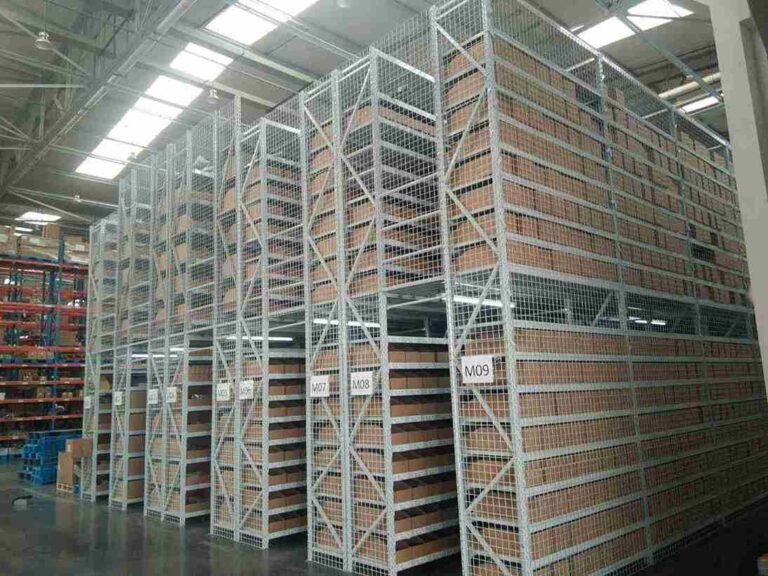
📐 "First 50 Enterprise Queries Get Custom 3D Warehouse Design" Plan
















The Strategic Imperative: Mastering Very Narrow Aisle Racking Integration for Unassailable Competitive Advantage
In the high-stakes arena of global logistics, where every square meter and every minute translates directly into cost or profit, a singular solution has repeatedly proven its transformative power: the very narrow aisle racking system. However, the discourse must evolve. The pinnacle of performance is no longer achieved by merely installing a very narrow aisle racking structure. True leadership in sectors from e-commerce fulfillment in Jakarta to manufacturing in São Paulo is seized by those who execute a deeper, more intelligent synthesis.
This involves the seamless, cyber-physical integration of the very narrow aisle racking fortress with a fleet of autonomous mobile robots—specifically, AGVs and automated forklifts engineered for this precise environment. This article delineates the comprehensive roadmap for this integration, moving beyond vendor promises to provide the substantive, technical, and strategic knowledge required to architect a facility achieving and sustaining the heralded 40%+ efficiency uplift.

Deconstructing the Core: The Synergistic Components of a High-Performance VNA Ecosystem
The monumental gains promised by an integrated system stem from the intrinsic compatibility and mutual enhancement of its core components. One cannot simply pair any automation with any storage structure; the design philosophy must be holistic from inception.
The Storage Spine: Engineering Principles of Modern Very Narrow Aisle Racking
A very narrow aisle racking system is a study in precision engineering and structural optimization. Unlike conventional selective pallet racking, a very narrow aisle racking configuration reduces operational aisle widths to typically between 1.5 and 1.8 meters. This radical compression is not arbitrary but calculated based on the load dimensions, the turning radius of the handling equipment, and critical safety tolerances. The design of a very narrow aisle racking installation demands exceptional vertical alignment and beam levelness, as the margin for error is virtually eliminated when automated equipment operates within it.
The choice of very narrow aisle racking type directly influences system capabilities. Static very narrow aisle racking provides a fixed, high-density grid. Mobile very narrow aisle racking, where entire rack rows are mounted on electrically driven carriages, can increase storage density by a further 80% or more by eliminating multiple permanent aisles, creating a dynamic storage block where only one aisle opens at a time. The decision between static and mobile very narrow aisle racking hinges on throughput requirements.
A mobile very narrow aisle racking system offers phenomenal density but can introduce sequencing complexities for automation, often requiring sophisticated software to coordinate carriage movement with vehicle retrieval cycles. For operations targeting maximum SKU concentration with very high throughput, a well-designed static very narrow aisle racking grid, paired with a sufficiently large AGV fleet, often provides the optimal balance of speed and density.
The Robotic Workforce: AGVs and Automated Forklifts Purpose-Built for the Narrow Aisle
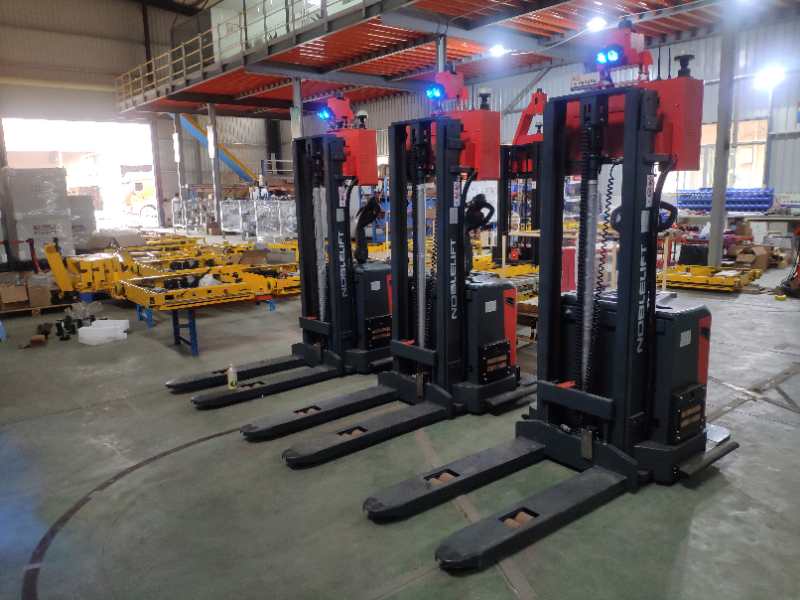
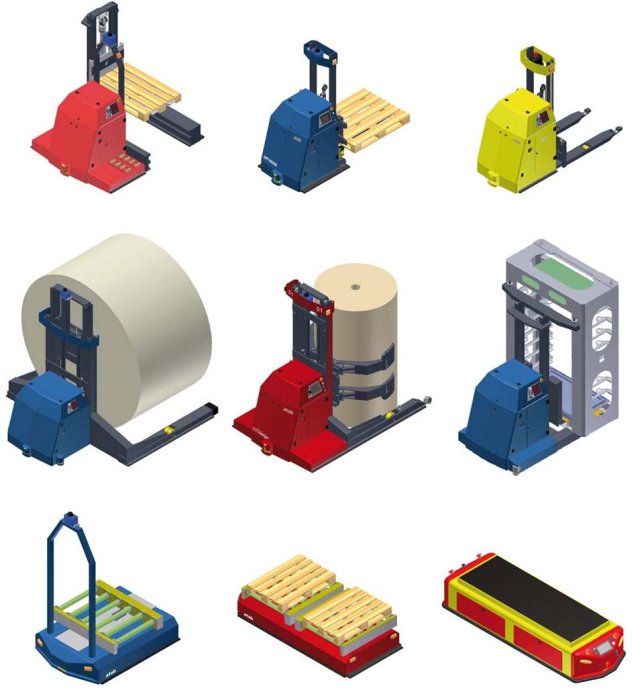
The equipment that navigates this constrained landscape must be its perfect counterpart. Standard automated guided vehicles (AGVs) are insufficient; the requirement is for VNA-specific AGVs or automated reach trucks. These machines are characterized by several non-negotiable features essential for operating within very narrow aisle racking:
Guidance Precision: Navigation tolerance is measured in millimeters, not centimeters. While free-navigation SLAM (Simultaneous Localization and Mapping) technologies have advanced, many high-performance very narrow aisle racking applications still rely on or hybridize with systems offering absolute reference. This includes inertial guidance (gyroscope-based) regularly corrected by laser triangulation to wall- or column-mounted reflectors, or wire guidance embedded in the floor. This ensures the vehicle knows its exact position within the very narrow aisle racking bay at all times, preventing catastrophic rack collisions.
Mast and Forks Design: The mast must be designed for high-lift stability, often incorporating tilting and side-shifting capabilities at height to gently engage and disengage loads within the very narrow aisle racking structure. Fork cameras and integrated distance-measuring lasers are standard for precise placement, automatically compensating for minor pallet overhang or rack beam deflection.
Safety in Confinement: Operating in a very narrow aisle racking environment precludes traditional pedestrian safety zones. Safety is engineered through a combination of downward-facing LiDAR scanners that create a protective field around the vehicle’s base, proximity sensors on the mast, and comprehensive 3D obstacle detection at height. The system’s control software also manages “virtual zoning,” ensuring only one vehicle enters a specific very narrow aisle racking aisle at a time.
An automated forklift designed for very narrow aisle racking applications is more than a robot; it is a high-precision instrument for material handling.
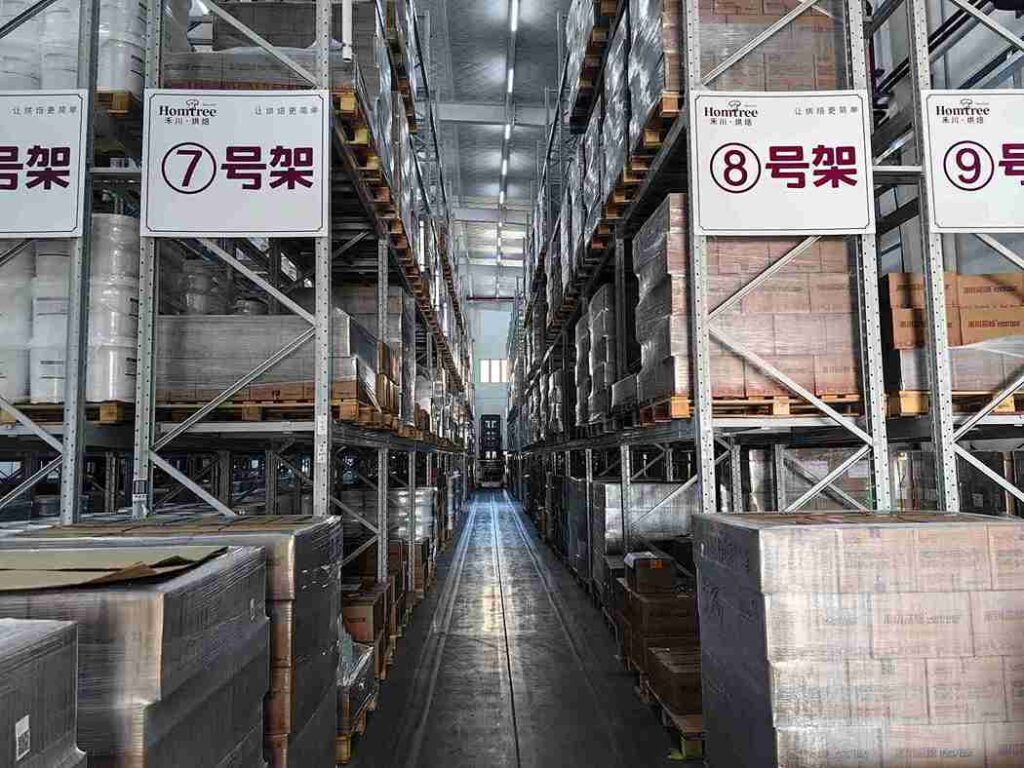
The Integration Architecture: Where Efficiency is Forged
The 40% efficiency claim is not a magical result but an arithmetic outcome of solving multiple constraints simultaneously. The integration of very narrow aisle racking with automation addresses these constraints systematically.
Orchestrating the Symphony: The Indispensable Role of the Warehouse Control System (WCS)
The physical integration of very narrow aisle racking and AGVs is governed by the digital integration of software systems. The Warehouse Management System (WMS) handles inventory and order logic, but the real-time orchestration is the domain of a robust Warehouse Control System (WCS). This is the mission-critical brain of the smart warehouse.
For a very narrow aisle racking automation system, the WCS performs several vital functions:
Dynamic Task Interleaving: The system intelligently groups orders and sequences tasks. If an AGV is delivering a pallet to a location deep within the very narrow aisle racking, the WCS will simultaneously assign it a retrieval task from a nearby location for the return journey, minimizing empty travel and doubling effective throughput within the confined space.
Traffic Management and Aisle Locking: In a complex network of very narrow aisle racking aisles and cross-aisles, the WCS acts as an air traffic controller. It implements “aisle locking” protocols, granting exclusive access to a specific very narrow aisle racking aisle to one vehicle at a time to prevent deadlocks. It optimizes routing to avoid congestion at aisle entrances.
Fleet Optimization and Battery Management: The WCS monitors the state of charge of each automated forklift and schedules proactive charging during natural lulls or lower-priority tasks, ensuring the fleet’s availability matches the workflow demands of the very narrow aisle racking operation. It can also assign tasks based on vehicle proximity and specialized capabilities (e.g., a vehicle equipped for double-deep very narrow aisle racking).
Without this sophisticated layer of control, even the finest very narrow aisle racking and most advanced AGVs would operate in a sub-optimal, chaotic manner. The WCS is what transforms individual components into a cohesive, high-performance system.
The Physical-Cyber Interface: Critical Enablers of Integration
Several physical and digital enablers form the glue of this integration:
Pallet and Load Standardization: The success of an automated very narrow aisle racking system is predicated on uniform unit loads. Pallet quality, dimensions, and stacking consistency are paramount. The system can be programmed to handle variance, but every millimeter of non-conformance reduces system speed and reliability.
Communications Infrastructure: Reliable, low-latency wireless communication (often industrial-grade Wi-Fi or private 5G networks) is the central nervous system. Every vehicle in the very narrow aisle racking area, every PLC on a conveyor spur, must report to and receive commands from the WCS instantaneously and without dropout.
Advanced Simulation and Digital Twins: Prior to installation, a detailed digital simulation of the entire very narrow aisle racking operation—including racking, vehicles, and product flow—is conducted. This “digital twin” validates design choices, identifies potential bottlenecks at the interface between the very narrow aisle racking area and manned zones, and accurately predicts throughput capacity, de-risking the capital investment.
The Emerging Market Blueprint: Tailoring VNA Automation for Success
Implementing a state-of-the-art very narrow aisle racking automation project in Southeast Asia, the Middle East, Africa, or Latin America requires a nuanced strategy that acknowledges local conditions while upholding non-negotiable technical standards.
Navigating Infrastructure and Environmental Realities
A very narrow aisle racking system, by its nature, is sensitive to its physical environment. Key adaptations include:
Floor Flatness as a Foundational Investment: The requirement for exceptional floor flatness (e.g., F∆ 50/25 per FEM 9.100 standards) is not a luxury but a prerequisite. In regions where construction practices may vary, specifying and rigorously testing floor flatness before very narrow aisle racking installation is the single most important factor in long-term system performance. It prevents vehicle vibration, misalignment, and premature wear.
Climate Resilience: Very narrow aisle racking structures and automated vehicles must be specified for local climates. In humid tropical environments, corrosion-resistant coatings and paints are essential for both the very narrow aisle racking steelwork and the AGVs. In dusty Middle Eastern locales, enhanced filtration systems for vehicle electronics and cooling are critical. For cold storage applications, a very narrow aisle racking automation system requires vehicles with cold-chain-rated components (lubricants, batteries, sensors) and racking materials suited to sub-zero temperatures.
Power and Grid Stability: Solutions incorporate onboard vehicle power management that can handle voltage fluctuations. System design often includes localized UPS (Uninterruptible Power Supply) protection for critical servers and network gear, allowing the WCS to execute a controlled shutdown of the very narrow aisle racking automation during a power failure, preserving data and preventing unsafe conditions.
Phased Implementation and Scalability as a Strategic Tool
For many organizations, a full-scale “big bang” automation of a very narrow aisle racking warehouse is prohibitively risky and capital-intensive. A phased, modular approach is overwhelmingly superior.
Phase 1 – The Proof of Concept: Automate a single, high-volume very narrow aisle racking aisle or a specific product category. This allows the operational team to build competency, the maintenance crew to train, and the finance department to validate the projected ROI in a controlled environment.
Phase 2 – Expansion and Integration: Based on learnings, expand the automated zone within the very narrow aisle racking block. Integrate the inbound receiving or outbound staging areas with automated transfer vehicles or automated forklifts that bridge the gap between the very narrow aisle racking area and other processes.
Phase 3 – System Optimization and AI Enhancement: With a stable system running, introduce advanced WCS features, predictive analytics for maintenance, and potentially AI-based slotting optimization that dynamically reassigns fast-moving SKUs within the very narrow aisle racking structure to minimize travel time.
This approach manages cash flow, builds internal buy-in, and creates a resilient learning organization alongside a resilient physical system.
Beyond Efficiency: The Tangible Business Outcomes of a Fully Integrated VNA System
When executed correctly, the fusion of very narrow aisle racking with automation delivers a cascade of business benefits that justify the investment many times over.
Radical Space Savings and Deferred Capital Expenditure: By enabling building height utilization and minimizing aisle space, a very narrow aisle racking system typically increases storage capacity by over 60% within the same footprint. When this dense storage is coupled with automation that can access it 24/7, the effective throughput per square meter soars. This can delay or eliminate the need for expensive new warehouse construction—a decisive advantage in markets with rising real estate costs.
Predictable, Scalable Operations: The system delivers consistent, measurable throughput independent of shift patterns, labor availability, or skill gaps. Scaling output often requires adding more autonomous vehicles to the existing very narrow aisle racking grid, a more flexible and faster process than training large cohorts of specialized VNA truck operators.
Unmatched Inventory Integrity and Traceability: Every interaction with the very narrow aisle racking is recorded and verified. The system provides a real-time, flawless digital map of inventory. Cycle counting becomes a automated background process, and the incidence of “lost” stock in high-bay very narrow aisle racking is eradicated. This accuracy improves order fulfillment rates, reduces safety stock requirements, and enhances supply chain visibility.
Enhanced Workplace Safety and Talent Utilization: Automating the most hazardous, repetitive tasks—high-level work in confined very narrow aisle racking aisles—fundamentally improves site safety. This not only reduces incident-related costs but also helps reallocate human talent to more cognitive, rewarding roles in supervision, continuous improvement, data analysis, and customer service, addressing the global challenge of talent attraction in logistics.
Conclusion: Forging the Future-Proof Distribution Center
The integration of high-density very narrow aisle racking with intelligent automated material handling represents the current apex of warehouse design. It is a powerful response to the converging pressures of space constraints, labor dynamics, and the demand for rapid, flawless order fulfillment. For logistics leaders and investors in the world’s most dynamic growth markets, mastering this integration is not merely an operational upgrade; it is a strategic repositioning.
The journey demands a partner with profound, demonstrable expertise in both structural storage science and real-time automation software—a partner who understands that the soul of the system lies in the invisible handshake between the steadfast very narrow aisle racking and the agile robotic fleet. It requires a commitment to foundational quality, a phased and scalable implementation philosophy, and a relentless focus on total cost of ownership. For those who embark on this path with diligence and vision, the reward is a distribution asset of unparalleled efficiency, resilience, and competitive power: a true smart warehouse.
FAQs
1. How does the system handle pallets that are slightly damaged or non-standard?
A well-designed integration includes an exception handling protocol managed by the WCS. Sensors on the automated forklift (e.g., fork cameras, pallet presence sensors) can detect significant misalignment or damage. If a load cannot be safely stored or retrieved from the very narrow aisle racking, the vehicle will transport it to a designated “exception station” within the warehouse. Here, a human operator resolves the issue—repairing the pallet or manually performing the put-away. The WCS then updates the inventory record. This hybrid approach ensures the very narrow aisle racking automation handles the vast majority of perfect cases at high speed while gracefully managing exceptions.
2. What is the typical return on investment (ROI) period for such a system in an emerging market context?
While highly project-specific, a comprehensive very narrow aisle racking automation project typically targets an ROI period of 2 to 4 years in emerging markets. The calculation is heavily influenced by local labor costs, real estate savings, and throughput gains. The ROI model must include hard savings (labor reduction in specific roles, lower energy consumption vs. traditional forklifts, reduced damage) and significant soft benefits (increased revenue capacity from the same space, improved order accuracy leading to fewer returns, enhanced service level allowing for premium contracts). A detailed pre-project simulation and financial modeling are essential to establish a credible, customized ROI forecast.
3. Can the automated system be retrofitted into an existing warehouse with a different racking system?
A full retrofit is complex but possible. It often involves removing existing racking and installing a new, precision-engineered very narrow aisle racking structure to meet the tight tolerances required for automation. The critical assessment points are: 1) Building Clear Height: Sufficient vertical space is needed to justify the high-density very narrow aisle racking. 2) Floor Condition: The slab must be capable of being brought to the required flatness tolerance, which may require grinding or overlay. 3) Column Grid: Existing building columns can limit the optimal layout of the very narrow aisle racking block. A thorough site survey and feasibility study are the first mandatory steps for any retrofit project.
4. What happens if the central WCS software fails?
System resilience is a core design principle. Redundant servers in a hot-standby configuration are standard for critical deployments. In the event of a primary server failure, the secondary takes over with minimal interruption. Furthermore, modern AGVs and automated forklifts are often equipped with sufficient onboard intelligence to complete their current assigned task safely and then park in a secure location, awaiting further instructions. This “fail-safe” design philosophy prevents chaos and protects both inventory and equipment within the very narrow aisle racking system.
5. How does the system adapt to seasonal peaks or sudden spikes in demand?
The scalability of an automated very narrow aisle racking system is one of its key advantages. For predictable seasonal peaks, workflows within the WCS can be pre-programmed to optimize for maximum throughput. For handling sustained increased demand, additional automated forklifts or VNA AGVs can typically be added to the existing fleet and integrated into the WCS without major reconfiguration of the very narrow aisle racking infrastructure itself. The system’s 24/7 operating capability also allows it to make more productive use of time, effectively increasing daily throughput without expanding the physical footprint.
If you require perfect CAD drawings and quotes for warehouse racking, please contact us. We can provide you with free warehouse racking planning and design services and quotes. Our email address is: jili@geelyracks.com