📐 "First 50 Enterprise Queries Get Custom 3D Warehouse Design" Plan
















The Unseen Foundation of Warehouse Safety and Efficiency
In the dynamic world of global logistics and warehousing, where throughput speed and storage density are paramount, an unseen element forms the literal foundation of operational success and safety: the pallet racking anchoring methods employed. For facility managers, logistics directors, and business owners across Southeast Asia, the Middle East, Africa, and Latin America, the choice of anchoring is a critical technical and financial decision.
It transcends a simple procurement item, representing a fundamental investment in risk management, asset protection, and regulatory adherence. A comprehensive understanding and meticulous application of effective pallet racking anchoring methods are what separate a resilient, durable storage facility from one operating on borrowed time.
This guide delves beyond catalog specifications and generic advice, offering a masterclass in selecting, implementing, and maintaining anchoring solutions that deliver unwavering performance under the unique pressures of emerging markets—from seismic tremors and corrosive climates to variable local standards and intense operational demands. The journey toward a truly secure warehouse begins not with the first upright erected, but with the strategic planning of its connection to the earth.

Decoding the Critical Role of Anchoring in Storage System Integrity
To appreciate the sophistication required in pallet racking anchoring methods, one must first understand the complex mechanical ballet performed by a loaded storage system. A pallet rack is a semi-rigid structure, ingeniously designed to carry immense vertical loads while remaining adaptable. However, this design inherently creates lateral forces that must be resisted. Without proper anchorage, even the most robust racking components are vulnerable.
The primary function of any pallet racking anchoring method is to transfer destabilizing forces from the rack structure safely into the building’s concrete floor slab. These forces are not static. They include the constant, predictable load of stored goods and the dynamic, unpredictable loads from material handling equipment. A slight nudge from a forklift, the dynamic force of a pallet being slotted into place, or the harmonic vibration from nearby machinery—all generate lateral energy that seeks to displace the rack upright.
In regions prone to seismic activity, this challenge is magnified exponentially, as the ground itself moves. The right pallet racking anchoring methods act as a steadfast counterweight to these forces, ensuring the system remains plumb, aligned, and structurally sound. It is the difference between a system that merely stands and one that stands firm.
The High Cost of Anchor Failure: Beyond Immediate Collapse
The consequences of inadequate or failed pallet racking anchoring methods are severe and multifaceted, extending far beyond the dramatic image of a total collapse. Progressive failure is a more common, insidious threat.
Progressive Misalignment: Loosened anchors allow uprights to shift incrementally. This misalignment can cause beams to dislodge, create unsafe load conditions, and lead to premature wear on components. Forklift operators may notice increasing difficulty in pallet placement—a subtle but critical warning sign.
Metal Fatigue and Crack Propagation: When a rack is not fully stabilized, micro-movements occur under load. Over thousands of cycles, this can initiate stress cracks in the upright base or column, potentially leading to sudden, brittle failure.
Cascading Damage: The failure of a single anchor point can redistribute loads unpredictably to adjacent anchors, overloading them and triggering a sequential failure. In high-bay or drive-in configurations, this domino effect can be catastrophic.
Operational and Financial Ruin: Beyond physical damage to racking and inventory, failures lead to operational shutdowns, regulatory investigations, crippling insurance claims, and devastating reputational harm. A single incident can erase years of profit and erode stakeholder trust.
Therefore, evaluating pallet racking anchoring methods through a lens of lifecycle cost and risk mitigation, rather than mere initial price, is the hallmark of a prudent warehouse operator.

A Technical Deep Dive: The Primary Categories of Pallet Racking Anchoring Methods
The engineering community has developed several proven pallet racking anchoring methods, each with distinct mechanical principles, performance characteristics, and ideal applications. Selecting among them requires a forensic understanding of the project conditions.
Mechanical Expansion Anchors: Friction and Interlock
These pallet racking anchoring methods rely on physical expansion within the concrete hole to create clamping force and friction.
Sleeve Anchors: A versatile and common choice. As the bolt is tightened, a cone draws up into an expander sleeve, forcing it outward against the concrete walls. Their effectiveness is highly dependent on the quality and compressive strength of the concrete substrate.
Wedge Anchors: Known for high shear strength. The anchor features a clip at the embedded end. When tightened, the clip is drawn into a sleeve, causing it to splay and wedge firmly into the concrete. They offer excellent performance in solid, high-strength concrete and are a mainstay for heavy-duty applications.
Strike Anchors: Installed by driving a steel pin into the anchor body, causing it to expand. While fast, they generally offer lower holding values and are less common for primary structural anchoring of racking, often being reserved for lighter-duty or temporary applications.
Performance Profile: These pallet racking anchoring methods are typically rated for use in uncracked concrete. Their performance can diminish in vibratory environments or where concrete cracking is possible. Correct installation torque is absolutely critical; under-torquing fails to activate full expansion, while over-torquing can strip threads or damage the concrete.
Chemical (Adhesive) Anchors: The Power of Molecular Bond
Representing a significant advancement, these pallet racking anchoring methods utilize a high-strength, typically two-component resin to create a bond between the steel anchor and the concrete.
How They Work: A hole is drilled, meticulously cleaned, and filled with adhesive. The threaded rod or rebar is then inserted. As the resin cures, it creates a monolithic connection that distributes stress over a larger bonded area. This makes them exceptionally effective in cracked concrete, near edges, and under sustained tension.
Types of Adhesives: Epoxy, vinylester, and polyester resins are common, each with different cure times, temperature sensitivities, and chemical resistances. For example, certain epoxies are formulated for wet-hole conditions or sub-zero installation temperatures—a critical factor for projects in varied climates from the highlands of Peru to the humid coasts of Nigeria.
Key Advantage: Among all pallet racking anchoring methods, chemical anchors often provide the highest ultimate load capacity and are the preferred solution in seismic zones where anchors must withstand cyclic tension and shear loads.
Undercut Anchors: Mechanical Lock at its Peak
These high-performance pallet racking anchoring methods utilize a unique principle: instead of expanding against the sides of the hole, they create a positive mechanical interlock at its base.
The Process: A special diamond-tipped drill bit creates a hole with an undercut (a wider cavity) at the bottom. The anchor, once installed and torqued, expands a sleeve or key into this undercut. Failure requires the concrete above the undercut to shear, which involves a massive volume of material, resulting in extraordinarily high pull-out resistance.
Application: These are premium pallet racking anchoring methods specified for the most demanding applications: extremely high tensile loads, minimal edge distances, and projects where absolute predictability of performance is non-negotiable, such as in automated storage and retrieval system (AS/RS) supports.
The Engineering Selection Matrix: Choosing the Right Pallet Racking Anchoring Methods
No single pallet racking anchoring method is universally superior. The optimal choice emerges from a rigorous engineering assessment. Here is the decision matrix used by industry professionals.
Factor 1: Substrate Analysis – Interrogating the Concrete
The floor slab is not a generic platform; it is a variable structural element.
Compressive Strength: Measured in psi or MPa, this is the starting point. Anchor pull-out values are directly correlated to concrete strength. A 3,000 psi slab may only support 60% of the load capacity of the same anchor in a 5,000 psi slab.
Condition – Cracked vs. Uncracked: Will the concrete be in tension under service loads? Most warehouse slabs are considered “cracked” for design purposes. Only anchors rated for “Condition C” (per standards like ACI 355 or ETAG) should be used in such scenarios. Chemical and some specialized mechanical anchors carry this rating.
Thickness and Rebar Location: Embedment depth must not compromise the slab’s integrity. Ground-penetrating radar (GPR) scans are increasingly used to map rebar, preventing drilling conflicts that weaken both the rebar and the anchor’s holding power.
Factor 2: Load Case Analysis – Quantifying the Forces
Anchors are sized for specific loads, calculated by a qualified engineer.
Shear Load Dominant: In low-to-moderate seismic zones with high forklift traffic, shear forces govern. Robust mechanical anchors like heavy-duty wedge anchors may suffice.
Tension/Uplift Load Dominant: In high seismic zones or for tall, narrow racks, seismic forces induce uplift. This demands pallet racking anchoring methods with certified high tension capacity, such as chemical or undercut anchors.
Combined Load: Most real-world scenarios involve a combination. The interaction is calculated using a failure envelope diagram specific to the anchor, ensuring the combined stress does not exceed safe limits.
Factor 3: Environmental & Operational Context
The local environment dictates material and method specifications.
Corrosion Potential: Coastal regions in Southeast Asia, the Middle East, or West Africa present high chloride exposure. Pallet racking anchoring methods here must employ A4 (316) stainless steel components or hot-dip galvanized steel with appropriate thickness. Zinc-plated anchors are unsuitable.
Temperature Extremes: Ambient temperature during installation and in service affects chemical anchor cure times and mechanical anchor preload. In the arid heat of the Arabian Gulf or the cool highlands of Colombia, product selection and installation protocols must be adjusted accordingly.
Vibration and Impact: Facilities with continuous conveyor systems, heavy machinery, or rampant forklift impacts create a fatigue environment. Pallet racking anchoring methods chosen must have a proven resistance to vibrational loosening.
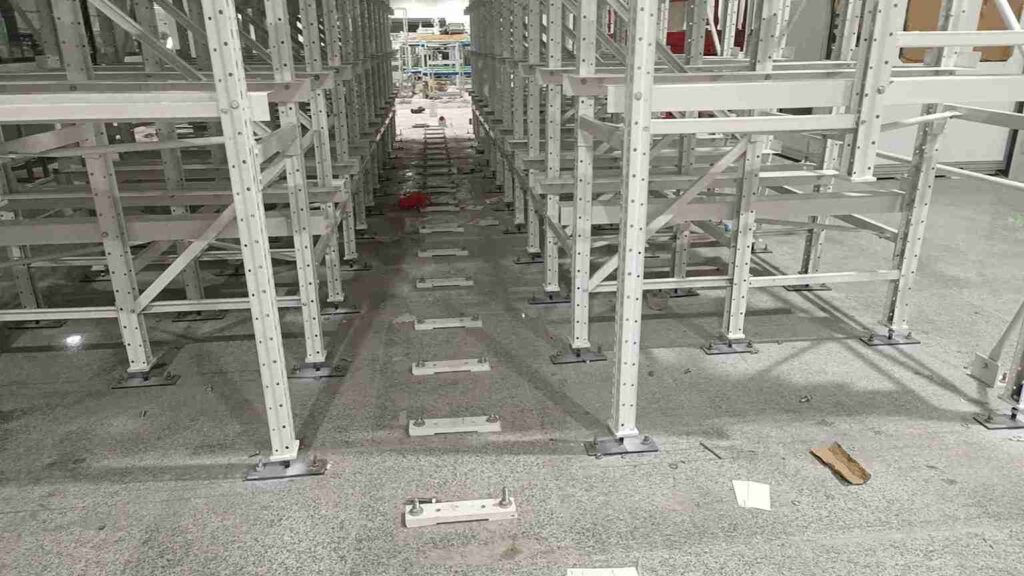
The Imperative of Local and International Safety Standards
Adherence to standards is not bureaucratic red tape; it is the codified wisdom of engineering best practices. Effective pallet racking anchoring methods must be demonstrably compliant.
The Hierarchy of Standards: While local national codes are legally binding, they often reference international frameworks. Key among these are:
FEM 10.2.02 / EN 15635: The European standards governing the design and use of storage equipment, with strict guidelines on stability and safety.
RMI/ANSI MH16.1: The comprehensive US standard, including detailed provisions for seismic design and anchor qualification.
Specific Seismic Codes: Such as IBC (International Building Code), Eurocode 8, or regional codes like Chile’s NCh433. These define the seismic forces for which the pallet racking anchoring methods must be designed.
Navigating the Global Patchwork:
In Southeast Asia, authorities in Thailand (DIW), Indonesia (SNI standards), or the Philippines may require third-party certification or a local Professional Engineer’s stamp on anchor calculations.
Across the GCC, projects must align with Civil Defense requirements and often require approval from bodies like ESMA (UAE) or SASO (KSA), who may accept CE-marked products (indicating compliance with European Assessment Documents for anchors) or require specific local testing.
In Latin America, particularly in seismic hotspots like Chile, Mexico, and Colombia, the structural review process is stringent. Anchor calculations, based on the local seismic coefficient, are a critical part of the permit submission package.
Therefore, specifying pallet racking anchoring methods involves not just selecting a product from a catalog, but ensuring the product has the requisite test reports (ETA – European Technical Assessment, ICC-ES ESR reports) that align with the project’s governing standards. Proven compliance is a non-negotiable component of a trustworthy anchoring solution.
Installation Excellence: Where Theory Meets Reality
The most perfectly engineered pallet racking anchoring methods can be rendered useless by poor installation. Precision in execution is paramount.
The Non-Negotiable Installation Protocol
Verified Layout: Positions are marked from approved shop drawings, respecting minimum edge and spacing distances critical for preventing concrete breakout failure.
Precision Drilling: Using rotary hammer drills with carbide bits (or diamond for undercuts), holes are drilled to the exact diameter and depth specified by the anchor manufacturer. Deviation can reduce capacity by 20% or more.
Scientific Hole Cleaning: This is the most frequently neglected step. For chemical anchors, it is a three-stage process: blow out loose dust with oil-free air, brush the walls with a dedicated nylon brush, and blow out again. Residual dust acts as a lubricant, destroying the bond.
Controlled Adhesive Injection (for chemical anchors): Using a calibrated dispenser, resin is injected from the bottom of the hole upwards to avoid entrapping air, which creates a weak point.
Torque Control (for mechanical anchors): Using a calibrated, recently certified torque wrench, anchors are tightened to the manufacturer’s specified value. “Good and tight” is an unacceptable standard.
Post-Installation Verification: Proof Testing
On critical projects or when substrate conditions are uncertain, a proof test program is implemented. A representative sample of installed anchors (typically 1-2%) is subjected to a non-destructive test load (often 150% of the design service load) to verify real-world performance before the rack is loaded. This provides irrefutable evidence that the chosen pallet racking anchoring methods are performing as intended in the actual slab.
Regional Application Focus: Tailoring Pallet Racking Anchoring Methods
A one-size-fits-all approach is a recipe for failure. Expertise lies in adaptation.
Southeast Asia – Humidity & Seismicity: In port cities like Jakarta or Manila, the combination requires A4 stainless steel chemical anchors. The resin must have high moisture tolerance, and designs must account for high seismic zone factors. Collaboration with local structural engineers for stamping is standard.
Middle East – High Temperatures & Modern Slabs: In Dubai or Riyadh, concrete is often high-strength but can be brittle due to mix designs and heat. Pallet racking anchoring methods like undercut anchors are advantageous as they are less sensitive to concrete tensile strength. UV-stable adhesives are selected for any exterior applications.
Africa – Variable Infrastructure: Projects may range from a new build in a Kenyan special economic zone with good concrete to a retrofit in an older Durban warehouse with weak topping slabs. The approach is investigative first: test the concrete, then prescribe. Solutions may involve a combination of slab remediation (e.g., bonding a new topping) followed by the application of high-performance chemical pallet racking anchoring methods.
Latin America – Seismic Stringency: In Santiago or Mexico City, the seismic design is the project’s core. Pallet racking anchoring methods are not an afterthought but a primary structural element. Designs use dynamic analysis, and anchors are specified with large safety margins, almost exclusively being chemical or undercut types with full certification for cyclic loading.
The Lifecycle Management of Anchored Systems
Implementing the correct pallet racking anchoring methods is the beginning, not the end. A proactive management regime ensures longevity.
Scheduled Inspection Regimes:
Weekly/Visual: Operators and supervisors are trained to spot obvious issues: damaged floor plates, visible corrosion, or pools of liquid that could indicate corrosion under the plate.
Annual/Formal: A detailed inspection by a competent person using a checklist: verifying anchor tightness with a torque wrench (for mechanical types), checking upright plumbness with a digital level, and documenting the condition of the concrete substrate.
Post-Event: Any significant seismic event, major forklift impact, or flood necessitates an immediate, full structural inspection of the pallet racking anchoring methods and the entire system.
Record Keeping: Maintaining a permanent “anchor log” for the facility is a best practice. This includes the original anchor specification, layout drawings, installation dates, torque values recorded, and all subsequent inspection reports. This document is invaluable for risk management, insurance audits, and due diligence during facility sales.

Conclusion: Securing More Than Just Racks – Securing Your Enterprise
The strategic implementation of engineered pallet racking anchoring methods is a profound exercise in operational intelligence. It represents a clear understanding that the safety, efficiency, and profitability of a warehouse are intrinsically linked to the integrity of its most fundamental connections. In the competitive and fast-paced markets of Southeast Asia, the Middle East, Africa, and Latin America, where growth is rapid and margins are carefully watched, this is not an area for compromise or guesswork.
The most cost-effective pallet racking anchoring methods are those that are correctly specified from the outset—chosen through a rigorous process of site analysis, load calculation, and compliance verification. They are installed with surgical precision and maintained with disciplined vigilance. This approach transforms anchoring from a mere cost line into a powerful enabler of business continuity, asset protection, and brand reputation.
For any organization looking to build new capacity or fortify existing operations, the message is unequivocal: prioritize expertise in pallet racking anchoring methods. Engage with partners who demonstrate not just product knowledge, but deep regional experience, engineering rigor, and an unwavering commitment to installation excellence. By doing so, you anchor more than your storage systems; you secure the very foundation of your logistical enterprise, ensuring it is built to withstand the tests of time, nature, and commerce.
Frequently Asked Questions (FAQs)
1. How does the presence of a raised access floor or a thick epoxy coating affect the choice of pallet racking anchoring methods?
These surfaces introduce a “stand-off” or “cladding” layer that can severely compromise the performance of standard anchors. Special techniques are required. The anchoring must always engage the structural concrete below. This often involves drilling through the overlay with a core bit to its full depth, then switching to a standard hammer drill for the concrete. The hole in the overlay must be oversized to prevent the non-structural material from bearing on the anchor sleeve, which can cause cracking. For thick coatings, anchors with extended threads or specially designed spacer sleeves may be necessary. The design pull-out capacity may need to be de-rated, and consultation with both the anchor manufacturer and a structural engineer is critical.
2. What is the realistic expected service life of different pallet racking anchoring methods, and what factors cause degradation?
Service life varies dramatically with environment and material. In a dry, indoor warehouse, properly installed carbon steel wedge anchors can last decades. However, in corrosive environments, unprotected carbon steel can fail within years. A4 (316) stainless steel anchors offer the longest life in harsh conditions. For chemical anchors, the epoxy itself is generally inert and stable for the long term, but the steel rod must be corrosion-resistant. The primary degradation factors are corrosion (from moisture, chlorides, or chemicals), sustained overloading, vibrational loosening (for mechanical types), and physical damage from impacts. A regular inspection schedule is the only way to monitor and ensure the ongoing integrity of all pallet racking anchoring methods.
3. For a warehouse with very poor-quality, old concrete, are there any pallet racking anchoring methods that can work without completely replacing the slab?
Yes, several advanced pallet racking anchoring methods are designed for challenging substrates. High-performance chemical adhesives are often formulated for low-strength concrete. Alternatively, “through-bolt” or “expansion through-bolt” methods can be considered, where a bolt passes completely through the slab and is secured with a plate and nut on the underside (if accessible). Another solution is the use of a “grouted baseplate” system, where a large baseplate is set in a high-strength, non-shrink grout bed that distributes loads over a much larger area of the weak concrete. Each of these solutions requires specialized engineering analysis to verify suitability.
4. In an automated warehouse (AS/RS), why are the tolerances for pallet racking anchoring methods so much tighter than in a manual system?
Automated storage and retrieval systems (AS/RS) operate with precision measured in millimeters. The stacker crane’s guidance rails are mounted directly to the racking structure. Any movement or misalignment in the rack uprights, caused by loose or settling anchors, translates directly into misalignment of the rails. This can cause the crane to fault, derail, or experience excessive wear. Therefore, the pallet racking anchoring methods used must not only be strong but must also provide absolute rigidity and preclude any long-term creep or settlement. This often drives the selection towards undercut anchors or high-modulus chemical anchors installed with laser-guided alignment tools.
5. Can different pallet racking anchoring methods be mixed within the same warehouse installation?
It is generally discouraged unless explicitly designed by a qualified engineer. Different pallet racking anchoring methods have different stiffness characteristics (how much they deflect under load). Mixing anchor types on the same run of racking or within the same frame can lead to an uneven distribution of lateral forces. One anchor type may attract more load than another, potentially leading to its premature overload. Consistency is key to predictable performance. The only exception might be in a retrofit scenario where a specific, engineered solution is required for a localized problem, but this must be analyzed and approved on a case-by-case basis.
If you require perfect CAD drawings and quotes for warehouse racking, please contact us. We can provide you with free warehouse racking planning and design services and quotes. Our email address is: jili@geelyracks.com