📐 "First 50 Enterprise Queries Get Custom 3D Warehouse Design" Plan
















The Definitive Industrial Guide: Engineering High-Density Teardrop Pallet Rack Systems for Uncompromising AGV/ASRS Fusion
Executive Overview: The Structural Core of Tomorrow’s Automated Warehouse
Within the dynamic landscapes of emerging global markets—from the manufacturing hubs of Vietnam and Indonesia to the logistical gateways of Dubai and the burgeoning distribution centers of Nigeria and Brazil—a critical evolution is underway. The focal point of this transformation is a foundational storage component, now re-engineered for the age of automation: the teardrop pallet rack system.
Modern logistics operators are no longer asking for simple storage; they demand high-density teardrop pallet rack systems conceived and fabricated with intrinsic compatibility for Automated Guided Vehicles (AGVs) and Automated Storage and Retrieval Systems (ASRS). This paradigm shift represents a move from passive storage to active, intelligent inventory architecture. For businesses targeting superior logistics efficiency in Asia and Africa sectors, the selection and implementation of the racking infrastructure is the decisive factor that separates a functionally limited facility from a seamless, high-throughput logistics engine.
This authoritative guide provides an exhaustive analysis of the engineering principles, integration imperatives, and market-specific deployment strategies that define world-class teardrop pallet rack systems in an automated world.
Chapter 1: The Engineered Superiority of the Teardrop Pallet Rack System
1.1 Deconstructing the Global Benchmark: The Science of the Teardrop
The term “teardrop” specifies the unique geometry of the connector hole punched into the upright frame. This design is the culmination of decades of material science and structural engineering, offering an optimal solution for load-bearing, safety, and adaptability. The shaped orifice allows the beam’s connector tab to be inserted and secured with a robust, hammer-driven lock, creating a moment-resistant connection without bolts.
Structural Performance and Predictable Integrity: Compared to slotted or bolted alternatives, the teardrop pallet rack system ensures superior force distribution. The connection minimizes beam deflection under load, guaranteeing that the system consistently meets its rated capacity—a non-negotiable prerequisite when interfacing with precision automation equipment worth hundreds of thousands of dollars. The inherent strength of a properly specified teardrop pallet rack system provides the stable, predictable environment that AGV guidance systems and ASRS cranes fundamentally require.
Operational Agility through Rapid Configuration: In growth markets where speed-to-operation directly impacts ROI, the installation and reconfiguration efficiency of teardrop pallet rack systems is a monumental advantage. Certified crews can erect vast warehouses of teardrop pallet rack systems significantly faster than bolted counterparts. More strategically, the design permits effortless reconfiguration. As inventory profiles or workflow patterns change, the teardrop pallet rack system can be adapted without destructive cutting or welding, protecting capital investment and ensuring the infrastructure evolves with the business.
1.2 The Density Revolution: Maximizing volumetric Efficiency
A standard teardrop pallet rack system organizes inventory; a high-density teardrop pallet rack system actively conquers space constraints. In regions where industrial land value is soaring, the ability to store more within the same footprint is a direct competitive lever.
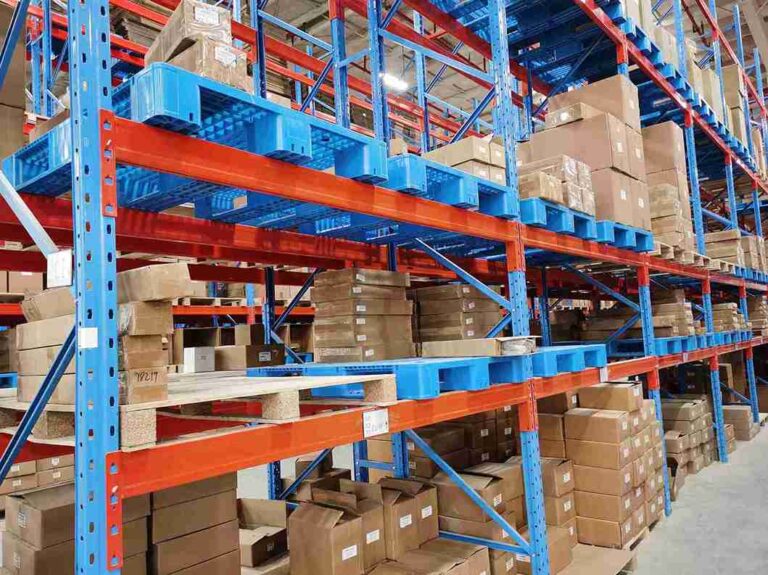
Dynamic High-Density Configurations: The inherent strength and flexibility of the teardrop pallet rack system facilitate advanced configurations like push-back racking, where pallets are stored deep and retrieved via a series of nested carts, or drive-in/drive-through systems. These teardrop pallet rack systems are engineered for bulk storage of slower-moving SKUs, dramatically increasing pallet positions and freeing prime floor space for faster-moving goods.
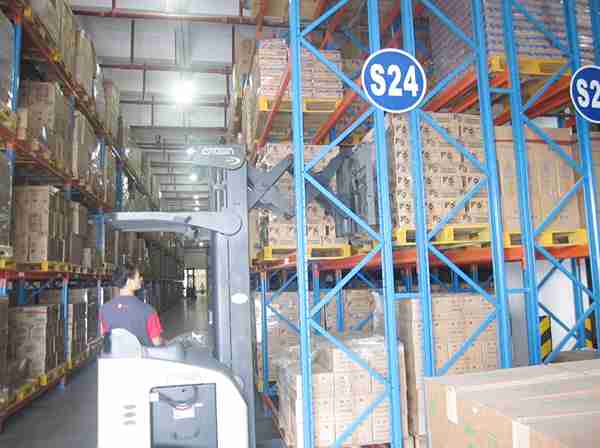
Selective Racking Reaching New Heights: Even conventional selective layouts achieve new levels of density. Utilizing heavy-duty upright columns and reinforced beams, modern teardrop pallet rack systems can safely extend to heights of 15 meters or more, fully capitalizing on a facility’s vertical cube. When paired with Very-Narrow-Aisle (VNA) forklifts or, optimally, ASRS cranes, this teardrop pallet rack system configuration delivers exceptional density without sacrificing direct access to every single pallet.

Chapter 2: The Symbiosis of Rack and Robot: A Millimetric Partnership
2.1 AGV Harmony: Precision Engineering at the Interface
True AGV compatibility transcends marketing claims; it is engineered into the very fabric of the teardrop pallet rack system. The operational marriage between autonomous vehicle and storage structure demands exacting standards.
Dimensional Fidelity and Systemic Consistency: AGVs rely on digital mapping and precision guidance. Their lift mechanisms are programmed for repeatable placement within a tight spatial window. A high-performance teardrop pallet rack system is manufactured with laser-cut accuracy, ensuring every upright, beam, and bay opening is consistent across the entire warehouse. This eliminates the variability a human operator might compensate for, thereby preventing mis-picks, costly impacts, and systemic failures. The reliability of the entire AGV fleet is contingent upon the predictable environment created by the teardrop pallet rack system.
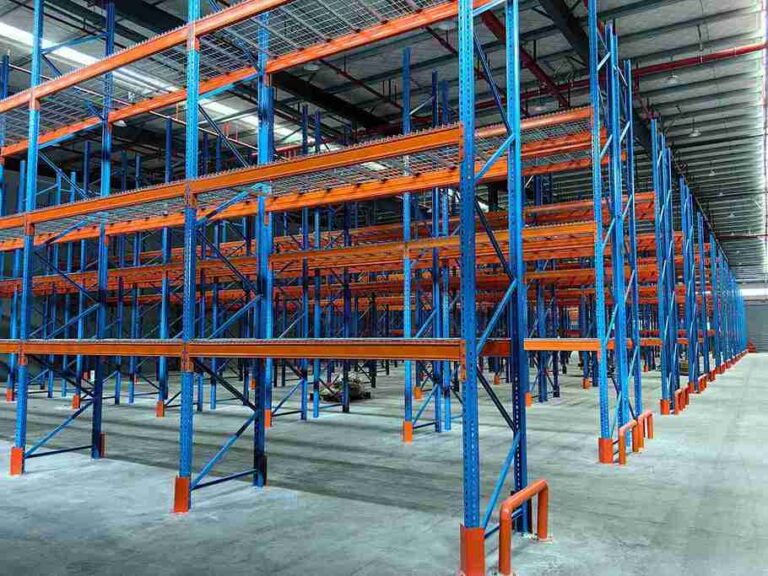
Integrated Impact Management and Protection: Proactive protection is a cornerstone of automation-ready design. Teardrop pallet rack systems destined for AGV environments are not complete without engineered safeguards. Heavy-duty column guards, often integrally welded to the baseplate, are mandatory. These act as sacrificial, high-visibility barriers that absorb kinetic energy from potential impacts, safeguarding both the structural integrity of the teardrop pallet rack system and the AGV itself. This is not an add-on but a fundamental component of a responsible automated storage solution.
Beam Profile and Pallet Interaction Dynamics: The design of the beam’s front face is critical. A smooth, unobstructed profile ensures pallets slide without catching on protrusions. The beam step—the ledge supporting the pallet—must be precision-engineered to match regional pallet standards (e.g., GMA, EUR, CPC), ensuring flawless transfer during the AGV’s automated deposit and retrieval cycles within the teardrop pallet rack system.
2.2 ASRS Demands: When the Rack Becomes Part of the Machine
Integration with a unit-load ASRS represents the pinnacle of storage automation, placing the highest possible demands on the supporting teardrop pallet rack system. The rack transitions from a static structure to an integral component of a high-speed, dynamic machine.
Mastering Static and Dynamic Load Calculations: An ASRS crane accelerates, travels, and decelerates heavy unit loads within the rack’s framework, imparting dynamic horizontal and vertical forces. Engineering a teardrop pallet rack system for ASRS requires advanced structural analysis that accounts for these live loads, seismic activity, and the dead weight of the stored goods. The teardrop pallet rack system must provide a rigid, unwavering path for the crane’s travel.
Absolute Precision in Alignment and Squareness: The performance and longevity of an ASRS crane are directly tied to the geometric perfection of its supporting teardrop pallet rack system. Laser-guided alignment during installation is mandatory, with tolerances often within ±3mm over 100-meter runs. Deviations cause premature wear on crane wheels, induce motor stress, and lead to operational failures. The installation of an ASRS-grade teardrop pallet rack system is a certified process, validated against the automation provider’s strictest specifications.
Designing for the Machine Ecosystem: An ASRS-compatible teardrop pallet rack system incorporates features beyond storage: integrated mounting points for crane rails, dedicated raceways for power and data cables, and clear internal pathways that define the crane’s operating envelope. Every element is co-engineered with the automation partner.

Chapter 3: Strategic Deployment in Key Growth Regions
3.1 Adapting to Diverse Infrastructural Realities
Deploying a high-performance teardrop pallet rack system in a greenfield facility in Saudi Arabia presents different challenges than retrofitting an existing building in the Philippines. Expert deployment is context-aware.
Foundation and Flooring: The Critical First Layer: The performance of both the teardrop pallet rack system and the automation it supports begins with the foundation. For AGV/ASRS projects, floor flatness (measured to Fmin/Fmax or waviness standards) is paramount. A comprehensive site survey precedes any design, informing requirements for professional grinding, leveling, or reinforcement. The anchoring system for the teardrop pallet rack system—whether chemical epoxy or mechanical—is specified based on the concrete’s condition and local seismic codes.
Environmental and Regulatory Compliance: A teardrop pallet rack system in coastal Bahrain requires a different corrosion protection specification than one in the arid climate of Chile’s interior. Hot-dip galvanization, specialized powder coatings, or the use of pre-galvanized steel are selected based on environmental audits. Furthermore, structural calculations for the teardrop pallet rack system must adhere to, and often exceed, local building codes for wind and seismic loads, ensuring resilience and safety.
3.2 The Total Cost of Ownership (TCO) Framework for Strategic Buyers
Informed clients in growth markets increasingly evaluate capital expenditures through a TCO lens. A premium teardrop pallet rack system engineered for automation justifies its investment through multi-faceted returns.
Asset and Space Utilization Multipliers: A high-density teardrop pallet rack system directly reduces the required building footprint or allows for greater inventory within an existing one, deferring costly expansion. The automated interaction minimizes product and rack damage, preserving asset value.
Throughput and Accuracy Dividends: Automation enabled by a precision teardrop pallet rack system facilitates 24/7 operation, slashes order cycle times, and achieves near-perfect inventory accuracy. These factors enhance customer service and unlock revenue capacity.
Future-Proofing and Scalability: The modular, reconfigurable nature of a quality teardrop pallet rack system protects the investment against obsolescence. The infrastructure can evolve from manual to semi-automated to fully automated workflows without wholesale replacement, allowing for phased capital deployment.

Chapter 4: The Implementation Lifecycle: A Phased Methodology
4.1 Phase 1: Deep-Dive Discovery and Co-Design
Successful projects stem from collaborative analysis, not catalogue selection. This phase involves:
Data-Driven Profiling: Analyzing SKU dimensions, weights, turnover rates (ABC classification), and growth forecasts to model the ideal teardrop pallet rack system layout.
Throughput Simulation and Workflow Mapping: Using simulation software to model goods flow, determining optimal pick face locations, AGV traffic patterns, and crane cycles to ensure the teardrop pallet rack system design meets operational KPIs.
Digital Integration Planning: Facilitating the technical dialogue between the warehouse management system (WMS) provider, the automation vendor, and the racking engineers to ensure the physical teardrop pallet rack system layout is a perfect digital twin within the WMS.
4.2 Phase 2: Precision Manufacturing and Global Logistics
Components for a mission-critical teardrop pallet rack system are manufactured in ISO-certified facilities using CNC machinery for absolute consistency. Each upright, beam, and brace is fabricated, finished, and kitted according to detailed erection drawings. This logistical precision ensures that all parts for the teardrop pallet rack system arrive on-site correctly sequenced, minimizing handling and accelerating the installation schedule for projects from Kenya to Colombia.
4.3 Phase 3: Certified Installation and Integrated Commissioning
The final phase transforms components into a performance-certified asset. Our certified installation teams follow rigorous protocols:
Anchor Verification: Every anchor is torqued to specification and documented.
Geometric Certification: The entire teardrop pallet rack system is verified for plumb, level, and square alignment using laser instrumentation.
Load Beam Finalization: Every beam-end lock is secured and inspected.
Co-Commissioning with Automation Partners: Our supervisors work alongside AGV/ASRS technicians during the first operational tests, making micro-adjustments to the teardrop pallet rack system to achieve flawless mechanical interaction.

Chapter 5: The Intelligent Edge: The Data-Enabled Rack System
The next frontier for the teardrop pallet rack system is connectivity. The future lies in smart infrastructure where the rack itself provides operational intelligence.
Sensor Integration: IoT-enabled load sensors can be embedded in beam levels of the teardrop pallet rack system, providing real-time weight data for inventory validation and predictive analytics.
Automated Identification Points: Strategic mounting points for RFID readers or barcode scanners on the teardrop pallet rack system uprights create automated verification checkpoints for AGVs, confirming location and load identity.
Enhanced Safety Systems: Modular safety features, such as integrated task-lighting or proximity warning systems, can be incorporated directly into the design of the teardrop pallet rack system, fostering a safer human-robot collaborative environment.
Conclusion: Specifying the Strategic Backbone for Competitive Advantage
Selecting a high-density teardrop pallet rack system is a foundational strategic decision that sets the operational parameters for a warehouse for a decade or more. In the fast-moving, competitive environments of Asia, Africa, the Middle East, and Latin America, logistical excellence is a primary differentiator.
By investing in a teardrop pallet rack system that is intrinsically engineered from its inception for AGV and ASRS compatibility, businesses are not merely purchasing industrial equipment; they are deploying the resilient, intelligent, and adaptable structural core upon which profitable, scalable, and future-ready logistics operations are built. This teardrop pallet rack system becomes the silent, robust partner to advanced automation, enabling a facility to meet today’s demands while possessing the inherent flexibility to adapt to tomorrow’s unforeseen challenges. The journey toward market leadership begins with the right foundation.
Frequently Asked Questions (FAQs)
Q1: What specific steel grade and finish specifications are recommended for a teardrop pallet rack system in a high-humidity coastal environment like Vietnam?
For such environments, a teardrop pallet rack system should utilize steel with a minimum yield strength of 50 KSI (345 MPa). The corrosion protection is critical. A recommendation would be a teardrop pallet rack system fabricated from pre-galvanized steel sheets (with a zinc coating of Z275 or higher) prior to forming, or the application of a multi-stage phosphate pretreatment followed by a durable epoxy-polyester hybrid powder coat. For extreme conditions, hot-dip galvanizing the entire teardrop pallet rack system after fabrication provides the highest level of protection, though it may affect dimensional tolerances and requires specialized manufacturing processes.
Q2: How does the design of a teardrop pallet rack system for a multi-shift, high-throughput e-fulfillment center differ from one for a cold storage ASRS application?
While both require precision, the design parameters diverge. For e-fulfillment, the teardrop pallet rack system prioritizes fast, selective access and high flexibility for frequent SKU changes; beam levels are often closer together for smaller case picking. In cold storage ASRS, the teardrop pallet rack system must account for steel’s behavior at sub-zero temperatures (increased brittleness), requiring specially graded steel and calculations for thermal contraction. Lubricants for locks and connections must be cryogenic-rated. The entire teardrop pallet rack system design, from steel grade to connection details, is tailored for the thermal environment.
Q3: Can a single teardrop pallet rack system infrastructure effectively support both AGV pallet put-away and manual order picking operations concurrently?
Yes, this is a common hybrid model. The teardrop pallet rack system is designed with this duality in mind. Lower levels (e.g., up to 2.5 meters) are configured for manual or cart-based picking, with considerations for ergonomic shelf heights and clear aisle visibility for personnel. Upper levels are dedicated to high-density, AGV-serviced storage. The teardrop pallet rack system design ensures all structural elements, including upright protectors and clear aisle markings, safely accommodate both human and robotic traffic flows within the same footprint.
Q4: What are the key maintenance and inspection protocols for a teardrop pallet rack system integrated with automation to ensure long-term reliability?
A formal, scheduled inspection program is vital. For an automated teardrop pallet rack system, this includes monthly visual checks for any new impacts or deformities on uprights and column guards. Bi-annual inspections should involve using a torque wrench to verify the tightness of baseplate anchors and checking beam-end locks for security. Annually, a professional survey using alignment tools should verify the ongoing plumb and level of the teardrop pallet rack system, as any shift can degrade AGV/ASRS performance. All inspections should be documented in a log specific to the teardrop pallet rack system.
Q5: For a retrofit project with limited ceiling height, what high-density configurations of a teardrop pallet rack system are most effective, and how is compatibility with automation maintained?
In low-clearance buildings, horizontal density is key. Push-back teardrop pallet rack systems (typically 2-5 pallets deep) are highly effective, as they use depth rather than height. Double-deep teardrop pallet rack systems are another option. Maintaining automation compatibility requires ensuring that the AGVs or specialized forklifts have the precise reach and articulation to access the deeper pallet positions. The teardrop pallet rack system must be engineered with exceptionally consistent bay depths and opening heights, and the guidance software for the automation must be meticulously mapped to the specific layout of this high-density teardrop pallet rack system.
If you require perfect CAD drawings and quotes for warehouse racking, please contact us. We can provide you with free warehouse racking planning and design services and quotes. Our email address is: jili@geelyracks.com