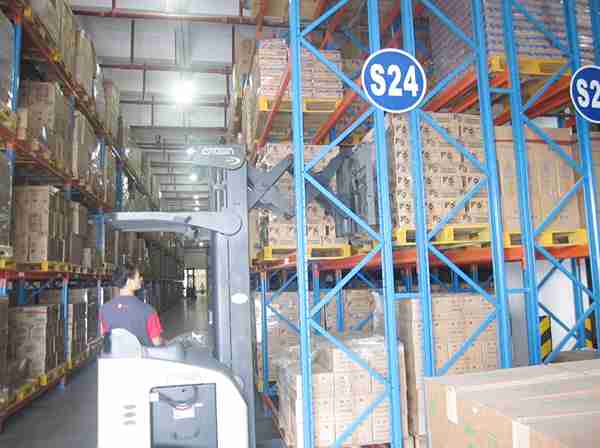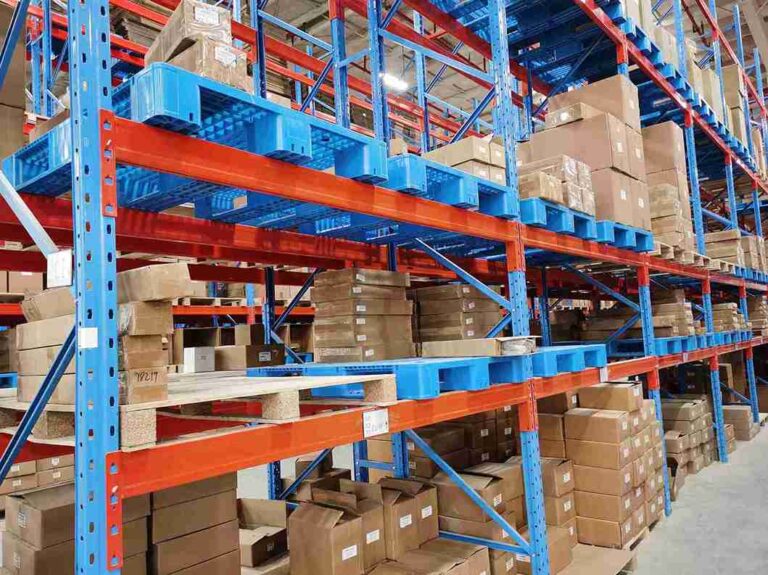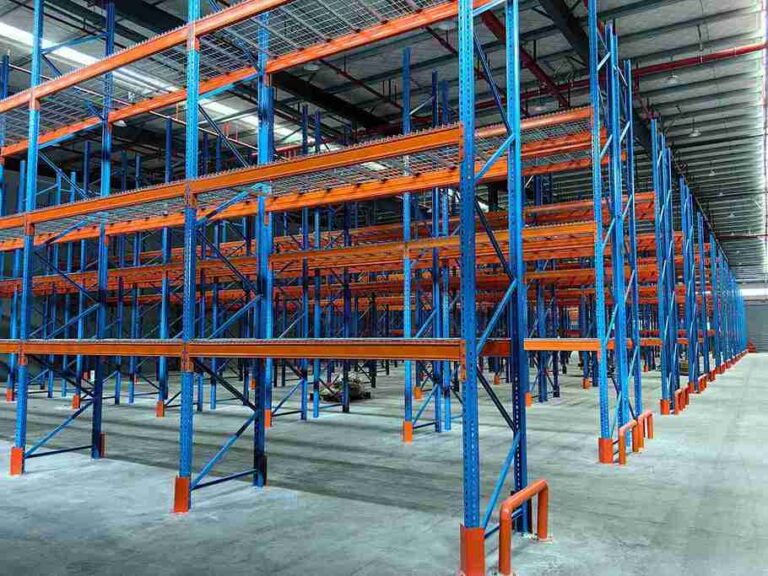
📐 "First 50 Enterprise Queries Get Custom 3D Warehouse Design" Plan
















A Comprehensive Guide to Warehouse Pallet Racking Layout: Optimize Storage, Cut Costs, and Future-Proof Your Operations
In the dynamic and cost-sensitive markets of Southeast Asia, the Middle East, Africa, and Latin America, warehouse operational efficiency is a decisive competitive edge. The strategic cornerstone of this efficiency is a meticulously planned warehouse pallet racking layout. Far from a simple exercise in space allocation, an optimized warehouse pallet racking layout represents a complex integration of engineering precision, inventory behavior analytics, and workflow ergonomics.
A suboptimal design silently erodes profitability through underutilized cubic volume, inflated labor costs, sluggish throughput, and preventable safety incidents. Conversely, a professionally engineered warehouse pallet racking layout, developed from first principles and tailored to specific operational data, unlocks transformative value. It systematically increases storage density by 30-50%, drastically accelerates material handling cycles, creates a seamless pathway for automation integration, and delivers a compelling return on investment through sustained operational savings.
This definitive resource, synthesizing decades of cross-industry and cross-continent project execution, provides a masterclass in designing, implementing, and continuously refining a warehouse pallet racking layout that functions as a dynamic, scalable, and profit-centric asset.

The Tangible and Hidden Costs of a Suboptimal Warehouse Pallet Racking Layout
Managers often sense their storage configuration is inefficient, yet they struggle to quantify the full financial drain. An ineffective warehouse pallet racking layout initiates a domino effect of operational deficiencies with direct and indirect cost implications. The most apparent cost is wasted real estate; a poorly configured warehouse storage system can necessitate a facility footprint 25-40% larger than actually required—a crippling expense in regions experiencing rapid industrialization and rising property costs. The indirect costs, however, are more insidious and pervasive.
Excessive travel distances for forklifts and order pickers directly correlate to higher fuel or battery consumption, increased labor hours, and reduced order fulfillment capacity. Congested aisles, a direct result of a flawed warehouse pallet racking layout, elevate the risk of product damage and serious workplace accidents, leading to higher insurance premiums, potential litigation, and operational downtime.
The genesis of these issues is rarely a single error but a combination of common planning oversights exacerbated by unguided operational evolution. Many facilities adopt a replicated or standardized rack configuration without a granular analysis of their unique SKU characteristics, inventory turnover profiles, and handling equipment specifications. This generic approach to warehouse pallet racking layout guarantees significant performance leakage and forfeited profit from the outset.
Strategic Data Foundation: The Pre-Analysis for a Custom Warehouse Pallet Racking Layout
The journey to an optimized warehouse pallet racking layout begins not with CAD software, but with data acquisition. A custom warehouse layout design is a data-driven artifact. Leading logistics consultants initiate every engagement with a holistic, on-site diagnostic audit. This critical phase encompasses:
Granular SKU Analytics & Velocity Profiling: Every item is analyzed for its dimensions, weight, turnover rate (using ABC/FMR analysis), and physical characteristics. This data determines its ideal location and storage medium within the final warehouse pallet racking layout.
Process Flow Mapping & Bottleneck Identification: Every touchpoint in the material and information flow is charted, from truck arrival to dispatch. This reveals hidden inefficiencies and informs the overarching flow pattern (U-shaped, straight-through) of the new pallet racking system layout.
Comprehensive Equipment & Facility Assessment: The capabilities of existing forklifts, reach trucks, and conveyors are evaluated against current and future needs. Simultaneously, building constraints—column spacing, clear height, floor load capacity, door and sprinkler locations—are meticulously documented as fixed parameters for the warehouse pallet racking layout design.
This foundational intelligence transforms the design process from guesswork into a precise science, ensuring the resulting bespoke storage solution is engineered for peak performance within the client’s specific ecosystem.
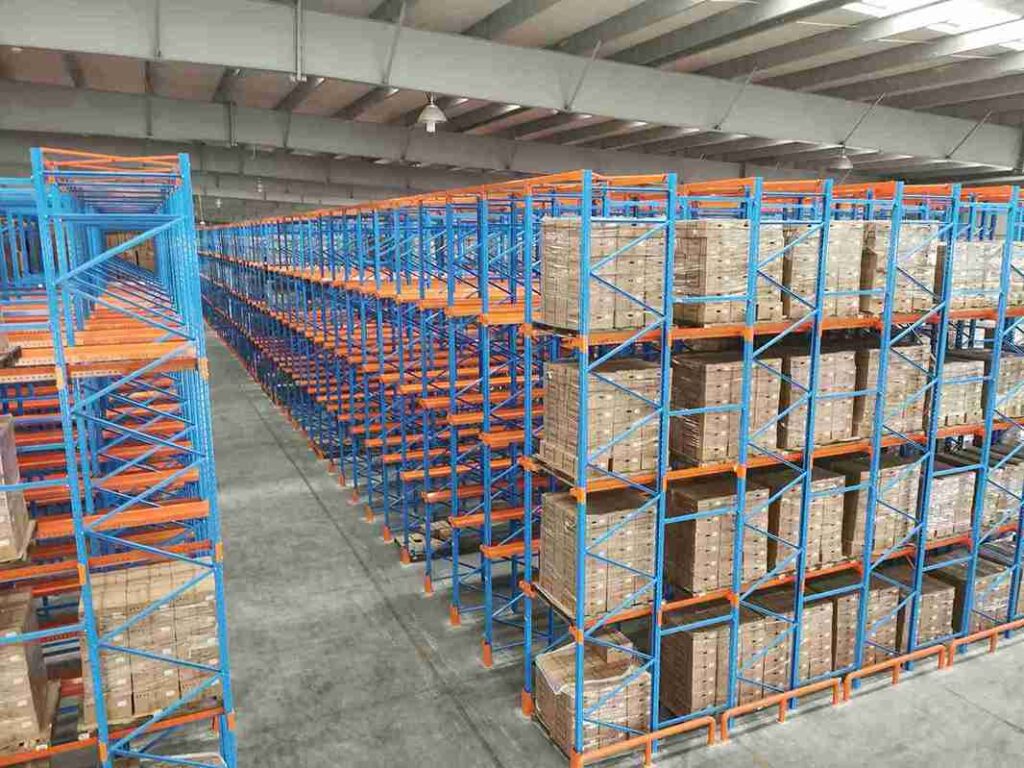
Core Engineering Principles of a High-Performance Warehouse Pallet Racking Layout
Armed with robust data, the design of a high-performance warehouse pallet racking layout applies time-tested engineering and logistical principles.
Principle 1: Strategic Storage Philosophy Integration
The physical warehouse pallet racking layout must embody the chosen storage strategy. The choice between Dedicated, Random (WMS-dependent), or Class-Based storage fundamentally shapes the rack configuration and aisle design. A Class-Based strategy, often optimal, zones the warehouse pallet racking layout into high, medium, and low-velocity areas, each with tailored equipment and access profiles, maximizing both selectivity and density.
Principle 2: Material Flow Optimization and Travel Path Minimization
The primary goal of any warehouse pallet racking layout is to minimize non-value-added travel. This involves designing a logical, unidirectional flow (U, I, or L-shaped) to prevent cross-traffic and designating distinct zones for receiving, staging, storage, picking, packing, and shipping. The placement of these zones within the overall warehouse pallet racking layout is critical to reducing handling steps and transit time.
Principle 3: Precision Slotting: The Micro-Design of the Layout
Slotting is the tactical placement of individual SKUs within the macro warehouse pallet racking layout. Key rules govern this: placing ‘A’ items in the most accessible “Golden Zone” (between knee and shoulder height), positioning heavy items at ergonomically safe levels, grouping related items (family grouping) to facilitate multi-pick efficiency, and ensuring hazardous or incompatible products are adequately separated. Effective slotting within a custom pallet racking layout can boost pick productivity by over 20%.
Principle 4: Dynamic Aisle Width Configuration for Maximum Density
A critical lever in warehouse pallet racking layout design is variable aisle width. The formula Aisle Width = (2 x Load Length) + (2 x Clearance) + Equipment Turning Radius is applied zone-by-zone. By matching aisle width precisely to the equipment used—be it a wide-aisle counterbalance forklift, a narrow aisle layout for reach trucks, or a very-narrow-aisle for turret trucks—the warehouse pallet racking layout achieves optimal storage density without compromising accessibility.
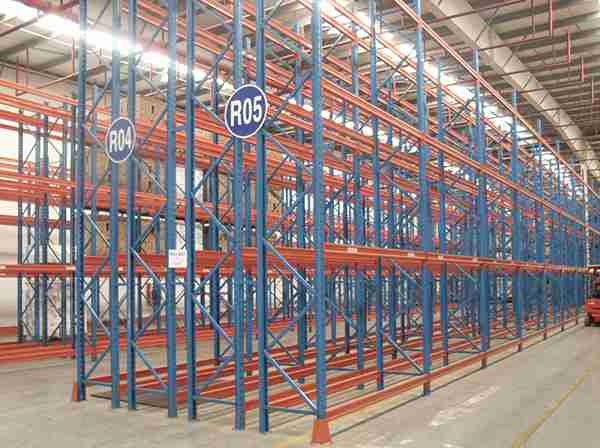
Selecting the Optimal Pallet Racking System for Your Layout Objectives
The vision for the warehouse pallet racking layout is realized through the physical racking system. The selection is pivotal to achieving specific goals like density, selectivity, or throughput.
Selective Pallet Racking: The Foundation of Flexibility
As the most versatile system, it provides direct access to every pallet location. The focus in a warehouse pallet racking layout using selective racking is on optimizing pick paths and aisle widths for the intended mix of equipment and SKU velocity.
High-Density Storage Systems: Engineered for Cubic Utilization
When maximizing storage volume is paramount, the warehouse pallet racking layout integrates specialized systems:
Drive-In/Drive-Through Racking: Forklifts drive into the rack structure, creating a high-density block for homogeneous, slower-moving products. This configuration is a key component in a bulk storage zone within a larger warehouse pallet racking layout.
Push-Back Racking: Utilizing a series of nested carts on a slight incline, this system offers Last-In, First-Out (LIFO) access with greater density than selective racking. It is an excellent solution for medium-velocity products within a custom pallet racking layout.
Pallet Flow Racking: A gravity-fed, dynamic system ensuring perfect First-In, First-Out (FIFO) inventory rotation. It is ideal for high-throughput, time-sensitive goods and is often the centerpiece of a fast-moving zone in an advanced warehouse pallet racking layout.
Specialized Structural Solutions
Cantilever Racking: For long, bulky, or irregularly shaped items, a dedicated zone with cantilever racking is integrated into the overall warehouse pallet racking layout.
Mezzanine Systems: Effectively creating a multi-level structure within the existing building envelope, mezzanines are a powerful tool in a warehouse pallet racking layout for storing lighter, slower-moving items or housing ancillary functions.
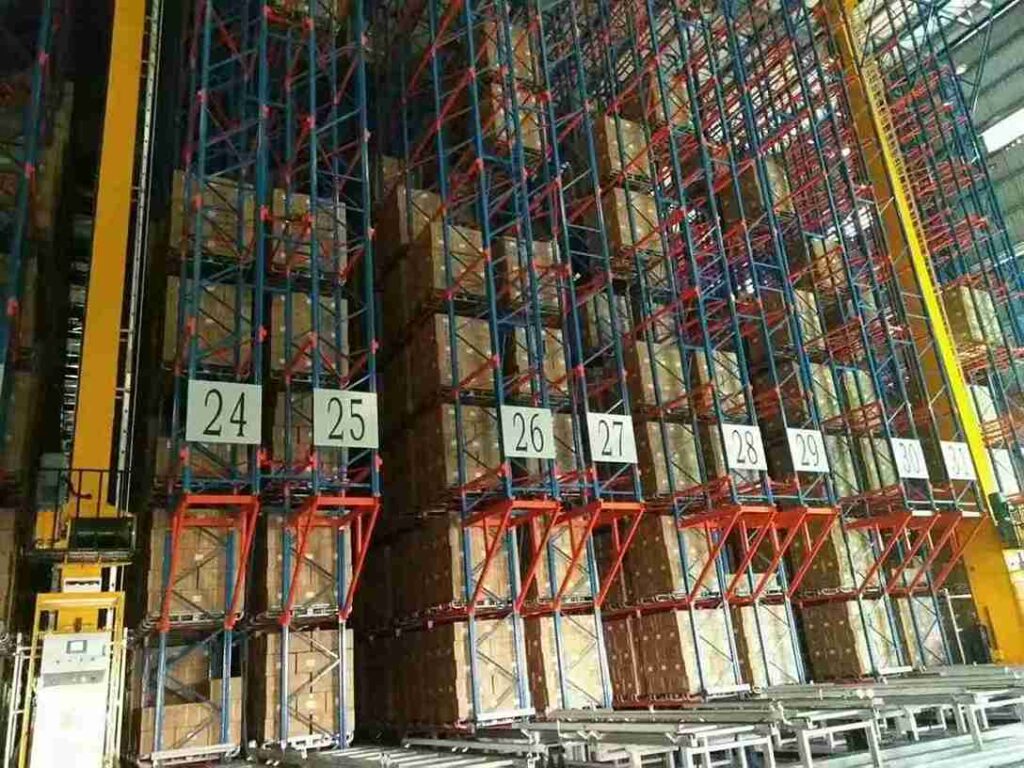
The Digital Nervous System: WMS Integration with the Physical Layout
A sophisticated physical warehouse pallet racking layout requires a digital brain to realize its full potential. A robust Warehouse Management System (WMS) acts as this central intelligence, making the static layout dynamic and responsive.
The WMS directs all activities within the warehouse pallet racking layout. It determines the most efficient put-away location based on real-time space availability and slotting rules, generating optimized pick paths that reduce travel. For a layout utilizing random storage, the WMS is essential, tracking every pallet’s location. It automates replenishment tasks, manages cycle counts, and provides the performance analytics needed to continuously refine the warehouse pallet racking layout over time. In an automated environment, the WMS seamlessly orchestrates AS/RS cranes, AGV fleets, and conveyor systems, making the entire automated warehouse layout function as a single, coherent organism.
Safety and Regulatory Compliance by Design
A warehouse pallet racking layout that sacrifices safety for density is fundamentally flawed. Industry-leading design integrates safety from the outset, adhering to international standards (e.g., FEM, RMI) and local regulations. Key safety-by-design features in a professional warehouse pallet racking layout include:
Impact Protection: Strategic placement of column guards, rack protectors, and aisle-end barriers to absorb forklift impacts.
Structural Integrity: Specification of load beams with mechanical or boltless safety locks, clearly marked load capacity plaques on every bay, and engineering for seismic activity where required.
Traffic Management: Clearly marked, dedicated pedestrian walkways, adequate lighting, and visible signage are integral to the overall warehouse pallet racking layout plan to separate human and machine traffic flows.
Future-Proofing: Designing the Layout for Scalable Automation
The modern warehouse pallet racking layout must be conceived with technological evolution in mind. A forward-thinking design allows for phased, scalable warehouse automation integration without requiring a complete rebuild.
Preparing for Mobile Robotics (AGVs/AMRs)
Designing a warehouse pallet racking layout for future Automatic Guided Vehicles (AGVs) or Autonomous Mobile Robots (AMRs) involves specific considerations: ensuring main transit aisles are straight and wide enough for efficient robot corridors, specifying floors with minimal joints and slopes, and planning for charging/transfer station locations within the layout. The rack configuration itself, particularly lower beam heights and pallet overhang, must be compatible with robot interaction points.
Architecting for Automated Storage and Retrieval Systems (AS/RS)
For clients eyeing the pinnacle of density and speed, the warehouse pallet racking layout must be architected to accept an AS/RS in the future. This requires stringent floor flatness and load-bearing specifications, column grids that do not interfere with potential crane runways, and dedicated vertical clearance zones. Electrical and data conduit planning during the initial warehouse pallet racking layout phase is crucial to minimize retrofitting costs later.
The Implementation Roadmap: Translating Layout Design into Operational Reality
A flawless warehouse pallet racking layout design demands an equally meticulous implementation strategy to ensure success with minimal operational disruption.
Detailed Engineering & Documentation: The approved warehouse pallet racking layout is translated into full construction and installation drawings, including foundation plans and structural load letters for local authority approval.
Phased, Managed Installation: Experienced project managers coordinate the installation sequence—site preparation, rack erection, safety device installation—around live operations, often utilizing weekend or off-peak work windows.
Concurrent WMS Deployment & Testing: The WMS is configured and tested in parallel with the physical build, ensuring data integrity and process alignment from day one.
Structured Inventory Migration: Inventory is transferred into the new system using a carefully planned “flash cut” or phased approach, with rigorous cycle counting to ensure accuracy.
Comprehensive Training & Knowledge Transfer: All levels of staff, from operators to supervisors, receive hands-on training on the new warehouse pallet racking layout, equipment, and processes.
Post-Go-Live Support & Continuous Improvement: Following commissioning, periodic performance audits are conducted to identify tuning opportunities, ensuring the warehouse pallet racking layout continues to evolve with the business.
Conclusion: The Warehouse Pallet Racking Layout as a Strategic Growth Platform
In conclusion, a masterfully planned warehouse pallet racking layout is far more than a tactical storage plan; it is a strategic platform upon which scalability, resilience, and customer satisfaction are built. For businesses operating in the fast-growing yet cost-conscious markets across the globe, the distinction between an ad-hoc storage arrangement and a data-driven, custom-engineered warehouse pallet racking layout is the difference between reacting to market demands and proactively shaping market advantage.
Investing in a professional warehouse pallet racking layout is an investment in foundational operational excellence. It yields a tangible, measurable return by unlocking latent capacity, slashing ongoing costs, and creating an agile infrastructure ready to embrace the future of logistics. The journey begins with recognizing the immense value trapped within your current four walls and partnering with experts who specialize in liberating it through intelligent, holistic, and forward-looking design.
Frequently Asked Questions (FAQs)
1. How does climate (e.g., high humidity in Southeast Asia or dust in the Middle East) influence warehouse pallet racking layout and system choice?
Environmental factors critically influence the warehouse pallet racking layout and component specification. In high-humidity coastal regions, a layout must consider enhanced ventilation and the use of galvanized or powder-coated racking with higher corrosion resistance (e.g., Z600 coating). In dusty environments, the layout might avoid complex pallet flow racking where debris can jam wheels, opting instead for more open selective racking. The facility audit phase of designing a custom warehouse layout always includes an environmental assessment to specify appropriate materials and protect inventory integrity.
2. For a multi-client 3PL warehouse, how does the pallet racking layout approach differ?
A Third-Party Logistics (3PL) facility requires a uniquely flexible warehouse pallet racking layout. The design must accommodate diverse and changing client SKU profiles, making adaptability paramount. The layout often relies heavily on a WMS-driven random storage strategy within a versatile selective racking system. Clear zoning and potentially demarkable sections within the layout are crucial for client segregation. The warehouse pallet racking layout must also efficiently handle varying levels of value-added services (VAS), requiring dedicated, flexible spaces within the flow plan.
3. What role does lighting design play in an optimized warehouse pallet racking layout?
Lighting is an integral, often overlooked, component of an effective warehouse pallet racking layout. A well-lit warehouse improves safety, accuracy, and productivity. The layout design should coordinate with lighting plans to ensure aisles and pick faces are evenly illuminated, avoiding shadows cast by racks. Modern, energy-efficient LED systems with motion sensors can be zoned to align with the warehouse pallet racking layout, providing bright light in active picking zones and dimmed light in bulk storage, yielding significant energy savings. Proper lighting also supports WMS barcode scanning accuracy throughout the pallet racking system layout.
4. Can an existing warehouse pallet racking layout be significantly optimized without a complete teardown and rebuild?
Absolutely. While a greenfield project offers maximum freedom, most optimization projects involve retrofitting an existing warehouse pallet racking layout. Strategies include: conducting a full slotting review and re-organizing inventory per new velocity data, re-configuring aisles (e.g., widening some, narrowing others with new equipment), adding vertical storage via taller uprights or mezzanines, and integrating targeted high-density systems like push-back racking in specific zones. Even incremental changes to a warehouse pallet racking layout can yield 15-30% efficiency gains without a full capital overhaul.
5. How do you measure the success of a new warehouse pallet racking layout post-implementation?
Success is measured through a set of Key Performance Indicators (KPIs) established during the design phase. These typically include: Storage Density (pallet positions per square meter), Order Picking Productivity (lines/orders picked per hour), Travel Time Reduction (average distance per pick/put-away), Space Utilization Rate (percentage of occupied locations), and Safety Incident Rate. A post-implementation audit conducted 3-6 months after go-live collects this data, comparing it against pre-implementation baselines to objectively quantify the ROI of the new warehouse pallet racking layout.
If you require perfect CAD drawings and quotes for warehouse racking, please contact us. We can provide you with free warehouse racking planning and design services and quotes. Our email address is: jili@geelyracks.com