📐 "First 50 Enterprise Queries Get Custom 3D Warehouse Design" Plan
















Maximize Warehouse Space Utilization: A Strategic Blueprint for 20% More Storage Without Expansion
For logistics managers, warehouse operators, and business owners across the growing industrial landscapes of Southeast Asia, the Middle East, Africa, and Latin America, a universal challenge is emerging: the walls are closing in. The existing warehouse space is no longer sufficient. The costs and complexities of physical expansion—from soaring land prices to protracted construction timelines—are often prohibitive.
However, the most potent solution to this crisis of capacity does not lie in acquiring more land; it lies in a fundamental re-engineering of the warehouse space already owned. This comprehensive guide details a proven, strategic methodology for achieving a minimum of 20% more storage capacity within the same four walls, a transformation rooted not in magic, but in the meticulous science of warehouse space optimization.
The journey to maximizing warehouse space is a multidimensional puzzle. It demands a shift from traditional, two-dimensional thinking about floor area to a dynamic, three-dimensional mastery of the entire storage cube. It involves the strategic implementation of high-density storage systems, the intelligent integration of automation, and the data-driven orchestration of inventory.
For companies specializing in warehouse storage systems and automation solutions, the mission is to unlock this hidden potential, transforming static, congested warehouse space into a fluid, high-throughput asset. The following sections will provide a detailed, actionable blueprint for this transformation, demonstrating how a holistic approach to warehouse space management can yield dramatic gains in capacity, efficiency, and profitability.
The Foundational Shift: Mastering the Storage Cube, Not Just the Floor Plan
The single most significant conceptual leap in modern logistics is the transition from managing square footage to mastering the cubic footprint. The storage cube represents the total volumetric capacity of a facility, from the foundation slab to the bottom of the roof trusses. A staggering number of warehouses operate with a cube utilization rate of below 50%, leaving a vast, untapped reservoir of potential warehouse space overhead. This vertical frontier is the new battleground for operational efficiency. Maximizing this cube is the most direct path to gaining more usable warehouse space without a single brick being laid.
This three-dimensional perspective forces a reevaluation of every element within the warehouse space. It challenges the standard clearances, the aisle widths, and the height limitations of conventional racking. An expert analysis of a facility’s warehouse space begins with a precise volumetric assessment, identifying not just where floor space is wasted, but where air space is being paid for but not utilized. This cube-centric philosophy underpins all advanced strategies for warehouse space optimization, from simple racking extensions to the deployment of fully automated, cube-harvesting systems.
The Vertical Imperative: Engineering Height into the Warehouse Space
The ceiling is the most consistently underutilized asset in a typical warehouse. Modern pre-engineered steel structures are capable of supporting immense loads at significant heights, yet this inherent strength is often met with storage systems that fail to capitalize on it. Exploiting this vertical potential is the first and most impactful step in creating more functional warehouse space.
Strategic Racking Enhancements: A common sight in under-optimized facilities is selective pallet racking that stops several meters short of the ceiling. A foundational intervention involves a structural review of the building to determine the safe maximum height for racking uprights. Upgrading to custom, taller uprights and adding additional beam levels can instantly add multiple layers of storage within the same warehouse space, effectively adding a mezzanine level’s worth of capacity without the steelwork.
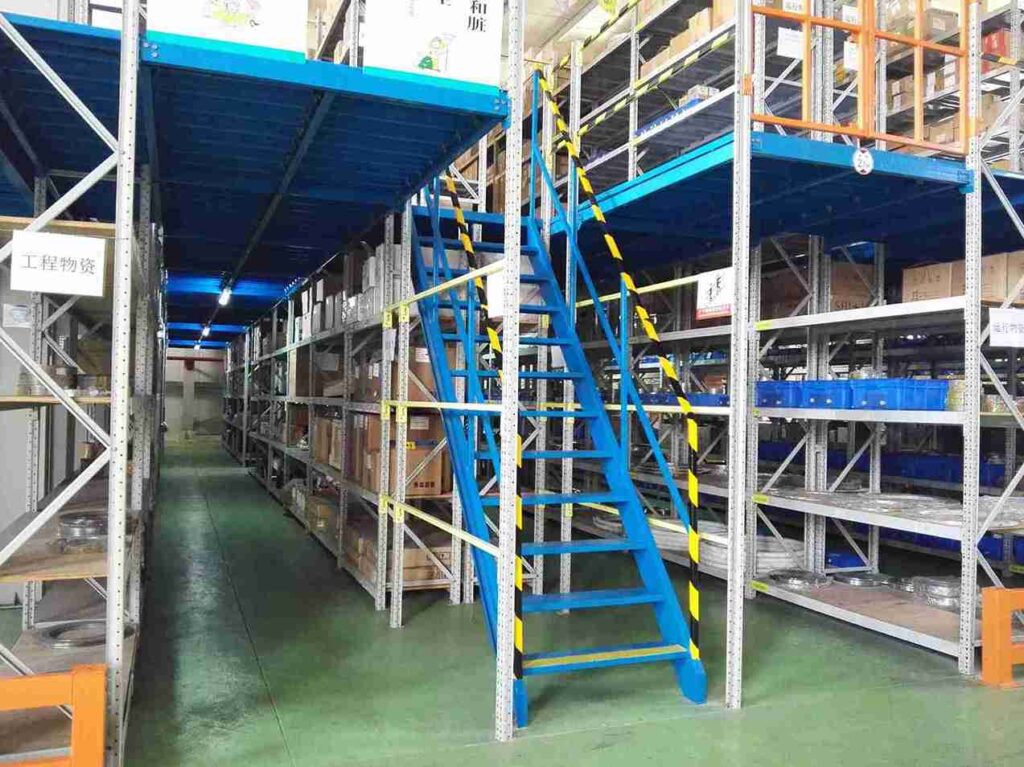
Mezzanine Floors: Creating a Second Tier of Warehouse Space: For facilities with high ceilings, the installation of a mezzanine floor is a transformative solution. It effectively manufactures new, high-value warehouse space within the air rights of the existing facility. This second tier is ideal for housing slow-moving inventory, packaging supplies, or hosting value-added services like light assembly or kitting. A well-designed mezzanine system can double or even triple the usable floor area within a specific footprint of the warehouse space, liberating the ground floor for more dynamic, high-turnover operations.
High-Bay and Automated Storage and Retrieval Systems (ASRS): The apex of vertical warehouse space utilization is the high-bay warehouse. These monumental structures, often exceeding 30 meters in height, represent the ultimate conquest of the cubic footprint. Integrated with Automated Storage and Retrieval Systems (ASRS), they create a hyper-dense, lights-out storage environment where the warehouse space is so optimized that human access is neither required nor efficient. The return on investment for such systems is calculated not only in the phenomenal density achieved—dramatically reducing the footprint required per pallet—but also in the near-perfect inventory accuracy and radical reduction in labor costs per transaction.

High-Density Storage Systems: The Science of Aisle Elimination
Once the vertical dimension is being actively managed, the next frontier is the horizontal plane, specifically the vast tracts of warehouse space dedicated solely to access aisles. In a conventional layout, aisles for counterbalance forklifts can consume over 50% of the total floor area. High-density storage systems are engineered on a simple but powerful principle: to compress the storage footprint by making aisles dynamic, shared, or, in some cases, entirely eliminated.
Narrow Aisle (NA) and Very Narrow Aisle (VNA) Strategies
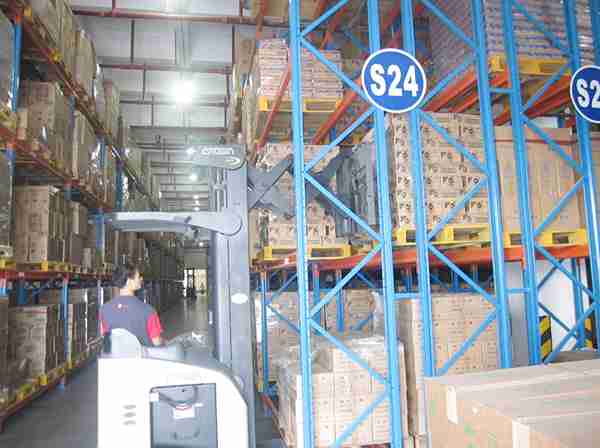
Transitioning from standard forklifts to specialized Narrow Aisle or Very Narrow Aisle trucks is one of the most effective first steps in reclaiming warehouse space. These machines are designed to operate within drastically reduced aisle widths—often as narrow as 1.6 to 2 meters for VNA trucks.
Infrastructure Synergy: This approach requires a symbiotic relationship between the equipment and the warehouse space. VNA operations typically depend on guidance systems, such as wire or rail, to ensure precision and prevent rack damage. Furthermore, they necessitate a super-flat floor to operate safely and efficiently. The investment in this infrastructure is directly justified by the immense gain in pallet positions achieved by converting former aisle warehouse space into productive storage warehouse space.
The Direct Impact on Warehouse Space: The mathematics are compelling. By reducing an aisle from 3.5 meters to 1.8 meters, a facility can add multiple additional rows of racking within the same overall warehouse space. This single change can routinely increase storage density by 20% to 40%, making it a cornerstone strategy for any serious warehouse space optimization project.
Mobile Pallet Racking: The Dynamic Warehouse Space Solution
For a truly radical reconfiguration of warehouse space, mobile pallet racking stands apart. This system mounts entire rows of racking onto electrically driven carriages that glide on rails embedded in the floor. Instead of a static grid of multiple permanent aisles, only one single “access aisle” is opened at any given time, precisely where needed.
Operational Mechanics: An operator, or an automated system, selects a specific pallet location. The command prompts the mobile bases to move, sliding the multi-ton racking structures apart to create a temporary aisle. After the storage or retrieval task is completed, the racks close, and the warehouse space is once again a solid, uninterrupted block of storage.
Quantum Leap in Warehouse Space Density: The space-saving potential is unparalleled. Mobile racking systems can increase storage density by up to 80% or more compared to traditional selective racking. This makes them the definitive solution for any environment where the cost of the warehouse space is exceptionally high, such as in urban logistics centers, cold storage facilities where refrigeration costs are a major operational expense, or for archiving low-turnover items.
Drive-In and Drive-Through Racking for Bulk Storage
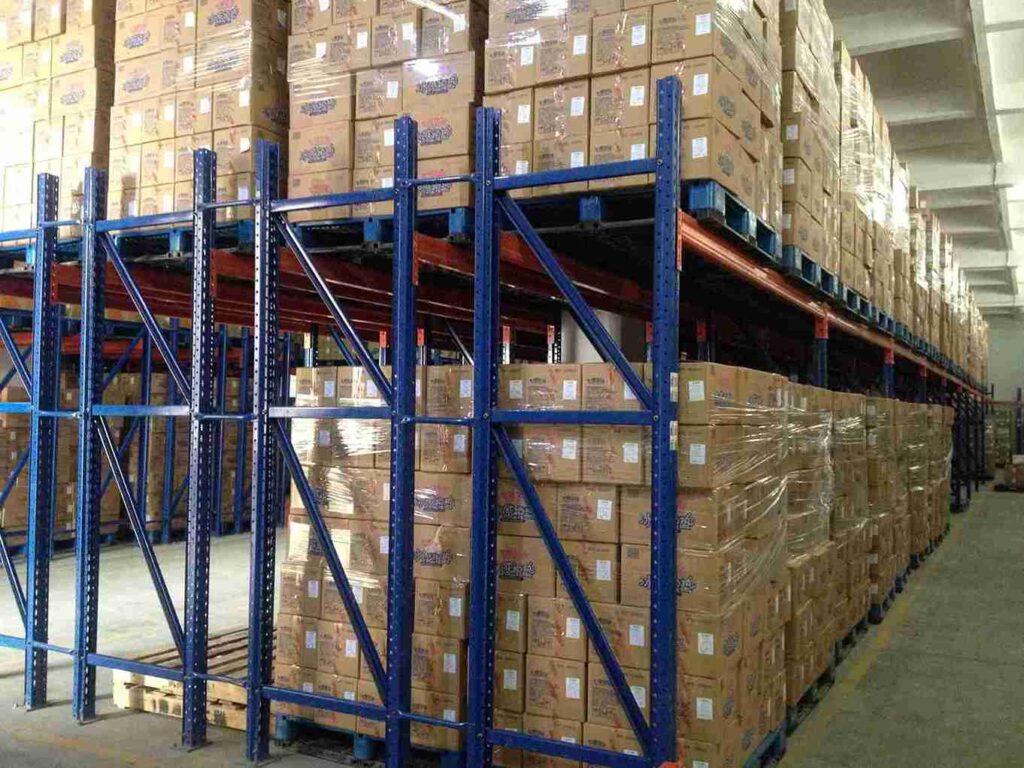
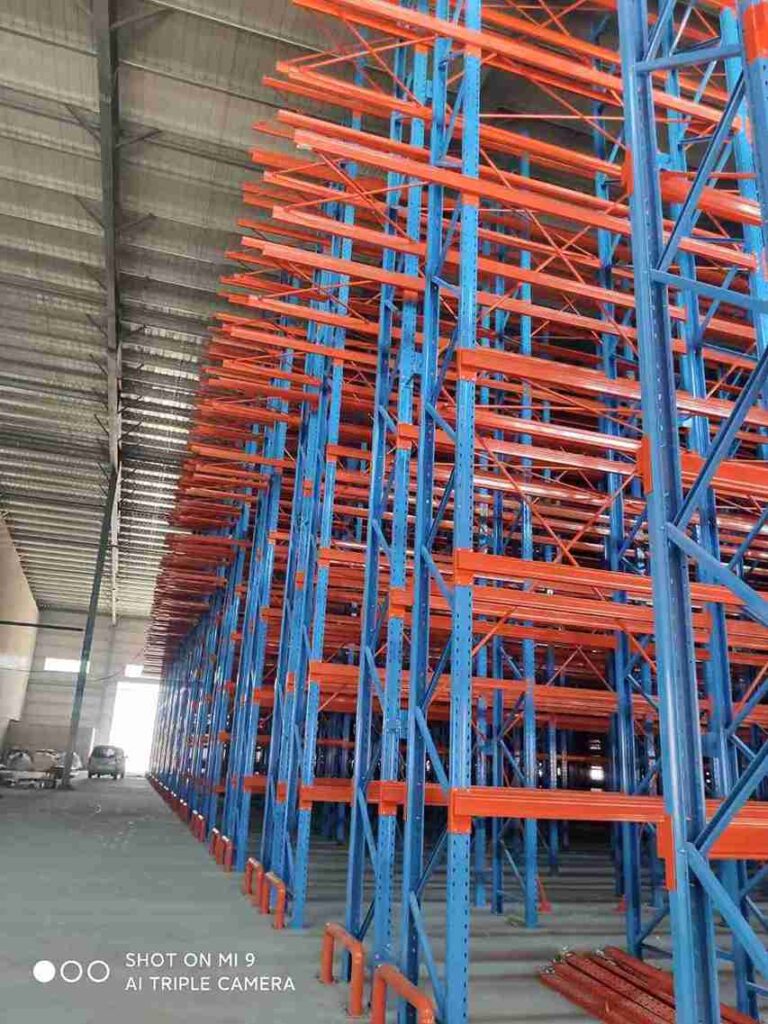
When dealing with high volumes of a limited number of SKUs, such as in the beverage industry or for raw material storage, maximizing the density of the warehouse space is paramount. Drive-in and drive-through racking systems are designed for this exact purpose, allowing forklifts to drive directly into the rack structure to place and retrieve pallets.
LIFO and FIFO Configurations: Drive-in racking typically operates on a Last-In, First-Out (LIFO) basis, ideal for seasonal products or non-perishable goods. Drive-through racking, with access from both ends, enables a First-In, First-Out (FIFO) flow, which is critical for managing perishable goods, chemicals, or any product with a strict shelf life. Both configurations are engineered to eliminate the interstitial aisle warehouse space, creating a continuous, high-density storage block that makes the most intense use of the allocated warehouse space.
The Intelligence Layer: Automation and WMS in Warehouse Space Orchestration
Physical storage systems provide the skeleton, but automation and software provide the central nervous system that brings the optimized warehouse space to life. This intelligence layer is what ensures that high-density systems do not become high-complexity bottlenecks, but rather fluid, high-velocity enablers.
Automated Storage and Retrieval Systems (ASRS): The Precision Tool
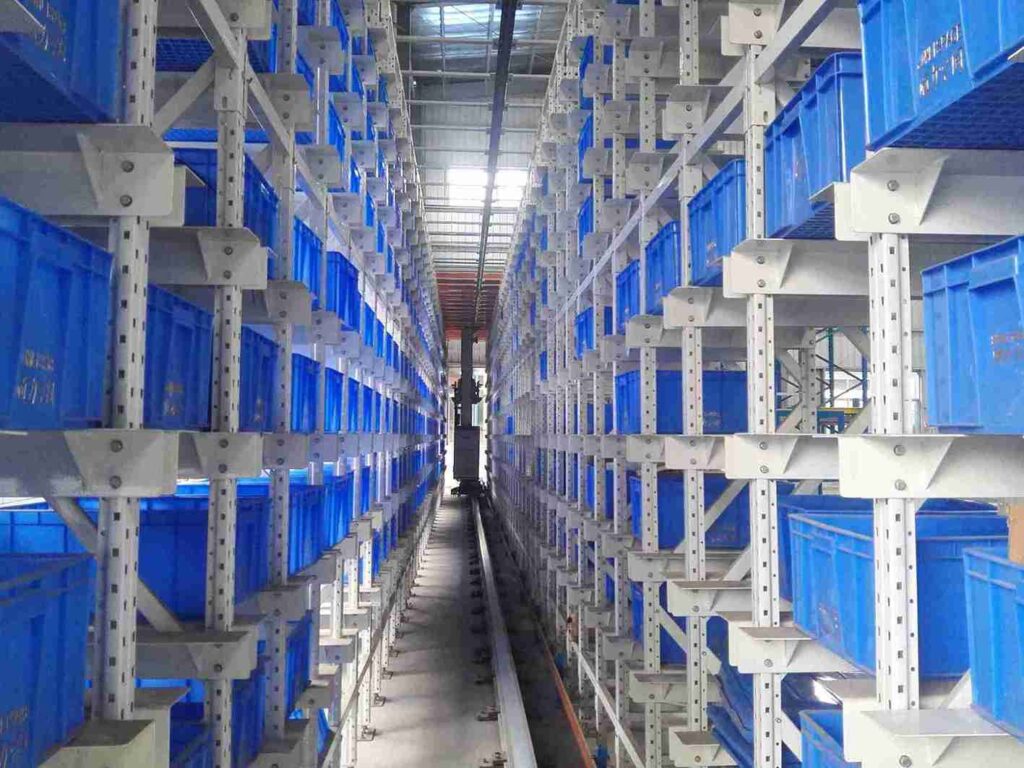
As previously mentioned in the context of high-bay, ASRS technology is equally transformative for smaller-item storage. Mini-load ASRS and shuttle-based systems operate in aisles that are only centimeters wider than the stored totes or boxes. These robotic cranes navigate the vertical warehouse space with unerring accuracy, retrieving items on demand and delivering them to a picker at a static workstation.
The Dual Benefit for Warehouse Space and Labor: The primary benefit is the ultra-dense utilization of the warehouse space, as the system can store items from floor to ceiling with minimal access requirements. The secondary, equally powerful benefit is the dramatic increase in order-picking productivity and accuracy. By managing the movement of inventory within the warehouse space, the ASRS allows human labor to be focused on value-added tasks, fundamentally changing the labor economics of the operation.
Goods-to-Person (G2P) Technologies: AGVs and Shuttles
The traditional “person-to-goods” model is inherently inefficient from a warehouse space perspective, as it necessitates a layout designed for human traversal, with wide aisles and easy access. The Goods-to-Person (G2P) model revolutionizes this dynamic. In a G2P system, the inventory is brought automatically to the operator.
Automated Guided Vehicles (AGVs) can be deployed to transport pallets from dense, static storage areas to ergonomic picking or staging stations. This allows the bulk of the warehouse space to be configured for maximum density, without regard for human access, as the AGVs are the sole interface with the deep storage zones.
Cube-Based Automated Shuttles represent the next evolution. These robots travel within the racking structure itself, moving in the X, Y, and Z axes to retrieve individual totes from the deepest, highest locations in the storage cube. This technology allows for the design of a warehouse space that is purely for storage density, as the shuttles require only minimal clearance. The resulting system is a perfect synergy of maximum warehouse space utilization and optimal human ergonomics.
The Cognitive Core: Intelligent Slotting and WMS Optimization
A warehouse could be equipped with the most advanced physical systems, but without intelligent inventory placement, the potential of the warehouse space will never be fully realized. Intelligent slotting, governed by a powerful Warehouse Management System (WMS), is the cognitive core that dictates the efficiency of the entire operation.
Data-Driven ABC Analysis: The foundational step is a dynamic ABC analysis of inventory. ‘A’ items, characterized by high velocity, must be slotted in the most accessible “golden zone” of the warehouse space to minimize travel time. ‘B’ and ‘C’ items are then positioned in the higher, lower, or denser storage areas of the warehouse space. This strategic placement ensures that the flow of high-turnover products is not hindered by the density required for slower movers.
The Warehouse Management System (WMS) as the Conductor: A modern, tier-1 WMS is non-negotiable for a truly optimized warehouse space. It acts as the central brain, making real-time decisions that maximize the utility of every square and cubic meter. A sophisticated WMS will:
Dynamically assign put-away locations based on product dimensions, weight, velocity, and compatibility, ensuring every pallet is placed in the most space-efficient and operationally logical location within the warehouse space.
Actively prevent honeycombing—the creation of unused slots that are too small for a new pallet—by consolidating inventory and directing put-away to fill gaps.
Continuously analyze order data and adjust slotting profiles to adapt to seasonal shifts and changing demand patterns, ensuring the warehouse space is always organized for peak efficiency.
Direct the movements of AGVs and ASRS cranes, orchestrating the dance of automation within the warehouse space to minimize cycle times and prevent system conflicts.
Foundational Optimizations: Pallet and Package Dimensions
Sometimes, the most straightforward way to create more warehouse space is to reduce the size of the unit loads being stored. Inefficiencies at the pallet and carton level are magnified exponentially across thousands of storage locations, silently consuming vast amounts of valuable warehouse space.
Pallet Footprint Analysis: A critical, yet often overlooked, audit involves pallet selection. Are you using the most space-efficient pallet size for your specific racking dimensions? A difference of a few centimeters in length or width, when multiplied across thousands of rack locations, can equate to the loss of an entire row of storage, effectively wasting a significant portion of the available warehouse space.
Enhanced Stackability and Unit Load Integrity: Evaluating the stackability of products or palletized loads can directly increase cube utilization. Investing in more robust palletizing techniques or stronger secondary packaging can allow for an additional unit load to be stored safely within the same vertical warehouse space, instantly increasing capacity.
The War on “Air”: A pervasive enemy of efficient warehouse space utilization is “shipping air”—the empty space within partially filled cartons and pallets. Implementing cartonization software, which algorithmically selects the perfect box size for each order, and promoting right-sized packaging initiatives can free up a remarkable amount of space both in storage and in outbound vehicles, making the entire warehouse space work harder.
Engineering for Safety and Sustainability in Dense Warehouse Spaces
A high-density warehouse space introduces unique safety and environmental considerations. Compressing inventory and automating movement creates a new operational environment where safety and sustainability must be engineered into the design from the outset, not added as an afterthought.
Structural Integrity and Seismic Considerations: Any project aimed at increasing the density or height of storage must begin with a certified structural analysis of the building. This is especially critical in regions prone to seismic activity. The evaluation must cover the floor load capacity, the upright impact ratings of the racking, and the overall stability of the structure under the new, more concentrated loads. The integrity of the warehouse space is the foundation of all other gains.
Advanced Fire Protection Systems: The fire dynamics in a high-density warehouse space are fundamentally different. Conventional ceiling sprinklers may be ineffective at controlling a fire that starts deep within a rack structure, shielded by multiple layers of inventory. In-rack sprinkler systems are often a mandatory requirement, creating a layered defense that can contain a fire at its source within the complex geometry of the warehouse space.
Airflow and Thermal Management: In temperature-controlled environments, particularly cold storage, dense packing can severely inhibit airflow, leading to thermal stratification and spoilage. The design of the storage system must be fully integrated with the refrigeration engineering. This ensures that the quest for dense warehouse space does not compromise the primary function of preserving the product, which would be a catastrophic failure.
A Phased Action Plan for Unlocking 20% More Warehouse Space
The path to a transformed warehouse space is a methodical process, not a single event. The following step-by-step plan provides a roadmap for any organization to begin this journey.
Comprehensive Diagnostic Audit: The first step is to conduct a deep-dive analysis of the current warehouse space. This involves precise volumetric measurements, an inventory profile analysis (SKU count, dimensions, velocity, seasonality), and a detailed mapping of all material and human workflows. This establishes a quantifiable baseline for the existing warehouse space utilization.
Workflow and Bottleneck Mapping: Every process—from receiving to shipping—must be mapped and measured. Identifying travel path inefficiencies, congestion points, and process bottlenecks reveals how the current layout of the <b>warehouse space</b> is hindering flow, not just how it is failing to store enough.
Define Key Performance Indicators (KPIs): “20% more storage” must be translated into specific, measurable KPIs. This could be the number of additional pallet locations, a target increase in picks per hour, a reduction in order cycle time, or a decrease in the cost per unit handled within the warehouse space.
Develop a Phased, Investment-Staged Roadmap: A full-scale overhaul is rarely feasible or necessary. A prudent strategy involves a phased implementation. Phase 1 might involve optimizing the existing racking layout and implementing a WMS. Phase 2 could introduce VNA equipment in a specific section. Phase 3 might be the installation of a mobile racking system for archive goods. This approach manages risk and capital expenditure while delivering continuous improvement to the warehouse space.
Select a Technology-Integrated Solutions Partner: This transformation requires more than an equipment vendor. It demands a partner with deep expertise in storage system engineering, automation integration, and software implementation. The right partner acts as a consultant and project manager, ensuring that the new design for the warehouse space is not just a collection of parts, but a cohesive, high-performing system.
Conclusion: The Warehouse Space as a Strategic, Appreciating Asset
The constraint of finite physical warehouse space is, in reality, a powerful catalyst for innovation and operational excellence. The journey to achieving 20% more capacity is a disciplined and holistic process of re-engineering the facility from a passive container into a dynamic, intelligent system. It is a symphony of physical engineering—vertical storage, high-density systems, and automation—conducted by the digital intelligence of a advanced WMS.
By embracing this comprehensive approach, businesses do not merely create more storage; they build a more resilient, agile, and profitable logistics operation. The optimized warehouse space becomes a strategic, appreciating asset that drives competitive advantage, reduces operational costs, and provides the scalable platform necessary for future growth. The latent capacity is already contained within the existing warehouse space. The decision to unlock it is the first step toward a more efficient and prosperous future.
(H2) Frequently Asked Questions (FAQs)
1. What is the typical ROI period for investing in high-density storage systems like mobile racking or ASRS?
The return on investment is highly variable, dependent on the scale of the project, local labor and real estate costs, and the specific throughput gains. However, in high-cost environments like urban logistics centers or cold storage, mobile racking systems often demonstrate an ROI of 1-3 years due to the extreme value of the saved warehouse space. For larger, more complex ASRS projects, a 3-5 year ROI is common. The financial model must holistically account for hard savings from avoided expansion, soft savings from labor productivity, and the value of improved inventory accuracy and throughput.
2. How can we implement these changes without completely shutting down our ongoing warehouse operations?
A live, operational implementation is a standard requirement and a core competency of any experienced solutions provider. The strategy is always phased and zonal. The project is broken down into segments, allowing operations to continue in other areas. Work is often scheduled during off-peak shifts or weekends, and temporary operational protocols are established to maintain flow. A detailed, communicated project plan is essential to minimize disruption while transforming the warehouse space.
3. Our warehouse has a relatively low ceiling. Are high-density solutions still viable for us?
Absolutely. While the dramatic gains of high-bay storage may not be applicable, the principles of aisle elimination are just as powerful. Systems like mobile pallet racking or push-back racking deliver their massive density gains horizontally, by collapsing multiple aisles into one. Even in a facility with a 5-6 meter clear height, these systems can easily increase storage capacity by 50% or more, proving that optimizing the warehouse space is not solely about height.
4. How does automation like AGVs integrate with our existing, non-automated racking?
Modern Automated Guided Vehicles (AGVs) are designed for flexible integration. They can navigate a standard warehouse space with conventional racking, interfacing with it just as a human-operated forklift would. They are perfectly suited for repetitive horizontal transport tasks—such as moving pallets from the receiving dock to a designated put-away zone or ferrying picked orders to the shipping lane. This allows a company to start its automation journey and achieve significant labor savings without a complete and immediate overhaul of the entire warehouse space.
5. What are the ongoing maintenance requirements and costs for these advanced systems?
All mechanized and automated systems require a disciplined preventative maintenance (PM) program to ensure uptime, safety, and longevity. For complex systems like ASRS and AGVs, this typically involves scheduled service contracts with the provider or a trained in-house team. The cost of this maintenance should be viewed as a predictable operational expense that safeguards the significant investment in the warehouse space optimization. A well-maintained automated storage system can have a functional lifespan of 15-20 years or more, making the ongoing maintenance a critical component of long-term ROI.
If you require perfect CAD drawings and quotes for warehouse racking, please contact us. We can provide you with free warehouse racking planning and design services and quotes. Our email address is: jili@geelyracks.com