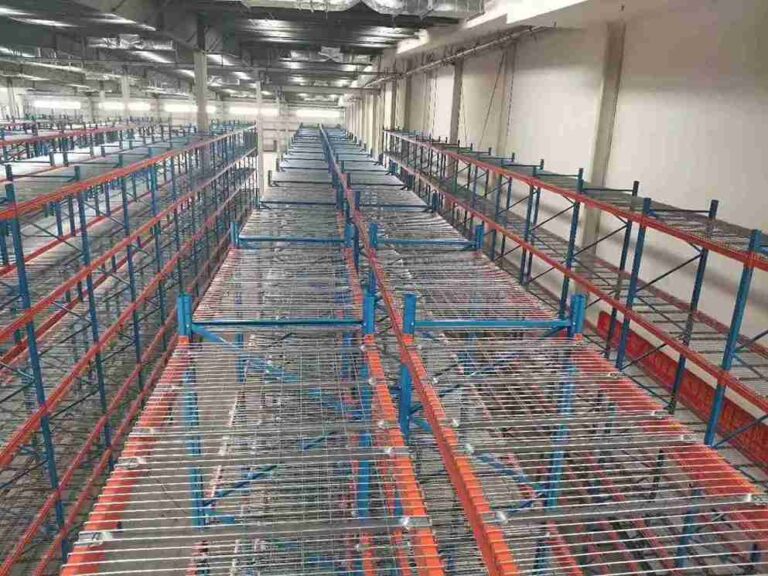
📐 "First 50 Enterprise Queries Get Custom 3D Warehouse Design" Plan
















The Definitive Guide to Heavy-Duty Pallet Racking for Automated Warehouses: Engineering Synergy with AGVs & Unmanned Forklifts
In the high-stakes arena of modern logistics, the transformation from manual storage to a fully automated fulfillment center represents a monumental leap in operational strategy. For decision-makers across Southeast Asia, the Middle East, Latin America, and other burgeoning industrial hubs, this transition is pivotal for maintaining a competitive edge. The spotlight often falls on the dynamic technologies—the sleek Automated Guided Vehicles (AGVs) and the sophisticated unmanned forklifts that glide effortlessly across the warehouse floor.
However, the unsung hero, the absolute bedrock upon which the entire automated ecosystem either thrives or stumbles, is the heavy-duty pallet racking system. This is not merely a storage structure; it is the critical, static interface that must communicate flawlessly with its robotic partners. A standard, off-the-shelf heavy-duty pallet racking solution, not engineered for this specific purpose, can become the single point of failure in a multi-million dollar automation investment, leading to chronic inefficiencies, safety incidents, and a severely compromised return on investment.
This comprehensive guide delves into the intricate engineering, strategic selection, and seamless integration protocols necessary for deploying a heavy-duty pallet racking system that actively enables, rather than passively supports, a high-performance automated warehouse. It explores how the correct heavy-duty pallet racking transforms a static storage asset into a dynamic, high-throughput component of an intelligent material handling symphony, working in perfect, uninterrupted harmony with AGVs and unmanned forklifts.

Why Conventional Heavy-Duty Pallet Racking Is a Liability in Automated Systems
A pervasive and costly assumption in warehouse automation is that any heavy-duty pallet racking with sufficient load capacity will suffice. This belief fundamentally misunderstands the operational paradigm of automation. Conventional heavy-duty pallet racking is designed with human operators in mind. Humans possess unparalleled cognitive ability to adapt to real-world imperfections—a beam slightly out of alignment, a pallet overhanging a few inches, or a minor deflection in an upright. They compensate subconsciously.
AGVs and unmanned forklifts lack this adaptability. They are systems of absolute precision, operating on digital commands and relying on unwavering physical consistency. The failure of a conventional heavy-duty pallet racking system in an automated environment is not a possibility; it is an inevitability. The deficiencies are systemic and profound:
The Tolerance Gap: A human operator can maneuver around a beam that is 5mm out of its specified position. An AGV, programmed for millimeter precision, will either jam its forks, misplace the load, or trigger a fault condition, halting the workflow and creating a downstream bottleneck. The precision required for automation is orders of magnitude higher.
Dynamic vs. Static Load Considerations: Standard heavy-duty pallet racking is rated for static load capacity. It does not account for the constant, dynamic forces exerted by robotic vehicles operating 24/7. The relentless cycle of insertion and retrieval at speeds and frequencies far beyond human capability induces metal fatigue much earlier, compromising long-term structural integrity.
The Vibration Factor: A fleet of AGVs in motion creates a constant, low-frequency vibration throughout the facility. This can gradually loosen standard beam connectors, leading to a dangerous loss of integrity over time. The heavy-duty pallet racking must be engineered to resist this vibrational stress.
The Lack of a Digital Handshake: A conventional heavy-duty pallet racking system is a mute structure. It offers no features to assist the machine’s guidance systems—no embedded targets for LiDAR, no protected mounts for RFID tags. It does not participate in the digital conversation of the warehouse.
Understanding these critical shortcomings is the first step in specifying a heavy-duty pallet racking solution that is not just strong, but also smart and precise enough for the robotic age.
Specifying Automation-Grade Heavy-Duty Pallet Racking: The Non-Negotiable Engineering Parameters
Selecting heavy-duty pallet racking for an automated warehouse moves far beyond the question of “how much can it hold?” It enters the realm of precision engineering. The heavy-duty pallet racking must be conceived, designed, and manufactured as a mission-critical component of the automation system itself. The following parameters are non-negotiable:
Uncompromising Dimensional Precision and Tolerance Control
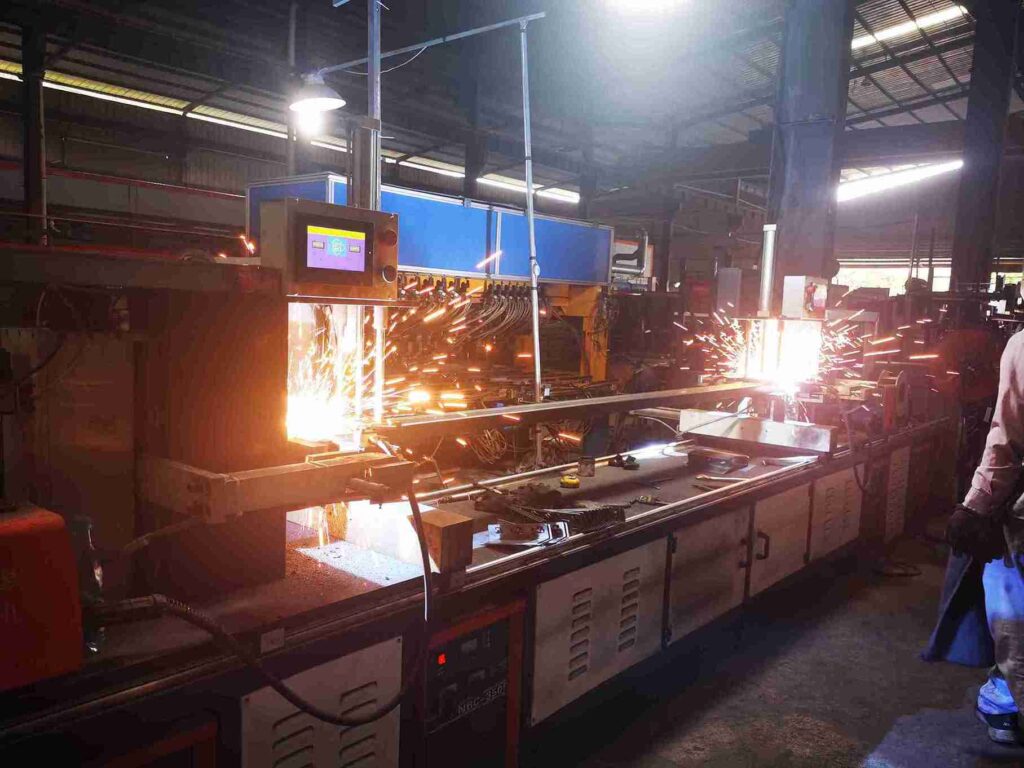
Every single component of the heavy-duty pallet racking—from the upright frames to the beam connectors—must be manufactured with tolerances akin to precision machinery. The allowable variation in upright depth, beam length, and hook profile must be tightened to ±1mm or less across the entire system. This guarantees that every single pallet location, from the first to the thousandth, is geometrically identical. This uniformity is what allows an AGV to execute thousands of perfect pick-and-place operations without a single manual intervention. This level of consistency is the hallmark of a true automation-grade heavy-duty pallet racking system.
Enhanced Dynamic Load Capacity and Fatigue Resistance
While the static load capacity of the heavy-duty pallet racking is a foundational spec, the dynamic and cyclic load capacity is paramount. An unmanned forklift placing a 1,500 kg pallet exerts different forces than a human-driven truck. The heavy-duty pallet racking must be designed with an enhanced safety factor, typically 1.5 to 1.75 times the stated static capacity. This accounts for impact loads, the kinetic energy of the AGV, and the relentless, high-frequency cycling of a three-shift operation. The steel quality and welding techniques used in the heavy-duty pallet racking must be superior to resist the onset of material fatigue, ensuring a decades-long operational lifespan even under the most demanding automated conditions.
Advanced Frame and Beam Design for Robotic Interaction
Upright Frames: The backbone of the system must be exceptionally robust. High-tensile, cold-formed steel is standard, but the profile is key. A closed-tube design or a reinforced open-back profile with continuous lacing offers superior resistance to torsional forces, ensuring the heavy-duty pallet racking remains square and true under uneven loads and constant robotic activity.
Beam Connectors and Decks: Standard teardrop hooks are a point of failure in an automated system. Vibration can walk them loose. The solution is a positive-lock beam connector system, often requiring a specific tool for installation and removal. This eliminates any risk of accidental dislodgement. Furthermore, the beam itself must have a high moment of inertia to resist bending, ensuring a perfectly level deck that presents a consistent target for the AGV’s forks, load after load.
The Integration Blueprint: Facilitating Communication Between AGVs and Heavy-Duty Pallet Racking
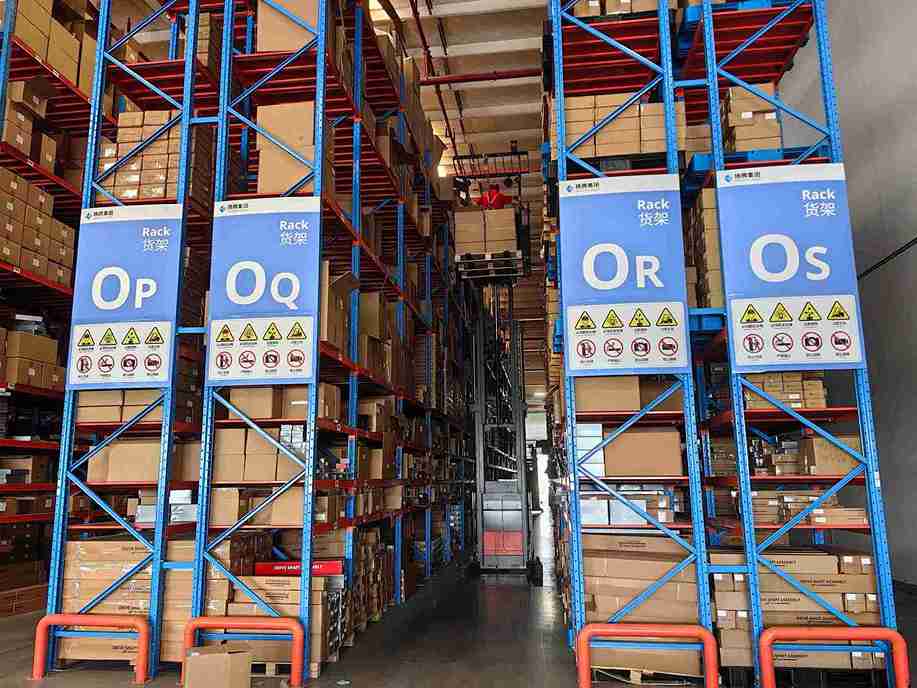
The true potential of an automated warehouse is unlocked not when the robots and racking coexist, but when they communicate. This requires a deliberate integration blueprint that physically and digitally marries the heavy-duty pallet racking to the AGV fleet.
Precision Navigation: Turning Heavy-Duty Pallet Racking into a Guidance Map
AGVs navigate using a sophisticated fusion of LiDAR, inertial guidance, and sometimes vision systems. The heavy-duty pallet racking can be designed to actively support this navigation. By integrating subtle, non-intrusive reflector strips or fiduciary markers at specific, predetermined heights on the uprights, the heavy-duty pallet racking itself becomes a calibrated map. These markers act as high-precision landmarks, allowing the AGV to triangulate its position and correct its path in real-time as it approaches the target bay, ensuring fork insertion is accurate to within millimeters.
Data Integration: Embedding Identity into the Heavy-Duty Pallet Racking
In an automated warehouse, every storage location must have a unique, machine-readable digital identity. A purpose-built heavy-duty pallet racking system includes dedicated, hardened mounting points for RFID tags or high-resolution barcode placards. These are positioned for optimal read/write accuracy by the AGV’s onboard scanners, creating a failsafe data link between the Warehouse Management System (WMS), the physical inventory on the heavy-duty pallet racking, and the robot’s task list. This closed-loop data verification is critical for achieving 99.99%+ inventory accuracy.
Physical Guidance: Assisting the Final Inch of Placement
To compensate for the most minuscule final-positioning errors, the heavy-duty pallet racking can be equipped with pallet guide rails and alignment decks. These are not crude barriers but precision-engineered components that act as a funnel. As the AGV’s forks retract, these guides gently nudge the pallet into its perfectly squared and seated position on the heavy-duty pallet racking beam. This simple yet effective feature guarantees every load is secure and prevents pallets from being partially seated, which is a major safety and operational risk.
Selecting the Optimal Type of Heavy-Duty Pallet Racking for Your Automated Workflow
The choice of heavy-duty pallet racking configuration is not one-size-fits-all; it is dictated by the material handling strategy and the nature of the inventory. The heavy-duty pallet racking must be the physical manifestation of the warehouse’s operational logic.
High-Precision Selective Heavy-Duty Pallet Racking for Maximum Accessibility
For warehouses with a vast number of SKUs requiring direct access—such as e-commerce fulfillment centers—selective heavy-duty pallet racking remains the most flexible and popular choice. In its automation-grade form, it is enhanced with all the precision engineering and integration points discussed. This configuration allows AGVs to access any pallet in any aisle at any time, making it the workhorse heavy-duty pallet racking solution for high-velocity, high-variety environments.
High-Density Drive-In/Drive-Through Heavy-Duty Pallet Racking
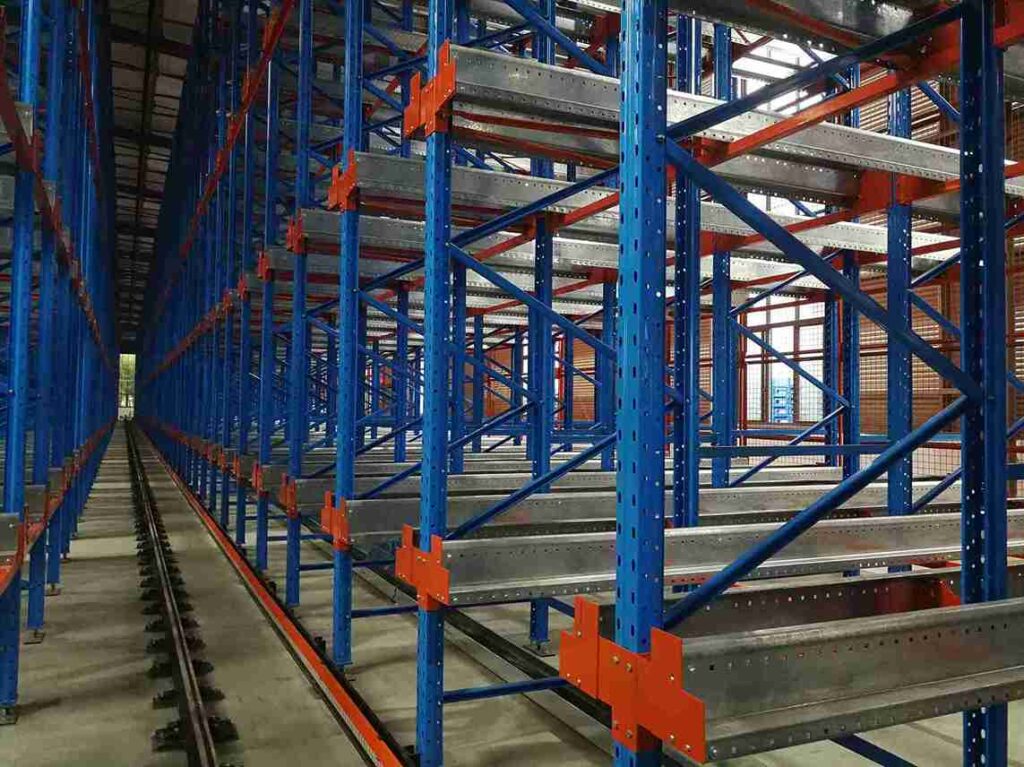
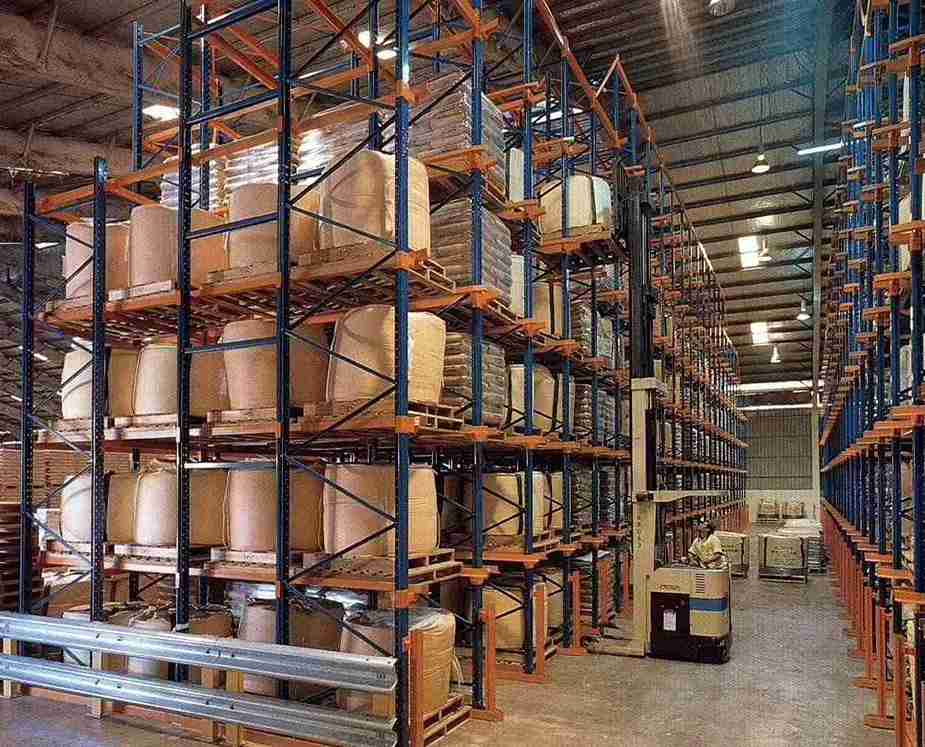
When storage density for slower-moving, homogeneous goods is the primary driver, drive-in or drive-through heavy-duty pallet racking systems are the answer. These can be automated using specialized unmanned forklifts or turret trucks that enter the racking structure itself. Here, the integration of the heavy-duty pallet racking is even more critical, as it forms the “tunnel” through which the vehicle navigates. The focus is on extreme structural integrity, reinforced guide rails, and exceptionally well-protected uprights to withstand the inevitable occasional contact from vehicles operating in confined spaces.
Dynamic Push-Back Heavy-Duty Pallet Racking for LIFO Efficiency
Push-back heavy-duty pallet racking offers an excellent compromise between density and selectivity, operating on a Last-In, First-Out (LIFO) basis. For automation, this presents a unique challenge: the AGV must place a pallet with a consistent, calibrated force to push the entire row of carts back. The engineering of the heavy-duty pallet racking‘s carriage and wheel system is paramount; it must have a predictable and uniform coefficient of friction. This allows the AGV’s placement routine to be programmed with the exact force required, ensuring smooth, reliable, and shock-free operation for every single placement on the heavy-duty pallet racking.
The Critical Role of Installation and Ongoing Integrity in Automated Systems
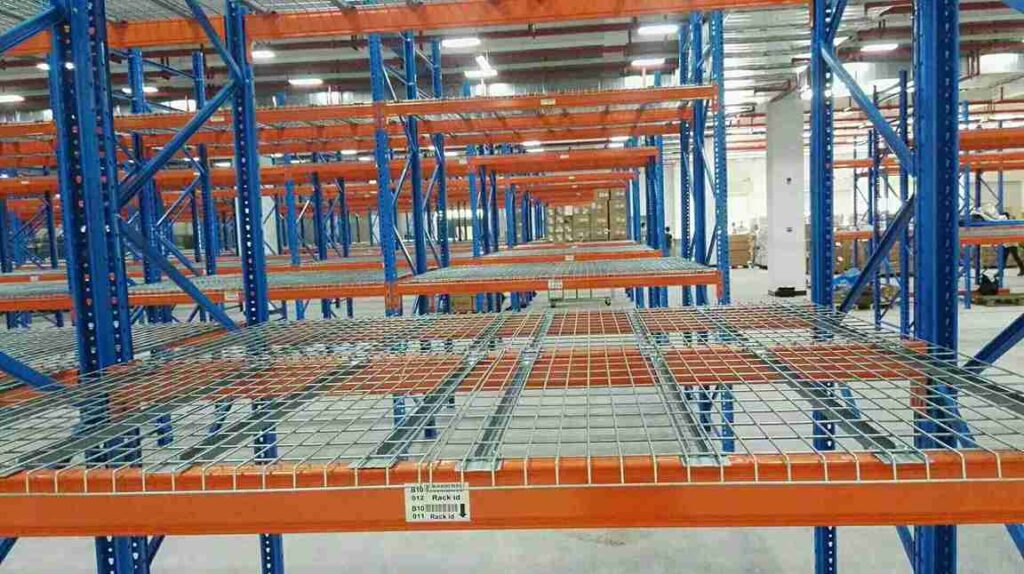
The most exquisitely engineered heavy-duty pallet racking system can be rendered dangerous and inefficient by poor installation. In an automated environment, where the margin for error is zero, the installation is not a separate phase; it is the final, critical step of the manufacturing process.
Laser-Guided Installation and The Digital “As-Built” Twin
Professional installers do not rely on tape measures and spirit levels alone. The installation of automation-grade heavy-duty pallet racking requires laser alignment tools and digital transits to ensure that every upright is perfectly plumb and every bay is perfectly square across the entire warehouse floor. Upon completion, a detailed “as-built” survey is conducted, often using laser scanning, to create a digital twin of the heavy-duty pallet racking system’s exact dimensions. This digital model is then used to fine-tune the paths and positioning coordinates of the AGV fleet, ensuring the virtual world of the WMS matches the physical world of the heavy-duty pallet racking perfectly.
Comprehensive Heavy-Duty Pallet Racking Protection Systems
The consequences of a single impact in an automated warehouse are magnified. A navigational error by an AGV or a misplaced pallet can strike an upright with significant force, potentially compromising the entire bay’s integrity. A comprehensive protection strategy for the heavy-duty pallet racking is mandatory. This includes high-impact column guards made from energy-absorbing materials like UHMW polyethylene, designed to dissipate force and protect the critical structural uprights. Furthermore, high-visibility aisle markers and structural guardrails at the end of rows create a physical buffer zone, providing a last line of defense for the heavy-duty pallet racking.
Rigorous Preventive Maintenance and Inspection Protocols
An automated warehouse cannot be shut down for unexpected maintenance. A rigorous, data-driven preventive maintenance schedule for the heavy-duty pallet racking is essential. This involves periodic inspections by qualified engineers using calibrated tools to check for plumb, beam level, connector integrity, and any signs of impact or wear. This data is logged and tracked over time, creating a health monitor for the heavy-duty pallet racking system that allows for predictive maintenance, addressing potential issues long before they can cause disruptive and costly downtime.
Case Study: Engineering Success for a Southeast Asian E-Commerce Leader
A leading e-commerce platform in Thailand faced the challenge of scaling its operations to meet a 400% projected increase in order throughput for its new 50,000 sqm regional distribution hub. The core requirement was a storage system that could handle over 50,000 unique SKUs while integrating seamlessly with a fleet of 50 AGVs.
The Solution: A high-precision, automation-grade heavy-duty pallet racking system was deployed throughout the bulk storage area. The specification was meticulous:
Upright frames and beams manufactured with a tolerance of ±0.8mm.
Positive-lock beam connectors to resist vibrational loosening.
Integrated, protected RFID tags at every single storage location within the heavy-duty pallet racking.
Laser-aligned installation followed by a comprehensive as-built survey provided to the AGV systems integrator.
The Result: The integration was remarkably smooth. The AGV fleet was operational at over 95% of its theoretical maximum efficiency within just two weeks of deployment. The client reported a 60% reduction in load placement errors and successfully achieved their aggressive throughput target within the first operational quarter. This case underscores that the right heavy-duty pallet racking infrastructure is not a cost, but a catalyst, directly determining the success and ROI of the entire automation project.
Future-Proofing Your Investment: The Next Generation of Heavy-Duty Pallet Racking
The evolution toward fully unmanned, “lights-out” warehouses is accelerating. An investment in heavy-duty pallet racking today must be ready for the innovations of tomorrow. This requires a forward-thinking design philosophy focused on:
Ultimate Modularity and Scalability: The heavy-duty pallet racking system must be easily reconfigurable and expandable without compromising the integrity of the original installation. As business needs and automation technologies evolve, the heavy-duty pallet racking must adapt seamlessly.
Inherent Compatibility with Emerging Tech: Designing the heavy-duty pallet racking with the foresight to integrate with technologies like rack-climbing inventory drones or autonomous manipulator arms. This could involve including universal mounting points, ensuring clear vertical pathways, and even considering conductive elements for in-rack charging.
By viewing the heavy-duty pallet racking not as a commodity, but as a scalable, adaptable platform, businesses build a foundation that not only supports today’s automation but actively enables and accelerates tomorrow’s logistical innovations.
Conclusion: The Indispensable Role of Precision Heavy-Duty Pallet Racking in Automation
The journey to a fully automated warehouse is a complex orchestration of software, robotics, and infrastructure. While the AGVs and unmanned forklifts command attention, their performance, reliability, and safety are utterly dependent on the quality, precision, and intelligence of the heavy-duty pallet racking that forms their operational landscape. To compromise on this core component is to introduce a fundamental, systemic risk to the entire automation investment.
The heavy-duty pallet racking is the bedrock. It is the precise, durable, and integrated foundation upon which speed, accuracy, and 24/7 operational uptime are built. Partnering with an expert who possesses a deep, engineering-led understanding of the synergy between static heavy-duty pallet racking and dynamic robotics is the most critical decision a business can make. It is the decisive factor that separates a functioning automated warehouse from an exceptional one, delivering unparalleled efficiency, resilience, and a powerful competitive advantage in the global marketplace.
Frequently Asked Questions (FAQs)
1. How does the seismic activity in certain regions impact the design of heavy-duty pallet racking for automated warehouses?
In seismically active zones like parts of Southeast Asia and Latin America, the design of heavy-duty pallet racking must account for lateral forces and ground acceleration. Standard designs are insufficient. An engineered seismic heavy-duty pallet racking solution incorporates specialized bracing, base plates that can be anchored to the slab with high-strength bolts, and potentially even moment-resisting frames. This ensures the heavy-duty pallet racking system maintains its integrity during an seismic event, preventing a catastrophic collapse that would not only destroy inventory but also the integrated AGVs operating within it.
2. What are the specific considerations for corrosion resistance in heavy-duty pallet racking located in high-humidity coastal regions?
The combination of high humidity and salty air in coastal industrial parks is highly corrosive to standard steel heavy-duty pallet racking. For these environments, the specification must move beyond basic paint. The optimal solution is a heavy-duty pallet racking system that has been hot-dip galvanized after fabrication. This process coats every surface, including the interiors of tubes and weld points, with a thick, bonded layer of zinc, providing superior, long-term protection against corrosion and ensuring the long-term structural integrity of the automated storage system.
3. Can automation-grade heavy-duty pallet racking be designed to accommodate non-standard pallet sizes and weights?
Absolutely. While standardization is ideal for automation, many industries use non-standard pallets (e.g., in the beverage or automotive sectors). A proficient engineer can design a custom heavy-duty pallet racking solution to accommodate these. This involves calculating the specific load points, designing beams with the appropriate moment of inertia, and ensuring the overall configuration of the heavy-duty pallet racking provides the necessary clearances and support for the unique pallet dimensions, all while maintaining the precision and integration features required for AGV interaction.
4. How does the choice of heavy-duty pallet racking influence the warehouse’s energy consumption, particularly lighting?
The configuration of the heavy-duty pallet racking directly impacts the warehouse’s lighting requirements. High-bay, high-density heavy-duty pallet racking creates deep aisles that require significant energy to illuminate for both human inspection and machine vision systems. A strategic approach involves designing the heavy-duty pallet racking layout in conjunction with the lighting plan, potentially incorporating efficient LED aisle-lighting that is triggered by AGV movement. Furthermore, using a lighter-color paint on the heavy-duty pallet racking components can improve light reflectance, reducing the overall energy needed for adequate illumination.
5. What is the lead time for a fully engineered, automation-grade heavy-duty pallet racking system compared to a conventional one?
Prospective clients should anticipate a longer lead time for a true automation-grade heavy-duty pallet racking system. While a conventional heavy-duty pallet racking might be available from stock, a precision-engineered solution involves a comprehensive process: detailed consultation and data collection, custom engineering design and validation, precision manufacturing with tighter quality controls, and often a more complex installation. This entire process, from order to operational heavy-duty pallet racking, ensures a superior, fit-for-purpose outcome and is a critical investment in the long-term success and reliability of the automated warehouse.
If you require perfect CAD drawings and quotes for warehouse racking, please contact us. We can provide you with free warehouse racking planning and design services and quotes. Our email address is: jili@geelyracks.com