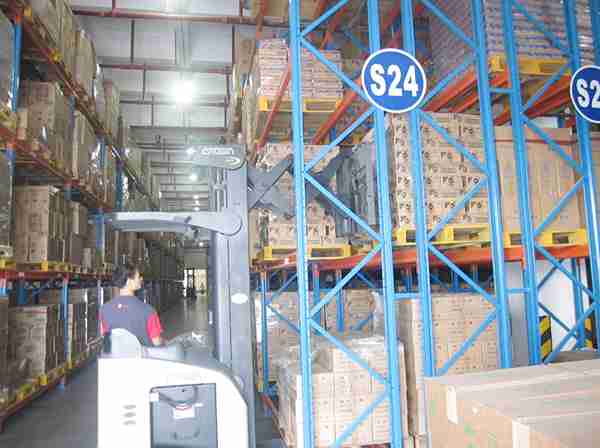
📐 "First 50 Enterprise Queries Get Custom 3D Warehouse Design" Plan















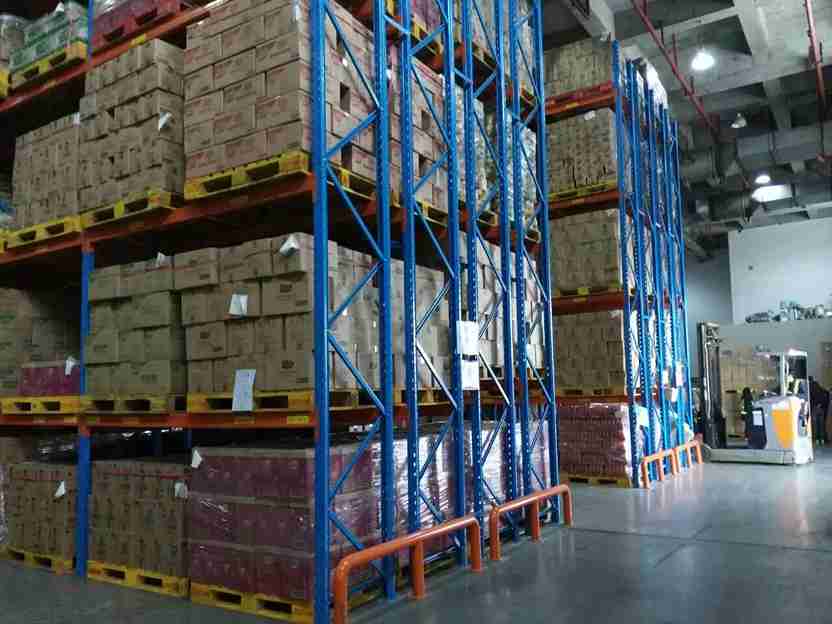
Maximize Storage Density with Double Deep Racking: 50% More Space, Zero Expansion Costs
In the relentless logistics landscape, where every square meter translates directly to the bottom line, warehouse managers and business leaders face a universal challenge: the walls are fixed, but inventory is not. Growth, while desirable, creates a tangible pressure point within the four walls of a storage facility.
The conventional playbook often points toward a single, capital-intensive solution—physical expansion. However, a paradigm shift is underway, championed by storage engineers and logistics strategists who understand that the most cost-effective square footage is the square footage you already own. The key to unlocking this latent potential lies in the strategic implementation of Double Deep Racking.
This high-density storage solution is far more than a simple variation of standard pallet racking; it is a fundamental re-engineering of storage philosophy. By transitioning from a single-row to a double-row configuration, facilities can achieve a dramatic 50% increase in storage capacity, a claim grounded in solid mathematical and spatial logic. This guide delves into the intricate details of Double Deep Racking systems, exploring not just the “how,” but the “why,” the “when,” and the critical considerations for successful deployment.
The core promise is compelling: achieve transformative storage gains with zero expansion costs, avoiding the monumental expenses of new construction, leasing, or relocation. For operations across Southeast Asia, the Middle East, Latin America, and other growth markets where space is at a premium, mastering the application of Double Deep Racking is becoming a non-negotiable component of competitive logistics strategy.
Beyond the Basics: A Deep Dive into the Double Deep Racking System
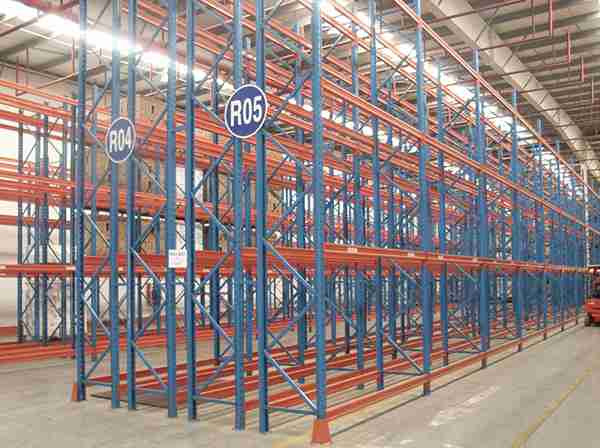
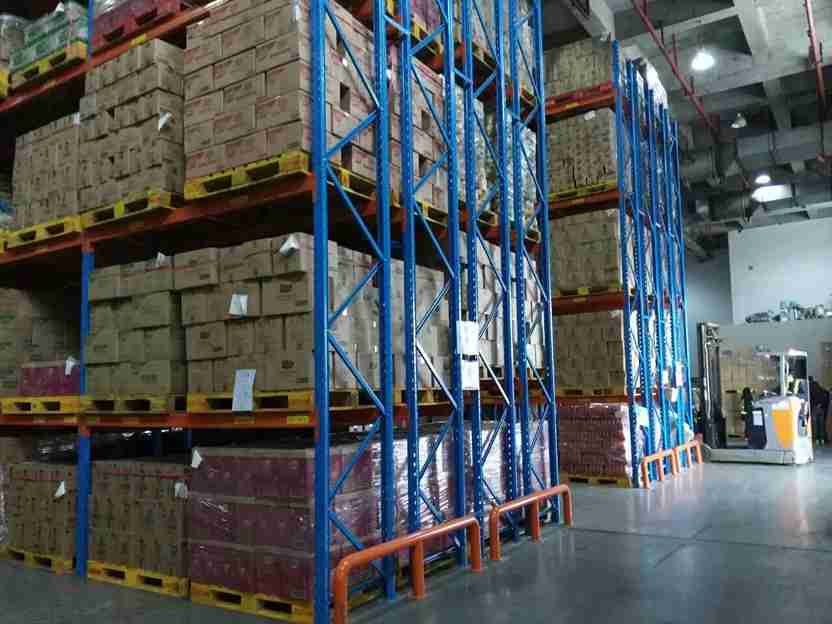
To appreciate the transformative power of this system, one must first move beyond a superficial understanding. At its core, Double Deep Racking is an elegantly simple concept that demands sophisticated execution. Imagine a standard selective pallet rack, the workhorse of countless warehouses worldwide. Now, visualize placing a second, identical racking structure directly behind the first, creating a continuous storage lane that holds two pallets deep. This configuration is the foundational principle of Double Deep Racking.
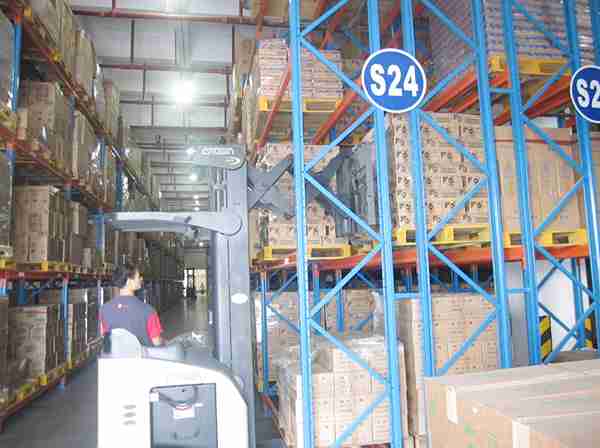
The critical differentiator, and the element that defines its operational character, is the requirement for specialized material handling equipment (MHE). A conventional counterbalance forklift is rendered useless in the confined aisles of a Double Deep Racking layout. The hero of this setup is the Double Reach Truck or Deep-Reach Forklift. These machines are engineered with a telescopic mechanism that allows the forks to extend beyond the front pallet, securely engage the rear pallet, and retract it, all within an aisle width that is only marginally wider than that of a standard single-deep reach truck system. This engineered precision is what makes the entire Double Deep Racking concept viable and efficient.
The Mathematical Inevitability of Increased Density
The promised 50% density increase is not a marketing hyperbole; it is a geometric certainty. The gain is realized not merely from storing two pallets deep instead of one, but from the strategic elimination of non-productive aisle space. Consider a simplified warehouse footprint:
Single Deep Racking Scenario: A block of storage consists of 10 single-deep lanes, each holding 10 pallets, totaling 100 pallet positions. This configuration requires 11 access aisles.
Double Deep Racking Transformation: By converting to a Double Deep Racking system, these 10 lanes are consolidated into 5 double-deep lanes, each holding 20 pallets, maintaining the 100-pallet total. Crucially, this consolidation eliminates 5 aisles.
The real magic happens when this reclaimed aisle space is repurposed. The floor area previously dedicated to access is now available for additional Double Deep Racking lanes. By adding just a few more of these double-depth lanes, the total pallet count easily surges by 50% or more. The Double Deep Racking system fundamentally reallocates the warehouse’s square footage from circulation to storage, directly addressing the core pain point of constrained space.
The Financial Masterstroke: Deconstructing the “Zero Expansion Cost” Promise
The phrase “zero expansion costs” is a direct, powerful counter-argument to the exorbitant expense of physical growth. To fully grasp the value of a Double Deep Racking investment, one must first understand the true, often hidden, costs of the alternative.
The Multi-Million Dollar Burden of Physical Expansion
Embarking on a warehouse expansion or relocation is a venture fraught with financial risk and operational disruption. The costs extend far beyond a simple lease or construction quote:
Capital Lock-Up: Constructing a new facility is a massive capital project, tying up millions in funds that could otherwise be deployed for core business growth, technology, or market expansion.
Recurring Liabilities: Leasing additional space commits the company to a long-term, escalating operational expense, a fixed cost that remains regardless of business fluctuations.
The Relocation Black Hole: The process of moving an entire warehouse inventory is phenomenally expensive. Costs include specialized moving contractors, double-handling of inventory, significant operational downtime, a high risk of inventory damage and loss, and the immense challenge of managing two locations during the transition.
Compounded Operational Overheads: A second location inevitably duplicates costs for management, staff, security, utilities, and MHE, creating a more complex and costly operation to manage.
The Strategic Investment: Calculating the Double Deep Racking ROI
In stark contrast, the investment in a Double Deep Racking system is a focused, efficient, and rapidly amortizing capital expenditure. The primary cost components are transparent:
The Double Deep Racking structure itself, including heavier-duty upright frames, beams, and bracing.
The acquisition of Double Reach Trucks.
Professional services for design, engineering, and installation.
The financial comparison is unequivocal. The capital required for a high-density Double Deep Racking retrofit is a mere fraction of the cost of physical expansion. The project timeline is measured in weeks, not years, and can be executed in phases to minimize operational disruption. Most critically, the Return on Investment (ROI) for a well-planned Double Deep Racking project is typically realized in under 24 months. After this payback period, the savings generated from avoided rent, construction, and duplicated overhead flow directly to the company’s profitability. This is the essence of “zero expansion cost”—it is the avoidance of a massive, recurring financial drain through a single, intelligent investment in optimization.
Operational Profile: Is Your Warehouse a Candidate for Double Deep Racking?
Not every storage facility will reap the full benefits of a Double Deep Racking system. Its efficiency is intrinsically linked to inventory profile and operational workflows. The system is exceptionally well-suited for operations characterized by:
High-Volume, Low-Variety SKUs: The ideal scenario for Double Deep Racking is storing large quantities of a limited number of SKUs. Dedicating an entire lane to a single product eliminates the primary access inefficiency.
Full-Pallet In/Full-Pallet Out (FIFO or LIFO): While naturally leaning towards LIFO (Last-In, First-Out), a Double Deep Racking system can effectively support FIFO for a single-SKU lane. The retrieval of the front pallet automatically promotes the rear pallet to the front position.
Slow and Medium-Turnover Inventory: Products that are picked in full-pallet loads and do not require ultra-rapid, single-item order fulfillment are perfect candidates. The minor time penalty for accessing the second pallet is inconsequential for inventory that moves in bulk.
Conversely, a pure Double Deep Racking system is less ideal for environments with a vast number of SKUs, each with low pallet quantity, or for operations requiring strict FIFO control across multiple different products within the same lane. In such cases, consultants might recommend alternative high-density solutions like push-back racking or mobile pallet racking, but for the right profile, no system matches the straightforward efficiency and cost-effectiveness of Double Deep Racking.
**<h2>The Engineered Foundation: Safety and Structural Integrity in Double Deep Racking</h2>
The increased storage density and depth of a Double Deep Racking system introduce unique structural and safety imperatives. This is not a domain for amateur installation or substandard components. The integrity of the entire system rests on professional engineering and rigorous protocols.
Robust Design for a Demanding Application
The design of a Double Deep Racking system must account for significantly different load dynamics compared to single-deep racking. A professional assessment is non-negotiable and includes:
Heavy-Duty Upright Frames: The upright frames in a Double Deep Racking system must be engineered to handle not only the static load of double the pallets but also the increased potential for dynamic impact forces from the reach trucks operating in tighter confines.
Reinforced Beam Connections: The beam-to-upright connections are critical points of stress. These must be of a high-quality, safety-locked design to prevent accidental dislodgement when the Double Reach Truck is inserting or retrieving a load from the rear position.
Floor Anchorage and Load-Bearing Capacity: The concentrated load on the uprights of a Double Deep Racking system is substantial. The concrete slab must be tested for its compressive strength, and a robust anchoring system must be specified to ensure the entire structure remains perfectly plumb and secure.
A Culture of Safety: Operational Best Practices
Technology and infrastructure are only half of the safety equation. The human element is paramount. A successful Double Deep Racking operation is built on a foundation of stringent safety practices:
Precision Aisle Management: Aisle widths are calculated to the millimeter to provide safe clearance for the specific model of Double Reach Truck in use. Regular checks ensure these aisles remain clear of obstructions.
Pallet and Load Quality Control: The system’s efficiency hinges on the use of high-integrity, standardized pallets and securely unitized loads. Damaged pallets or unstable loads pose a severe risk when being slotted into or retrieved from the hard-to-reach second position of a Double Deep Racking lane.
Comprehensive and Ongoing Operator Training: Operators of Double Reach Trucks require specialized training beyond standard forklift certification. They must master the smooth operation of the deep-reach mechanism, develop spatial awareness for the extended fork length, and understand the unique load-handling characteristics to prevent swinging impacts that can damage both the racking and the inventory.
The Automated Frontier: Integrating Double Deep Racking with Industry 4.0
For forward-thinking operations, Double Deep Racking is not an endpoint but a high-capacity platform for automation. The logical evolution of this system is the integration with automated guided vehicles (AGVs) or autonomous mobile robots (AMRs). In this advanced setup, the manual Double Reach Truck is replaced by an automated unit.
These robotic vehicles can be programmed through the Warehouse Management System (WMS) to navigate to a specific Double Deep Racking lane, execute the deep-reach retrieval with flawless, repeatable precision, and transport the pallet to a designated pick-up/drop-off (P&D) point. This creates a powerful hybrid model: the Double Deep Racking system provides the high-density, bulk storage buffer, while the automation handles the material movement with relentless efficiency. This synergy allows for true 24/7 operation, maximizing both spatial and human resources. For companies in emerging industrial hubs, investing in a Double Deep Racking system with an eye toward future automation is a strategically astute move, building a scalable foundation for growth.
A Comparative Analysis: Double Deep Racking in the High-Density Landscape
Intelligent warehouse design involves selecting the right tool for the job. How does Double Deep Racking stack up against other high-density storage solutions?
Double Deep Racking vs. Drive-In Racking: Drive-in racking offers even higher density but operates almost exclusively on a LIFO basis. It requires the forklift to physically enter the racking structure, significantly increasing the risk of damage to both the rack and the sprinkler systems, and creating a less safe environment for the operator. Double Deep Racking provides a superior balance of density, selectivity, and operator safety.
Double Deep Racking vs. Push-Back Racking: Push-back racking (typically 2-5 pallets deep) offers dynamic selectivity within each lane. However, it is a more mechanically complex system, relying on carts and rails on each beam level, which translates to a higher cost per pallet position and potentially higher maintenance. For straightforward two-deep storage, Double Deep Racking is often the more robust and cost-effective choice.
A professional storage consultant would never recommend a Double Deep Racking system in a vacuum; it is always evaluated within the context of the client’s specific inventory, throughput, and budget.
The Implementation Roadmap: A Phased Approach to Double Deep Success
Deploying a Double Deep Racking system is a significant operational change. A methodical, phased approach ensures a smooth transition and maximizes the return on investment.
Phase 1: In-Depth Discovery and Data Interrogation: This foundational phase involves a deep analysis of inventory data—SKU velocity (ABC analysis), physical dimensions, pallet types, and future growth projections. This data-driven approach ensures the Double Deep Racking design is perfectly tailored to the business’s unique needs.
Phase 2: Conceptual Design and Financial Modeling: Using the collected data, designers create a detailed layout of the proposed Double Deep Racking system. This is accompanied by a transparent financial model projecting the capacity gain, required investment, and a clear ROI calculation.
Phase 3: Detailed Engineering and Sourcing: Upon project approval, engineering teams produce precise fabrication and installation drawings. High-quality Double Deep Racking components are sourced, and coordination begins with trusted MHE partners for the Double Reach Trucks.
Phase 4: Managed Installation with Operational Continuity: Expert installation teams work to a precise plan, often in phases, to install the Double Deep Racking system with minimal disruption to the live warehouse environment.
Phase 5: Empowerment, Training, and Go-Live Support: The project culminates with comprehensive training for operational and maintenance staff. Support continues post-installation to ensure the new Double Deep Racking system is operating at peak efficiency and safety.
Conclusion: The Strategic Imperative of High-Density Storage
The logic is inescapable. In an era of rising costs and intense competition, the strategy of solving storage constraints by adding more square footage is financially and operationally obsolete. The future belongs to intelligent density, to optimizing the cube, and to leveraging engineering ingenuity to do more with less. A Double Deep Racking system represents a proven, powerful, and pragmatic path to this future.
It delivers on the compelling promise of a 50% increase in storage capacity with zero expansion costs, transforming a warehouse from a cost center into a strategic asset. For logistics leaders across developing global markets, the question is no longer whether they can afford to implement a high-density Double Deep Racking system, but how much longer they can afford the staggering cost of inefficiency.
Frequently Asked Questions (FAQs)
1. What is the typical lead time for the manufacturing and installation of a large-scale Double Deep Racking system?
Lead times can vary based on project scope and component sourcing, but a typical timeline for a sizable Double Deep Racking project is 8-12 weeks from finalized design to completed installation. This includes manufacturing of the custom Double Deep Racking components, shipping, and the on-site installation phase, which is often planned to occur in sequential zones to minimize operational disruption.
2. How does the weight capacity of a Double Deep Racking system compare to a single-deep system?
The weight capacity per pallet position in a Double Deep Racking system is determined by the beam specification and upright frame capacity, just like a single-deep system. However, because the Double Deep Racking configuration uses heavier-duty components to handle the dynamic loads and potential impacts, the per-position capacity is often equivalent to or even greater than that of a standard rack. The key is the professional load calculation during the design phase.
3. Can a Double Deep Racking system be easily expanded or reconfigured in the future?
Yes, one of the significant advantages of a standard structural Double Deep Racking system is its inherent modularity. Unlike some other high-density systems, a Double Deep Racking layout can be extended, reduced, or even reconfigured back to a single-deep setup by repositioning the upright frames and beams. This flexibility provides long-term adaptability as storage needs evolve.
4. What are the fire safety and sprinkler system considerations for a Double Deep Racking installation?
A Double Deep Racking system, due to its increased density, presents a different challenge for fire protection. Standard sprinkler systems may be insufficient. The installation of a Double Deep Racking system typically requires a review by a fire safety engineer, who may recommend in-rack sprinkler heads at various levels to ensure water can penetrate the dense storage array and suppress a fire at its source.
5. Are there specific Warehouse Management System (WMS) features that are critical for managing a Double Deep Racking warehouse?
Absolutely. An advanced WMS is crucial for maximizing the efficiency of a Double Deep Racking operation. Key features include sophisticated put-away logic that consolidates like SKUs into the same lane, precise location tracking that identifies both front and rear pallet positions, and intelligent task interleaving that sequences retrieval tasks to minimize the “shuffling” of pallets within a Double Deep Racking lane.
If you require perfect CAD drawings and quotes for warehouse racking, please contact us. We can provide you with free warehouse racking planning and design services and quotes. Our email address is: jili@geelyracks.com