📐 "Eerste 50 bedrijfsvragen krijgen aangepast 3D-ontwerp van magazijn" Plan














Summary
Optimizing warehouse layouts for OSHA compliance is a critical strategy for enhancing workplace safety, operational efficiency, and legal adherence. This guide explores actionable steps to align your warehouse design with OSHA standards, mitigate hazards, and streamline workflows. We’ll cover everything from ergonomic storage solutions enaisle width regulations to fire prevention protocols enemployee training programs, ensuring your facility meets—and exceeds—regulatory expectations.
1. Understanding OSHA’s Role in Warehouse Safety
(1.1) Occupational Safety and Health Administration (OSHA)
DeOccupational Safety and Health Administration (OSHA) sets enforceable standards to protect workers from injuries, fatalities, and hazardous conditions. Warehouses fall under specific regulations, such as 29 CFR 1910.176 (material handling) and 29 CFR 1910.36 (emergency exit routes). Non-compliance can result in fines up to **$15,625 per violation** and reputational damage. For a detailed breakdown of OSHA’s warehouse guidelines, refer to the OSHA Warehousing Safety Resource.
(1.2) Key OSHA Standards for Warehouses
- 29 CFR 1910.178: Guidelines for powered industrial trucks (e.g., forklifts).
- 29 CFR 1910.157: Requirements for fire extinguisher accessibility.
- 29 CFR 1910.212: Machinery guarding to prevent contact with moving parts.
(1.3) Why Compliance Matters Beyond Penalties
A compliant warehouse reduces workers’ compensation claims, boosts employee morale, and minimizes downtime from accidents. For example, Amazon reported a 32% reduction in injuries after redesigning workflows to prioritize ergonomic practices (National Safety Council Case Study).
2. Designing an OSHA-Compliant Warehouse Layout
(2.1) Zoning for Safety and Efficiency
Divide your warehouse into zones based on activity:
- Receiving/Shipping Areas: Ensure clear pathways for loading docks.
- Storage Zones: Separate high-traffic and low-traffic inventory.
- Picking/Packing Stations: Position near storage for minimal travel.
(2.2) Aisle Width and Clearance Requirements
OSHA mandates minimum aisle widths based on equipment size. For example:
- 4 feet for manual pallet jacks.
- 12 feet for forklifts carrying standard 48” pallets.
Gebruikyellow floor markings to define boundaries and prevent collisions. Learn more about aisle design in our guide to Ergonomic Storage Solutions.
(2.3) Maximizing Vertical Space Safely
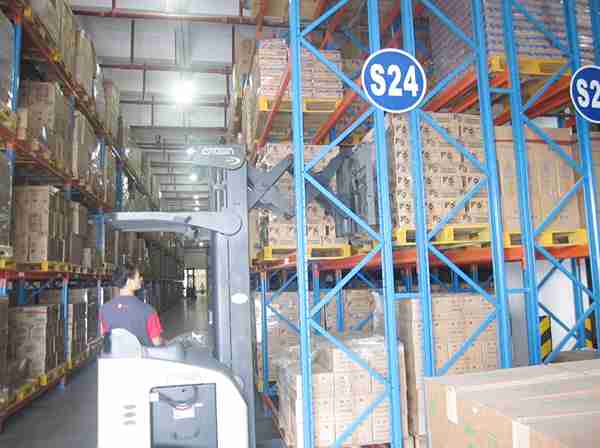
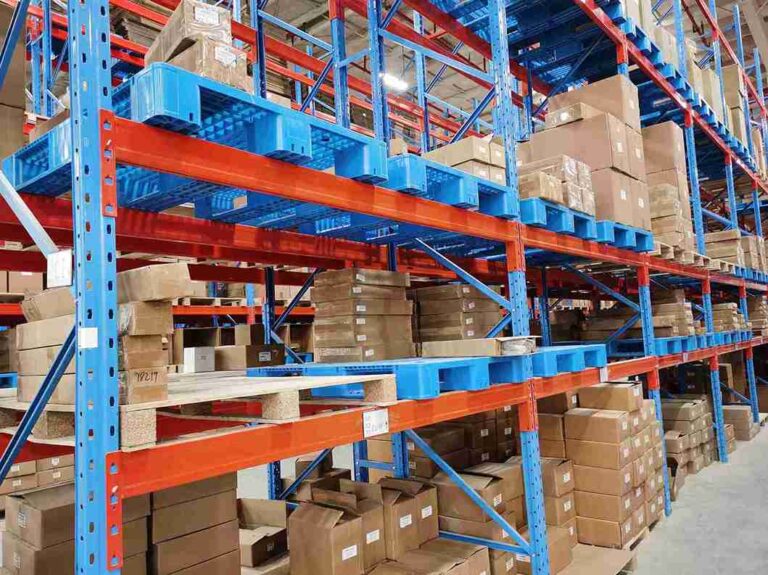
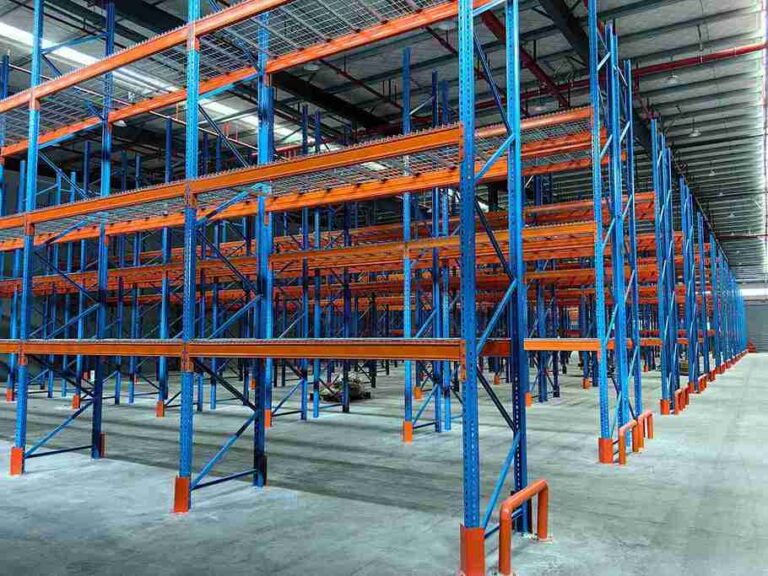
Pallet racking systems must adhere to load capacity limits and include horizontal row spacers to prevent tipping. Overloading shelves accounts for 15% of warehouse accidents annually.
3. Storage Solutions That Align With OSHA Standards
(3.1) Choosing the Right Shelving Systems
- Cantilever Racks: Ideal for long items like pipes.
- Drive-In/Dive-Through Racks: Optimize bulk storage but require strict load distribution practices.
(3.2) Anchor Storage Equipment Properly
Secure racks to the floor using anchor bolts to withstand seismic activity or impact. The 2019 California earthquakes caused $50M in warehouse damage due to unanchored shelving (FEMA Report).
(3.3) Labeling and Signage Best Practices
- GebruikOSHA-compliant labels for hazardous materials (e.g., flammable liquids).
- Post “No Smoking” signs near chemical storage.
4. Preventing Slips, Trips, and Falls: OSHA-Compliant Strategies
(4.1) Floor Maintenance Protocols for Hazard Mitigation
Slips, trips, and falls account for 25% of warehouse injuries annually, making floor safety a top priority under OSHA Standard 1910.22 (Walking-Working Surfaces). To align with compliance and reduce risks:
(4.1.1) Spill Response and Cleaning Workflows
- Immediate Cleanup: Assign staff to clean spills within 5 minutes using absorbent materials like oil-dri granules of microfiber mats.
- Wet Floor Signage: Place OSHA-compliant “Wet Floor” signs (with reflective stripes) around affected areas until surfaces are dry.
- Documentation: Log spills in a safety incident tracker to identify recurring hazards (e.g., leaking machinery).
(4.1.2) Flooring Material and Repair Standards
- Anti-Slip Coatings: Apply epoxy coatings with 0.5+ coefficient of friction (COF) to concrete floors, as recommended by the National Floor Safety Institute (NFSI).
- Crack Repairs: Use polyurethane sealants for cracks exceeding 1/4 inch—a common OSHA violation in aging warehouses.
- Drainage Systems: Install grated drains in wash bays to prevent water pooling (OSHA Drainage Guidelines).
(4.2) Stair and Ladder Safety: Engineering Controls and Training
(4.2.1) Stair Design Requirements
- Handrails and Guardrails: Install 42-inch-high guardrails with mid-rails on all stairs (per 29 CFR 1910.25). Use knurled surfaces to improve grip.
- Tread Specifications: Ensure stair treads are **≥10 inches deep** with anti-slip nosing to prevent foot slippage.
(4.2.2) Ladder Safety Best Practices
- Fixed Ladders: For platforms over 24 feet, provide cage guards offall arrest systems (mandated by 29 CFR 1910.28).
- Inspection Checklists: Require daily checks for:
- Bent or corroded rungs.
- Loose bolts on step ladders.
- Secure locking hinges on extension ladders.
(4.2.3) Employee Training for Elevated Work
- Climbing Techniques: Train workers to maintain 3-point contact (two hands, one foot or vice versa) on ladders.
- Load Limits: Enforce maximum capacity labels (e.g., 250 lbs for Type IA ladders).
(4.3) Case Study: Reducing Slip-and-Fall Incidents by 60%
A Texas-based distribution center implemented:
- Robotic Floor Scrubbers: Automated cleaning during off-peak hours.
- Anti-Fatigue Matting: Installed in packing stations to reduce leg strain.
- Quarterly Ladder Inspections: Partnered with Grainger for certified safety audits.
Result: OSHA violations dropped from 12 to 3 within a year.
5. Fire Prevention and Emergency Preparedness
(5.1) Fire Extinguisher Placement
Mount extinguishers no higher than 5 feet and within 75 feet of employees.
(5.2) Emergency Exit Route Design
- Keep exits unobstructed and marked with glow-in-the-dark signage.
- Conduct quarterly fire drills to familiarize staff with evacuation paths. For more tips, see our Fire Prevention Best Practices guide.
6. Material Handling Equipment (MHE) Compliance
(6.1) Forklift Operational Guidelines
- Perform daily inspections of brakes, horns, and hydraulics.
- Enforce speed limits (e.g., 5 mph in congested areas).
(6.2) Training and Certification
Only certified operators should use forklifts. Training must cover load stability principles and blind spot management.
7. Employee Training Programs for OSHA Adherence
(7.1) Hazard Communication (HazCom) Training
Teach staff to read Safety Data Sheets (SDS) and handle chemicals safely.
(7.2) Ergonomics Education
Train teams on proper lifting techniques to avoid musculoskeletal disorders, which cost employers **$20 billion yearly** (Bureau of Labor Statistics).
8. Conducting Regular OSHA Compliance Audits
(8.1) Internal Audit Checklist
- Verify aisle clearance and emergency exit accessibility.
- Review equipment maintenance logs and training records.
(8.2) Third-Party Inspections
Hire OSHA consultants to identify overlooked risks, like inadequate lockout/tagout (LOTO) procedures.
9. Leveraging Technology for OSHA Compliance: Advanced Solutions
(9.1) Warehouse Management Systems (WMS): Beyond Inventory Tracking
Modern Warehouse Management Systems (WMS) are critical for aligning operations with OSHA standards while boosting efficiency. Leading platforms like SAP EWM, ,Oracle WMS, enInfor CloudSuite offer specialized features for compliance:
(9.1.1) Safety-Centric Inventory Placement
- Dynamic Slotting Algorithms: Automatically assign high-turnover items to ergonomic picking zones (e.g., waist-height shelves), reducing repetitive lifting injuries.
- Overload Alerts: Sensors integrated with WMS block scan guns from registering items if shelves exceed 85% capacity—preventing rack collapses.
(9.1.2) Predictive Maintenance for Equipment
- AI-Driven Insights: Monitor forklift battery health and hydraulic leaks via IoT-enabled WMS. For example, Dematic’s iQ software reduces forklift downtime by 30% through predictive alerts.
- Compliance Reporting: Auto-generate OSHA-required logs, such as daily forklift inspection records (per 29 CFR 1910.178).
(9.1.3) Route Optimization for Hazard Avoidance
- Collision Prevention: WMS directs forklifts away from congested zones using real-time location data. Honeywell’s Momentum WMS cut near-miss incidents by 45% in a 2023 pilot.
(9.2) IoT Sensors: Proactive Hazard Detection and Mitigation
(9.2.1) Environmental Monitoring Systems
- Cold Storage Compliance:
- Track temperatures in real-time with BT-connected sensors (e.g., Monnit Wireless Sensors), ensuring perishables stay within FDA/OSHA-approved ranges (typically 0°F to 40°F).
- Receive SMS alerts for freezer malfunctions to prevent spoilage-related slip hazards.
- Chemical Storage Safety:
- Deploy gas leak detectors (e.g., Honeywell Sperian) in areas storing ammonia or propane. Devices auto-trigger ventilation fans when gas levels exceed 25 ppm (OSHA’s PEL limit).
(9.2.2) Wearable Tech for Worker Safety
- Fatigue Monitoring: Smartwatches like StrongArm Tech’s SafetyIO analyze heart rate variability to flag overexertion risks.
- Proximity Alerts: RFID tags on vests vibrate when workers enter forklift blind spots—reducing struck-by incidents by 60% (Crown Equipment Case Study).
(9.2.3) Fire Prevention Automation
- Thermal Imaging Cameras: Detect overheating electrical panels (common in warehouses) before fires ignite. Integrate with AutoSuppression® sprinklers for instant response.
- Smoke Density Sensors: Differentiate between dust clouds and actual smoke to reduce false alarms (OSHA Fire Detection Standards).
(9.3) Blockchain for Audit Transparency
- Immutable Safety Records: Platforms like IBM’s TradeLens timestamp OSHA training completions, equipment inspections, and incident reports—simplifying compliance audits.
- Supplier Compliance Tracking: Verify chemical SDS sheets are updated to GHS Revision 15 standards before accepting shipments.
10. Case Study: Transforming a Non-Compliant Warehouse
(10.1) A Midwest logistics firm reduced OSHA violations by 90% after:
- Widening aisles to 10 feet for forklifts.
- Installing LED lighting to improve visibility.
- implementerenbi-annual training on spill response.
Conclusion
Optimizing your warehouse layout for OSHA compliance is an ongoing process that safeguards employees, enhances productivity, and avoids costly penalties. By integrating ergonomic designs, ,rigorous training, entechnology-driven audits, your facility can set a industry benchmark for safety and efficiency.
FAQs
1. What’s the first step to make a warehouse OSHA-compliant?
Conduct a hazard assessment to identify risks like blocked exits or unanchored racks.
2. How often should fire extinguishers be inspected?
OSHA requires monthly visual checks and annual professional inspections.
3. Can OSHA fine a warehouse for poor lighting?
Yes. Inadequate lighting violates 29 CFR 1910.36 and can result in fines.
4. Are forklift operators required to wear seatbelts?
Yes. OSHA Standard 1910.178 mandates seatbelt use for all powered industrial trucks.
5. What’s the penalty for not reporting a workplace injury?
Failure to report severe injuries within 24 hours can lead to fines up to **$31,250**.
Welkom om contact met ons op te nemen, als je CAD-tekeningen voor magazijnstellingen nodig hebt. Wij kunnen u voorzien van magazijn rack planning en ontwerp gratis. Ons e-mailadres is: jili@geelyracks.com