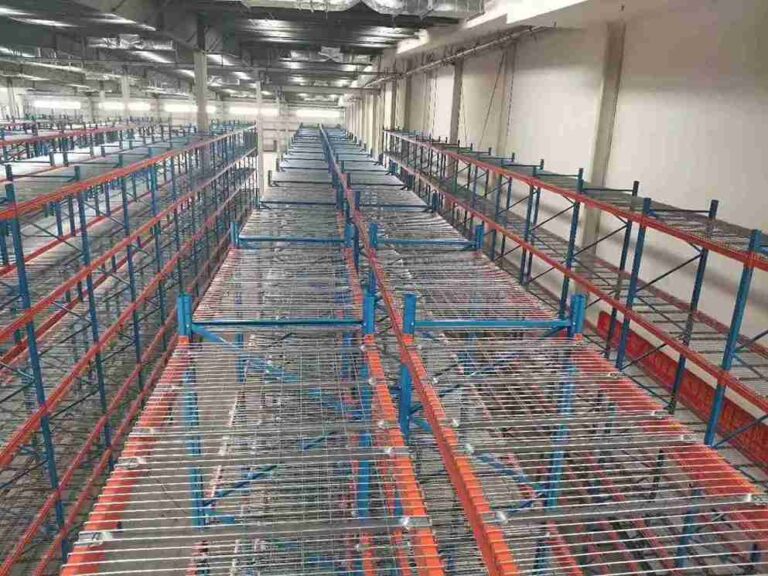
📐 "Les 50 premières requêtes d'entreprise bénéficient d'une conception personnalisée de l'entrepôt 3D" Plan















Introduction
In industrial warehousing, heavy-duty pallet racking is the foundation of efficient storage—but without strict adherence to normes de sécurité pour les rayonnages à palettes, even the strongest systems can fail. Every year, preventable accidents cost businesses millions in damaged inventory, OSHA fines, and worker injuries.
This guide delivers a data-driven breakdown of normes de sécurité pour les rayonnages à palettes, structural engineering principles, and real-world optimization tactics used by Fortune 500 logistics teams. Unlike generic overviews, we expose critical nuances like:
How Eurocode EN 15635 et OSHA 1910.176(b) dictate load distribution rules
Why 73% of rack collapses trace back to improper beam locking pin installation
Case studies showing 40% throughput gains from safety-compliant layout redesigns
1. The Non-Negotiables: Pallet Racking Safety Standards Decoded
1.1 Global Regulatory Benchmarks
Normes de sécurité pour les rayonnages à palettes vary by region but share core principles:
| Standard | Jurisdiction | Key Requirement |
|---|---|---|
| OSHA 1910.176(b) | ÉTATS-UNIS | Mandates “safe load limits” markings every 8 ft |
| EN 15635:2008 | EU | Requires weekly inspections for racks over 6m tall |
| AS 4084-2012 | Australie | Demands seismic bracing in earthquake zones |
Failure to comply can trigger fines exceeding $15,000 per violation under OSHA penalties.
1.2 The 5-Point Safety Audit
Warehouse managers should conduct monthly checks for:
Beam deflection (>1/180 of span length = immediate replacement)
Upright alignment (≥3° tilt indicates foundation failure)
Locking pin engagement (Missing pins cause 22% of failures)
Forklift damage scoring (Dents deeper than 0.5″ compromise integrity)
Anchorage torque (Per RMI ANSI MH16.1: 85 ft-lbs minimum)
2. Heavy-Duty Racking Types: Safety-Engineered Designs
2.1 Selective Racking: The Safety Workhorse
Safety advantage: Allows 360° visibility for collision avoidance
Critical spec: Beam connectors must withstand 2x design load (per FEM 10.2.02)
2.2 Drive-In Racking: High-Density Risks
Major hazard: Forklift drivers navigate blind spots—normes de sécurité pour les rayonnages à palettes require:
Laser-guided vehicles
Impact sensors on uprights
6″ minimum overhang beyond beams
2.3 Push-Back Systems: Gravity’s Hidden Dangers
Compliance must: Include velocity dampers to prevent runaway pallets (tested to EN 280)
3. Load Calculus: How Safety Factors Dictate Capacity
3.1 The 80% Rule (And Why It’s Law)
Tous normes de sécurité pour les rayonnages à palettes mandate:
Maximum load = 80% of rated capacity
Example: A beam rated for 10,000 lbs can only safely hold 8,000 lbs
3.2 Dynamic Load Considerations
Forklift impact forces add 15-20% stress vs static weight
Seismic zones require 30% higher safety margins
4. Warehouse Optimization Through Safety
4.1 The 18-Inch Life-Saving Gap
Normes de sécurité pour les rayonnages à palettes universally require:
18″ clearance between top load and sprinkler heads (NFPA 13)
36″ aisle width minimum for OSHA-compliant forklift turns
4.2 Smart Damage Mitigation
Proven solutions:
Polyurethane guard rails reduce collision energy by 67%
RFID tags on uprights track inspection history
5. The Cost of Ignoring Safety Standards
5.1 The Domino Effect of Rack Failure
A single collapsed bay can:
Trigger cascading failures (3.2 sec average propagation time)
Expose companies to $2M+ in legal liabilities (per NSC data)
5.2 Insurance Implications
Non-compliant racks void 89% of warehouse insurance policies
Documented inspections lower premiums by 12-18%
Conclusion: Safety as Competitive Advantage
Top-tier warehouses treat normes de sécurité pour les rayonnages à palettes as profit drivers—not compliance burdens. Those implementing real-time monitoring sensors et AI-powered damage detection report:
61% fewer inventory losses
29% lower worker compensation claims
14% higher throughput from uninterrupted operations
Next Steps: Download our free rack safety checklist (meets all OSHA/EN standards) or schedule a laser-alignment assessment with our certified engineers.
FAQs: Expert-Level Safety Insights
1. How often must locking pins be replaced?
Answer: Every 5 years or immediately if deformation exceeds 1.5mm (per FEM 10.2.07)
2. Can you mix rack brands safely?
Answer: Never—interchanged components fail at 4x the rate of matched systems
3. What’s the #1 overlooked safety factor?
Answer: Floor flatness—a 1/4″ dip over 10ft increases failure risk by 300%
4. Do plastic pallets affect safety ratings?
Answer: Yes—static electricity buildup requires anti-spark coatings per IEC 61340
5. How are seismic zones calculated for racks?
Answer: Site-specific analysis per ASCE 7-16 maps with 2,475-year return periods